
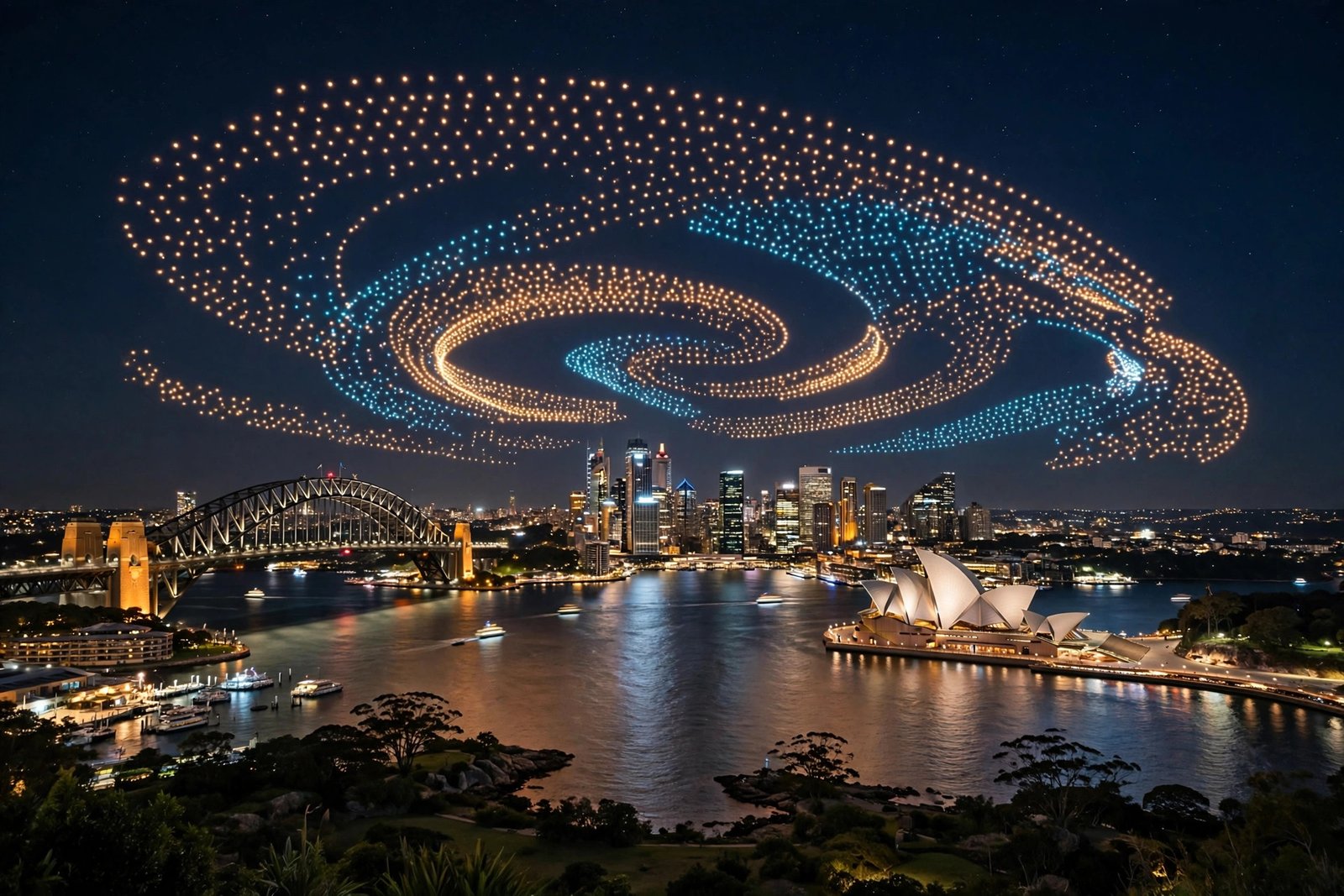
Picture this: you are standing on the edge of Darling Harbour in Sydney, looking up at the night sky as around 1,000 drones rise into the air and arrange themselves into glowing pictures above the water. The crowd is cheering. The music is swelling. Then, without warning, the picture starts to break apart. One drone drops. Then another. Then dozens of them begin falling out of the sky like burning rain, splashing into the harbour below as stunned onlookers gasp and reach for their phones. That is exactly what happened during the drones Sydney harbour show at Vivid Sydney, and the footage is going viral all over again this week after appearing on a viral-news list on November 23, 2026. But here is the twist that most of the viral clips leave out: the incident itself happened months earlier, on the evening of Monday, May 25, 2026, during the festival’s flagship “Star-Bound” drone show at Cockle Bay. What looked like a spectacular celebration turned into one of the most dramatic drone failures ever caught on camera, and the questions it raised about the safety of giant drone shows are still being asked today.
In this article, we will walk you through exactly what happened that night, why 89 drones ended up in the water, what the people who were there saw, and what the fallout means for the future of drone light shows in Sydney and around the world. It is a story about cutting-edge technology, a mystery radio glitch, and a very expensive splash.
What Happened During the Drones Sydney Harbour Show
The drones Sydney harbour incident unfolded during the 7:30 p.m. performance of “Star-Bound,” the headline drone show of Vivid Sydney 2026. Vivid Sydney is one of Australia’s biggest annual festivals, a weeks-long celebration of light, music and ideas that transforms the city’s harbour precincts every winter. For 2026, the festival had promised its biggest drone program ever: 22 shows across 11 nights, with up to 1,000 drones flying twice nightly over Darling Harbour from Sunday through Wednesday, forming glowing images in the sky for eight to 12 minutes at a time. The show had only just returned after being cancelled the previous year over safety and crowd-management concerns, and festival director Brett Sheehy had told media in March 2026 that the festival had “secured the latest drone technology to ensure these are the brightest drones in the world.”
Everything seemed normal at first. The drones lifted off from their launch area and began forming the opening image of the show above Cockle Bay. Then, very shortly after that first image appeared, something went badly wrong on the southern side of the bay. Drones began dropping out of formation and falling into the water. A Darling Harbour worker who watched it happen told the ABC that it quickly became “a cascading failure of the drones,” with machines continuing to fall, some into the water and some onto the marina and nearby walkways, and some nearly hitting marina workers. Eyewitnesses described the scene as a “catastrophic failure” as the carefully choreographed display dissolved into chaos in front of a large crowd.
Within minutes, organisers stopped the show. According to the operator, SkyMagic, a UK-based drone company brought in to run the display, 89 drones entered failsafe mode and descended into the waters of Cockle Bay. Other reports described the number as “almost 90.” Some drones managed to land safely, but the rest were lost to the harbour. Remarkably, and mercifully, authorities confirmed that no one was injured. Most of the falling drones came down inside a designated exclusion zone that had been set up around the performance area, keeping the crowd clear of the danger. Safety crews were deployed to monitor the waterfront, and spectators were moved safely away from the affected zone.
Why Did the Drones Sydney Harbour Display Go Wrong?
So what actually caused nearly 90 drones to fall out of the sky at the same time? According to SkyMagic, the operator behind the show, the problem was an “unforeseen change in the radio frequency” environment shortly after takeoff. Drone light shows depend on precise, constant radio communication between the ground control system and every single drone in the sky. Each drone needs to know exactly where it is, where it should be, and what it should do next, many times per second. When that radio link is disrupted, the drones lose their positioning, and their safety programming takes over.
In this case, the interference disrupted the drones’ positioning systems, and many of them entered emergency failsafe mode. A failsafe descent is actually the safety system working as designed: rather than flying off uncontrolled across a crowded city, a drone that loses its signal is programmed to come down in a controlled way. The problem was that so many drones lost their signal at almost the same moment, so the sky filled with descending machines all at once, and dozens of them came down over the water of Cockle Bay instead of over a safe landing area. SkyMagic has indicated that initial investigations found no signs of sabotage, and experts continued to examine every possible cause. The exact source of the radio frequency change has not been publicly pinned down in the reporting so far, which is one reason the incident is still talked about: a mystery glitch brought down a million-dollar light show in minutes.
There are a few important things to understand about how these shows work, because they explain why one glitch can cascade so fast:
- Every drone in the swarm is constantly talking to a central computer on the ground, receiving position updates many times per second.
- The drones also rely on satellite positioning signals to hold their place in the sky with centimetre-level accuracy.
- If the radio link degrades, the drone cannot be sure where it is, so it switches to a pre-programmed emergency routine.
- When the same interference hits the whole swarm at once, dozens of drones can enter emergency mode within seconds of each other.
- Harbour shows are especially tricky because water reflects and scrambles radio signals, and a busy city waterfront is full of other wireless devices.
None of this excuses the failure, but it does explain why a single invisible problem in the radio spectrum can turn a beautiful display into a very public mess.
The Moment the Sky Started Falling
The human side of the story is what made the footage go viral. Videos recorded by spectators spread quickly across social media, showing parts of the formation breaking apart mid-performance before several drones appeared to lose control and drop. In the clips, you can see the glowing shapes in the sky suddenly develop holes, then streaks of light falling toward the water as the crowd’s cheers turn to gasps. One worker’s account, reported by the ABC, captures the confusion of those first seconds: everything seemed normal, and then, very shortly after the first image was displayed, drones started dropping into the water on the southern side of Cockle Bay, and from there it was a cascading failure.
Some drones crashed into the marina wharf and almost hit workers there, according to the same eyewitness account. The fact that nobody was hurt is genuinely remarkable, and it is a credit to the exclusion zone and the quick response of staff on the ground. It is also the reason the story stayed a viral curiosity rather than becoming a tragedy. Had the failure happened over a crowded promenade instead of over the water, the outcome could have been very different, and that near-miss is a big part of why regulators and festival organisers took the incident so seriously.
The footage has now found a second life online. Clips of the drones splashing into Sydney Harbour have been shared and reshared for months, and the incident’s appearance on a viral-news list on November 23, 2026, introduced it to a whole new wave of viewers who had never seen it before. That is a familiar pattern for spectacular failure videos: the internet never really lets go of a good “everything went wrong” clip, and this one has it all, a beautiful setting, cutting-edge technology, and a sudden, shocking reversal. If you enjoy watching viral moments unfold in real time, you will probably also enjoy our look at another livestream that kept the whole internet watching, IShowSpeed’s 52-hour GTA 6 livestream.
What Happened Next: Cancellations and a Safety Review
The response from Vivid Sydney was swift. The later 9:30 p.m. show on Monday night was cancelled, and the festival then called off the drone shows planned for Tuesday and Wednesday as well, replacing them with a full technical and safety review. A Vivid Sydney spokesperson apologised for “the disappointment and inconvenience caused to attendees” and stressed that “public safety is always the number one priority and a full assessment is now underway with the specialist operators and relevant government agencies advising on next steps.” In total, the shutdown affected at least five of the 22 drone shows the festival had planned across its 11 nights.
That is a significant blow for a festival that had promoted the 2026 drone series as its largest ever, and for a show that had only just made its comeback after being cancelled the previous year. The drone program was meant to be one of the festival’s signature attractions, and instead it became its biggest headache. The cancelled performances were not rescheduled immediately; the festival said the shows would only return once the review was complete and the relevant government agencies were satisfied. For the crowds who had travelled to Darling Harbour specifically to see the lights in the sky, the disappointment was real, but most people understood that safety had to come first.
The review itself involves the festival, the specialist operator SkyMagic, and aviation and government authorities. Large drone shows operate under strict aviation rules in Australia, and any incident of this scale triggers a formal examination of what went wrong and what needs to change before the drones fly again. That process takes time, and it is deliberately thorough: nobody wants a repeat performance, literally or figuratively.
Drone Shows Over Sydney Harbour: A Troubled History
To understand why this incident stung so much, it helps to know the backstory. Drone light shows over Sydney Harbour are not new, and they have not always gone smoothly. The Vivid Sydney drone show had been cancelled the previous year due to safety and crowd-management issues, which means the 2026 return was already a second chance. The festival invested heavily in making the comeback a success, bringing in SkyMagic, one of the world’s leading drone display companies, and promoting the series as featuring the brightest drones in the world.
That context makes the May 25 failure feel less like a freak accident and more like a warning sign. When a show fails after a previous cancellation, and fails in front of thousands of people and millions of viewers online, it raises a fair question: are giant drone swarms over busy harbours simply too risky, or was this a fixable technical problem? The honest answer, based on what has been reported so far, is that we do not know yet. The radio frequency issue is a known risk in drone operations, and operators have tools to manage it, from frequency scanning before a show to backup communication links. Whether those tools were used properly on the night, and whether they were enough, is exactly what the safety review is meant to determine.
Sydney is far from the only city to embrace drone shows. Around the world, drone swarms have replaced fireworks at festivals, New Year celebrations and major sporting events, because they are quieter, reusable, and capable of forming detailed pictures in the sky. But the technology is still young, and the Sydney incident is a reminder that a thousand flying robots sharing one radio link is a system with a single point of failure. The industry will be watching the outcome of the Vivid review closely, because what Sydney decides could shape how other cities run their own shows.
What This Means for the Future of Drone Shows
The drones Sydney harbour incident has already changed the conversation about large-scale drone entertainment. Here are the big questions now facing organisers, operators and regulators:
- How much radio interference is too much? A busy harbour is full of wireless signals, from boats and buildings to phones and Wi-Fi networks. Shows may need stricter frequency monitoring and protected channels.
- Should failsafe descents aim for water? The drones that fell into Cockle Bay were lucky in one sense: water is a soft landing compared to concrete. Future shows may be designed so that any emergency descent happens over water or empty ground, never over people.
- How big is too big? A 1,000-drone show is spectacular, but it is also 1,000 chances for something to go wrong at once. Smaller swarms, or swarms split into independent groups, might be more resilient.
- Who pays when it goes wrong? Eighty-nine lost drones represent a serious financial hit, on top of cancelled shows and reputational damage. Insurance and liability for drone shows is still evolving.
- Will audiences trust the shows again? The viral footage is unforgettable, and the next time a drone show is announced over Sydney Harbour, plenty of people will remember the night the sky fell into the water.
None of these questions has a simple answer, and that is why the incident keeps being shared and discussed months later. It sits at the intersection of technology, entertainment and public safety, and it is a perfect example of how a single night can change an entire industry’s plans. For more stories about science and technology pushing into strange new territory, check out our article on the super-Earth discovered next door, and for another tale of the unexpected, read about the smart bear that escaped a Japanese factory.
Key Takeaways
- During Vivid Sydney’s “Star-Bound” drone show on Monday, May 25, 2026, 89 drones fell into Cockle Bay at Darling Harbour after a radio frequency problem disrupted their positioning.
- The show featured up to 1,000 drones and had been promoted as the festival’s largest drone series ever, returning after a cancellation the previous year.
- Operator SkyMagic said an “unforeseen change in the radio frequency” caused the drones to enter failsafe mode; no sabotage was found in initial investigations.
- No one was injured, thanks largely to the exclusion zone around the performance area, though some drones nearly hit marina workers.
- The 9:30 p.m. show that night and the Tuesday and Wednesday shows were cancelled for a full technical and safety review.
- The footage went viral on social media and resurfaced on a viral-news list on November 23, 2026, introducing the incident to a new audience.
Conclusion
The drones Sydney harbour incident is one of those stories that is funny, frightening and fascinating all at once. It is funny because the image of 89 high-tech drones splashing into a harbour like confused ducks is genuinely absurd. It is frightening because it happened over a crowded festival, and it could so easily have ended differently. And it is fascinating because it exposes the fragile link at the heart of drone light shows: a thousand machines in the sky, all depending on an invisible radio signal that nobody can see and, on that night, nobody could protect.
The good news is that nobody was hurt, the shows were stopped before anything worse could happen, and a serious safety review is underway. The bad news for drone-show fans is that the biggest drone series Vivid Sydney ever planned was cut short, and the road back to the sky will be slow and careful. Whether the drones return to Darling Harbour bigger and safer than ever, or whether the May 25 failure marks the end of giant harbour drone shows in Sydney, will depend on what that review finds. One thing is certain: the next time a thousand drones rise over Sydney Harbour, the whole world will be watching, and not just for the pictures in the sky. For further reading, see the ABC’s coverage of the incident and the reporting on the Vivid Sydney drone show incident, as well as video reports of the cancelled Sydney drone show.