
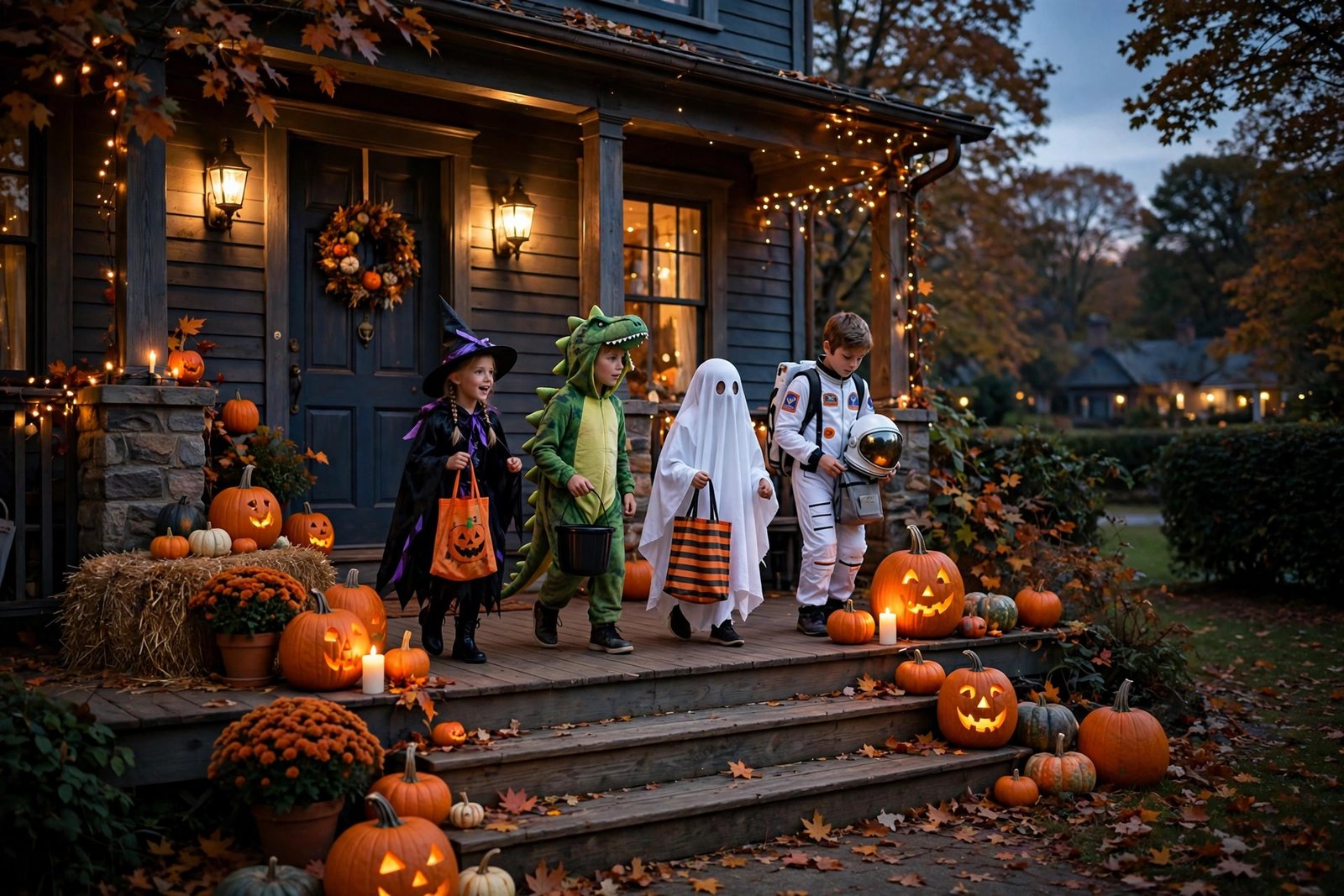
Picture a child in a ghost costume knocking on a stranger’s door and asking for candy. It feels like a simple, modern game. But the history of trick-or-treating stretches back about two thousand years, through Celtic bonfires, medieval prayers, Scottish street performances, and a wave of immigration that carried an old custom across the Atlantic. The candy bucket is new. The knocking on doors is ancient.
That long journey is what makes the tradition so fascinating. Trick-or-treating did not spring from one single invention. It grew, layer by layer, as different communities kept the same basic idea alive: dress up, visit your neighbors, offer something in return, and come home with a treat. Each era added its own twist, and each twist still shows up in the Halloween we know today.
The History of Trick-or-Treating Begins With Samhain
The story usually starts with Samhain, pronounced sow-in, an ancient Celtic festival celebrated around October 31. For the Celts in Ireland, Scotland, and Wales, this was the end of the harvest and the start of the darker half of the year. It was a hinge in the calendar, a night when the boundary between the living and the dead was believed to grow thin.
On Samhain, people lit bonfires and wore costumes, often made from animal skins. The belief, as retold by historians, was that spirits could cross over on this night. Disguises could protect the living by helping them blend in, or by scaring away unwelcome visitors. Food was also left out as an offering, a way to keep roaming spirits satisfied. If any of that sounds familiar, it should. Costumes and food offerings are still at the heart of Halloween.
Samhain was not a candy holiday, and it was not a children’s game. It was a seasonal festival tied to farming, fire, and the fear of the unknown. But it planted two ideas that never really left: dress up on this night, and mark the night with food shared between households and spirits. Those ideas would survive for centuries, even as the names and beliefs around them changed.
How Samhain Became All Hallows’ Eve
As Christianity spread across the British Isles, older festivals were often woven into the Christian calendar rather than erased. November 1 became All Saints’ Day, also called All Hallows’ Day, a day honoring saints and martyrs. November 2 became All Souls’ Day, a day for remembering the dead. The evening before All Saints’ Day was All Hallows’ Eve, and over time that name was shortened to Halloween.
This blending matters because it explains why Halloween carries both spooky and solemn threads. The bonfires, costumes, and talk of spirits came from the older festival. The prayers, remembrance of the dead, and door-to-door charity came from the Christian observances that followed. Halloween became a season of remembering, dressing up, and visiting, all at once.
Historians describe these days together as Hallowtide. For ordinary people, Hallowtide was not an abstract church calendar entry. It was a time to gather, to light fires, to remember loved ones who had died, and to share food with neighbors. Out of that mix came the first custom that looks unmistakably like trick-or-treating.
Souling: Prayers in Exchange for Soul Cakes
In medieval Britain, a custom called souling took shape. People who were poor would go from house to house around All Souls’ Day, offering to pray for the dead relatives of the household. In return, wealthier families gave them small pastries known as soul cakes. The exchange was simple and deeply human: a prayer for a treat, charity wrapped in ritual.
References to souling date back to the fourteenth century, and the custom survived longest in Catholic communities after the Reformation changed religious life in Protestant areas. Over time, children took up the practice too, going door to door and asking for gifts. The basic shape was already there: knock, ask, receive something sweet, move on to the next house.
Soul cakes themselves are worth picturing. They were small, sweet, spiced breads, often marked with a cross. They were not candy bars, and they were not handed out in plastic buckets. But they were treats given at the door in exchange for words spoken at the threshold, and that transaction is the direct ancestor of the modern one. You can read more about this medieval background in this account of how trick-or-treating dates back to medieval times.
Guising in Scotland and Ireland: A Trick for a Treat
While souling was taking hold in England, Scotland and Ireland had their own version, and it may be even closer to the modern game. It was called guising, from the word disguise. Children and young people dressed in costume, went from house to house, and performed something in exchange for a treat: a song, a poem, a joke, or another small trick.
Guising is the missing link that explains the word trick in trick or treat. The performer did not simply ask. They earned the treat with a performance. The householder was the audience, the child was the entertainer, and the treat was the applause. It was playful, social, and a little theatrical, and it turned a doorstep visit into a tiny show.
Costumes in this era were often homemade and rough: straw, old clothes, masks, and face paint. There were no costume shops selling ready-made superheroes. The disguise was part of the fun and part of the tradition, a nod back to the old belief that dressing up on this night had protective power. Over time, the performance mattered as much as the disguise, and both survived the journey to America.
Other door-to-door customs existed too, including mumming, in which costumed performers sang, danced, or acted out short plays in exchange for food and drink. Mumming was not limited to Halloween, but it reinforced the same pattern: costumed visitors, a performance, and a reward at the door. Together, souling, guising, and mumming show that trick-or-treating was never a single invention. It was a family of customs that shared one shape.
The History of Trick-or-Treating Crosses the Atlantic
When Irish and Scottish immigrants came to North America in the nineteenth and early twentieth centuries, they brought these customs with them. Irish immigration in particular grew after the Potato Famine of the 1840s, and Irish and Scottish communities helped keep Halloween alive in their new home. Children revived souling and guising in American neighborhoods, adapting old customs to new streets.
At first, Halloween in America was not the tidy, family-friendly event we know today. In the early twentieth century, some Halloween nights were known for pranks and mischief: tipped-over outhouses, opened gates, and egged houses. The trick side of the tradition could get rowdy. Community leaders and neighbors gradually pushed the holiday toward something safer and more organized, and door-to-door visiting, with treats offered willingly, became the calmer alternative to pranks.
The phrase itself, trick or treat, began appearing in print in the 1920s, with early examples reported in the Canadian provinces of Saskatchewan and Alberta, and it reached the United States by the end of that decade. The words captured the bargain in a single line: give us a treat, or expect a trick. In practice, of course, the treat almost always won, and the trick was usually just a joke or a song.
For a fuller picture of these early American years, see this overview of the origins of Halloween, which traces the festival from its Celtic roots through its arrival in North America.
How Candy Took Over After World War II
The trick-or-treating we recognize today really took off after World War II. Several forces came together at once. Sugar rationing ended, suburbs grew, and neighborhoods offered long, safe routes of houses with lit porches. The postwar baby boom meant there were more children than ever to go door to door, and parents were ready for a holiday that felt communal and fun.
Early American trick-or-treaters did not always get candy. They might receive cookies, cake, fruit, nuts, coins, or small toys. Homemade treats were common. Over time, individually wrapped candy became the standard, partly because it was convenient, partly because it felt safe and sealed, and partly because candy makers began marketing their products for Halloween. The sealed wrapper became a symbol of trust between neighbors who might barely know each other.
Pumpkins joined the story too. In Ireland and Scotland, carved lanterns were traditionally made from turnips and other root vegetables, hollowed out and carved, often to frighten away evil spirits. In America, the pumpkin, larger and easier to carve, took over, and the jack-o’-lantern became the glowing face of the holiday. It was another old custom, reshaped by a new continent and a new crop.
By the 1950s, trick-or-treating had become the family-friendly centerpiece of Halloween in the United States. Costumes expanded beyond ghosts and witches to include characters from movies, television, and popular culture. The homemade straw costume gave way to store-bought outfits, but the doorstep bargain stayed the same. A summary of this transformation appears in this history of Halloween traditions, which notes how the custom spread widely after the war.
Why the Old Customs Still Matter Today
It is easy to treat trick-or-treating as a candy run, but its history explains why it feels so much bigger than that. Every part of the night carries an old meaning. The costume echoes Samhain disguises and guising masks. The door-to-door visit echoes souling and the charity of Hallowtide. The treat echoes soul cakes, fruit, nuts, and coins. Even the playful threat in trick or treat echoes the old bargain: perform, or prank.
That history also explains why Halloween keeps reinventing itself without losing its shape. New costumes arrive every year, new candies appear on shelves, and new neighborhoods join in, but the core ritual holds. Children dress up, neighbors open their doors, and a community shares something sweet on a dark autumn night. It is a small act of trust, repeated millions of times, and it has been repeated, in one form or another, for centuries.
Like other unsolved and surprising stories from the past, this one rewards curiosity. If you enjoy digging into mysteries that refuse to stay simple, you may also like our look at the D.B. Cooper ransom money mystery and the story of Amelia Earhart and the Nikumaroro expedition, where old clues still spark new questions today.
Takeaways From the History of Trick-or-Treating
- Samhain, the Celtic festival around October 31, gave Halloween its costumes, bonfires, and belief in a thinning boundary between worlds.
- Souling turned door-to-door visits into an exchange: prayers for the dead in return for soul cakes.
- Guising added the performance: a song, poem, or joke earned the treat, which is where the trick in trick or treat comes from.
- Irish and Scottish immigrants carried these customs to North America, where the phrase trick or treat appeared in print in the 1920s.
- After World War II, suburbs, the baby boom, and wrapped candy turned an old custom into the family tradition we know today.
The next time a costumed child knocks on your door, you are not just handing out candy. You are taking part in a ritual that has traveled from Celtic bonfires to medieval doorsteps, from Scottish streets to American suburbs, and into your own porch light. The history of trick-or-treating is, in the end, a history of neighbors: people dressing up, stepping outside, and sharing something sweet on the darkest night of the year.
Frequently Asked Questions
What is the oldest ancestor of trick-or-treating?
The oldest ancestor most often cited is Samhain, the ancient Celtic festival around October 31, when people believed the boundary between the living and the dead grew thin and disguises and offerings played a part in the night.
What was souling?
Souling was a custom in which people, often the poor, went door to door offering prayers for the dead in exchange for soul cakes, small pastries given by wealthier households.
What was guising?
Guising was a custom in Scotland and Ireland in which children and young people dressed in costume and performed a song, poem, joke, or other trick in exchange for food, coins, or other treats.
When did the phrase trick or treat first appear?
The phrase began appearing in print in the 1920s, with early examples reported in Canada, and it reached the United States by the end of that decade.
Did trick-or-treaters always receive candy?
No. Early treats included fruit, nuts, coins, homemade food, and small toys. Individually wrapped candy became the standard handout later in the twentieth century.