
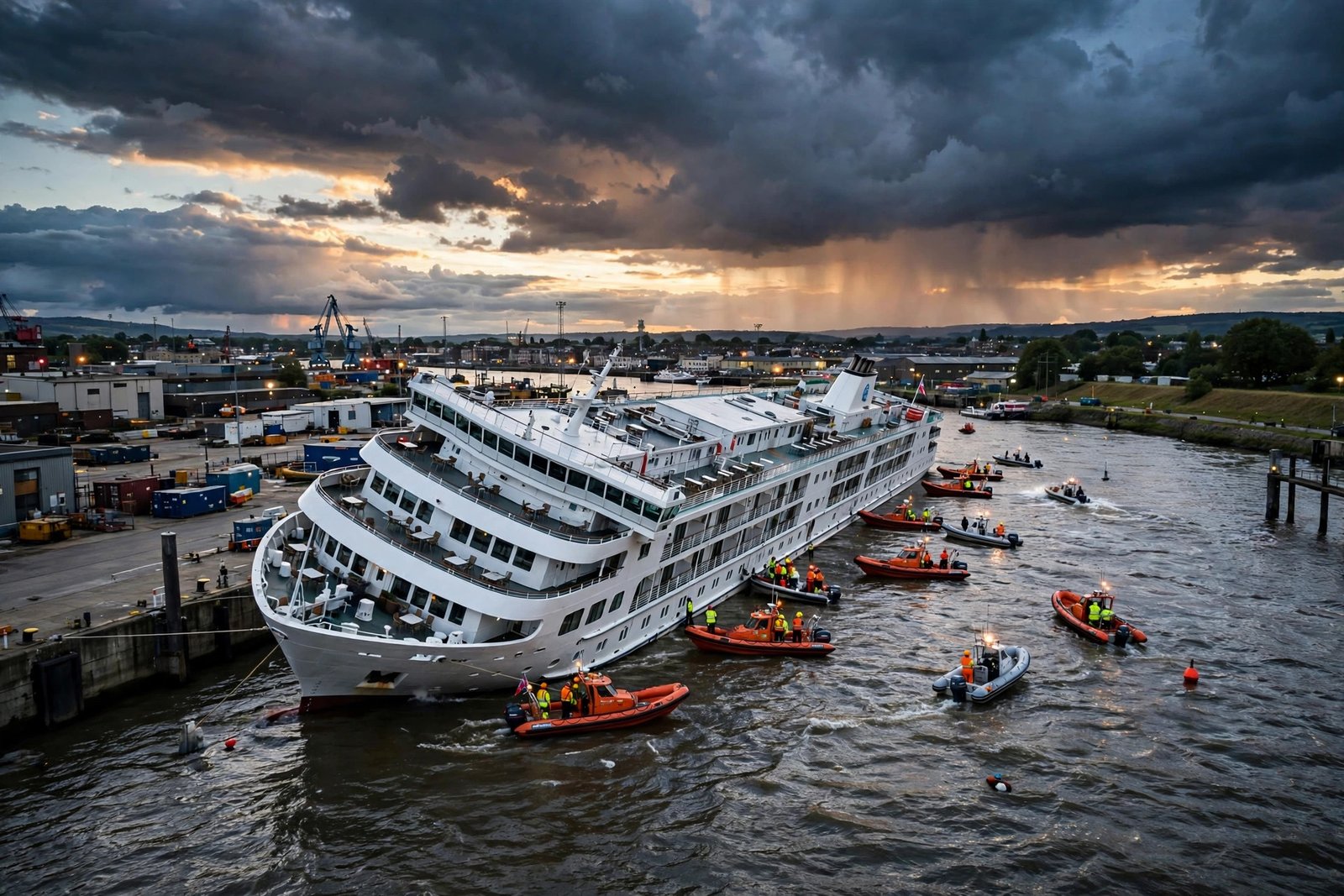
It was supposed to be an ordinary Friday lunchtime on the Mississippi River. Passengers aboard the American Heritage cruise ship were docked at the Port of New Orleans, some settling in for the afternoon, others already out on deck enjoying the view. Then, in a matter of seconds, everything changed. A tanker called the Atlantic Asphalt struck the river cruise ship broadside, and the vessel began to lean, then tip, in full view of the people on board. Phones came out almost instantly, and within hours the footage was everywhere.
The American Heritage cruise ship capsizing video is the kind of clip that stops you mid-scroll. It is shaky, urgent, and deeply human: ordinary travellers suddenly living through something no holiday brochure ever mentions. One passenger, wearing a red life jacket, can apparently be seen filming even as the emergency unfolds around them. That single detail has become one of the most talked-about parts of the whole story, and it is also why so many people online reached for the same comparison: this is what it would have been like if people had mobile phones on the Titanic.
This is the story of what happened on Friday, November 13, 2026, what the viral video actually shows, what passengers did next, and what officials have said so far. No deaths were reported, but roughly 100 people ended up in the water, and dozens were taken to hospitals. Here is everything we know.
What Happened to the American Heritage Cruise Ship?
Around 12:30 p.m. on Friday, November 13, 2026, the American Heritage river cruise ship was docked at the Port of New Orleans on the Mississippi River. The ship, operated by American Cruise Lines, was not out at sea and not battling a storm. It was moored at the port, which is part of what makes the incident so startling. A river cruise ship at dock is supposed to be one of the calmest places a traveller can be.
That calm ended when the Atlantic Asphalt, a tanker, struck the American Heritage cruise ship broadside. The impact pushed the vessel over, and it began capsizing beside the dock. Passengers and crew suddenly found themselves in a rapidly unfolding emergency, with the deck tilting under their feet and the river just below.
The image of a cruise ship capsizing is one most people associate with disaster movies or with the great ocean liners of a century ago. Seeing it happen to a modern river cruise ship, in broad daylight, in one of America’s busiest ports, is what gave the story its instant, shocking power. It did not happen far away or out of sight. It happened at the dock, in the middle of the day, with cameras already in almost every pocket.
The Viral Video That Stopped the Internet
The footage spread with remarkable speed. A viral video from the scene shows the ship leaning heavily as the emergency develops, with passengers reacting in real time. One passenger in a red life jacket is apparently filming as events unfold, a detail that has fascinated and unsettled viewers in equal measure. Some people praised the instinct to document what was happening. Others asked how anyone could keep filming in such a moment. That argument, playing out across comments sections and social feeds, helped push the clip even further.
Viral videos of disasters work differently from news reports. A news report tells you what happened. A video puts you there. You hear the noise, you see the tilt of the deck, you watch ordinary people make split-second decisions. The American Heritage footage has that quality, which is why it travelled far beyond the usual cruise and travel communities and into the feeds of people who had never thought about river cruising at all.
The clip also spread because it raised an immediate question that everyone could picture: what would you do? Would you grab your belongings, help the person next to you, or reach for your phone? The passenger in the red life jacket, still filming, became a kind of stand-in for that question, and the debate around the footage kept it circulating for days.
It is worth remembering, as with any viral clip, that a short video shows only a fragment of a much longer and more frightening experience. The people on board lived through the full event, from the impact to the rescue, and the footage captures only seconds of it. The real story belongs to the passengers and crew who were there.
“Titanic With Mobile Phones”: Why the Comparison Stuck
Online, one comparison appeared again and again: this is what it would have been like if they had had mobile phones on the Titanic. The line captures something real about how disaster is experienced in the modern world. When the Titanic sank in 1912, the world learned about it through wireless messages, newspaper headlines, and the accounts of survivors. There was no footage, no livestream, no passenger video. The event reached the public slowly, in words.
The New Orleans incident was the opposite. Within minutes, images and video from the scene were moving across social media, shared by passengers, picked up by news outlets, and discussed by millions of people who were nowhere near the Mississippi River. The comparison to the Titanic is not really about the ships, which are very different in size, era, and circumstance. It is about the difference between an age when a disaster was reported and an age when a disaster is witnessed, live, by the whole world.
There is also a deeper reason the comparison resonated. The Titanic has become a kind of shorthand for a ship in trouble, the reference point everyone reaches for when a vessel is in danger. The moment a modern cruise ship began to tip over, that century-old story was the first thing many people thought of. Add a passenger filming in a life jacket, and the parallel became almost irresistible, even though the outcome in New Orleans, thankfully, was very different.
The comparison also says something about how we process shocking news now. A viral video can make a distant event feel personal in seconds. The same technology that lets a passenger film an emergency also lets the rest of us watch it unfold from our sofas, and that closeness is exactly what makes these clips so powerful and so hard to look away from.
What Passengers Did Next
When a ship begins to capsize, there is no time for a plan. Passengers have to act on instinct, and by the accounts that have emerged, many of them did. Passenger Joe Knab told the Associated Press that roughly 100 people ended up in the water, a figure that gives a sense of the scale of the emergency. People who had been relaxing on a docked cruise ship suddenly found themselves in the Mississippi River, needing rescue.
Emergency responders moved quickly, and dozens of people were taken to hospitals. The fact that no deaths were reported is remarkable given the circumstances, and it is a credit to the passengers, the crew, and the rescue teams who responded at the port. River rescues are not simple operations, and the speed of the response mattered.
The passenger in the red life jacket, filming as the emergency unfolded, has become the most discussed figure in the footage, but the wider story is one of ordinary people helping each other through a frightening and chaotic few minutes. In incidents like this, the accounts that matter most often come later, when survivors have had time to describe what they saw and did, and those accounts are still emerging.
For travellers watching the footage from home, the human details are the ones that linger: the suddenness of it, the tilt of the deck, the life jackets, the water. A cruise, especially a river cruise, is sold as one of the most relaxed ways to travel, and seeing that calm shattered in seconds is part of why the video has stayed in people’s minds.
What Officials Said About the American Heritage Cruise Ship
New Orleans Mayor Helena Moreno addressed the incident, saying the tanker had apparently “lost control”. That description is important, but it is not a final determination. The cause of the collision has not yet been finally determined, and officials were careful to frame the mayor’s words as an early account rather than a conclusion.
A major federal investigation followed the incident, as is standard when a collision of this kind takes place on American waterways. Federal investigators examine the vessels, the movements in the river, the communications between ships, and the conditions at the time, and their findings take time. Early statements from city officials give the public an initial picture, but the full account of what went wrong will come from the investigation.
The distinction matters. In the hours after a dramatic event, speculation fills the gap while facts are still being gathered. The mayor’s comment that the tanker had apparently lost control was the most authoritative early explanation available, but it was offered with the caution that word “apparently” carries. The investigation will establish what actually happened, and until then, the careful version of events is the honest one.
The Investigation and What Comes Next
A major federal investigation is now under way, and it will look at every part of the incident. Investigators will want to know how the tanker came to strike the American Heritage cruise ship, what happened in the minutes before the collision, and whether anything in the movement of vessels on the river that day contributed to it. They will also examine the response, including how quickly passengers were rescued and how the ship’s crew handled the emergency.
Investigations of this kind are thorough and slow, and that is by design. A quick answer is less useful than a correct one, particularly when the findings may lead to changes in how vessels move through busy ports. For the passengers who were on board, the investigation is also a matter of accountability and of understanding exactly what happened to them on an ordinary Friday afternoon.
In the meantime, the footage continues to circulate, and the questions it raises will keep being discussed. Why did the tanker lose control? Could the collision have been avoided? What happens to a river cruise ship after an incident like this? Some of those questions will be answered by the investigation. Others, about how the industry and the port respond, will play out over the months that follow.
River Cruising Safety: What Travellers Should Know
River cruising has grown enormously in popularity, and for good reason. The ships are smaller and more intimate than ocean liners, the scenery changes constantly, and the pace is gentle. Passengers step off the ship straight into towns and cities, often right in the centre. It is one of the most relaxing ways to see a river, and incidents like the one in New Orleans are rare, which is exactly why this one attracted so much attention.
Still, the incident is a reminder that safety briefings matter, even on a calm river cruise at dock. Knowing where your life jacket is, knowing where the muster points are, and listening to the crew’s instructions are not formalities. They are the things that matter in the unlikely event that something goes wrong. Passengers who had listened to the briefing were better placed to act quickly when the deck began to tilt.
It is also a reminder that the most dangerous moments in travel are often the ones nobody expects. A ship at dock, on a clear afternoon, in a major port, is not the setting anyone imagines for an emergency. That is precisely why the crew’s training and the port’s emergency response matter so much, and why the rescue in New Orleans, with no deaths reported, deserves to be recognised alongside the drama of the footage.
Travellers who love river cruising should not be put off by a single incident, but they should take the lesson it offers: pay attention to the safety briefing, know your surroundings, and keep your phone charged, not because you might need to film something, but because in an emergency it is your link to help.
Key Takeaways
- On Friday, November 13, 2026, around 12:30 p.m., the American Heritage river cruise ship was struck broadside by the Atlantic Asphalt tanker while docked at the Port of New Orleans.
- A viral video from the scene, apparently showing a passenger in a red life jacket filming as the emergency unfolded, spread rapidly and sparked the “Titanic with mobile phones” comparison.
- Passenger Joe Knab told the Associated Press that roughly 100 people ended up in the water; dozens were taken to hospitals, and no deaths were reported.
- New Orleans Mayor Helena Moreno said the tanker had apparently “lost control”, but the cause has not yet been finally determined.
- A major federal investigation is under way and will establish the full account of what happened.
The story of the American Heritage cruise ship is, in the end, two stories at once. One is the dramatic footage: a river cruise ship tipping over at dock, a passenger filming in a red life jacket, and a clip that travelled around the world in hours. The other is the human story underneath it: roughly 100 people in the water, dozens in hospital, a rapid rescue, and no deaths. The first story is why the world watched. The second is why the outcome, given what could have happened, is something to be grateful for.
As the federal investigation continues, more detail will emerge about how the Atlantic Asphalt came to strike a docked cruise ship on a Friday afternoon. Until then, the footage remains a vivid reminder of how quickly an ordinary day can change, and of how the phones in our pockets have changed the way the whole world experiences a disaster. For more on viral moments that capture the internet’s attention, see our story on the Stranger Things prequel teaser that racked up 166 million views, and for another tale of ordinary people in extraordinary moments, read these Reddit stories of people who met celebrities in random places. Travel disruption can also strike from the sky, as our report on the US flight ground stop that followed an FAA outage shows.
For the original report on the viral video and the “Titanic with mobile phones” reaction, see the Sunday Guardian Live coverage, and for wider reporting on the incident, see AP News.