
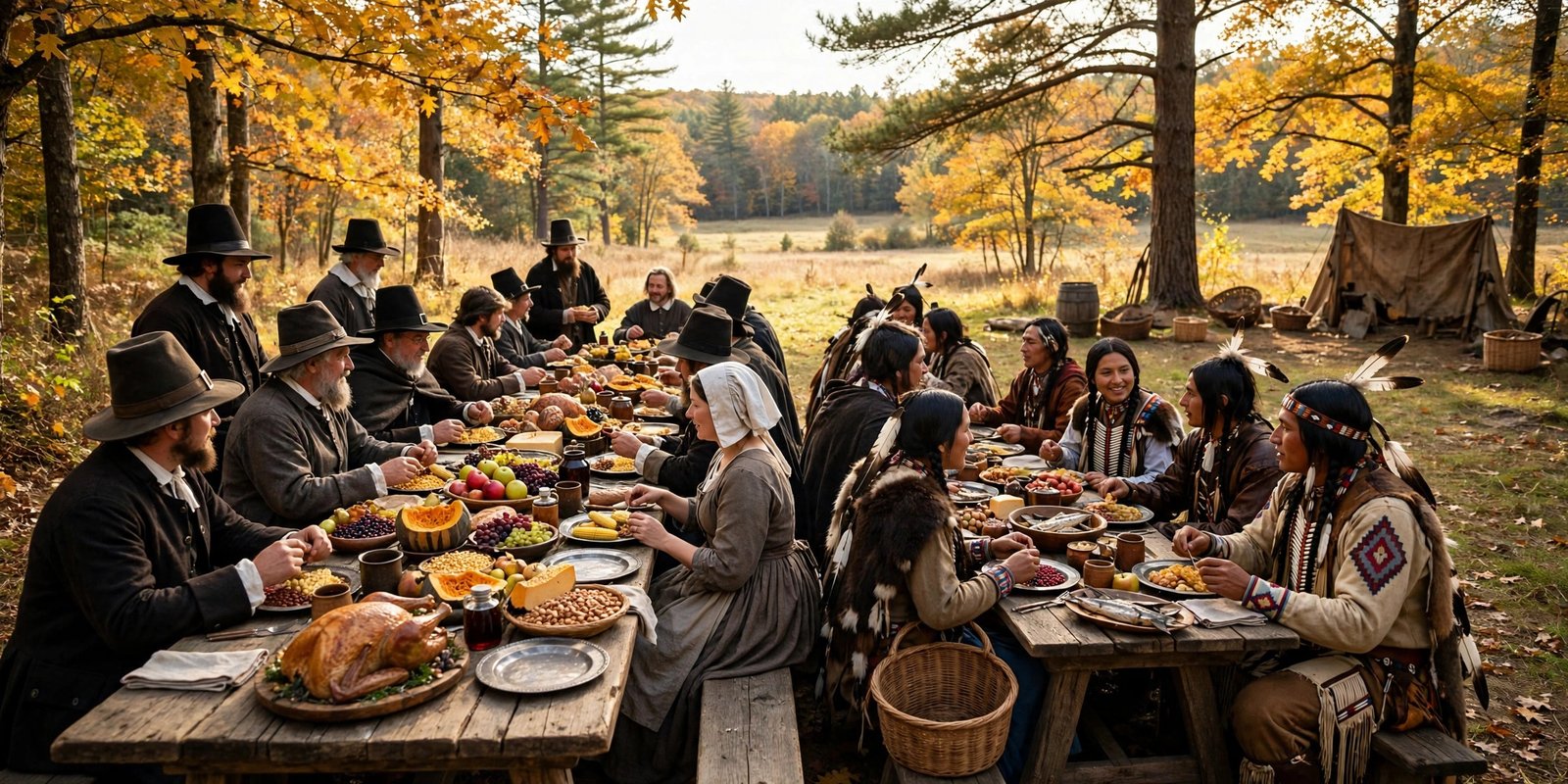
Every November, millions of Americans sit down to turkey, stuffing, and pumpkin pie. But the first Thanksgiving 1621 looked almost nothing like the holiday we know today. There was no turkey on a platter, no cranberry sauce, and no pumpkin pie. The real story is stranger, richer, and more interesting than the version most of us learned in school. It was a three-day harvest feast in a struggling colony, shared between English settlers and the Native people who had helped them survive.
The First Thanksgiving 1621: What Really Happened
The first Thanksgiving 1621 took place in the autumn at Plymouth, the small English settlement in what is now Massachusetts. The Pilgrims, as the settlers are known today, had arrived on the Mayflower the previous year. Their first winter had been brutal. Roughly half of the 102 passengers died from disease, cold, and hunger. By the fall of 1621, the survivors had managed a successful harvest with the help of their Wampanoag neighbors, and they held a feast to celebrate.
We know about the feast mainly from a short letter written by Edward Winslow, one of the colony leaders, and included in a 1622 pamphlet called Mourt’s Relation. Winslow wrote that after the harvest, the governor sent four men out hunting, and they returned with enough fowl to feed the colony for almost a week. Then Massasoit, the leader of the Wampanoag, arrived with about 90 men, and they stayed for three days. Winslow also noted that the Wampanoag went out and killed five deer, which they brought to the feast. Another brief account comes from William Bradford, the colony’s governor, who wrote in his history Of Plymouth Plantation that the settlers gathered the fruit of their labors and rejoiced together. You can read Winslow’s original account through the Pilgrim Hall Museum, which preserves early Plymouth records.
One important detail is that the people at the feast did not call it Thanksgiving. In the 1600s, a thanksgiving was a religious day of prayer, not a feast. The 1621 gathering was a harvest celebration, the kind of festival English people had held for centuries. The name Thanksgiving was attached to the event much later, when Americans in the 1800s began looking back for an origin story for their holiday.
Who Was Actually There?
About 53 English settlers were left alive by the fall of 1621, and nearly all of them attended the feast. Among them were William Bradford, the governor, and Edward Winslow. Captain Myles Standish, the colony’s military leader, was also there. The group included men, women, and children, though there were far more men than women, since many of the women had died during the first winter.
The Wampanoag guests numbered about 90 men, led by Massasoit, whose proper name was Ousamequin. They were not distant strangers. The Wampanoag had already formed an alliance with the settlers in the spring of 1621, a peace treaty that would last for decades. A Patuxet man named Tisquantum, known to history as Squanto, had taught the settlers how to plant corn, catch fish, and survive in the new land. Squanto spoke English because he had been taken to England years earlier and later returned. Without his help and the Wampanoag alliance, the colony might not have survived at all. The feast was, in part, a celebration of that alliance. For a fuller account of the Wampanoag perspective and the history of the colony, the Plimoth Patuxet Museums offer detailed exhibits and research.
What Did They Eat at the First Thanksgiving?
If you expect turkey, mashed potatoes, and pumpkin pie, the real menu will surprise you. The feast was built from what the land and the sea provided in New England in the autumn. Here is what historians believe was almost certainly on the table.
- Venison: The Wampanoag brought five deer to the feast, so venison was a main dish. It was likely roasted over a fire.
- Wild fowl: Winslow wrote that the settlers hunted fowl, which probably meant ducks and geese, and possibly wild turkey. Wild turkeys did live in the area, but no source says turkey was served.
- Fish and shellfish: The coast offered cod, bass, eels, clams, and mussels, all foods the settlers and the Wampanoag ate regularly.
- Corn: The harvest included corn, which was ground into meal and cooked as a porridge or bread. It was a staple crop the settlers learned to grow from the Wampanoag.
- Squash, beans, and pumpkins: These native crops were part of the harvest, though pumpkins were likely stewed or roasted, not baked into pie.
- Wild fruits and nuts: Chestnuts, walnuts, plums, grapes, and berries were in season and probably gathered for the feast.
Just as interesting is what was missing. There were no potatoes, because potatoes had not yet reached New England. There was no cranberry sauce, because the colony had almost no sugar, and cranberries are too tart to eat plain. There was no pumpkin pie, because the settlers had no butter, flour, or ovens for baking pies. There was no sweet potato, no green bean casserole, and no stuffing as we know it. The meal was probably cooked outdoors over open fires, and the guests ate with knives and their hands, since forks were not yet common in England. There were no chairs for everyone either, so many people likely sat on the ground or on logs.
How Long Did It Last and What Did They Do?
The feast lasted three days, according to Winslow’s letter. That was not unusual for a harvest festival in the 1600s, when celebrations stretched over several days. The days were probably filled with eating, but also with the kinds of recreation both groups enjoyed. The English settlers played games like stoolball, a bat-and-ball game, and practiced shooting. The Wampanoag men likely demonstrated their own games and skills, and there may have been dancing and contests.
The atmosphere was probably closer to a community festival than to a quiet dinner. Picture a settlement of small wooden houses, fires burning outside, deer roasting on spits, and more than 140 people eating, talking, and playing games together over three autumn days. The weather in New England in late September or early October, when historians believe the feast took place, would have been cool and crisp, with the leaves turning. It was a moment of relief and celebration after a year of hardship.
How the First Thanksgiving Became a National Holiday
For more than 200 years after 1621, Thanksgiving was not a fixed national holiday. Individual colonies and states declared days of thanksgiving at different times, usually as religious observances. The push to make it a national holiday came largely from one woman: Sarah Josepha Hale, the editor of a popular women’s magazine called Godey’s Lady’s Book. Starting in the 1840s, Hale wrote letters to presidents and governors for nearly two decades, arguing that a shared national Thanksgiving could help unite a divided country.
Her campaign finally worked in 1863, in the middle of the Civil War. President Abraham Lincoln proclaimed a national day of Thanksgiving to be held on the last Thursday of November. Lincoln’s proclamation framed the day as a time to give thanks for the nation’s blessings even in wartime. After that, presidents issued a Thanksgiving proclamation every year, and the holiday settled into the last Thursday of November.
That timing changed once more in the late 1930s and early 1940s. In 1939, President Franklin D. Roosevelt moved Thanksgiving up a week to the second-to-last Thursday of November, hoping to give stores a longer Christmas shopping season during the Great Depression. The change was unpopular and confusing, with some states following the new date and others sticking to the old one. In 1941, Congress settled the matter by passing a law that set Thanksgiving on the fourth Thursday of November, where it remains today. You can read Lincoln’s original 1863 proclamation at the National Archives.
Myths vs. Facts About the First Feast
The story of the 1621 feast has picked up a lot of myths over the centuries. Here are the most common ones, and what historians actually know.
Myth: The Pilgrims wore tall black hats with buckles. In reality, the settlers wore ordinary English clothing of the time in muted colors. The buckled-hat image was invented by artists in the 1800s. They also did not wear only black and white.
Myth: The first Thanksgiving was a peaceful, happy meeting with no complications. The feast itself was peaceful, but the relationship between the settlers and Native peoples was complicated. The peace between Plymouth and the Wampanoag lasted for about 50 years, but later conflicts, including King Philip’s War in the 1670s, devastated Native communities across New England. The full story includes both the feast and what came after.
Myth: The Pilgrims invited the Wampanoag to dinner. According to Winslow, Massasoit arrived with 90 men, far more guests than expected. It is likely the Wampanoag came because they heard the settlers celebrating and firing guns, and they may have come to see what was happening. The feast became a shared event, but it was not a formal dinner invitation as we imagine it.
Myth: Turkey was the centerpiece. As noted above, no source mentions turkey at the 1621 feast. Venison and wild fowl were the main meats. Turkey became the traditional centerpiece much later, in the 1800s, when it became popular as a holiday dish.
Key Takeaways From the First Thanksgiving
- The feast took place in the fall of 1621, after the Plymouth settlers’ first successful harvest.
- About 53 English settlers and about 90 Wampanoag men attended, and the celebration lasted three days.
- The menu featured venison, wild fowl, fish, corn, squash, and beans, not turkey and pumpkin pie.
- The people at the feast did not call it Thanksgiving. That name came much later.
- Thanksgiving became a national holiday in 1863, when Abraham Lincoln proclaimed it during the Civil War.
- The holiday moved to the fourth Thursday of November by law in 1941.
The first Thanksgiving 1621 was not the tidy scene on a greeting card. It was a harvest feast in a fragile colony, shared by people from two very different worlds who had decided, for a time, to help each other survive. Knowing the real story does not take away from the holiday. It makes it richer. This November, when you sit down to your own feast, you can remember that the first one had no turkey, no pie, and no cranberry sauce, but it had something just as important: people who had been through a hard year, sharing food and giving thanks together. If you want to know why the turkey became the star of the modern table, read our article on why Americans eat turkey at Thanksgiving, and for the shopping holiday that follows, see the story of how Black Friday got its name.