
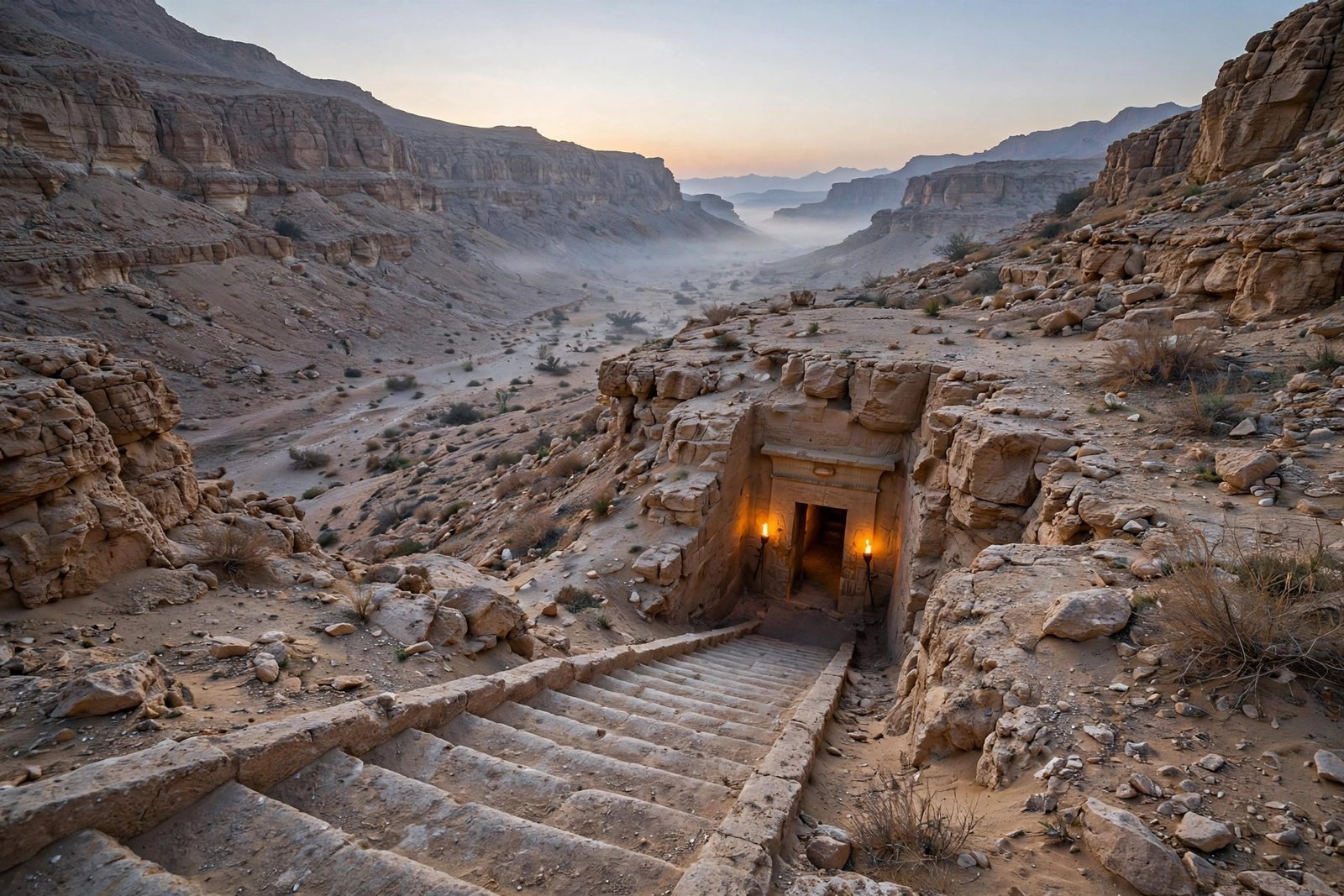
On the morning of November 4, 1922, in the dusty heat of Egypt’s Valley of the Kings, a workman clearing sand struck something hard beneath his feet. It was a single carved stone step, buried for more than 3,000 years. Within days, that step would lead to the greatest archaeological discovery of the twentieth century, and the Tutankhamun tomb discovery would change what the world knew about ancient Egypt forever. This is the story of how a stubborn archaeologist, a patient patron, and one lucky step uncovered a pharaoh the world had nearly forgotten.
What makes this discovery so extraordinary is not just the gold, though there was plenty of it. It is that the tomb was found nearly intact. Almost every other royal tomb in the Valley of the Kings had been robbed in antiquity, stripped bare by thieves centuries before archaeologists arrived. Tutankhamun’s tomb, hidden beneath debris from later tombs built above it, had escaped that fate. When Howard Carter finally peered inside, he saw a time capsule from the ancient world, sealed, silent, and waiting.
The Boy King Nobody Expected to Find
Tutankhamun was not one of Egypt’s great conquerors. He ruled for about a decade, roughly from 1332 to 1323 BCE, during the 18th Dynasty, and he came to the throne as a child, probably around nine years old. His reign was short, his achievements modest compared with pharaohs like Ramses II, and after his death, later rulers tried to erase his name from history. For centuries, he was little more than a footnote.
And yet, ironically, it is precisely because he was forgotten that his tomb survived. Because his burial place was small and unremarkable by royal standards, and because debris from the tomb of Ramses VI was later piled above it, looters and early explorers walked right past it. The tomb’s entrance lay hidden under the remains of ancient workmen’s huts. Tutankhamun’s obscurity became his protection, and his protection became his immortality.
If you enjoy facts that flip your sense of time upside down, you will love our story about how Cleopatra lived closer to the invention of the iPhone than to the building of the pyramids. Ancient history is stranger than most people imagine.
The Man Who Would Not Give Up
Howard Carter was a British archaeologist who had spent years working in Egypt. He was talented, meticulous, and famously stubborn. In 1907, he began working for George Herbert, the 5th Earl of Carnarvon, a wealthy English aristocrat who had developed a passion for Egyptology. Carnarvon funded Carter’s excavations in the Valley of the Kings, and together they searched for the tomb of a pharaoh most experts believed would never be found.
By 1922, the partnership was running out of steam. Other archaeologists had declared the Valley of the Kings exhausted, picked clean after decades of digging. In June 1922, Lord Carnarvon summoned Carter to England and told him he was ready to give up and stop funding the work. Carter begged for one more season, offering to pay for it himself if necessary. Carnarvon relented and agreed to finance a final season. It was the last chance, and Carter knew it.
Carter arrived back in Luxor on October 28, 1922, and work began almost immediately. His team started clearing an area near the entrance of the tomb of Ramses VI, a spot that had been overlooked because of the ancient workmen’s huts built over it. For days, there was nothing. Then, on November 4, everything changed.
November 4, 1922: The Tutankhamun Tomb Discovery
The details of that first moment are wonderfully ordinary. According to the popular account, a water boy digging a hole to store water jars for the workers struck stone under the sand. According to National Geographic’s reconstruction, a member of Carter’s team whose name is lost to history stumbled upon a carved stone, the top of a buried stairway. Either way, the stone turned out to be the first step of a staircase descending into the earth. In his pocket diary, Carter wrote just five words: “First steps of tomb found.”
The next day, the team uncovered 12 steps leading down to a doorway that had been plastered over and stamped with seals. The seals were indistinct, but they were clearly unbroken, a thrilling sign that the tomb might be intact. Carter was convinced he had found something extraordinary, but he did something remarkable: he stopped. He had the staircase re-covered and cabled Lord Carnarvon in England with a now-famous message: “At last have made wonderful discovery in valley; a magnificent tomb with seals intact… congratulations.” He would not open the tomb until his patron could be there to see it.
Carnarvon arrived on November 23, accompanied by his daughter, Lady Evelyn Herbert. By November 24, Carter’s team had exposed the full doorway and found seals that could be read clearly. Several contained a name Carter had been hunting for years: Nebkheperure, the throne name of Tutankhamun. The tomb belonged to the boy king.
“Wonderful Things”: The Moment That Made History
There was one worrying detail. The outer doorway showed evidence of ancient forced entry, someone had broken in long ago, though the tomb had been resealed afterward. Carter pressed on. The door was cut away, revealing a sloping passage filled with rubble. Two more days of digging brought the team to a second sealed doorway, more than 20 feet underground, again bearing seals naming Tutankhamun.
On November 26, 1922, Carter made a small hole in the upper part of the second doorway, held up a candle, and looked inside. The hot air escaping from the sealed chamber made the candle flicker, and for a moment he could see nothing. Then, as his eyes adjusted, the interior gradually emerged from the darkness: strange animals, statues, and gold, everywhere the glint of gold.
Lord Carnarvon, unable to stand the suspense, asked anxiously, “Can you see anything?” Carter replied with words that have echoed through history ever since: “Yes, wonderful things.” In his journal, Carter later wrote about the moment in more detail, describing “a medley of extraordinary and beautiful objects heaped upon one another.” It is one of the most famous exchanges in the history of archaeology, and it is worth remembering that Carter was not looking at the burial chamber yet. He was looking into the antechamber, a room stuffed with the pharaoh’s possessions, and the greatest treasures still lay beyond.
The first chamber was officially opened on November 29, 1922, in front of officials and guests. The burial chamber itself was not unsealed until February 1923, and the sarcophagus was not opened until February 1924. Discovery, in archaeology, is rarely a single moment. It is a slow unwrapping, and Carter’s unwrapping would take nearly a decade.
Inside the Tutankhamun Tomb Discovery: What Carter Found
So what was inside? The tomb, catalogued as KV62, contained more than 5,000 objects, with some catalogs putting the exact count at 5,398. Here are some of the most extraordinary finds:
- The golden funerary mask, made of gold inlaid with lapis lazuli, carnelian, obsidian, turquoise, and glass paste, about 54 centimeters high and weighing over 10 kilograms. It is now the most recognizable work of art from ancient Egypt.
- Three nested coffins, one inside another, with the innermost made of solid gold and weighing about 110 kilograms.
- A golden throne, covered in gold sheet and inlaid with faience, glass, and semi-precious stones, showing Tutankhamun and his wife Ankhesenamun.
- Six chariots, disassembled and packed into the tomb, alongside weapons, musical instruments, and hunting equipment.
- A meteorite-iron dagger, a blade forged from metal that fell from the sky, one of the most fascinating objects in the collection.
- Over 400 shabti figures, small servant statues meant to work for the pharaoh in the afterlife.
- Clothing, jewelry, sandals, board games, food, and everyday objects, an intimate portrait of a young king’s daily life.
The tomb itself was small by royal standards, just four main chambers, but it was packed floor to ceiling. Golden couches shaped like animals, ebony statues, gilded shrines, ornamental caskets, and carved chairs filled every corner. As Thames and Hudson’s account of the tomb’s treasures describes it, the mask alone bears the likeness of Osiris, god of the dead, wearing the traditional nemes headcloth topped by the royal cobra and vulture insignia. Carter’s team spent years cataloguing, photographing, and conserving every item, a task that required extraordinary patience and care.
The mummy itself was not revealed until October 28, 1925, when Carter opened the innermost gold coffin. Inside lay the young pharaoh, wearing the golden mask, surrounded by 143 amulets, bracelets, necklaces, and other objects placed on the body itself. He was, by modern estimates, about 19 years old when he died, though the exact cause of his death remains debated by scholars to this day.
The Curse That Wasn’t
No story about Tutankhamun is complete without the famous curse, but this is where fact and legend must be carefully separated. Within months of the tomb’s opening, Lord Carnarvon died in Cairo in April 1923, after an infected mosquito bite led to blood poisoning. Newspapers of the era, hungry for a sensational story, began reporting a “curse of the pharaohs” that would strike down anyone who disturbed the tomb. The legend grew with every retelling, helped along by the eerie atmosphere of the discovery and the public’s love of a spooky story.
The facts tell a different tale. Howard Carter himself lived for another 17 years after the discovery, dying in 1939 at the age of 64. Lady Evelyn Herbert, who was present at the opening, lived until 1980. Most of the people who worked on the excavation lived long, normal lives. There is no evidence that any ancient curse was inscribed in the tomb, and modern researchers treat the curse as a media invention, a myth born from coincidence and sensational journalism. The real story, a forgotten boy king and a decade of painstaking archaeology, is far more interesting than any curse.
For more mind-bending stories from the internet’s favorite fact-sharing corners, check out our collection of viral Reddit Today I Learned facts, where everyday users uncover history’s strangest truths.
Why the Tutankhamun Tomb Discovery Still Fascinates
More than a century later, the Tutankhamun tomb discovery still holds the public imagination like no other archaeological find. Part of the reason is the sheer beauty of the objects. The golden mask, the throne, the jewelry, these are masterpieces that need no explanation to be appreciated. But there is something deeper at work too. The discovery gave the world a complete picture of what a pharaoh was buried with, something no other royal tomb could offer, because every other royal tomb had been robbed.
The discovery also changed Egypt itself. As National Geographic has noted, the find offered the world a dazzling vision of ancient life on the Nile and helped instill in modern Egyptians a new sense of national pride. The tomb was discovered at a moment when Egypt was moving toward independence from Britain, and the boy king became a symbol of Egyptian heritage, a heritage that belonged to Egyptians. Today, that legacy continues: the Grand Egyptian Museum near the Giza pyramids, which opened to the public on November 4, 2025, exactly 103 years after the discovery, now displays the complete Tutankhamun collection together for the first time, reuniting all 5,398 objects in one place.
There is also the human story. Carter’s decade-long refusal to give up, Carnarvon’s last-minute decision to fund one more season, and the ordinary workman who struck a stone step in the sand, these are the ingredients of a perfect story, and they happen to be true. The discovery reminds us that history is not only made by kings and generals. Sometimes it is made by a man with a candle, peering through a hole in a wall, and finding wonderful things.
And the tomb still has secrets. The pharaoh’s mummy remains in its original resting place in the Valley of the Kings, and researchers continue to study the artifacts with modern technology, from CT scans of the mummy to chemical analysis of the objects. New questions keep emerging: about Tutankhamun’s health, his family, and the circumstances of his death. A century after Carter’s candle flickered in the dark, the boy king is still talking to us.
Key Takeaways
- On November 4, 1922, Howard Carter’s team found the first step of a buried staircase in the Valley of the Kings, leading to the tomb of Tutankhamun.
- Carter had been searching for years, and Lord Carnarvon had nearly withdrawn funding before agreeing to one final season.
- On November 26, 1922, Carter peered through a hole in the sealed doorway and famously replied, “Yes, wonderful things.”
- The tomb, KV62, contained more than 5,000 objects, including the golden funerary mask, three nested coffins, a golden throne, six chariots, and a meteorite-iron dagger.
- The tomb was nearly intact because it was hidden beneath debris from later tombs and the huts of ancient workmen.
- The famous “curse of the pharaohs” is a media myth: Carter lived 17 more years, and most excavators lived long lives.
- The complete collection is now displayed together at the Grand Egyptian Museum near the Giza pyramids, which opened to the public on November 4, 2025.
Conclusion
The Tutankhamun tomb discovery is a reminder that the past is never as buried as we think. A boy king forgotten by history, a tomb hidden under rubble and workmen’s huts, and an archaeologist who refused to quit, all came together on a November morning in 1922 to give the world a glimpse of ancient Egypt in its full, glittering glory. The gold made headlines, but the real treasure was the story: a complete, untouched burial that let us see, for the first time, exactly how a pharaoh was sent into eternity.
Next time you see the golden mask in a photograph or a museum gallery, remember the candle, the small hole in the wall, and the man who could barely get the words out. “Yes, wonderful things.” A century later, they still are.
History’s shortest events can be just as fascinating as its grandest. Read about the shortest war in history, which lasted only 38 minutes, for another story where a single moment changed everything.
Frequently Asked Questions
When was Tutankhamun’s tomb discovered?
Tutankhamun’s tomb was discovered on November 4, 1922, when Howard Carter’s team found the first step of a buried staircase in the Valley of the Kings. Carter first peered inside the tomb’s antechamber on November 26, 1922, and the burial chamber was unsealed in February 1923.
Who discovered Tutankhamun’s tomb?
British archaeologist Howard Carter discovered the tomb, funded by his patron George Herbert, the 5th Earl of Carnarvon. Carter had searched the Valley of the Kings for years, and Carnarvon agreed to finance one final season in 1922 after nearly ending the project.
What did Howard Carter say when he first looked inside the tomb?
When Lord Carnarvon asked, “Can you see anything?” Carter famously replied, “Yes, wonderful things.” He was looking into the antechamber by candlelight, where he could see statues, golden objects, and treasures heaped together in the darkness.
What was found inside Tutankhamun’s tomb?
The tomb contained more than 5,000 objects, including the golden funerary mask, three nested coffins with the innermost made of solid gold, a golden throne, six chariots, jewelry, weapons, a meteorite-iron dagger, over 400 shabti figures, clothing, and everyday items from the young king’s life.
Where can you see Tutankhamun’s treasures today?
The complete collection of Tutankhamun’s tomb artifacts is now displayed together at the Grand Egyptian Museum near the Giza pyramids, which opened to the public on November 4, 2025. The pharaoh’s mummy remains in its original resting place in the tomb in the Valley of the Kings.