
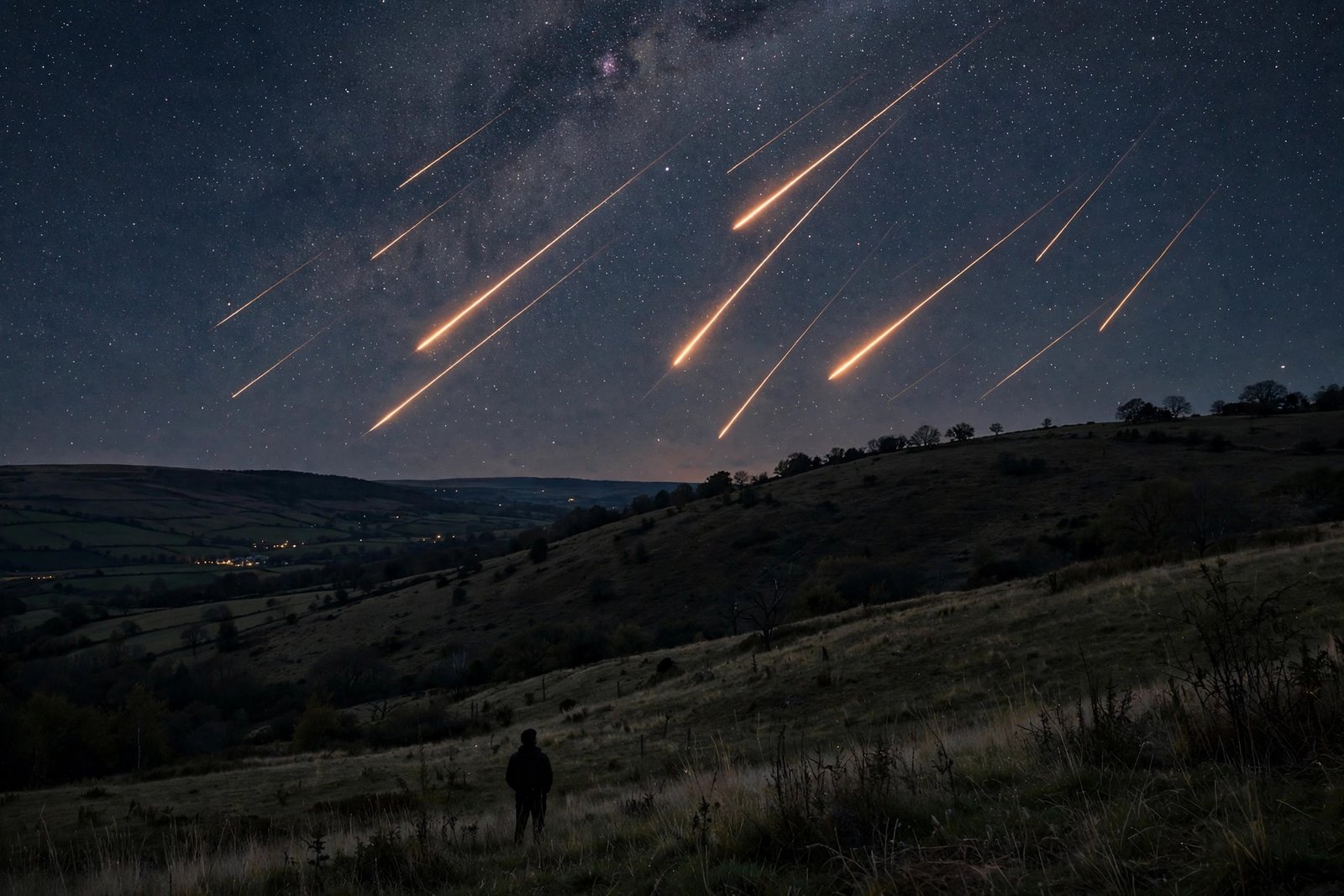
Every November, Earth ploughs through a trail of ancient comet dust, and the night sky answers with streaks of light. The Leonid meteor shower November 2026 is almost here, and this year the timing is kind to skywatchers: the Moon gets out of the way just when the show is at its best. If you have ever wanted to see a shooting star, this is one of the easiest chances of the year, and you do not need a telescope, an app, or any experience at all.
The Leonids are famous for two things: their blazing speed and their wild history. Their meteors slam into the atmosphere at around 71 kilometres per second, making them some of the fastest shooting stars you can see, and they have produced some of the most spectacular sky shows in recorded history. This year’s display will not be a storm, but under a dark sky it should still deliver a beautiful, steady sprinkle of bright meteors. Here is everything you need to know to catch it.
When Is the Leonid Meteor Shower November 2026?
The Leonid meteor shower November 2026 is active from early November through to the end of the month, with most sources giving an activity window of around November 6 to November 30. The peak, the night when you will see the most meteors, falls on the night of November 17 to 18, 2026.
Forecasts put the peak at around 01:00 UT on the morning of November 18, though the exact minute matters less than the general window. The best viewing time is after midnight and before dawn, when the radiant, the point in the sky the meteors appear to come from, has climbed high. From the United States, the sweet spot is roughly 4:20 a.m. local time on the peak night, when the radiant sits high in the east-south-east.
The Moon is cooperating beautifully this year. It is just past first quarter at the peak, and it sets around midnight in many locations, leaving the crucial pre-dawn hours dark. That is a big deal for meteor watching, because even a little moonlight can wash out the fainter meteors. In 2026, the darkest hours and the highest meteor rates line up nicely.
Leonid Meteor Shower November 2026: The Comet Behind It
The Leonid meteor shower November 2026 happens because Earth is passing through debris left behind by Comet 55P/Tempel-Tuttle. This comet loops around the Sun once every 33 years, and each time it passes through the inner solar system, it sheds dust and tiny rock fragments along its orbit. Think of it as a cosmic breadcrumb trail, hundreds of millions of kilometres long.
Every November, Earth crosses that trail. The dust particles, most no bigger than a grain of sand or a pea, hit our atmosphere at roughly 70 to 71 kilometres per second. That is about 250,000 kilometres per hour. At that speed, even a speck of dust burns up in a brilliant flash of light, tens of kilometres above the ground. That flash is what we call a meteor, or a shooting star.
The shower gets its name from the constellation Leo, the Lion. The meteors appear to radiate from a point inside Leo, near the distinctive backward question-mark pattern of stars known as the Sickle, which ends at the bright star Regulus. That point is called the radiant. In reality, the meteors are travelling on parallel paths, but perspective makes them look as if they fan out from one spot, just like railway tracks seem to converge in the distance.
How to Watch the Leonids: A Beginner’s Guide
Watching a meteor shower is one of the simplest pleasures in astronomy, and the Leonids are a perfect first shower. Here is how to do it right:
- Get away from city lights. Light pollution is the single biggest enemy of meteor watching. Even driving 20 or 30 minutes out of town can transform the sky. A dark rural spot, a hilltop, or a designated dark-sky park is ideal.
- Go out after midnight. The Leonid radiant rises in the late evening, but it is highest in the hours before dawn. Plan your main watch between midnight and dawn, and aim for the pre-dawn hours on November 18 for the peak.
- Give your eyes time. It takes about 20 to 30 minutes for your eyes to fully adapt to the dark. Avoid looking at your phone, and if you need light, use a red torch or your phone’s red-light mode, which disturbs night vision less.
- Lie back and look wide. A reclining chair or a blanket on the ground beats craning your neck. Do not stare directly at the radiant in Leo; meteors near it look short, while those further away leave longer trails. Face east, look about halfway up the sky, and take in as much sky as you can.
- No equipment needed. Telescopes and binoculars actually make meteor watching worse, because they narrow your view. Your naked eyes are the best tool for the job.
- Be patient and dress warm. Meteors come in bursts and lulls. Give yourself at least an hour, bring a warm blanket and a hot drink, and enjoy the quiet. November nights are cold in much of the Northern Hemisphere, so layers are essential.
- Check the weather. Clouds are the one thing that can cancel the show entirely. Check your local forecast on the afternoon of November 17 and be ready to try again on the nights before or after the peak if the peak night is cloudy.
What to Realistically Expect in 2026
Honesty matters here, because meteor showers are often overhyped online. The Leonids in 2026 are expected to produce a zenithal hourly rate of around 15 meteors per hour. That is a theoretical number, describing what a perfect observer under a perfect sky with the radiant overhead would see. From a typical dark site, you might count roughly 10 or 11 per hour on the peak night, and from a light-polluted city, far fewer.
That may sound modest, but the Leonids make up for quantity with quality. They are among the fastest meteors of any annual shower, and they are known for being bright and colourful, often leaving glowing trails that linger for a few seconds. They also produce more than their fair share of fireballs, exceptionally bright meteors that can briefly outshine the stars. A single Leonid fireball is worth a dozen faint streaks.
Importantly, no source is predicting a Leonid storm in 2026. The great storms happen roughly every 33 years, tied to the comet’s return, and the next great cycle is not due until the 2030s. What 2026 offers is a reliable, graceful annual display under unusually dark peak-night skies. Set your expectations there, and you will not be disappointed.
The History of the Great Leonid Storms
The Leonids earned their legendary reputation on two unforgettable nights. The first came on November 12 to 13, 1833, when observers across North America watched a tempest of falling stars that lasted for hours. One estimate put the peak rate at more than 100,000 meteors per hour, and another calculation suggested some 240,000 meteors fell during the nine-hour storm. People woke to what they described as the sky falling, and the event helped launch the scientific study of meteors, which until then had been widely thought of as atmospheric weather rather than cosmic debris.
The second great storm struck on November 17, 1966. Observers in the central and western United States watched rates climb from about 40 meteors per hour to an astonishing 40 per second, a rate equivalent to roughly 144,000 meteors per hour, sustained for around 20 minutes. It remains one of the greatest meteor displays ever recorded. The European Space Agency notes that the storms of 1833 and 1966 saw the sky awash with more than 100,000 shooting stars per hour.
Strong displays also returned in 1999, 2001, and 2002, with rates in the thousands per hour. The 1999 storm produced more than 3,000 meteors per hour. Scientists now understand that these outbursts happen when Earth passes through dense, freshly laid trails of comet dust, while in most years we cross older, thinner parts of the trail. That is why the Leonids alternate between quiet years and unforgettable ones.
There is a bittersweet footnote to this history. Long-range calculations suggest a close encounter with Jupiter in 2028 will disturb the comet’s debris trails, making storms of historic magnitude unlikely for many decades. That makes every Leonid season worth appreciating, even the quieter ones. The 2026 shower is part of a long, storied tradition, and watching it connects you to observers who have looked up in wonder for more than a thousand years.
November 2026 Sky Bonus: Taurids and a Supermoon
The Leonids are not the only November sky event worth your time. The Northern Taurid meteor shower peaks around November 11 to 12, producing a handful of meteors per hour but famous for slow, bright fireballs. The Southern Taurids peak earlier, around November 4 to 5. Patient watchers in early November might catch both Taurid and early Leonid meteors on the same night.
Then, on November 24, comes the full Beaver Moon, a supermoon and the first of three consecutive supermoons running through January 2027. A supermoon looks slightly larger and brighter than an ordinary full Moon because it coincides with the Moon’s closest approach to Earth. It is a lovely consolation prize if clouds spoil your Leonid peak night.
Mid-November also brings a close conjunction of Mars and Jupiter on November 15 to 16, when the two bright planets appear about 1.2 degrees apart in the pre-dawn sky. Taken together, November 2026 is one of the richest skywatching months of the year, and the Leonids sit right at its heart.
Key Takeaways
- The Leonid meteor shower peaks on the night of November 17 to 18, 2026, with the best viewing after midnight and before dawn.
- Expect around 15 meteors per hour under ideal dark skies, fewer from towns and cities, but look out for bright, fast meteors and occasional fireballs.
- The meteors are debris from Comet 55P/Tempel-Tuttle, hitting the atmosphere at about 71 kilometres per second.
- The Moon sets around midnight on the peak night, leaving dark skies for the best hours, so 2026 is a better-than-average Leonid year.
- No telescope is needed. Find a dark spot, lie back, let your eyes adapt for 20 to 30 minutes, and look toward the east.
- No storm is expected in 2026, but the Leonids’ legendary storms of 1833 and 1966 remain the greatest meteor displays ever recorded.
If you love mind-bending facts about time and space, read our piece on why Cleopatra lived closer to the iPhone than to the pyramids, and our story of the mysterious Wow! signal from deep space. For another jaw-dropping natural wonder, see the loudest sound in recorded history, heard 3,000 miles away.
So set an alarm, grab a blanket, and step outside on the night of November 17. The Leonid meteor shower November 2026 will not demand anything from you except patience and a dark sky, and in return it offers one of the oldest spectacles in human history: dust from a comet, burning up in a flash of light, just for you.
Sources and Further Reading
Want to dig deeper? These sources cover the facts behind this story:
- NASA Science: What’s Up — November 2026 Skywatching Tips
- Parade: 3 Meteor Showers Will Light Up the Sky in November
Frequently Asked Questions
When does the Leonid meteor shower peak in November 2026?
The Leonids peak on the night of November 17 to 18, 2026. The best viewing window is after midnight and before dawn, when the radiant in Leo is high in the sky and the Moon has already set.
How many meteors can I expect to see?
Under ideal dark skies, the Leonids are forecast to produce around 15 meteors per hour at peak. From a dark rural site you might see roughly 10 or 11 per hour, while city observers will see fewer. The meteors are fast and often bright, with occasional fireballs.
Do I need a telescope to watch the Leonid meteor shower?
No. Meteor showers are best watched with the naked eye, because telescopes and binoculars narrow your field of view too much. Find a dark location, lie back, and let your eyes adapt to the dark for 20 to 30 minutes.
What causes the Leonid meteor shower?
The Leonids are caused by Earth passing through debris left by Comet 55P/Tempel-Tuttle, which orbits the Sun every 33 years. The tiny dust particles burn up in the atmosphere at about 71 kilometres per second, creating the streaks of light we see.
Will there be a Leonid meteor storm in 2026?
No, no storm is expected in 2026. The legendary Leonid storms of 1833 and 1966, which produced more than 100,000 meteors per hour, happen roughly every 33 years when Earth crosses dense, fresh comet trails. The 2026 display will be a normal annual shower, still well worth watching.