
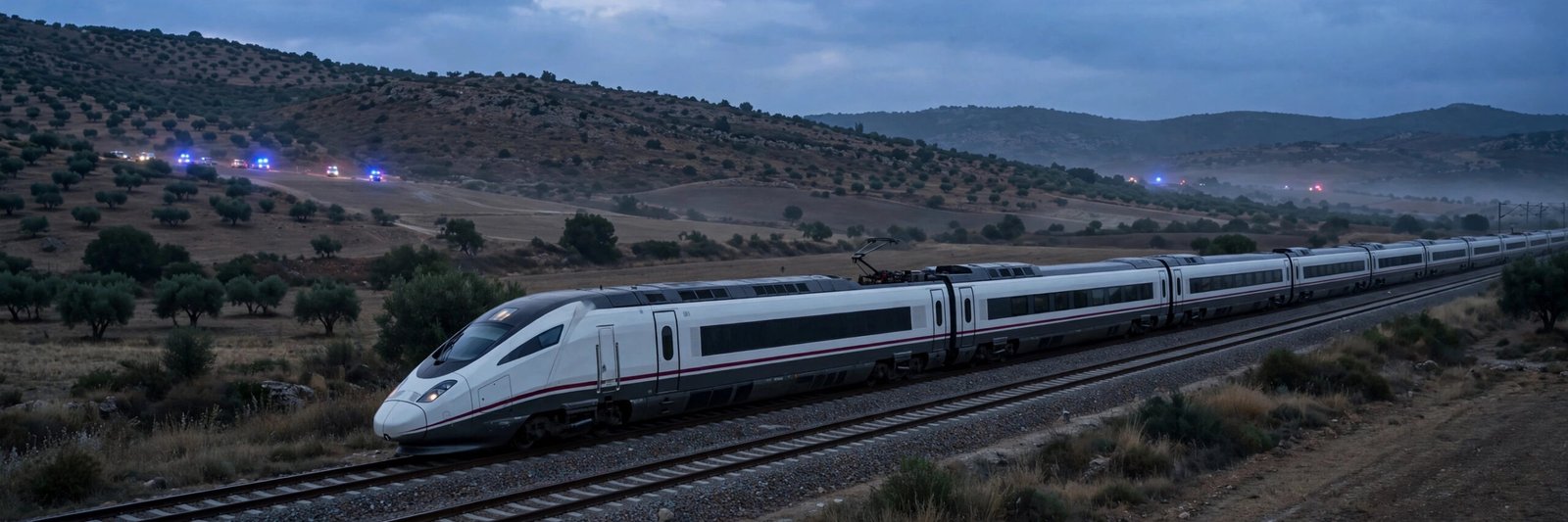
On an ordinary Wednesday morning, two high-speed trains carrying hundreds of passengers were gliding south from Madrid toward Seville. Within minutes, that routine journey turned into one of the deadliest rail disasters in modern Spanish history. The Spain train crash near Toledo on October 28, 2026, killed at least 68 people and left dozens more injured, and it has left an entire country asking how such a thing could happen on one of the world’s most modern rail networks.
As Spain enters three days of national mourning, officials are urging patience. The death toll remains provisional, the injured are still being treated, and investigators are still piecing together the chain of events. Here is what has been confirmed so far, what officials have said, and what is still unknown.
What Happened in the Spain Train Crash?
According to reports from major news outlets, the Spain train crash took place on the morning of Wednesday, October 28, 2026, in the province of Toledo, about 120 kilometres south of Madrid. The collision happened on the busy Madrid-Seville high-speed line, near the towns of Urda and Los Yébenes, between Mora and Orgaz.
Two trains were involved, both heading in the same direction toward Seville:
- An Iryo train, operated by the private company Iryo, which had stopped on the tracks after a signalling system failure.
- A Renfe AVE train, operated by Spain’s state-owned rail company Renfe, which struck the rear of the stationary Iryo train.
Reports indicate the Iryo train departed Madrid’s Atocha station in the morning carrying around 147 people, followed minutes later by the Renfe AVE train carrying roughly 397 passengers. Together, the two trains were carrying more than 500 people. The collision happened at around 8:53 or 8:54 a.m. local time, and the force of the impact derailed carriages from both trains. Two carriages reportedly tumbled down an embankment beside the tracks.
Emergency services rushed to the scene, and rescue workers spent the day searching the wreckage for survivors and victims. Aerial images showed derailed carriages, twisted metal, and large numbers of first responders working across the site.
The Victims and the Rescue Effort
Regional authorities in Castilla-La Mancha confirmed that at least 68 people were killed in the crash, a figure that was revised upward during the day as rescue teams reached more of the wreckage. Officials have described the toll as provisional, meaning it could still change as recovery work continues.
Dozens more were injured. Different outlets reported varying figures as the situation developed, with more than 100 people reported injured in total and dozens taken to hospitals. Some of the injured were reported to be in serious or critical condition. Local services were stretched so quickly that emergency teams reportedly asked the town of Urda to prepare a sports hall to receive the injured.
One British tourist who was rescued from the Renfe train described the shock of the impact to the Associated Press, a reminder that the passengers came from many countries and walks of life. At this stage, authorities have not released a full list of victims, and this article will not speculate about individual passengers. The focus, rightly, remains on rescue, medical care, and support for families.
Three Days of National Mourning
Spanish Prime Minister Pedro Sánchez visited the scene and announced three days of national mourning, to be observed on October 29, 30, and 31. Speaking from an emergency command post near the crash site, he said that all of Spain was in mourning.
“We will get to the bottom of this,” Sánchez said, pledging that any negligence would be uncovered and any failures in safety systems addressed decisively. He stressed that the immediate priorities were rescuing survivors, assisting the families of victims, and providing medical and psychological support to those affected.
The tragedy brought much of Spain’s public life to a pause. Political parties suspended campaigning ahead of a general election scheduled for late November, and the football federation postponed Copa del Rey matches scheduled for the day. It was a rare moment of national unity in the middle of an election campaign, with opposition leaders also offering support to the victims and the emergency teams.
Spain Train Crash: What Is Still Unknown
Perhaps the most important thing to understand about the crash right now is how much is still under investigation. Officials have described a sequence of events, but the formal cause has not been established.
Here is what has been reported about the sequence leading up to the crash:
- Spanish Transport Minister Óscar Puente said a malfunction in the LZB safety system, which controls train speed and traffic, triggered the automatic stoppage of several trains over a stretch of track near Urda.
- Traffic management was then transferred to the rail infrastructure manager ADIF’s control centre at Madrid’s Atocha station.
- Questions have been raised about decisions made during that period, including the decision to authorise a train to resume movement while another remained stationary ahead.
However, the exact cause of the accident remains under formal investigation, and it would be wrong to treat early descriptions as final conclusions. A judicial and technical investigation is under way, and officials have said that if negligence or safety-system failures are found, they will be addressed with the utmost severity.
Other questions also remain open: the final death toll, the full condition of the injured, and exactly how the safety systems behaved in the minutes before impact. Responsible reporting means waiting for investigators rather than filling those gaps with guesses.
A Second Disaster in One Year
The Spain train crash is the second deadly high-speed rail collision in Spain in 2026. Just nine months earlier, in January 2026, a crash at Adamuz in Andalusia killed 46 people and injured more than 150. That accident also involved trains operated by the same two companies, Renfe and Iryo, on the same Madrid-Seville line.
Sánchez addressed the connection directly, saying it was unacceptable for a country like Spain to suffer two high-speed rail accidents in the same year. He also noted that early indications suggested the causes of the two accidents were completely unrelated, while cautioning that such a judgment was for investigators to make, not politicians.
Spain’s high-speed rail network, known as AVE, has long been a source of national pride and is one of the largest in the world. That is part of why this disaster has shaken public confidence so deeply. Sánchez pledged that the government would take all necessary measures to restore confidence in the system and reinforce passenger safety.
History shows that moments of national tragedy often become turning points. Readers interested in how single days can reshape a nation’s story may also find our look at Black Saturday and the Cuban Missile Crisis of 1962 compelling, and our piece on the 140th anniversary of the Statue of Liberty shows how symbols of hope endure through difficult times.
What Happens Next
In the days ahead, several things will happen in parallel:
- Rescue and recovery teams will continue working through the wreckage until every carriage has been fully searched.
- Hospitals will continue treating the injured, and authorities will update casualty figures as they are confirmed.
- Investigators will examine the trains, the signalling system, and the decisions made in control centres before and during the incident.
- High-speed services between Madrid and Andalusia face major disruption, with more than 100 services reported affected.
- The government will face pressure to explain what went wrong and what will change.
For the families of victims, none of this will undo what happened. National mourning is a gesture of solidarity, but the real test will be whether the investigation delivers honest answers and genuine safety improvements.
Key Takeaways
- At least 68 people were killed and dozens more injured when a Renfe high-speed train struck a stationary Iryo train near Toledo on October 28, 2026.
- Spain has declared three days of national mourning, observed October 29 to 31.
- A signalling system failure stopped several trains before the collision, but the formal cause is still under investigation.
- It is Spain’s second deadly high-speed rail crash of 2026, after the Adamuz disaster in January killed 46 people.
- Officials have promised a thorough investigation and stronger safety measures to restore public confidence.
This crash is a tragedy first and a news story second. Behind every number is a person who boarded a train expecting an ordinary journey. As investigators do their work and Spain mourns, the most respectful thing the rest of us can do is pay attention, wait for facts, and remember the victims rather than rushing to blame. BolanPost will update this story as confirmed information becomes available.
Sources and further reading: Le Monde, China Daily (Xinhua), Associated Press via WESA News, and The Guardian via World Right Now.
When did the Spain train crash happen?
The crash happened on the morning of Wednesday, October 28, 2026, at around 8:53 a.m. local time, in Toledo province, about 120 kilometres south of Madrid.
How many people died in the crash?
Regional authorities confirmed at least 68 people were killed, with the toll described as provisional as rescue and recovery work continued. Dozens more were injured, some seriously.
What caused the crash?
The formal cause is still under investigation. Officials reported that a signalling system failure stopped several trains on the line before a Renfe train struck a stationary Iryo train, but investigators have not yet established the full cause.
Where exactly did the crash happen?
The crash happened on the Madrid-Seville high-speed line near Urda and Los Yébenes in Toledo province, in central Spain, between the towns of Mora and Orgaz.
Why did Spain declare three days of national mourning?
Prime Minister Pedro Sánchez declared three days of national mourning, October 29 to 31, 2026, to honour the victims of the crash and to mark a period of national grief and solidarity with their families.