
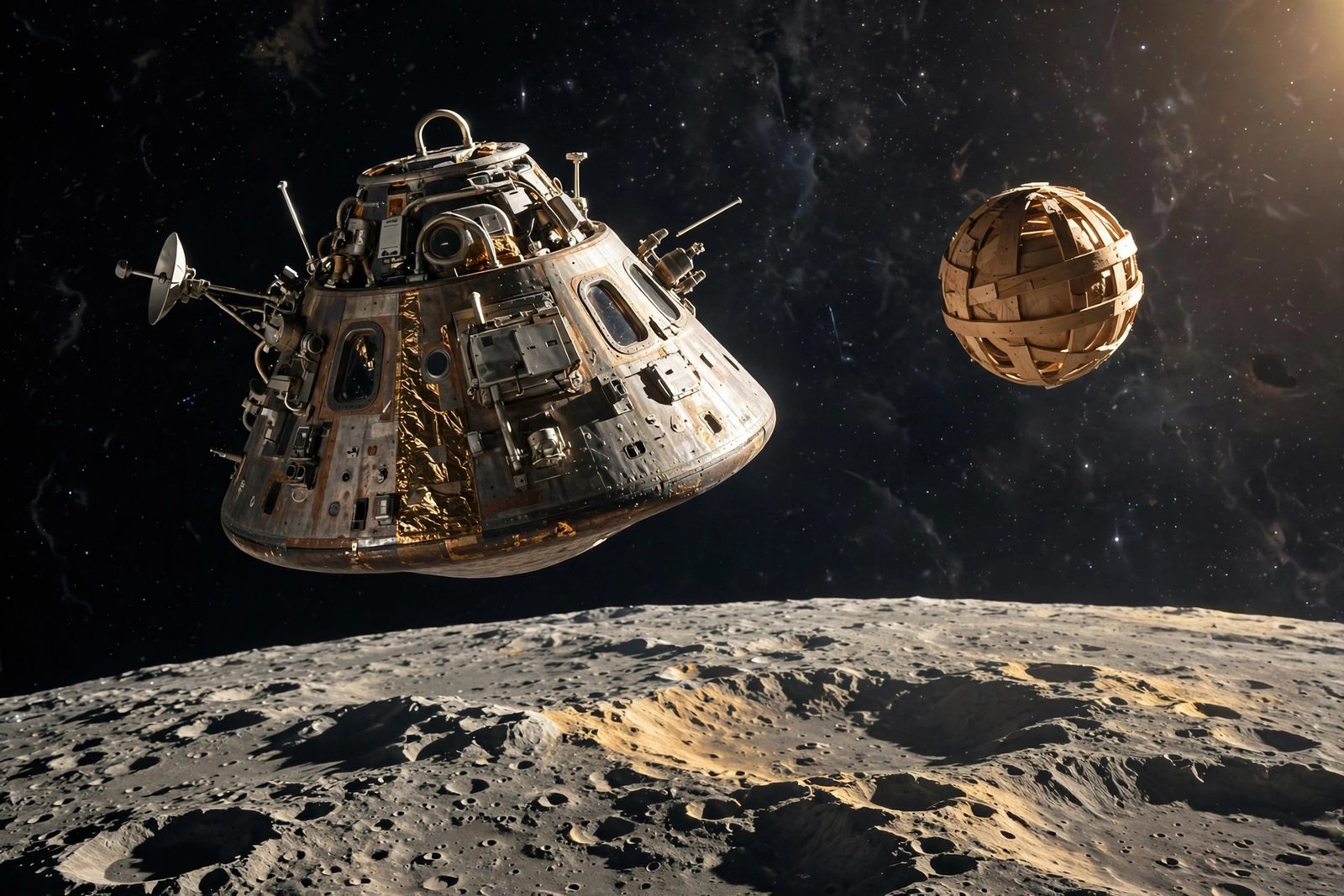
In the early 1960s, the race to the Moon was still new, risky, and full of strange ideas. Engineers knew how to launch rockets, but landing anything gently on the Moon was another problem entirely. The NASA wooden Moon capsules were one of the boldest answers to that problem. Inside each 65-centimetre balsa-wood sphere sat a seismometer capsule, a small scientific instrument designed to survive a hard crash onto the lunar surface and then report back on moonquakes. It sounds like something from a science-fiction story, but it was real hardware, built for real missions in 1962.
The capsules flew on Ranger 3 and Ranger 5, two early NASA missions that were supposed to reach the Moon. Both spacecraft missed their target and ended up in orbit around the Sun instead. The wooden spheres never got their chance to bounce across the lunar surface. Yet the story of why engineers chose wood, how the spheres were supposed to work, and what the missions taught NASA is one of the most curious chapters of the early space race. It shows how much trial, error, and imagination went into getting to the Moon.
The Space Race Problem Nobody Could Solve Easily
By 1962, the United States and the Soviet Union were competing fiercely in space. Satellites had already orbited Earth, and both nations were aiming farther. The Moon was the obvious next goal, but it presented a serious engineering puzzle. The Moon has almost no atmosphere, which means parachutes, the usual way to slow a falling object, would be useless there. A spacecraft heading for the surface would either need rockets to slow it down at exactly the right moment, or it would need to survive a very hard impact.
Rocket braking sounds simple today, but in the early 1960s it was extremely difficult. Computers were bulky and slow, sensors were crude, and no one had ever landed anything on another world. Engineers had to plan for the possibility that a landing system might fail, and they needed a backup way to get at least some science back from the surface. That is where the idea of a rugged, impact-proof capsule came in. If a small instrument package could survive hitting the Moon at high speed, it could still do useful work after the crash.
The Ranger program was NASA’s early attempt to explore the Moon with robotic spacecraft. Its missions were designed to fly to the Moon, take photographs as they approached, and in some designs, deliver instruments to the surface. The program went through many setbacks, as early spaceflight often did. Rockets failed, guidance systems missed, and spacecraft went silent. Each failure, however, taught engineers something they used on the next try. The wooden spheres were part of that learning process.
What Were the NASA Wooden Moon Capsules For?
The NASA wooden Moon capsules were built around a single scientific job: measuring moonquakes. A seismometer is an instrument that detects vibrations in the ground, the same kind of tool used to study earthquakes on Earth. On the Moon, a seismometer could reveal whether the Moon was geologically active, how its interior was structured, and what happened when meteorites struck its surface. For scientists in 1962, those were wide-open questions. Almost nothing was known about the inside of the Moon.
The plan was daring in its simplicity. Instead of trying to land the seismometer softly, engineers would let it crash. The capsule carrying it would hit the lunar surface at high speed, bounce or roll, and then settle. If the instrument inside survived, it could begin sending data back to Earth. The idea traded elegance for toughness. Rather than building a complex landing system, the team built a package that could take a beating.
This approach also solved a weight problem. Every kilogram sent to the Moon cost fuel, engineering effort, and risk. A small, self-contained capsule was lighter and simpler than a full lander with legs, rockets, and guidance systems. The NASA wooden Moon capsules were therefore an experiment in doing more with less, a theme that would return again and again in space exploration. They asked a simple question: how little spacecraft do you need to learn something new about another world?
Why Wood? Inside the NASA Wooden Moon Capsules
Wood may sound like the last material you would choose for spaceflight, but balsa wood has unusual properties that made it attractive for this job. Balsa is extremely light for its strength, and it can crush and absorb energy when it hits something hard. Think of it as a natural crumple zone. A sphere made of balsa could deform on impact, soaking up some of the force before it reached the delicate instrument inside. A solid metal shell, by contrast, might be heavier and could transmit more of the shock straight through.
The spherical shape mattered just as much as the material. A ball has no corners to catch or break, and it can bounce and roll in any direction after landing. Engineers designed the 65-centimetre sphere so that, after impact, it could tumble across the surface and come to rest in a workable position. Inside the wood, the seismometer capsule was protected and cushioned, ready to operate once the wild ride was over. The whole package was a clever combination of simple physics and practical engineering.
There was also a practical reason to like wood: it was easy to shape, test, and adjust. In an era when space hardware was often built by hand and tested by dropping, smashing, and shaking prototypes, a wooden sphere could be rebuilt and refined quickly. Engineers could test impact after impact, learning how the sphere behaved, without waiting for expensive metal parts. Wood was not a joke or a shortcut. It was a deliberate engineering choice, based on how materials behave when they hit something very hard.
Ranger 3 and Ranger 5: Two Missions That Missed
Ranger 3 and Ranger 5 both carried these wooden-sphere capsules in 1962, and both missions ended in disappointment for their lunar goals. Each spacecraft missed the Moon and instead entered orbit around the Sun, where it drifted away into the solar system. The capsules never touched lunar soil, never bounced across a crater, and never sent back a single moonquake reading. For the engineers who had built them, it must have been a frustrating result after so much careful work.
Missing the Moon in 1962 was not unusual. Navigation to another world required aiming at a moving target hundreds of thousands of kilometres away, using rockets and guidance systems that were still being perfected. A small error early in the flight could grow into a large miss by arrival time. Spacecraft also had to survive launch vibrations, the vacuum of space, and long periods without repair. When something went wrong, there was no way to send a mechanic. The mission simply continued on whatever path physics gave it.
Even so, the Ranger missions were not wasted effort. They gave NASA experience in tracking spacecraft far from Earth, operating instruments in deep space, and diagnosing failures from millions of kilometres away. They also kept public and scientific attention on the Moon at a time when the larger goal of sending astronauts there was still taking shape. The wooden spheres themselves became a symbol of that era: inventive, brave, and willing to try an idea that looked odd on paper but made sense in physics.
What Happened Next in Moon Exploration
The story did not end with the missed Ranger missions. NASA kept refining its approach to the Moon, and later missions succeeded where the early ones had failed. Spacecraft eventually photographed the lunar surface up close, landed instruments softly, and finally carried astronauts to walk on the Moon. Seismometers did eventually reach the lunar surface as part of later missions, and they revealed a great deal about moonquakes and the Moon’s interior. The early wooden-sphere idea, while never tested on the Moon itself, pointed toward that future.
Later engineers took a different path to soft landings, using rockets, airbags, and other systems that would have been hard to build reliably in 1962. The airbag landing systems used on later Mars missions, for example, share a family resemblance with the balsa-sphere idea: protect the payload by letting the outside absorb the impact. The principle survived even though the wooden spheres themselves did not fly to success. Good ideas in engineering often work that way, reappearing in new forms when materials and technology catch up.
Today, the Ranger capsules are remembered by space-history enthusiasts as a reminder of how experimental the early space race really was. Museums and archives preserve models, photographs, and records from the program, and writers still retell the story of the wooden Moon capsules because it captures the imagination. It is hard to forget the image of a wooden ball, built to crash onto the Moon, drifting instead through sunlight on its way around the Sun.
Takeaways From a Strange Space Experiment
The most important lesson of this story is not about wood. It is about problem-solving under pressure. Faced with a Moon that had no air for parachutes and no proven way to land softly, engineers asked what could survive a crash instead. They chose a light, crushable material, a shape that could bounce, and an instrument small enough to ride inside. That kind of thinking, starting from the constraints rather than the ideal solution, is still how space engineers work today.
The NASA wooden Moon capsules also show how failure and progress lived side by side in the early space program. Ranger 3 and Ranger 5 missed the Moon, and their capsules never did their job. Yet the missions still pushed navigation, tracking, and spacecraft design forward. Without those hard lessons, the later successes would have taken longer, and possibly cost more. In spaceflight, a mission that misses its target can still move the whole program closer to its goal.
The next time you hear about a modern Moon mission, think back to 1962 and those two wooden spheres. They never landed, never bounced, and never reported a moonquake, but they represent a moment when reaching the Moon meant inventing everything from scratch, including the idea that the best landing gear might be made of wood. That is why the NASA wooden Moon capsules still capture imaginations more than sixty years later. If you enjoy strange true stories from science and history, you may also like the interstellar comet 3I/ATLAS, the facts behind the Bermuda Triangle, and the unsolved Voynich Manuscript mystery. For background reading, see NASA and the Britannica reference pages on early space exploration.
Frequently Asked Questions
What were the wooden Moon capsules carried by Ranger 3 and Ranger 5?
They were seismometer capsules placed inside 65-centimetre balsa-wood spheres, designed to survive a hard impact on the Moon and then study moonquakes.
Why did NASA use balsa wood for the spheres?
Balsa wood is very light for its strength and can crush on impact, absorbing energy before it reaches the instrument inside, much like a natural crumple zone.
Did Ranger 3 and Ranger 5 reach the Moon?
No. Both spacecraft missed the Moon in 1962 and entered orbit around the Sun instead, so their wooden spheres never landed on the lunar surface.
What is a seismometer?
A seismometer is an instrument that detects vibrations in the ground. On the Moon, it could reveal moonquakes, meteorite impacts, and clues about the lunar interior.
Why could the capsules not use parachutes on the Moon?
The Moon has almost no atmosphere, so parachutes would not slow a falling object. Engineers therefore designed the capsules to survive a hard impact instead of a soft landing.