
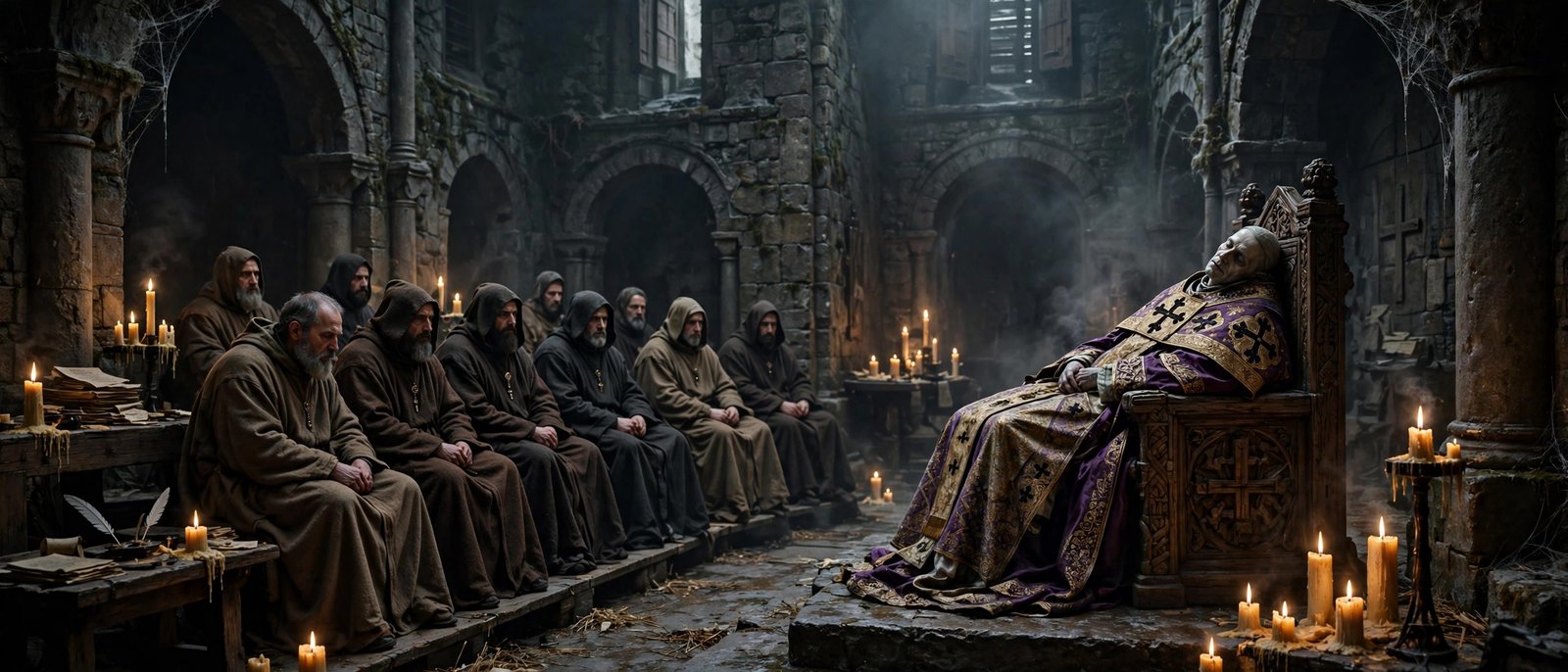
Imagine being found guilty in a court of law months after your death. Imagine your body dug out of its grave, dressed up, seated on a throne, and forced to stand trial while a furious prosecutor screams accusations at your silent corpse. It sounds like the plot of a horror movie. But the Cadaver Synod really happened — and it might be the strangest chapter in the entire history of the Catholic Church.
In January of the year 897, Pope Stephen VI ordered the nine-month-old corpse of his predecessor, Pope Formosus, exhumed and put on trial in Rome. The dead man was propped up before a synod of bishops, accused of crimes, found guilty, mutilated, and thrown into the River Tiber. The story is so bizarre that many people assume it must be a legend. It is not. This corpse trial is one of the best-documented scandals of the medieval papacy, recorded by contemporary chroniclers and studied by historians for over a thousand years.
So how did the Church reach a point where a pope put a dead man on trial? To understand how it happened, we have to go back to one of the most chaotic eras in European history — a time when the papacy was less a spiritual office than a political prize fought over by warlords.
Rome in the 890s: A Papacy Up for Grabs
The late ninth century was not a good time to be pope. The once-mighty Carolingian Empire — the empire built by Charlemagne — was falling apart. Local dukes, counts, and powerful Roman families were fighting over the ruins, and whoever controlled Rome controlled the pope. In the decades before that January day in 897, the papacy had become a revolving door: popes were elected, deposed, and sometimes murdered in quick succession, each one backed by a different faction.
Two rival camps dominated the struggle. On one side stood the Spoleto faction, a powerful family of dukes from central Italy led by Guy of Spoleto and his son Lambert. The Spoletans wanted the papacy as their own political instrument, and they had managed to get Guy crowned Holy Roman Emperor by Pope Stephen V. On the other side were those who looked outside Italy for protection — including Pope Formosus, who believed the German king Arnulf of Carinthia was a better bet.
Formosus himself had a dramatic history long before his corpse was exhumed. As bishop of Porto, he had been excommunicated by Pope John VIII in 876 for allegedly plotting against the pope and deserting his diocese. But he was later restored, and in 891 he was elected pope. His pontificate lasted five years, ending with his death on April 4, 896. On paper, it was a fairly ordinary reign. In death, however, Formosus was about to become the most famous corpse in Church history.
Why the Cadaver Synod Happened: Revenge Dressed as Justice
The Cadaver Synod did not come out of nowhere. It was the product of a bitter political vendetta. Formosus, as pope, had committed what the Spoleto faction considered an unforgivable betrayal: he had invited Arnulf of Carinthia into Italy and crowned him Holy Roman Emperor in 896, directly challenging the Spoletan claim to the imperial title held by Lambert. To the Spoletans, Formosus was a traitor who had to be destroyed — even in death.
After Formosus died in April 896, his immediate successor Boniface VI lasted only about two weeks on the throne. Then came Stephen VI, a pope sponsored by the Spoleto faction and deeply hostile to Formosus’s memory. According to the historian Liutprand of Cremona, one of the key sources for this period, Stephen was driven by a combination of personal hatred and political pressure from the Spoletans, who had regained power in Rome at the start of 897.
The charges Stephen VI brought against the dead man were a revival of old accusations mixed with new ones: perjury, coveting the papacy, and — most significantly — violating canon law by transferring from one bishopric to another. Church law at the time forbade a bishop from moving from one diocese to another, and Formosus had gone from bishop of Porto to bishop of Rome. Stephen’s argument was that Formosus had never been a legitimate pope at all — and if his papacy was invalid, then every ordination, appointment, and consecration he had performed was void too. That last point was the real weapon: it threatened the careers of dozens of bishops and priests ordained by Formosus, giving the Cadaver Synod enormous political stakes.
The Cadaver Synod Trial: A Courtroom Like No Other
In January 897, the scene that unfolded inside the Basilica of St. John Lateran in Rome was unlike anything before or since. Workmen exhumed the body of Pope Formosus, dead for roughly nine months, from its tomb. The decomposing corpse was dressed in full papal vestments — the white robes, the pallium, the symbols of the papacy — and propped upright on a throne before the assembled clergy.
Stephen VI personally presided, acting as prosecutor, judge, and jury. A young deacon was assigned to sit beside the corpse and speak on its behalf, offering a defense for a defendant who could not answer. According to later accounts, Stephen hurled questions and insults at the silent body. The historian George Ives later wrote of the scene that the old man’s body, supported by attendants, might nod and bend like a monstrous doll, but it made no sound.
Medieval chroniclers added a dramatic flourish to the story: in the middle of the proceedings, an earthquake shook the basilica. Later commentators read it as a sign of divine displeasure. Whether it happened exactly as described or was embellished by writers hostile to Stephen, the detail captures how the trial was perceived — as an act so grotesque that even the stones of the church seemed to protest.
The verdict was never in doubt. The Cadaver Synod found Formosus guilty on all charges. His papacy was declared null and void, retroactively erased from history. Every act of his five-year reign — every bishop he had ordained, every priest he had consecrated — was annulled. If you want to understand how shocking this was, consider that medieval Christians believed ordination left a permanent mark on the soul. Declaring years of ordinations invalid threw the entire clergy into spiritual chaos.
The Gruesome Sentence Handed to a Dead Man
The sentence handed down that day was designed for maximum humiliation. First, the corpse was stripped of its papal vestments and dressed in the rags of a layman — a symbolic demotion from pope to nobody. Then came the most infamous detail of the whole affair: the three fingers of Formosus’s right hand — the fingers used to give blessings — were cut off.
The body was then buried in a common grave for strangers. But Stephen was not finished. In a final act of spite, the corpse was dug up again and thrown into the Tiber River, the traditional Roman way of disposing of criminals and disgraced bodies. The message was unmistakable: Formosus was not a pope, not a priest, not even worthy of a grave. He was refuse.
Or so Stephen thought. But bodies thrown into rivers have a way of washing ashore — literally, in this case. According to tradition, Formosus’s body was recovered from the Tiber by a monk and hidden. The indignity of the corpse trial was about to backfire spectacularly on the man who had staged it.
The Backlash: How the Trial Destroyed Stephen VI
The Romans did not take kindly to the spectacle. The spectacle provoked outrage across the city — not just among Formosus’s supporters, but among ordinary clergy and citizens who saw the trial as a sacrilege. Digging up a pope and mutilating his corpse crossed a line that even the brutal politics of ninth-century Rome could not excuse.
Within months, the backlash turned into open revolt. Stephen VI was deposed, thrown into prison, and in the summer of 897 he was strangled to death in his cell. The man who had staged the trial of a corpse met his own violent end before the year was out — a downfall so swift that it reads like moral justice written by history itself.
What followed was a full reversal. Pope Theodore II, who reigned briefly in late 897, vindicated Formosus: he had the recovered body reburied with full papal honors and condemned the synod. Then Pope John IX, who ruled from 898 to 900, went further. He annulled every act of the corpse trial, reinstated the ordinations Formosus had performed, and ordered the synod’s decrees burned. The corpse trial was officially erased — declared, in effect, to have never legally happened.
For a fascinating parallel in how mass hysteria once gripped an entire city, see our story on the Dancing Plague of 1518, when hundreds of people in Strasbourg danced uncontrollably for days. And if you are drawn to history’s strangest disasters, the Great Molasses Flood of 1919 — when a wave of sticky syrup tore through Boston — is another true tale that sounds like fiction.
What This Medieval Scandal Teaches Us About Power
More than eleven centuries later, historians still argue about the episode. Was Stephen VI a fanatic acting on personal hatred? A puppet of the Spoleto faction? Or a calculating politician who believed that invalidating Formosus’s ordinations would consolidate his own power? The truth is probably a mix of all three — and that is what makes the episode so revealing.
- Power corrupts the symbols it claims to protect. Stephen VI staged the trial to defend the Church’s authority, but the spectacle did more damage to the papacy’s reputation than anything Formosus had ever done.
- Revenge has a short shelf life. The Spoleto faction got its vengeance against Formosus, but within months their pope was dead and every act of the synod was reversed.
- History remembers the spectacle, not the politics. Nobody today cares about the ninth-century dispute over transferring bishoprics. Everyone remembers the image of a dead pope on trial — which is why it still fascinates us.
- Institutions can survive their worst moments. The medieval papacy endured the scandal, reversed it, and carried on — a reminder that even the most grotesque institutional failures are not always fatal.
There is one more twist worth noting. This was not the only time a dead ruler faced judgment in history — posthumous trials were rare but not unheard of in the ancient and medieval world. But no other case combined the sheer theatricality of this one: the throne, the vestments, the defense deacon, the severed blessing fingers, the Tiber. It remains, by general agreement among historians, the most macabre episode in the history of the papacy.
Conclusion: The Trial That Condemned Its Judge
The Cadaver Synod of 897 set out to destroy the reputation of a dead man. Instead, it destroyed the living man who staged it. Pope Formosus was rehabilitated, reburied with honor, and restored to the official list of popes. Pope Stephen VI was strangled in a prison cell within months, remembered forever as the pope who put a corpse on trial.
There is a lesson in that reversal that goes beyond medieval church politics. The desperate need to rewrite the past — to dig up old enemies and punish them retroactively — almost always says more about the punisher than the punished. Stephen VI wanted history to remember Formosus as a usurper and a criminal. History had other ideas. Today, Formosus is remembered as the victim of one of history’s strangest injustices, and Stephen VI is remembered as its villain.
The next time you hear someone say that truth is stranger than fiction, think of a January day in 897, in the Lateran Basilica in Rome — where a pope screamed accusations at a silent, rotting corpse, and an entire city watched in horror. It really happened. And eleven hundred years later, we are still talking about it.
FAQs
What was the Cadaver Synod?
Why did Pope Stephen VI put a corpse on trial?
What happened to Pope Formosus’s body after the Cadaver Synod?
What happened to Pope Stephen VI after the Cadaver Synod?
Is the Cadaver Synod historically documented or a legend?
References: Cadaver Synod – Wikipedia; Cadaver Synod – Britannica; JSTOR Daily – The Cadaver Synod: Putting a Dead Pope on Trial; Pope Stephen VI – Wikipedia; Medieval Archives – Stephen VI: The Pope Who Put a Corpse on Trial.