
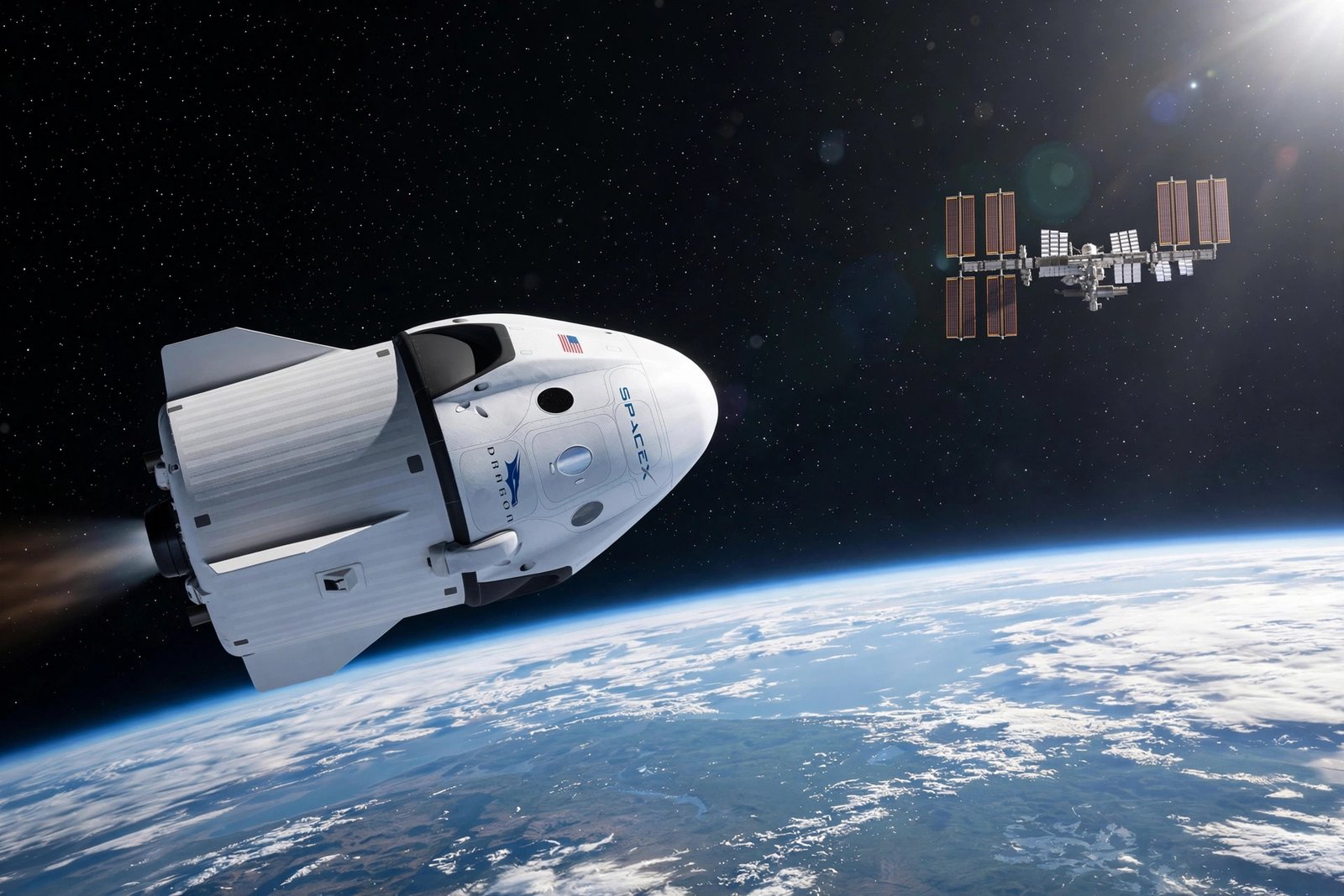
On October 15, 2026, a spacecraft gently docked with the International Space Station carrying some of the strangest — and most promising — cargo ever sent to orbit: miniature models of the human brain, lab-grown heart tissue, the makings of an artificial retina, a mysterious new kind of glass, and the final pieces of a giant solar power upgrade. This was not science fiction. This was the latest SpaceX Dragon ISS science delivery, and it might one day change how your doctor treats you.
According to SciTechDaily’s report, SpaceX’s Dragon capsule arrived at the station at 10:27 a.m. EDT, docking with the space-facing port of the Harmony module. The mission marks SpaceX’s 35th commercial resupply flight to the orbiting laboratory under its NASA contract — and with more than 6,300 pounds of food, equipment, and research gear aboard, it is one of the most science-packed deliveries in the station’s history.
So what exactly is flying around Earth right now in that cargo hold — and why should anyone who will never leave the ground care? Buckle up. The mission’s science manifest reads like a preview of 21st-century medicine.
SpaceX Dragon ISS Science Mission: By the Numbers
Before we dive into the miniature brains (yes, really), here are the mission facts, exactly as reported:
- Launch: October 13, 2026, at 6:33 a.m. EDT, aboard a SpaceX Falcon 9 rocket from Space Launch Complex 40 at Cape Canaveral Space Force Station in Florida.
- Docking: October 15, 2026, at 10:27 a.m. EDT, at the space-facing port of the station’s Harmony module.
- Mission number: SpaceX’s 35th commercial resupply mission to the ISS under its contract with NASA.
- Cargo: More than 6,300 pounds of food, equipment, and supplies for the Expedition 75 crew — plus the headline science experiments.
- Return plan: Dragon is expected to stay docked until mid-November, then haul time-sensitive research back to Earth, splashing down off the California coast.
Thirty-five resupply missions. Let that sink in for a moment. What began as an audacious bet — a private company ferrying cargo to a space station — has become routine orbital trucking. And this particular truck was carrying a laboratory’s worth of the future.
Tiny Brains in Orbit: The Brain Organoid Experiment
The most jaw-dropping item on Dragon’s science manifest is also the smallest: brain organoids — miniature, pea-sized models of human brain tissue grown from stem cells in a lab. They are not whole brains and they cannot think, but they do something remarkable: they mimic how real brain cells organize, connect, and respond to disease.
On Earth, these tiny brain models are already used to study neurological conditions. In orbit, researchers hope they will help identify potential treatment targets for Alzheimer’s disease, Parkinson’s disease, and multiple sclerosis — three devastating conditions that collectively touch hundreds of millions of lives.
Why send them to space at all? Here is the plain-language version: on Earth, gravity is constantly tugging cells downward, forcing scientists to grow tissues on flat scaffolds or in spinning bioreactors that only approximate the real thing. In microgravity, cells float freely and self-organize in three dimensions, much closer to how tissue actually develops in the human body. It is like the difference between pressing a flower flat in a book and watching it bloom in open air. Researchers believe organoids grown in orbit may reveal disease mechanisms — and drug responses — that flat, gravity-bound lab models simply cannot show.
Think about what that could mean: a future where a drug for Alzheimer’s is tested first on a tiny brain model that matured in weightlessness, catching failures before they ever reach a human trial. That is the kind of door this experiment is trying to open.
Printing an Artificial Retina in Zero Gravity
The second medical moonshot aboard Dragon sounds like something from a cyberpunk novel: manufacturing artificial retinas in microgravity, with the long-term goal of helping restore eyesight on Earth.
The retina — the light-sensing layer at the back of your eye — is staggeringly delicate. Building a replacement involves layering ultra-thin films of light-sensitive material with near-perfect uniformity, and gravity is the enemy: on Earth, heavier particles settle, fluids stratify, and temperature differences drive currents that warp the layers as they form.
Take gravity away, and the physics changes completely. Materials can be deposited in flawlessly even layers; structures can form without sagging or sedimentation. If researchers can prove that space-manufactured retinal implants are smoother, more uniform, and more reliable than anything made on Earth, the path opens toward implants that could one day restore vision to people with degenerative eye diseases.
It is worth pausing on the audacity of the idea: we may soon live in a world where the most delicate medical devices are not made in a factory at all, but in orbit — because orbit is the only clean room perfect enough.
A Beating Heart in 3D — and a Brand-New Kind of Glass
Dragon’s science cargo holds two more experiments that sound modest but could ripple through entire industries.
3D heart tissue models. Dragon delivered engineered heart tissue — living cardiac cells organized into three-dimensional structures — to support the development of large-scale drug testing during future space missions. Here is why that matters down here: testing a new drug on 3D heart tissue is vastly more predictive than testing it on cells smeared flat in a petri dish. A flat layer of heart cells cannot show you how a drug affects a beating, three-dimensional muscle. A 3D model can. And in microgravity, where the tissue assembles without gravity’s distortions, the models may become better still — eventually letting pharmaceutical researchers screen drugs faster, cheaper, and more safely before human trials.
A new type of glass. Another investigation will study how a novel glass formulation behaves as it forms in the weightless environment of space. Glass made on Earth is shaped by gravity at every step — molten glass sags, bubbles rise, and convection currents stir impurities through the melt. In orbit, glass can solidify in an almost perfectly uniform state. The result could be new materials with extraordinary optical or structural properties: sharper fiber optics, tougher specialty glass, or entirely new substances that cannot be manufactured anywhere on this planet.
If that sounds abstract, consider this: the glass in your phone screen, the fiber carrying this article to you, the lenses in a surgeon’s microscope — all of them began as someone’s materials experiment. The next generation might begin 250 miles up.
The Final iROSAs: Supercharging the Space Station
Not everything aboard Dragon was destined for a microscope. The cargo also included the final set of International Space Station Roll-Out Solar Arrays (iROSAs) — the last pieces of a years-long power upgrade for the aging orbital outpost.
The iROSAs are a marvel in their own right: unlike the station’s original rigid solar wings, these arrays unroll like a yoga mat — compact for launch, enormous once deployed. Astronauts are expected to install this final set later this fall, and once in place, the arrays will significantly expand the station’s ability to generate electricity from sunlight.
Why does a space station need more power? Because science is hungry. Every new experiment — the organoids, the retina manufacturing, the tissue models — draws electricity. The ISS is not winding down quietly; with this upgrade, it is gearing up for some of the most power-intensive research of its lifetime. There is a pleasing symmetry to it: the same sunlight that will soon stream through the new arrays is powering the search for cures to diseases of aging, on a station that is itself aging gracefully.
Space fans hungry for more cosmic rabbit holes will love BolanPost’s deep dive into the Wow! signal mystery and 8 space facts that sound fake but are totally real — and for a different kind of survival story, don’t miss Luna, the dog who survived 34 days in Yellowstone.
SpaceX Dragon ISS Science and the Microgravity Advantage
By now a pattern should be clear: almost everything on this mission’s science manifest is there because of microgravity. But why is weightlessness such a big deal for manufacturing and medicine? The answer comes down to three things gravity ruins on Earth:
- Sedimentation. On Earth, heavier particles sink and lighter ones rise — inside a growing tissue, a cooling glass melt, or a layering retina. In orbit, everything stays exactly where you put it.
- Convection. Warm fluids rise and cool ones sink, creating invisible currents that stir and distort whatever is forming. In microgravity, heat moves only by conduction — slow, even, predictable.
- Mechanical stress. Tissues grown on Earth must fight gravity every second, so they need scaffolds and supports that warp their natural structure. In orbit, cells can assemble the way biology intended: freely, in three dimensions.
The result is a manufacturing environment that cannot be replicated in any Earth-bound clean room, no matter how expensive. Proteins crystallize more perfectly (which is why space-grown protein crystals have repeatedly revealed drug targets invisible on Earth). Alloys mix without separating. Tissues mature without scaffolding. It is the ultimate laboratory upgrade — and the SpaceX Dragon ISS science program is steadily turning it into a pipeline for real-world products.
Skeptics reasonably ask whether it is worth the cost. Fair question — a Falcon 9 launch is not cheap. But consider the economics of a single breakthrough: Alzheimer’s disease alone costs the United States hundreds of billions of dollars a year in care. If orbital organoid research accelerates a disease-modifying treatment by even a few years, the return on every cargo flight dwarfs its price tag. Space manufacturing is not a luxury; it is R&D with the highest possible ceiling.
All mission facts in this article come from SciTechDaily’s coverage of the docking, published October 17, 2026.
Key Takeaways
- SpaceX’s Dragon docked with the ISS on October 15, 2026, at 10:27 a.m. EDT (Harmony module) — the company’s 35th commercial resupply mission for NASA, carrying over 6,300 pounds of cargo.
- The SpaceX Dragon ISS science manifest includes brain organoids for Alzheimer’s, Parkinson’s, and MS research; artificial retina manufacturing; 3D heart tissue for drug testing; a novel glass experiment; and the final iROSA solar arrays.
- Brain organoids grown in microgravity may reveal disease mechanisms and drug responses that flat Earth-bound models cannot — potentially accelerating treatments for devastating neurological diseases.
- Manufacturing retinas, tissues, and glass in orbit exploits microgravity’s freedom from sedimentation and convection — producing structures impossible to make on Earth.
- The final set of roll-out solar arrays, to be installed this fall, will boost the station’s power for its most science-intensive years yet.
- Dragon returns to Earth in mid-November with time-sensitive research, splashing down off the California coast.
Frequently Asked Questions
What is the SpaceX Dragon ISS science mission?
The SpaceX Dragon ISS science mission refers to Dragon’s 35th commercial resupply flight to the International Space Station, which docked on October 15, 2026. Alongside 6,300+ pounds of supplies for the Expedition 75 crew, it delivered advanced experiments including brain organoids, 3D heart tissue, artificial retina technology, a new glass experiment, and the final set of ISS Roll-Out Solar Arrays.
What are brain organoids, and why were they sent to the space station?
Brain organoids are pea-sized clusters of human brain cells grown from stem cells that mimic how real brain tissue organizes and responds to disease. They were sent to the ISS because microgravity lets cells self-organize in three dimensions without gravity’s distortions — potentially revealing treatment targets for Alzheimer’s, Parkinson’s, and multiple sclerosis that Earth-bound models miss.
How could making an artificial retina in space restore eyesight?
Building an artificial retina requires depositing ultra-thin, perfectly uniform layers of light-sensitive material — and gravity causes settling and distortion during the process. In microgravity, those layers can form flawlessly, which could lead to retinal implants smooth and reliable enough to help restore vision lost to degenerative eye diseases.
What are iROSAs, and why does the ISS need them?
iROSAs — International Space Station Roll-Out Solar Arrays — are a new generation of solar wings that unroll like a mat instead of unfolding rigidly. This mission delivered the final set, to be installed later this fall, expanding the station’s electricity generation to power its growing roster of energy-hungry science experiments.
When will Dragon return to Earth?
According to the mission plan, Dragon is expected to remain docked at the space station until mid-November 2026, then transport time-sensitive scientific research and other cargo back to Earth, concluding with a splashdown off the California coast.
Conclusion: The Pharmacy of the Future Has No Gravity
There is a quiet poetry in the image: a capsule full of miniature brains, printed retinas, and beating heart tissue, circling the Earth at 17,500 miles per hour while scientists below wait for the data that might save their patients’ minds, eyes, and hearts. The SpaceX Dragon ISS science delivery is a reminder that space exploration was never really about leaving Earth behind — it is about bringing back the tools to heal it.
Thirty-five resupply missions in, the orbital laboratory has become something its designers could barely have imagined: part power station, part factory, part hospital of the future. And somewhere above us right now, in a floating lab the size of a football field, tiny clusters of brain cells are drifting in weightlessness — doing science that no lab on Earth could do. The cures of tomorrow may literally be falling around the planet as you read this.
[…] at a time. If you are curious how modern spacecraft pull off their own orbital feats, our story on SpaceX’s Dragon missions to the ISS shows the peaceful side of the same technology — and the deformed exoplanet WASP-17b proves space […]
[…] glass on the seabed wins on capacity, latency, and cost — and it isn’t close. Just as SpaceX is quietly redefining what happens in orbit, Meta is quietly redefining what happens at the bottom of the […]