
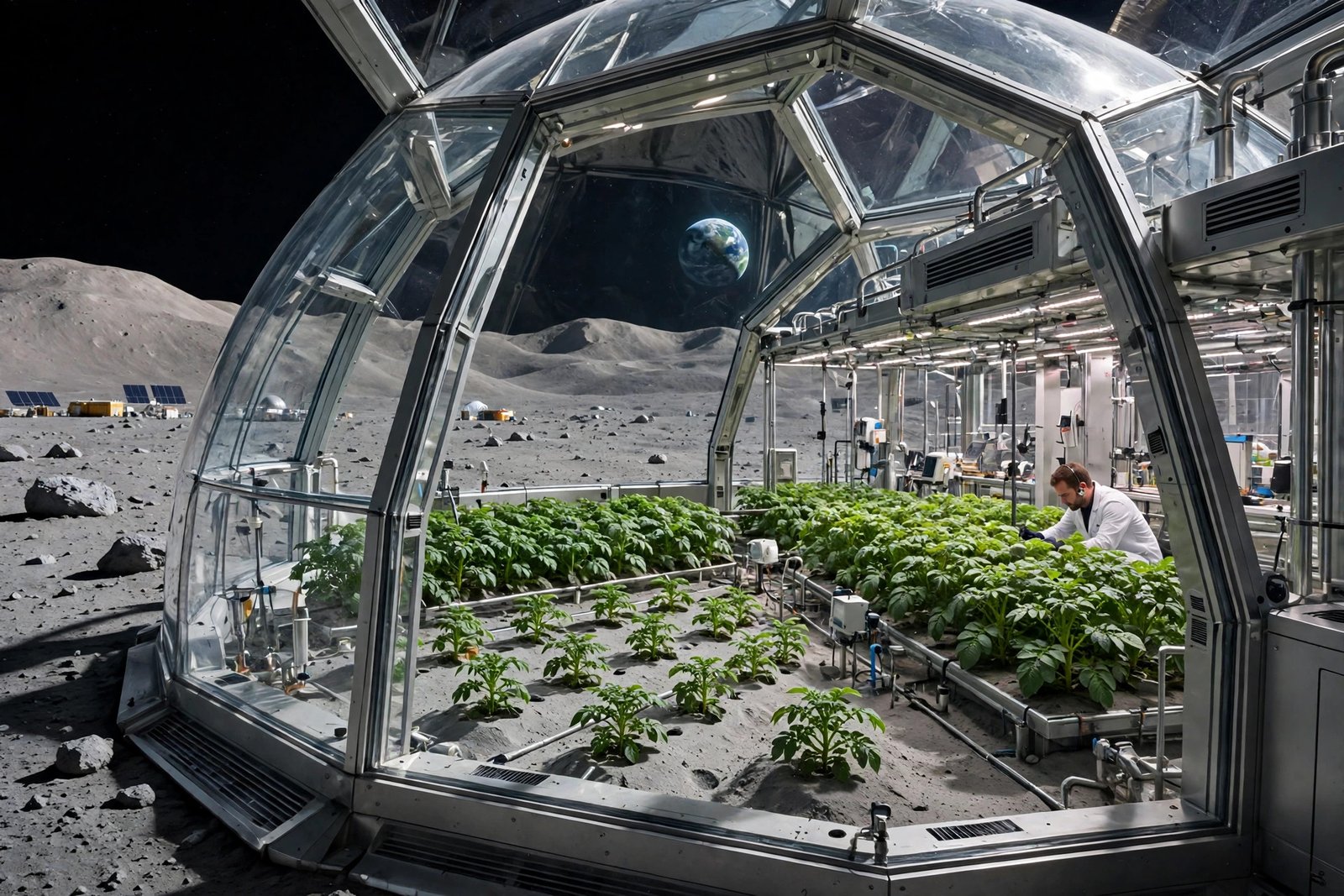
Imagine biting into a potato that grew in soil from the Moon. It sounds like science fiction, but researchers at Oregon State University have now done exactly that — they grew edible potatoes in simulated lunar soil, and the result could change how astronauts eat on future missions. Potatoes grown in moon soil are no longer a thought experiment. They are a real, edible harvest, and they point toward a future where astronauts grow their own food hundreds of thousands of miles from Earth.
The idea is simple to state and hard to achieve: if humans are going to live on the Moon, they cannot survive on food shipped from Earth forever. Every kilogram launched into space costs a fortune, and fresh food runs out fast. Growing food where astronauts live is the obvious answer — but Moon soil is nothing like the soil in a garden. The Oregon State experiment tackled that problem head on, and the potatoes came through.
Why Potatoes Grown in Moon Soil Changes Everything
Potatoes grown in moon soil matter because they solve two problems at once. First, potatoes are one of the most calorie-dense crops on the planet, packing a lot of energy into a small growing area. Second, they grow underground, which makes them naturally suited to the sheltered, controlled environments a lunar base would need.
For decades, space agencies have talked about growing food beyond Earth. The International Space Station has hosted lettuce, chillies and other small crops, but those were grown in carefully controlled systems with materials brought from Earth. Potatoes grown in moon soil take the idea a step further: the growing medium itself comes from the destination. If astronauts can use the ground beneath their feet, they need to bring far less with them.
That is the promise behind the Oregon State work. A Moon base that can grow its own potatoes is a Moon base that needs fewer supply rockets, stays supplied for longer, and gives its crew something fresh to eat. Fresh food is not a luxury on a long mission — it protects morale and health in ways that packaged rations cannot.
What Is Lunar Soil, Really?
Before we go further, it helps to understand what lunar soil actually is. Scientists call it regolith: a layer of loose, broken rock and dust that covers the Moon’s surface. It was formed over billions of years as meteorites smashed into the Moon, shattering rock into fine grains.
Lunar regolith is very different from Earth soil. Here are the key differences:
- No organic matter: Earth soil is alive with microbes, worms and decaying plants. Lunar regolith has none of that. It contains no humus and no natural nutrients from living things.
- Sharp grains: without wind or water to smooth them, lunar dust particles stay jagged and abrasive. That is hard on roots, equipment and lungs alike.
- No nitrogen: plants need nitrogen to grow, and lunar soil has essentially none in a form plants can use.
- Different chemistry: regolith is rich in minerals such as silicon, iron and aluminium, but those minerals are locked up in forms plants cannot easily absorb.
- No water: the Moon’s surface is dry, though ice has been found in permanently shadowed craters near the poles.
In short, lunar soil is not soil in the gardening sense at all. It is crushed rock. Turning it into something a potato can grow in is a genuine scientific challenge, and that is what makes the Oregon State result worth celebrating.
How Do You Grow Potatoes in Lunar Soil?
The researchers worked with a lunar regolith simulant — a material made on Earth to mimic the physical and chemical properties of real Moon dust. This is an important distinction: the experiment used simulated soil, not dust actually brought back from the Moon. Real lunar samples are rare, precious and tightly controlled, so simulants are the standard way to test ideas before any real mission.
Growing potatoes in lunar soil meant solving several problems at once. The simulant had to be made plant-friendly, which likely involved adding water, nutrients and organic material to compensate for everything the regolith lacks. The potatoes needed the right temperature, light and moisture — all of which would be controlled inside a lunar greenhouse rather than out in the open, where temperatures swing wildly and there is no atmosphere to speak of.
The details of exactly how the team treated the simulant matter less than the headline result: the potatoes grew, and they were edible. That is the proof of concept. It tells engineers and mission planners that lunar regolith is not a dead end for farming. With the right preparation, it can support one of humanity’s most important staple crops.
Why Potatoes? The Perfect Space Crop
Of all the crops scientists could have chosen, potatoes were a smart pick. There are good reasons why the humble potato keeps showing up in space farming research:
- Calories per square metre: potatoes produce more food energy per unit of growing area than most other staple crops, which matters when growing space is limited.
- Versatility: potatoes can be boiled, baked, mashed or fried, and they fit into cuisines from almost every culture on Earth.
- Nutrition: potatoes provide vitamin C, potassium, vitamin B6 and fibre — a useful package for astronauts who cannot pop out to a shop.
- Storage: potatoes keep well without refrigeration for weeks or months, which is exactly what a remote base needs.
- Familiarity: astronauts already eat potatoes in space food. Growing them fresh is a morale boost as much as a nutrition win.
There is also a cultural reason potatoes loom large in space farming. The 2015 film The Martian famously showed an astronaut growing potatoes on Mars to survive, and that story helped the public understand why space agriculture matters. The Oregon State experiment brings a version of that fiction closer to reality — on the Moon, not Mars, but with real plants and real soil science.
What the Oregon State Experiment Actually Proved
It is worth being precise about what this experiment did and did not prove. It proved that potatoes can grow in a material that mimics lunar regolith, and that the resulting potatoes are edible. That is a meaningful milestone, and it is exactly the kind of result mission planners need before they commit to growing food on the Moon.
What it did not do is prove that astronauts can scatter potato seeds on the lunar surface and harvest dinner. The experiment was small-scale and Earth-based, carried out under controlled conditions. A real lunar farm would need a pressurised greenhouse, a reliable water supply, artificial lighting or carefully managed sunlight, and systems to recycle nutrients. None of that is trivial.
Still, small-scale experiments are how big programmes begin. Every technology that now flies to space started as a lab test that looked modest at the time. Potatoes grown in moon soil have now passed that first test, and that is genuinely exciting news for anyone who follows space exploration.
The Honest Caveats
Good science reporting means saying plainly what we do not know, so here are the caveats that matter:
- Simulated soil, not real Moon dust: the experiment used a lunar regolith simulant made on Earth. Real lunar regolith may behave slightly differently, and only tests with genuine samples — or on the Moon itself — will settle that question.
- Small scale: this was a laboratory-scale experiment, not a farm. Scaling up to feed a crew is a much bigger engineering challenge.
- No published yields to quote: at the time of writing, no specific harvest figures have been widely reported, so we are not going to invent any. The story is the success of the concept, not a number.
- Water and nutrients still needed: lunar regolith alone does not feed plants. Water, fertiliser and organic matter must be supplied or recycled, and on the Moon those inputs are precious.
- Radiation and gravity: growing food on the Moon also means dealing with cosmic radiation and one-sixth of Earth’s gravity, neither of which a lab test on Earth can fully reproduce.
None of these caveats takes away from the achievement. They simply describe the road ahead, and scientists are used to long roads.
What Potatoes Grown in Moon Soil Mean for Moon Bases and Mars
The timing of this result is no accident. NASA’s Artemis programme aims to return astronauts to the Moon and establish a sustained presence there, and growing food locally is part of that vision. A lunar base that depends entirely on Earth for food is a base with a fragile supply line. A base that can grow even part of its own food is far more resilient.
Potatoes grown in moon soil also matter for Mars. A crewed Mars mission would last years, and carrying all the food for the whole trip is impractical. Astronauts travelling to Mars will need to grow food along the way or on arrival, and the Moon is the natural test bed. If lunar farming works, Martian farming — using Martian regolith, which has its own challenges — becomes a more realistic goal.
There is a broader point too. Learning to farm in hostile environments teaches us things that help back on Earth. Techniques for growing crops in poor soils, with little water and recycled nutrients, are directly relevant to dry regions and degraded farmland here at home. Space farming research has a habit of paying off on Earth in unexpected ways, and this experiment is part of that tradition.
Key Takeaways
- Researchers at Oregon State University grew edible potatoes in simulated lunar soil — a first step toward farming on the Moon.
- Lunar regolith is crushed rock with no organic matter or usable nitrogen, so it must be treated and supplemented before plants can grow in it.
- Potatoes are an ideal space crop: calorie-dense, nutritious, versatile and easy to store.
- The experiment used a simulant, not real Moon dust, and was small-scale — the concept is proven, not the farm.
- Success on the Moon would cut supply costs for lunar bases and pave the way for growing food on Mars.
Conclusion
Potatoes grown in moon soil sound like a punchline, but they are a serious milestone. A team at Oregon State University took a material that mimics the Moon’s surface, coaxed potatoes out of it, and showed that the food of the future might literally grow from the ground beneath astronauts’ boots. The experiment was small and the soil was simulated, and honest reporting means saying so — but the direction of travel is clear. The next time humans walk on the Moon, they may not just bring their dinner with them. They may grow it there. And if potatoes can grow in moon soil, the menu for the Moon just got a lot more interesting.
If you enjoyed this story, you might also like our look at why we dream, explained by science, or the amazing fact that honey never expires. For more mind-bending science, check out our viral Today I Learned facts from Reddit.
Did scientists really grow potatoes in moon soil?
Yes. Researchers at Oregon State University successfully grew edible potatoes in simulated lunar soil, known as a lunar regolith simulant, in experiments reported in November 2026.
Was it real soil from the Moon?
No. The experiment used a simulant — a material made on Earth to mimic the physical and chemical properties of real lunar regolith. Real Moon samples are rare and tightly controlled, so simulants are the standard way to test farming ideas before a mission.
Why are potatoes a good crop for space?
Potatoes are calorie-dense, nutritious, versatile in cooking, and they store well without refrigeration. They produce a lot of food energy per square metre of growing space, which matters when space is limited.
Can astronauts grow food on the Moon now?
Not yet. The experiment was small-scale and Earth-based. A real lunar farm would need a pressurised greenhouse, water, nutrients, lighting and radiation protection. The experiment proves the concept; building the farm is the next step.
Why does growing food on the Moon matter?
Shipping food from Earth is expensive and limits how long crews can stay. Growing food locally, growing food locally on the Moon would make lunar bases more self-sufficient and pave the way for long Mars missions.