
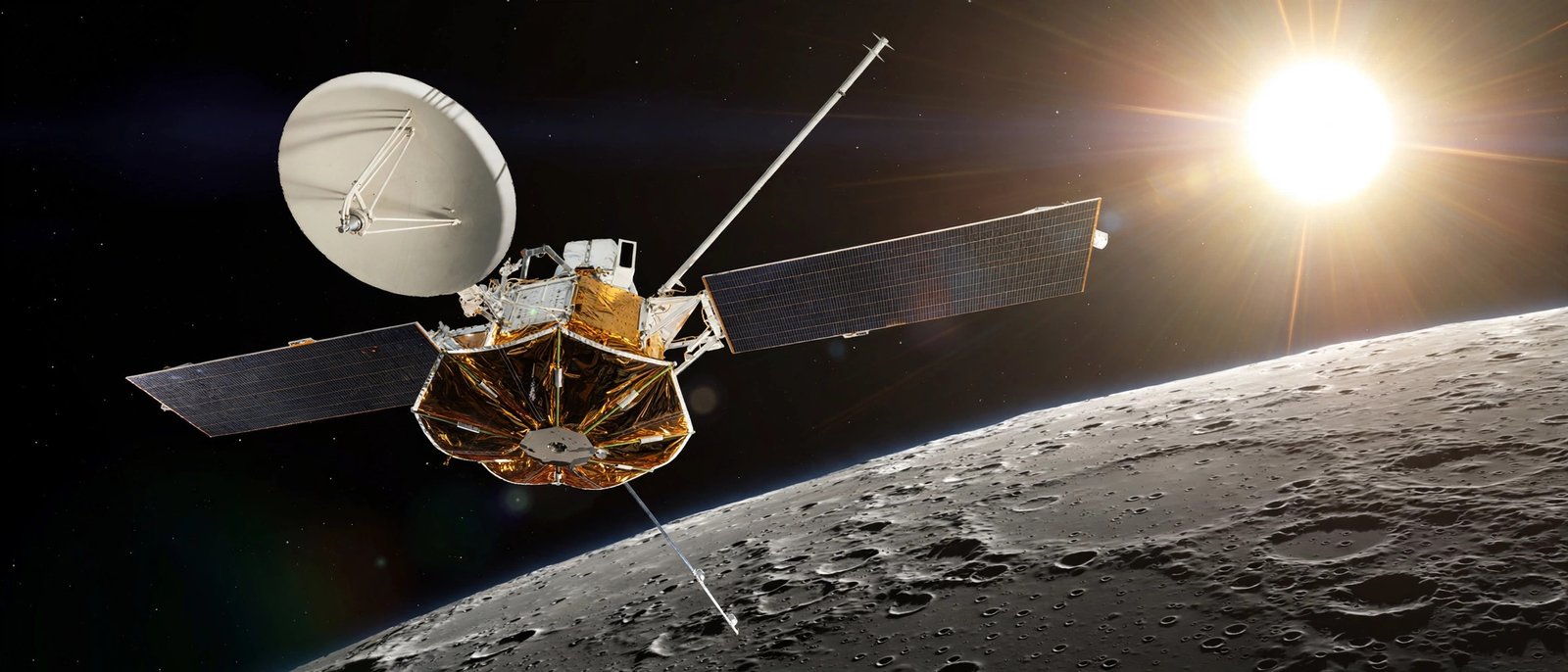
On November 21, 2026, a spacecraft that left Earth more than eight years ago finally slipped into orbit around the smallest, strangest planet in our solar system. The BepiColombo Mercury orbit mission — a joint venture between the European Space Agency (ESA) and the Japan Aerospace Exploration Agency (JAXA) — fired its thrusters high above Mercury’s scorched surface and let the little planet’s gravity catch it. In that moment, BepiColombo became only the second spacecraft in history to orbit Mercury, following NASA’s MESSENGER, which circled the planet from 2011 to 2015.
It was not a smooth arrival. The main engine burn, planned to last 37 minutes, ended earlier than expected after a software glitch upset the spacecraft’s thrusters, and BepiColombo dropped into safe mode as it passed behind the planet. For tense hours, engineers at ESA’s mission control centre in Darmstadt, Germany, waited for a signal. When contact returned, the news was good: the spacecraft was safe, stable, and firmly in orbit around Mercury. As ESA flight dynamics manager Frank Budnik announced to the control room, “We confirm Mercury orbit capture!”
The achievement closes one of the longest and most patient journeys in space exploration — and opens a new chapter in our understanding of the solar system’s most mysterious planet. Here is how BepiColombo got there, why the trip took so long, and what its two orbiters will do next.
The BepiColombo Mercury Orbit Burn That Almost Went Wrong
The big moment came at 18:24 UTC on November 21, 2026. As BepiColombo passed just 635 kilometres above Mercury’s surface, its four axial thrusters began firing as planned. The burn was supposed to last 37 minutes, slowing the spacecraft just enough for Mercury’s weak gravity to capture it. It was the first major manoeuvre since the mission’s Mercury Transfer Module — the cruise stage that had carried the two science orbiters across the inner solar system — separated from the spacecraft in early September 2026.
Then something went wrong. An issue during the thruster burn caused the manoeuvre to end earlier than expected, and the spacecraft entered safe mode, a protective state in which it shuts down non-essential systems and waits for instructions from Earth. Because the spacecraft was passing behind Mercury, mission control also faced a scheduled loss of contact. The team at the European Space Operations Centre in Darmstadt could only wait. When the signal returned, they found that BepiColombo had made it: the capture had worked, and the spacecraft was in a stable orbit. ESA later traced the problem to a software glitch involving attitude guidance and thruster control, and teams at ESOC worked around the clock with lead manufacturer Airbus and colleagues at JAXA to investigate it.
There was another first hidden inside the drama. BepiColombo entered orbit around another planet using a technique called “weak stability capture,” which uses the delicate gravitational balance between the Sun and Mercury to ease a spacecraft into orbit, rather than relying on brute-force braking alone. It was the first time the technique had been used to enter orbit around another planet, and it worked even with the burn cut short — a quiet triumph inside a very tense evening.
Why Mercury Is the Hardest Planet to Reach
Mercury sits closer to the Sun than any other planet, and that closeness makes it brutally hard to visit. A spacecraft flying toward the Sun does not slow down — it speeds up, pulled ever faster by the Sun’s enormous gravity. Arriving at Mercury is therefore less like driving to a destination and more like trying to stop a runaway train rolling downhill. The spacecraft must shed a huge amount of speed at exactly the right moment, or it will simply whip past the planet and be flung back out into space.
That is why BepiColombo’s journey took more than eight years to cover a trip that, in a straight line, would be far shorter. Launched on October 20, 2018, aboard an Ariane 5 rocket from Kourou in French Guiana, the spacecraft travelled more than 10 billion kilometres, using nine planetary flybys — one of Earth, two of Venus, and six of Mercury itself — to gradually bleed off speed. Each flyby stole a little momentum, bending the spacecraft’s path and slowing it down, like a skater dragging a hand along a wall to brake. Solar-electric ion engines provided a gentle, continuous push between encounters. The approach worked, but it was slow: a thruster problem in 2024 cost the mission some of its braking power and pushed the arrival date back from late 2025 to November 2026.
The heat was another enemy. At Mercury, sunlight is up to 11 times stronger than it is at Earth, and daytime temperatures on the surface can reach 430°C, hot enough to melt lead, while the night side plunges to minus 180°C. BepiColombo survived the journey behind a specially designed sunshield, and its orbiters are built to endure reflected heat from the planet below as well as direct sunlight from above. Few machines ever built have had to survive such extremes, and the numbers involved sound almost made up — which is part of what makes Mercury so fascinating.
Two Spacecraft Travelling as One
BepiColombo is not one spacecraft but two, flying bolted together for the long cruise. The European-built Mercury Planetary Orbiter (MPO) will map the planet’s surface, chemistry, and interior from a low orbit. The Japanese-built Mercury Magnetospheric Orbiter, nicknamed Mio, will study Mercury’s magnetic field and how the solar wind — the stream of charged particles blowing from the Sun — slams into it. The mission is named after Giuseppe Colombo, the Italian mathematician who first worked out how to use gravity assists to reach Mercury, back in the 1970s.
The two orbiters are due to separate on December 9, 2026 (December 10 in Japan), each heading for its own orbit. Mio will trace wide, looping ellipses between about 500 and 11,000 kilometres above the surface, sampling the magnetic field and the space environment around the planet. The MPO will gradually descend over the following months until, by March 2027, it reaches its working orbit between 400 and 1,500 kilometres up. Together the pair carries 16 science instruments, including cameras, spectrometers, a laser altimeter to measure the shape of the surface, and magnetometers to probe the field. Having two spacecraft measuring the same planet at the same time, from different places, is the mission’s great advantage: it lets scientists tell the difference between Mercury’s own magnetic field and the short-lived magnetic storms caused by the solar wind, something a single spacecraft could never do cleanly.
- Mercury Planetary Orbiter (MPO) — built by ESA, flies low to map the surface, minerals, gravity, and interior in fine detail.
- Mercury Magnetospheric Orbiter (Mio) — built by JAXA, flies high to study the magnetic field, the solar wind, and Mercury’s wispy exosphere.
- 16 science instruments between the two orbiters, working together for the first time at Mercury.
The Science: Mercury’s Strangest Secrets
Mercury is the solar system’s great oddball, and BepiColombo was built to solve its riddles. The planet is tiny — only slightly larger than our Moon — yet it hides a giant iron core that takes up about 85 percent of its radius. No other planet is built this way. How did Mercury end up with such a huge core and such a thin rocky shell? One idea is that a giant impact in the early solar system stripped away much of its outer rock. Another is that the young Sun’s heat vaporised the lighter material. BepiColombo’s measurements of Mercury’s composition and gravity field should finally narrow down the answer. That is the first big question the BepiColombo Mercury orbit mission will tackle once science operations begin.
Then there is the magnetic field. Mercury is the only rocky planet besides Earth with a global magnetic field, yet its field is strangely weak and off-centre, and nobody fully understands how such a small, slowly spinning world generates one at all. MESSENGER, which orbited Mercury from 2011 to 2015, found that the field is lopsided, with its centre shifted north, and BepiColombo’s two orbiters will map it far more precisely, including over the southern hemisphere, which MESSENGER could never measure well because of its orbit.
Perhaps the strangest secret is water. Despite daytime temperatures hot enough to melt lead, radar observations have shown that the floors of craters near Mercury’s poles — places where sunlight never reaches — hold deposits of water ice. BepiColombo will map those deposits and study the thin exosphere of atoms knocked off the surface by sunlight and solar wind. The mission will also track how Mercury is shrinking as its giant core cools, a slow contraction that has wrinkled the surface with cliffs and scarps, and investigate the mysterious bright “hollows” where volatile material seems to be vanishing from the ground.
Why Mercury Matters for Alien Worlds
BepiColombo is arriving at just the right moment for a bigger reason than Mercury itself. Most of the thousands of exoplanets discovered around other stars orbit very close to their suns, because those are the easiest to find. Mercury is our solar system’s only example of a planet living that close to its star, which makes it a natural laboratory for understanding how such worlds form and survive. As geophysicist Catherine Johnson of the University of British Columbia put it, “There’s a lot of interest in exoplanets right now, and it’s our example in our solar system of a planet that’s close to the sun.”
That connection makes every measurement BepiColombo sends home doubly valuable: it explains one planet and helps astronomers interpret thousands of others. It is the same reason space fans keep coming back to the great mysteries of the sky, from unexplained signals from deep space to the farthest human-made objects still sending data home. If you enjoy this kind of story, Voyager 1’s journey more than a light-day from Earth is a reminder of just how far patient engineering can take us.
What Happens Next for the BepiColombo Mercury Orbit Mission
The BepiColombo Mercury orbit phase is only the beginning. After the two orbiters separate in December 2026, engineers will spend several months easing them into their final science orbits, checking every instrument and calibrating every sensor. Science operations are due to begin in April 2027, when the real work starts: a full year of mapping, measuring, and watching Mercury through its seasons, with the possibility of an extended mission beyond that.
If all goes to plan, the data will rewrite the textbooks on how rocky planets form, how magnetic fields are born, and how worlds survive next to a star. Eight years of travel, ten billion kilometres, nine flybys, and one very nervous night in Darmstadt all come down to this: humanity finally has a permanent pair of eyes around the solar system’s most mysterious planet, and they are just getting started.
Key Takeaways
- The BepiColombo Mercury orbit capture on November 21, 2026, made it only the second spacecraft ever to circle the planet, after NASA’s MESSENGER.
- The 37-minute capture burn ended early because of a software glitch, but the spacecraft was safe in a stable orbit, using a first-of-its-kind “weak stability capture.”
- The eight-year, 10-billion-kilometre journey used nine gravity-assist flybys to shed speed, because falling toward the Sun makes braking the hardest part.
- Two orbiters — ESA’s MPO and JAXA’s Mio — separate in December 2026 to study Mercury’s surface, magnetic field, and space environment together.
- Science operations begin in April 2027, targeting Mercury’s giant iron core, its water ice, its lopsided magnetic field, and how it is shrinking.
After eight years of waiting, the BepiColombo Mercury orbit mission has given the little planet company again — and this time, it has two sets of eyes. The little planet that guards the Sun’s doorstep has kept its secrets for billions of years. Over the next year, BepiColombo will start giving them up, one measurement at a time.
When did BepiColombo enter orbit around Mercury?
Why did BepiColombo take eight years to reach Mercury?
What are the two orbiters on BepiColombo?
Was BepiColombo the first spacecraft to orbit Mercury?
When will BepiColombo start its science mission?
Sources: ESA — BepiColombo safely in Mercury orbit despite unexpected challenge; Nature — BepiColombo finally reaches Mercury after eight-year odyssey; ESA — BepiColombo mission; JAXA — Mio (Mercury Magnetospheric Orbiter).