
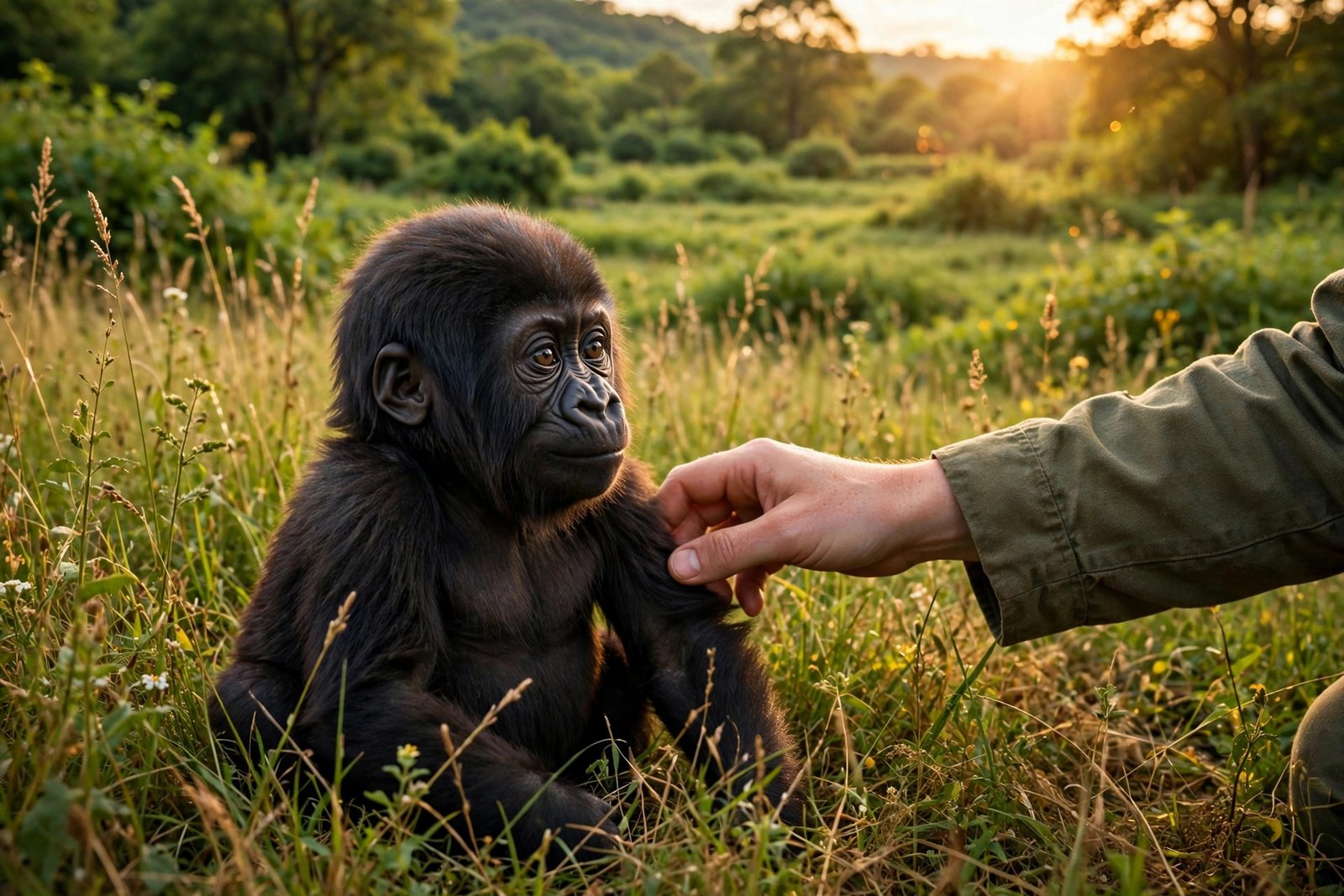
Three years ago, she was a terrified baby gorilla screaming at the sight of a cardboard box. Traffickers had ripped her from her family, sold her like a piece of luggage, and left her sick, infected, and clinging to a stranger’s body for comfort. Today, that same baby gorilla rescued traffickers could not keep is climbing trees in a forest sanctuary in the Republic of Congo — the first real taste of home she has had since she was stolen. Her name is Bili, and her journey is one of the most heartwarming wildlife stories of the year.
After three years of rehabilitation in Nigeria, Bili began an extraordinary international journey on September 21, 2026: a grueling 20-hour road trip, a flight across Africa courtesy of DHL, and a transfer deep into the forest — all to give one young western lowland gorilla what her rescuers call “a second chance at a normal life.” The news of her arrival has been celebrated by conservationists around the world, because Bili beat odds that kill more than 80 percent of trafficked baby gorillas.
Her story is also a window into a brutal $20 billion illegal trade — and into the remarkable humans fighting it, one rescued infant at a time.
A Baby Gorilla Rescued Traffickers Meant for the Exotic Pet Trade
Bili was only a few months old when Nigerian customs officials intercepted her in Lagos in August 2023. The rescue came from an undercover sting: investigators posing as buyers, working with the nonprofit Focused Conservation, arranged a purchase — and then took two men into custody. Both were later convicted of conspiracy, unlawful possession, and the attempted sale of a gorilla.
Experts are still uncertain exactly where Bili was born — she could have come from Cameroon, Gabon, or the Republic of Congo. But what is tragically certain, according to CNN’s in-depth reporting, is that members of her family were very likely slaughtered so she could be captured. This is the grim arithmetic of the ape trade — the dark engine behind every baby gorilla rescued traffickers headline: adult gorillas will fight to the death to protect their infants, so poachers simply kill the whole family and take the baby.
When primatologist Lindsay Maess first examined Bili at the rescue center, the infant was covered in a fungal infection and in poor health. Bili was, Maess said, a “miraculous case” — because upwards of 80 percent of trafficked gorillas do not survive. Trafficked infants are torn from their mother’s milk, which carries vital antibodies, and from the natural diet of forest foliage that helps treat parasitic infections. Many simply stop eating and collapse from emotional distress. On the very morning Maess spoke to CNN, another recently seized infant gorilla, named Maraya, had died despite the efforts of Maess, three veterinarians, and a nurse. “Just when you think they’re doing okay, they tank — and they tank so fast,” Maess said. “This is the sad reality of ape trafficking.”
The $20 Billion Trade Behind Her Capture
Bili’s story is the story of an illegal wildlife trade that Interpol estimates is worth $20 billion every year. Orphaned gorillas were once a byproduct of the bushmeat trade, but today infants are more likely to be deliberately targeted for trafficking, said Danny Murphy, a technical adviser for Focused Conservation — a U.S.-based nonprofit staffed by former law enforcement officers specializing in organized crime. It is funded by the U.S. Bureau of International Narcotics and Law Enforcement Affairs, not because America is a hotspot for trafficked wildlife, but because wildlife trafficking within Africa “funds insurgency, which does negatively impact Western interests.”
The trade is brazen. Buying and selling is often conducted on the open web, with sellers blatantly advertising animals — the trade is perceived as a “low-risk, high-gain” crime, Murphy explained. Nigeria is a key transit station for wildlife leaving Africa: dead animal goods typically leave by ship, live animals by air. Most buyers of baby gorillas appear to be based in the Middle East and Asia, said Patricia Raxter, director of intelligence and analysis at United for Wildlife, a wildlife-trafficking program of The Royal Foundation led by the Prince and Princess of Wales. “We’re seeing this massive acceleration in the trade in great apes,” Raxter said. “The exotic pet trade period is really exploding, and I think part of that is driven by social media.”
There has been progress. Between September 15 and October 15, 2025, a global crackdown coordinated by Interpol and the World Customs Organization seized almost 30,000 live animals, including more than 200 primates. Nigeria has outlined a national strategy to combat wildlife and forestry crimes, and in 2021 its customs service created the Special Wildlife Office, an investigative unit working with Focused Conservation — the very partnership that led to Bili’s seizure. If you love stories of animals beating the odds, don’t miss Luna, the dog who survived 34 days alone in Yellowstone — another tale of astonishing animal resilience.
Three Years of Healing at Drill Ranch
When Peter Jenkins, the American co-founder of the primate protection nonprofit Pandrillus, got the call from Nigerian customs about Bili, officials didn’t know what to do with her. “They sent me a picture of her sitting on the floor, looking about as pathetic as a baby gorilla can look,” Jenkins recalled. He took her to Drill Ranch, Pandrillus’ wildlife rehabilitation center in Calabar, in Nigeria’s Cross River State near the Cameroon border — a region known for its primates.
Bili’s trauma ran deep. She would scream at the sight of a box or cage — a haunting reminder of how she had been transported. For the first three months, she slept clinging to Jenkins’ body. “She was very young and needed that security — being loved,” he said. Then came an unlikely prescription: two chimpanzees named Brendan and Mili, themselves seized from traffickers, shared her enclosure. The outgoing chimps were “probably the best thing for her” and “got her out of her shell,” Maess said.
But healing a baby gorilla is staggeringly expensive. Caring for an infant gorilla for three years can cost “thousands of dollars on milk alone,” said Zack Schwenneker, project manager at Drill Ranch. “Seizures are great — and it’s a success — but the sanctuaries that end up caring for the animals end up bearing all of the costs,” he said, adding that large international grants for wildlife trafficking enforcement “never include post-seizure care costs.” Pandrillus looks after nearly 700 animals, and Nigeria’s rescue centers are said to be at maximum capacity. Every baby gorilla rescued traffickers tale like Bili’s reminds us that enforcement is only half the battle — the other half is care. Bili, Maess said, had been ready for a new home “for quite some time.” Speaking to CNN in September, Jenkins said he was relieved the gorilla was leaving for a larger sanctuary — even if he called it “way down the list of great outcomes.” “That animal belongs with its parent in the forest,” he said.
The Long Journey to a Second Chance
Moving a gorilla across Africa is not like booking a flight. United for Wildlife coordinated Bili’s relocation with Pandrillus and Focused Conservation, in an operation also involving Nigeria’s Ministry of Environment and Department of Forestry and the Congo Ministry of Forest Economy. The team spent weeks getting Bili comfortable with being confined again — no small task for an animal that once screamed at boxes.
Then, on September 21, Bili left Calabar on a 20-hour road trip to Lagos, beset by a breakdown and delays. Two days later, she was flown by DHL to the Republic of Congo, then transferred overland to Tchimpounga, a primate rehabilitation center operated by the Jane Goodall Institute north of the port city of Pointe-Noire. Anthony Beckley, DHL’s vice-president for operations and aviation in sub-Saharan Africa, said: “This was far more than a flight. It was a carefully coordinated conservation operation that required specialist animal care, regulatory compliance, security, ground transportation and aviation expertise across several countries.” DHL has been part of United for Wildlife’s Transport Taskforce since 2014, working to keep traffickers from exploiting transport networks.
The moment of arrival was pure joy — the payoff of a baby gorilla rescued traffickers saga three years in the making. Moments after being released into an enclosure at the Tchimpounga Nature Reserve, Bili raced out into the open, reached for a human carer who carried her into the forest — and as soon as she was lowered to the ground, she set off again, climbing trees and plowing through the undergrowth. This wasn’t a return to the wild yet, but it was as close to her natural habitat as she had seen since she was wrenched from her home three years ago. Dr. Rebeca Atencia, executive director of the Jane Goodall Institute in the Republic of Congo and the center’s head veterinarian, traveled with Bili and oversaw her introduction. “Bili has adjusted very well,” she said. “She has shown herself to be a very resilient young gorilla.”
A Baby Gorilla Rescued Traffickers Story: What Comes Next
Bili’s new life follows a careful script. First, she must complete a 40-day quarantine and pass health checks. Then she will be introduced to a younger female gorilla called Mozambique, already living at the sanctuary, with whom she can develop her social and behavioral skills — the kind of lessons a baby gorilla would normally learn from her mother and family group.
If all goes well, the two could eventually be moved together to the Lesio-Louna Reserve in the Republic of Congo — a 173,000-hectare protected area managed by The Aspinall Foundation and the Ministry of Forest Economy. “The hope is that, in time, this group will have the opportunity to progress through the rehabilitation and reintroduction process and ultimately return to a life in the wild,” said Dr. Atencia. “They will have,” she said, “a second chance at a normal life.”
The sanctuary itself is one of Africa’s most remarkable places. Founded in 1992, the Tchimpounga Chimpanzee Rehabilitation Center is among the largest primate sanctuaries in Africa, caring for more than 150 chimpanzees plus other rescued wildlife, with three forested islands where animals live in near-wild conditions. It is one of the few facilities in the world equipped to rehabilitate almost any Central and West African species in need — “from African Grey Parrots and pangolins to turtles and even a baby gorilla,” as Dr. Atencia puts it. For another incredible primate tale — this one pure fiction — read our fantasy story of the brave monkey and the crocodile.
Lulingu: Proof That Second Chances Actually Work
If you want proof that rescues like Bili’s can end in the wild, meet Lulingu. She is a Grauer’s gorilla — an eastern lowland subspecies — who was rescued as an orphan from traffickers and raised at the GRACE sanctuary in the Democratic Republic of Congo. After years of careful rehabilitation, Lulingu was returned to the wild in Virunga National Park, joining a small group of reintroduced females in a population that had dropped to just eight individuals.
Then came the milestone nobody dared to hope for too soon: Lulingu gave birth to a healthy baby in the wild — fathered by a wild silverback — about 17 and a half months after leaving the sanctuary. It was the ultimate demonstration — and a hopeful precedent for Bili’s own baby gorilla rescued traffickers journey — that an animal taken by traffickers can, after years of rehabilitation and careful preparation, return to a natural population and reproduce. “It filled my heart with immense joy,” said Dalmas Kakule Syangeha, GRACE’s animal care manager, who has known Lulingu since she was a baby. “May this birth symbolize a better future for the gorillas of Mt. Tshiaberimu.”
Stories like these matter because the species is running out of time. The western lowland gorilla remains critically endangered, and every infant that survives the trade — and every infant born free afterward — is a small victory against extinction. As one more dose of wonder, check out our collection of Reddit facts that feel fake but are 100% real — the natural world is stranger than fiction.
Key Takeaways
- Bili, a female western lowland gorilla, was rescued as an infant from wildlife traffickers in Lagos, Nigeria, in August 2023 during an undercover sting; two men were convicted for the attempted sale.
- More than 80% of trafficked baby gorillas die — Bili survived a fungal infection, poor health, and deep trauma during three years of rehabilitation at Drill Ranch in Nigeria.
- On September 21, 2026, she began a multi-day international journey — 20 hours by road, a DHL flight, and an overland transfer — to the Jane Goodall Institute’s Tchimpounga Nature Reserve in the Republic of Congo.
- After a 40-day quarantine, she will meet a young female gorilla named Mozambique; both may eventually move to the protected Lesio-Louna Reserve and, one day, return to the wild.
- Her story spotlights a $20 billion illegal wildlife trade — and the customs officers, nonprofits, vets, and companies proving that a second chance is possible, as Lulingu’s wild-born baby in Virunga shows.
Three years ago, Bili was merchandise. Today she is a climber of trees, an explorer of forests, and — if all goes well — a future mother of the wild. The traffickers took her family, her home, and her first years. They could not take her future. That is what a second chance looks like.
Frequently Asked Questions
Who is Bili the gorilla?
Bili is a female western lowland gorilla who was rescued from wildlife traffickers in Lagos, Nigeria, in August 2023, when she was only a few months old. After three years of rehabilitation at Drill Ranch in Nigeria, she was relocated in September 2026 to the Jane Goodall Institute’s Tchimpounga Nature Reserve in the Republic of Congo.
How was Bili rescued from traffickers?
Nigeria Customs Services’ Special Wildlife Office, working with the nonprofit Focused Conservation, ran an undercover operation in which investigators posed as buyers. Two men were arrested and later convicted of conspiracy, unlawful possession, and the attempted sale of the baby gorilla.
Why can’t Bili be released into the wild immediately?
Bili must first complete a 40-day quarantine and pass health checks. She will then be introduced to another young female gorilla, Mozambique, to develop the social and behavioral skills she would normally have learned from her family. If rehabilitation progresses well, both may eventually move to the protected Lesio-Louna Reserve and ultimately return to the wild.
How many trafficked baby gorillas survive?
According to primatologist Lindsay Maess, who cared for Bili, upwards of 80% of trafficked gorillas do not survive. Infants lose their mother’s antibody-rich milk and natural forest diet, and many die from illness or emotional distress. Bili was described as a “miraculous case.”
What is the Tchimpounga Nature Reserve?
Tchimpounga is a primate rehabilitation center in the Republic of Congo operated by the Jane Goodall Institute, founded in 1992. It is one of Africa’s largest primate sanctuaries, caring for more than 150 chimpanzees and other rescued wildlife across a main site and three forested islands, with the goal of rehabilitating animals for eventual return to the wild.