
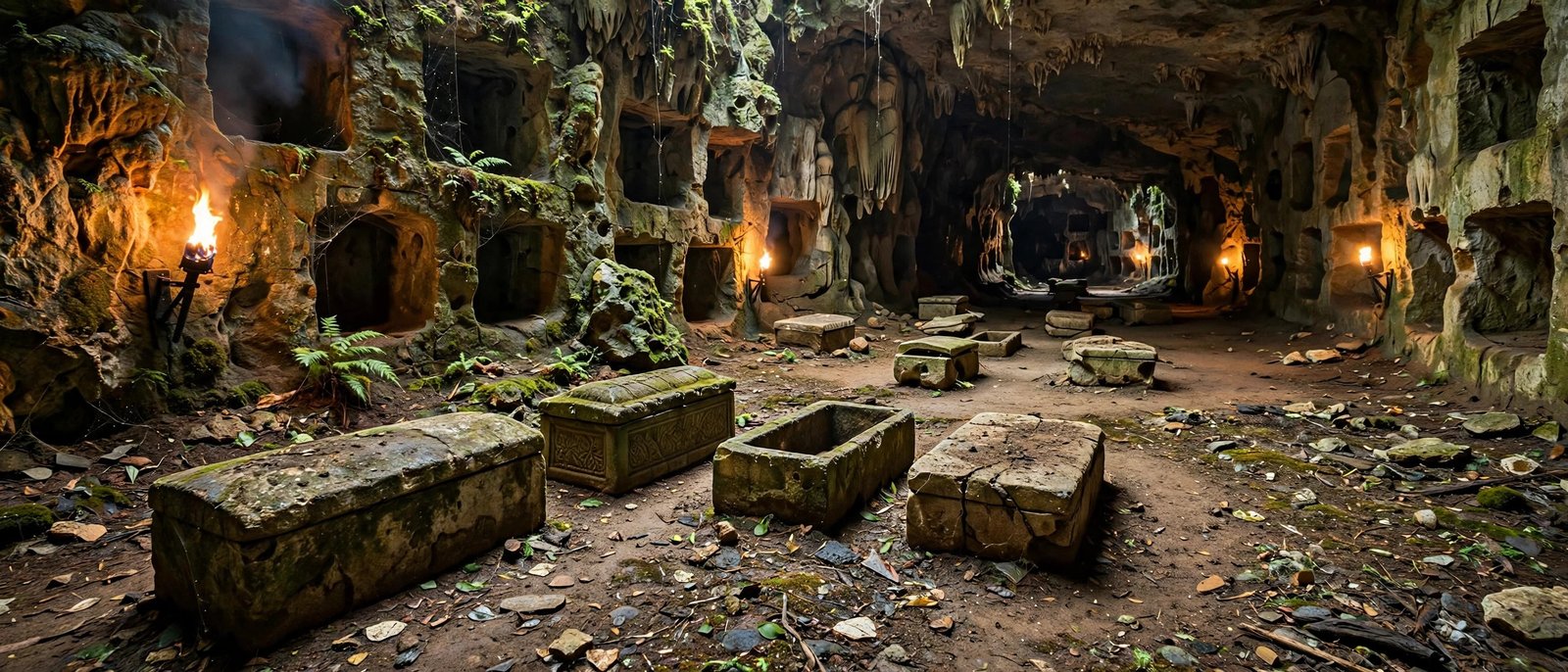
Picture this: Israeli Border Police officers, deep inside a search beneath an ordinary building in the Silwan neighborhood of East Jerusalem, suddenly realize the walls closing in around them are not concrete at all. They have walked straight into a Second Temple burial cave — an ancient tomb that has been sitting in silence for nearly 2,000 years.
According to offbeat-news coverage of the incident, the officers had stumbled into a Second Temple burial cave — the kind of rock-cut tomb where the Jewish residents of ancient Jerusalem laid their dead to rest back when the Second Temple still gleamed on the mountaintop above the city. The full details are still emerging from that initial report, so archaeologists have not yet published what — if anything — was found inside. But the discovery alone is enough to raise goosebumps on any history lover’s arms: a doorway into how people lived, grieved, and remembered their dead two millennia ago, hiding directly underneath a modern neighborhood.
What makes a find like this so electrifying? To answer that, you need to understand what this ancient tomb actually is, what the world looked like when it was carved, and why one of the most fought-over patches of ground on Earth keeps coughing up treasures from the age of the Caesars. Let’s descend into the dark together.
What Exactly Is a Second Temple Burial Cave?
A Second Temple burial cave is a tomb carved into the soft limestone bedrock of the Jerusalem hills during the Second Temple period — roughly 516 BCE to 70 CE, the era when the rebuilt Jewish Temple stood at the heart of the city. These were not the spooky, cobweb-draped crypts of a horror movie. They were family tombs: practical, intimate, carefully planned spaces where generation after generation of one extended family would be laid to rest.
Most of these caves share a recognizable architectural fingerprint, and once you know what to look for, you start seeing the logic of ancient grief in every chisel mark:
- A low, narrow entrance — often sealed originally with a heavy rolling stone or a stone slab, keeping both the living and wild animals out.
- A central standing pit or chamber — a small room where mourners could stand, pray, and perform burial rites.
- Kokhim (singular: kokh) — long, narrow burial niches cut perpendicular into the chamber walls, each just wide enough to receive a single body laid out on its back. Think of them as stone sleeping berths.
- Arcosolia — in later or wealthier tombs, arched recesses carved into the walls, a style that became fashionable toward the end of the period.
- Stone ossuaries — the signature artifact of the era: small limestone boxes, often decorated with rosettes or inscriptions, used to hold the bones of the dead after the flesh had decayed.
The practice is as fascinating as it is foreign to modern eyes. When someone died, their body was laid in a kokh. About a year later, after decomposition, family members would return, gather the bones, and place them into an ossuary — a practice scholars call secondary burial. It was, in a very real sense, a reunion: the bones of parents, grandparents, and children mingling in carved stone boxes inside the family cave, sometimes for centuries.
The Second Temple Period in Plain Language: 516 BCE to 70 CE
To feel the weight of this discovery, you need a quick tour of the era it belongs to — one of the most dramatic chapters in human history.
The story starts in heartbreak. In 586 BCE, the Babylonians destroyed the First Temple built by King Solomon and dragged much of Jerusalem’s population into exile. When the exiles finally returned decades later, they rebuilt the Temple — humbler, but theirs. That rebuilt sanctuary, dedicated around 516 BCE, is the Second Temple, and its name became the label for the entire era that followed.
Over the next five and a half centuries, Jerusalem lived through a whirlwind of empires:
- Persian rule, under which the Temple was rebuilt and the province of Yehud found its footing.
- Hellenistic influence, after Alexander the Great’s conquests flooded the region with Greek language and culture — a clash that eventually sparked the Maccabean revolt.
- Hasmonean independence, a century of Jewish self-rule and the holiday of Hanukkah’s origin story.
- Herod the Great’s golden age, when the ambitious king massively expanded and beautified the Temple into one of the wonders of the Roman world — the gleaming white-and-gold structure visitors described with awe.
- Roman domination, ending in catastrophe: the First Jewish Revolt and, in the summer of 70 CE, the Roman legions’ destruction of Jerusalem and the Temple itself.
That destruction is the hard stop of the Second Temple period. Every burial cave from this era is therefore a time capsule from a world that vanished in fire — which is exactly why each new one matters so much.
What’s Usually Hiding Inside: Ossuaries, Lamps, and Carved Stone
Here is where the curiosity really kicks in. When archaeologists open one of these ancient tombs, what do they typically find? Remember: the initial report on the Silwan find does not yet detail the contents, so everything below describes what is typical of such caves — the menu of wonders this new cave could hold.
- Stone ossuaries — the headliners. Hundreds have been found around Jerusalem. Many are plain, but others are exquisitely carved with geometric rosettes, and some bear inscriptions naming the deceased — in Hebrew, Aramaic, or Greek. A name on an ossuary is a voice calling across twenty centuries.
- Pottery and glass vessels — small jars, jugs, and perfume bottles left as offerings or for use in burial rites.
- Oil lamps — everyday objects that once lit the homes of the living, placed beside the dead.
- Coins — sometimes tucked with the deceased, and a gift to archaeologists: a coin’s mint date pins the tomb’s use to a specific reign or decade.
- Bone assemblages — the remains themselves, which modern analysis can use to study ancient diet, disease, and even family relationships through DNA.
The ossuary inscriptions deserve a special mention, because they are where archaeology turns into biography. One famous ossuary — discovered decades ago, not in this cave — bears the name “Caiaphas,” the high priest known from the New Testament. Another inscriptional find made global headlines as the possible ossuary of a relative of a biblical figure. Every new cave is a fresh lottery ticket in that same game: names, families, and forgotten lives waiting to be read again.
A word of honest caution, though: not every cave is a treasure chest. Many ancient tombs were looted in antiquity or disturbed by later construction. The scientific value of the Silwan cave will depend on careful, professional excavation — which is why archaeologists urge patience while the initial report is still so fresh.
Silwan: Where Shovels Meet Headlines
Now for the part of the story that crackles with modern electricity. Silwan is a predominantly Palestinian neighborhood in East Jerusalem, draped over the steep slopes just south of the Old City walls. It sits cheek-by-jowl with the area known as the City of David — the oldest settled part of Jerusalem, where excavations have peeled back layers from Canaanite, Israelite, Roman, Byzantine, and Ottoman times.
That density of history is precisely what makes archaeology here so contested and fascinating:
- Jerusalem is sacred to Judaism, Christianity, and Islam alike, so every trowel of soil can carry religious and political weight.
- Finds from the Second Temple period in particular feed into competing historical narratives about who was here, when, and what that means today.
- Excavations in Silwan have repeatedly made international news — celebrated by some as illuminating shared human heritage, criticized by others as entangled with the Israeli-Palestinian conflict.
Whatever one’s politics, the archaeological reality is undeniable: the ground beneath Silwan is one of the richest historical archives on the planet. An ancient burial cave surfacing beneath a modern building is a reminder that in Jerusalem, the past is never really past — it is literally the foundation the present is built on.
Why This Second Temple Burial Cave Discovery Matters
It is easy to shrug — another old tomb in a city full of them. But specialists get excited about finds like this for reasons that go far beyond the romance:
- Accidental discoveries are data gold. Planned excavations target known sites; chance finds like this one reveal where ancient cemeteries actually extended, mapping the true footprint of Second Temple–era Jerusalem.
- Every undisturbed cave is a statistical sample. How many ossuaries per family? What names were common? What did people eat? Burial caves answer questions about ordinary life that palaces and temples never can.
- They humanize history. Kings and high priests get the monuments, but a burial cave belongs to regular families — the merchants, craftspeople, and farmers whose names never made it into the history books.
- Context is everything. A cave found beneath a modern building, documented in place, preserves the spatial relationships looted or long-excavated tombs have lost.
In short: this ancient tomb is not just a hole in the ground with old bones. It is a new page — possibly a new chapter — in the biography of one of humanity’s most storied cities.
Jerusalem Is Having an Archaeological Golden Age
The Silwan cave is not arriving out of nowhere. Jerusalem’s soil has been astonishingly generous lately, with 2026 delivering one headline discovery after another. Here are two that put the burial cave in context:
The pilgrims’ purification complex (announced September–October 2026). At the foot of the Temple Mount, in the Ophel area of the Old City, Hebrew University archaeologists led by Prof. Uzi Leibner and Prof. Orit Peleg-Barkat uncovered a monumental Second Temple–period complex of ritual baths — three large mikva’ot, a 12-by-9.5-meter plastered pool with steps on all four sides, and a paved plaza, all dating to the first century BCE through 70 CE. One bath survives to its full height of 4.2 meters, vaulted stone ceiling and all — a floor-to-ceiling preservation described as exceedingly rare in Jerusalem. The complex likely served the flood of Jewish pilgrims who purified themselves before ascending to the Temple, and it met its end in the Roman destruction of 70 CE, with revolt-era coins scattered across its floors. Read the full announcement via the American Friends of the Hebrew University and the Times of Israel’s detailed report.
The 2,000-year-old aqueduct (announced October 2026). Near Kibbutz Ramat Rachel, just south of Jerusalem, the Israel Antiquities Authority exposed a 300-meter section of the ancient Lower Aqueduct — built in the Hasmonean era of the Second Temple period to carry spring water more than 20 kilometers to the Temple Mount, powered by nothing but gravity and a gradient of about one meter per kilometer. Excavation directors Dr. Benyamin Storchan and Gil Freid noted the system was so well engineered it stayed in intermittent use until roughly a century ago. Details are in Algemeiner’s coverage.
Seen together, these finds sketch a living, breathing city: pilgrims purifying themselves in monumental baths, water gliding downhill through stone channels, families burying their dead in caves beneath the hillsides. The new Silwan find slots right into that picture — another brushstroke in the portrait of Jerusalem at its ancient peak.
If stories like this light up your curiosity, you will love these other mind-bending reads on BolanPost: the mystery of the Wow! signal from deep space, 8 space facts that sound fake but are totally real, and the unbelievable tale of Luna, the dog who survived 34 days in Yellowstone.
Key Takeaways
- Israeli Border Police reportedly found an ancient Second Temple–era burial cave beneath a building in Silwan, East Jerusalem, during searches — details are still emerging from the initial offbeat-news report.
- Such caves date to the Second Temple period (516 BCE–70 CE) and typically contain kokhim burial niches and inscribed stone ossuaries from the ancient Jewish practice of secondary burial.
- Silwan sits beside the City of David in one of the most archaeologically — and politically — sensitive landscapes on Earth, which is why every find there makes global headlines.
- The discovery joins a remarkable 2026 streak in Jerusalem: a monumental pilgrims’ ritual-bath complex at the Temple Mount’s foot and a 2,000-year-old Hasmonean aqueduct, both Second Temple–era engineering marvels.
- Each new burial cave adds hard data about ordinary ancient life — names, families, diet, and disease — that palaces and temples can’t provide.
Frequently Asked Questions
What is a Second Temple burial cave?
A Second Temple burial cave is a rock-cut family tomb carved into Jerusalem’s limestone bedrock during the Second Temple period (516 BCE–70 CE). These caves typically feature a central chamber, narrow burial niches called kokhim cut into the walls, and stone ossuaries — small bone boxes used in the ancient Jewish practice of secondary burial.
Who found the Second Temple burial cave in Silwan?
According to offbeat-news coverage, the cave was found by Israeli Border Police during searches beneath a building in Silwan, East Jerusalem. The report is still in its early stages, and archaeologists have not yet published a detailed account of the cave’s contents.
What are ossuaries, and why are they important?
Ossuaries are small limestone boxes used to hold the bones of the dead about a year after burial, once the body had decomposed — a practice called secondary burial. They are important because many are carved with decorations or inscribed with the names of the deceased in Hebrew, Aramaic, or Greek, giving historians direct evidence of ancient names, languages, and family relationships.
Why is archaeology in Silwan so controversial?
Silwan lies in East Jerusalem, adjacent to the ancient City of David, in a city sacred to Judaism, Christianity, and Islam. Excavations there — especially of Second Temple–period remains — intersect with competing historical and political narratives, so discoveries routinely attract international attention far beyond academic circles.
What other major discoveries have been made in Jerusalem recently?
Jerusalem has had a remarkable 2026: Hebrew University archaeologists uncovered a monumental Second Temple–period ritual-bath complex for pilgrims at the foot of the Temple Mount, and the Israel Antiquities Authority exposed a 300-meter section of a 2,000-year-old Hasmonean aqueduct that once carried water over 20 kilometers to the Temple Mount by gravity alone.
Conclusion: The Past Is Closer Than We Think
There is something deliciously humbling about the idea that a family’s final resting place — carved with love and grief two thousand years ago — can sit quietly beneath a modern building, waiting for a routine police search to pull back the curtain. The Silwan cave is a reminder that history is not locked away in museums. In Jerusalem, it is under your feet.
As archaeologists get to work and the details of this find emerge, one thing is certain: every chisel mark, every inscription, every fragment of bone has a story to tell. And in a city that has been telling stories for three thousand years, there is always room for one more. Keep your eyes on Jerusalem — the ground there is not done talking yet.