
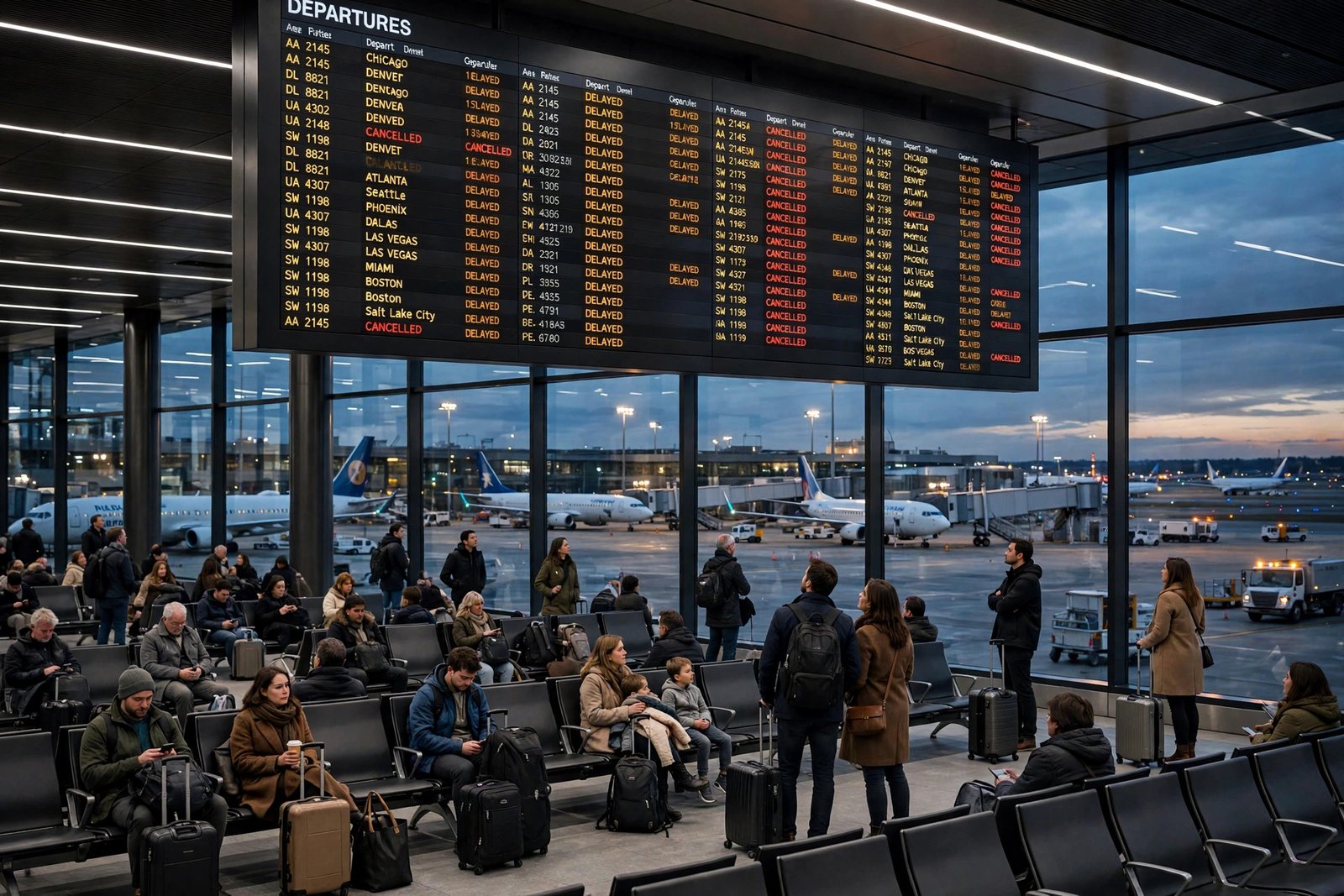
Imagine waking up on a normal Saturday morning, coffee in hand, boarding pass already on your phone, only to learn that planes across the entire United States are not moving at all. No takeoffs. No departures. Just gate agents, crowded terminals, and a departures board slowly turning red. That is exactly what thousands of travellers faced on November 14, 2026, when a US flight ground stop brought air travel to a standstill. The cause was not bad weather, not a security scare, and not a strike. It was a failure in the communications systems that air traffic controllers depend on every single minute of every single day.
The story is a reminder of how much of modern life runs on invisible infrastructure. We think of flying as engines, wings, and runways, but behind every safe takeoff is a constant stream of radio calls, radar data, flight plans, and digital messages passing between pilots and controllers. When that stream breaks, the safest thing a controller can do is stop departures altogether. That is what happened on November 14, 2026, and the ripple effects reached around 7,000 flights before the nationwide hold was finally lifted.
In this article, we explain what happened, why a telecom outage can ground an entire country, what passengers went through at airports from coast to coast, how a ground stop differs from a delay, and what you should do if you ever find yourself caught in one. Everything here sticks to what was reported about the day, and where a detail has not been confirmed, we say so plainly.
What Happened on November 14, 2026: The US Flight Ground Stop Explained
The ground stop was later lifted, and departures gradually resumed, but the restart was not instant. Anyone who has watched a major airport recover from a morning of disruption knows the pattern: planes and crews are in the wrong places, gates are occupied, and a backlog of passengers needs rebooking. Even after the official all-clear, it takes hours for schedules to untangle themselves. That lag is part of why a short ground stop can ruin travel plans for an entire day.
Why a Telecom Outage Can Ground Planes Across America
To understand why a telecom failure can cause a US flight ground stop, it helps to picture what air traffic control actually is. It is not one tower, and it is not one room. It is a network of control towers at airports, terminal control facilities around busy cities, and en route centres that manage aircraft cruising at high altitude between cities. All of those facilities have to talk to each other constantly, and they have to talk to pilots, and the information they share has to be current to the second.
That communication happens over a mix of radio, dedicated telephone lines, and data networks. Controllers issue clearances by voice, they hand aircraft from one sector to another with a coordinated transfer, and they receive radar and flight plan data over wired networks. When the telecom links between facilities degrade, controllers lose the ability to coordinate handoffs safely. A controller in one centre may not be able to confirm that the next centre is ready to accept an aircraft, and without that confirmation, the aircraft cannot safely proceed.
Around 7,000 Flights Hit: What Passengers Faced at the Airport
When around 7,000 flights are affected by a single event, the human experience is remarkably similar whether you are flying for a wedding, a business meeting, a holiday, or a flight home. The day starts with hope, then confusion, then a long wait, then a scramble for alternatives. On November 14, 2026, passengers described terminals that filled up fast as departures stopped and arriving passengers had nowhere to go, because the aircraft they were meant to connect to were not leaving either.
The most immediate problem was information. In the first hour of a ground stop, even airline staff often do not know how long it will last. Gate agents can see the same departure boards passengers see, and they are waiting for word from operations centres and from the FAA. That uncertainty is genuinely hard to manage. A delay of thirty minutes is annoying. A delay of unknown length, with no new departure time, forces every passenger to make the same calculation: wait it out, or try to rebook, or give up and go home.
Then comes the rebooking crush. When thousands of flights are disrupted at once, the phone lines, apps, and airport service desks all get overwhelmed at the same time. Airlines use automated systems to rebook many passengers, but those systems have to work through a queue, and when the queue is enormous, some people wait hours for a new itinerary. Passengers who were flexible and quick, or who had travel insurance and a backup plan, often fared better than those who waited for a gate announcement to tell them what to do next.
Families travelling with children, older travellers, and people with tight connections faced the hardest day. A missed connection can mean an overnight stay in a city you never intended to visit, and a cancelled flight can mean a lost hotel night or a missed event that cannot be rescheduled. That is the part of a ground stop that does not show up in a flight count. The number around 7,000 flights tells you the scale, but it does not tell you about the birthday, the job interview, or the funeral that was on the other end of the journey.
There was also a knock on effect for crews. Pilots and cabin crew have strict limits on how long they can work in a day. When a ground stop eats into those limits, a crew that was meant to fly onward may time out, which means the airline needs a replacement crew before the next flight can go. That is one reason recovery takes so long, and why some flights are cancelled even after the ground stop itself has been lifted. The system does not just need the communications fixed. It needs people and planes back in the right places at the right times.
Ground Stop vs Ground Delay: What Is the Difference?
Travellers often hear the terms ground stop and ground delay used as if they mean the same thing, but they describe two different tools, and the difference matters if you are trying to work out what will happen to your flight. A ground delay program slows departures down. Flights still leave, but they leave at a controlled rate, spaced out so that arrivals at a busy or constrained airport do not overwhelm it. Think of it as a metered on ramp on a highway: traffic keeps moving, just more slowly.
There is a third term you may hear, a ground delay program, and a fourth, an airspace flow program, which manages traffic in the air rather than on the ground. All of them share the same goal: keep the number of aircraft in any piece of sky at a level controllers can safely handle. When the tools work well, you may never notice them. Your flight leaves a few minutes late, and you arrive more or less on time. When a ground stop is needed, the effect is impossible to miss, because nothing leaves at all.
For passengers, the practical difference is simple. In a ground delay, your flight will probably still go, just later. In a ground stop, your flight will not go until the stop is lifted, and even then it may be cancelled if the knock on effects are too great. That is why it pays to check the status of your flight in the airline app rather than relying on the original departure time, and why rebooking early can make a real difference.
How the FAA Keeps Flying Safe When Systems Fail
What To Do If You Are Caught in a US Flight Ground Stop
If you ever find yourself in a ground stop, the best approach is calm, quick, and practical. The passengers who recover fastest are usually the ones who act early, stay flexible, and use every channel available to them. Here is a step by step approach that works in almost any major disruption, including a nationwide hold on departures.
One more tip is worth remembering: be kind to the staff. Gate agents and flight attendants did not cause the ground stop, and they are managing the same uncertainty you are, often while being shouted at by hundreds of people. A calm, polite request is more likely to get a creative solution than an angry demand, and in a long disruption, the staff remember the passengers who treated them well.
Your Rights and Refunds After a Cancellation
When a flight is cancelled, American travellers have stronger rights than many people realise. The US Department of Transportation requires airlines to give you a full refund of the ticket price, including taxes and fees, if the airline cancels your flight and you choose not to travel on the alternative offered. That applies even if you bought a non refundable ticket. The key point is that you have to choose the refund. If you accept rebooking onto another flight, the airline has met its obligation by getting you there, even if it is much later.
Travel insurance can help, but read the fine print. Some policies cover trip interruption and extra accommodation after a major delay, while others exclude events described as air traffic control issues or limit cover to specific causes. If you travel often, a good policy with clear delay cover can pay for itself after a single bad day. Keep boarding passes, booking confirmations, and receipts together, and take screenshots of cancellation notices, because insurers and airlines both ask for documentation.
For more on passenger rights, the Department of Transportation maintains a fly rights guide, and consumer reporting from outlets such as Reuters aerospace coverage often explains how a particular disruption is being handled. If you were affected on November 14, 2026, keep your records, check the airline app for refund and rebooking options, and do not accept a voucher if you would rather have the cash refund you are entitled to.
Takeaways: What November 14, 2026 Teaches Us About Flying
The nationwide ground stop of November 14, 2026 will be remembered as one of those days when the invisible infrastructure of aviation suddenly became visible. A telecom failure, not a storm, stopped planes across the country, affected around 7,000 flights, and reminded everyone that flying depends on communications as much as it depends on engines. The stop was lifted, flights resumed, and the system recovered, but the day left a mark on the thousands of people whose plans were upended.
The deeper lesson is about resilience. Aviation is one of the safest ways to travel precisely because it is designed to stop when it is not safe to continue. That is cold comfort when you are stuck at a gate, but it is the reason the story of November 14 is a story of disruption rather than disaster. Controllers held departures, pilots landed safely, and the system waited until it could be sure before it started moving again. That is how safety is supposed to work.
For travellers, the practical lessons are simple and worth carrying into every future trip. Build buffer time into important journeys, especially if you have a connection. Keep your phone charged, your documents handy, and your receipts saved. Know your refund rights before you need them. And remember that when a ground stop happens, the fastest recovery usually belongs to the passenger who checks the app, acts early, and stays flexible about how they get home.
As the official review of the outage unfolds, expect more detail about what failed and what will change. Until then, the facts we can state with confidence are these: on November 14, 2026, a telecom and FAA communications failure triggered a nationwide hold on departures, around 7,000 flights were affected, and the stop was later lifted as systems were restored. If you were caught in it, you experienced a rare event, and you now know exactly what to do if it ever happens again. For more surprising stories from the world of travel and beyond, see our piece on a wild elephant trampling a biker twice in a viral video, and our look at the viral AIIMS population counter from India. And if you want a lighter read after a heavy travel day, our story about the Chicago Fire cast comforting a dumped TikToker is a reminder that the internet can still be kind.
What caused the US flight ground stop on November 14, 2026?
A telecom outage disrupting air traffic control communications was reported as the cause. The failure affected the systems the FAA relies on to coordinate flights, and departures were held nationwide until communications were restored and the ground stop could be safely lifted.
How many flights were affected by the ground stop?
Reports on the day put the figure at around 7,000 flights affected. That includes cancellations and delays caused directly by the hold and by the knock-on disruption as planes and crews ended up out of position.
Was the US flight ground stop lifted?
Yes. The ground stop was later lifted and departures gradually resumed. Recovery took time, however, because aircraft and crews needed to be repositioned and backlogs of passengers needed rebooking even after the official all-clear.
What should I do if my flight is cancelled during a ground stop?
Check the airline app first for rebooking options, keep all receipts, and remember that if the airline cancels your flight and you choose not to travel, you are generally entitled to a full refund of the ticket price under US Department of Transportation rules, even on a non-refundable ticket.
Can a telecom outage really ground all flights in the US?
Yes. Air traffic control depends on constant voice and data links between control facilities and pilots. When those links fail, controllers cannot safely coordinate handoffs between sectors, so the safe response is to hold departures on the ground until communications are restored.