
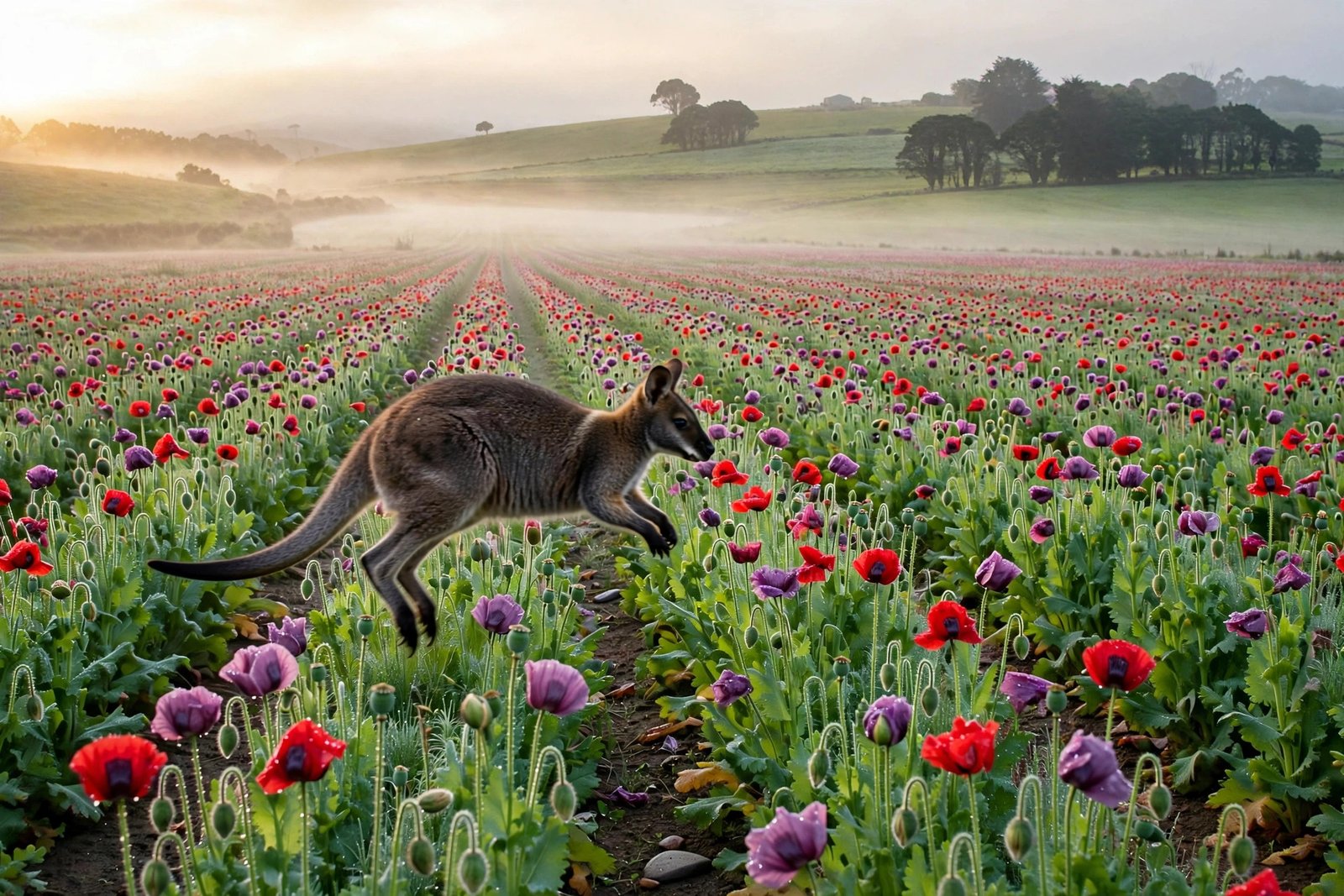
Farmers in Tasmania noticed something strange happening in their poppy fields: perfect little crop circles were appearing overnight, with flowers trampled in neat rings as if something had been dancing in the dark. No vandals. No storms. No alien landings. The mystery baffled growers for years — until the truth came out, and it turned out to be even funnier than the theories. The culprits were not extraterrestrials. They were wallabies, breaking into the legal opium poppy fields at night, gorging on the poppy bulbs, getting completely high — and then running around in drugged-up circles, trampling the wallabies poppy crop circles into the fields. It is one of the funniest true stories ever shared on the internet, and the best part is that it is 100 percent real.
This classic story belongs to the beloved “Today I Learned” (TIL) genre — the kind of wild-but-true trivia that makes you stop scrolling and read twice. It was immortalized in a widely shared roundup of the weirdest and coolest TIL facts on Bored Panda, and it has been making the rounds on Reddit for years. But behind the comedy lies a genuinely fascinating tale about Tasmania, pharmaceutical poppy farming, Australian wildlife, and what happens when nature meets chemistry. So grab a coffee — this one is a ride.
The Wallabies Poppy Crop Circles Mystery Begins
To understand how the wallabies poppy crop circles mystery started, you first need to understand Tasmania’s poppy fields. Tasmania — the island state off Australia’s southeast coast — is one of the world’s major legal producers of opium poppies. These are not illicit drug crops; they are tightly regulated pharmaceutical plantations grown to supply the raw material for legitimate painkillers like morphine and codeine. The fields stretch across the island’s farmland in gorgeous, surreal blooms of pink and purple every spring.
And then, one season, growers started noticing something odd. Circular patches of trampled, flattened poppy plants were showing up overnight in the middle of otherwise pristine fields. The flowers inside the circles were crushed and broken. The patterns were roughly round, as if something had run in a loop, again and again, through the same patch. Nobody could explain it. The fields were fenced. There were no footprints of trespassers. No machinery had been through. The damage was happening in the dark, when no one was watching.
Naturally, theories flew. Was it some new pest? A strange weather phenomenon? A prank? On the mainland, tabloids would have screamed “crop circles” and invited the alien enthusiasts. But Tasmanian farmers are a practical bunch, and they kept their heads down and watched their fields. The answer, when it finally emerged, was so absurd that nobody had taken it seriously — even though the evidence had been staring them in the face the whole time.
How the Wallabies Poppy Crop Circles Case Was Cracked
The truth came to light in 2009, and it came from the top: Lara Giddings, then Tasmania’s Attorney-General, revealed it during a hearing about the island’s poppy industry. According to reporting at the time — including a widely circulated piece in The Guardian — Giddings told officials that wallabies had been discovered breaking into the poppy fields, eating the poppy bulbs, and becoming intoxicated. And then, in what might be the funniest official statement in agricultural history, she explained that the high wallabies would hop around in circles, stamping the crop circles into the fields with their intoxicated laps.
Read that again: stoned wallabies were doing laps in the poppy fields and trampling crop circles into them. It sounds like a joke a comedian would invent for a late-night monologue. But it was an official of the Tasmanian government, on the record, explaining real crop damage to a parliamentary-style hearing. The story exploded around the world within days. Headlines everywhere carried some version of the same punchline: drugged wallabies, crop circles, Tasmania. It was the perfect storm of a news story — absurd, adorable, and completely true.
It turns out wallabies — small, bouncing relatives of kangaroos that are abundant across Tasmania — are no strangers to the poppy fields. Farmers had apparently known for years that wildlife nibbled at the crops; deer and livestock can be drawn to the plants too. But the wallabies’ particular party trick, eating the potent bulbs and then hopping in disoriented circles, created the signature ring-shaped damage that had puzzled everyone. The mystery was solved not by a scientist in a lab, but by watching what the local wildlife was doing after dark.
Wallabies, Tasmania, and Opium: The Fascinating Background
The wallabies poppy crop circles story is funnier when you know the backstory. Tasmania’s legal poppy industry is serious business. The island grows a huge share of the world’s pharmaceutical opiates, and the crop is heavily regulated — fields are licensed, security is strict, and the harvested straw is processed by pharmaceutical companies into medicines used in hospitals worldwide. The idea that this ultra-regulated crop was being casually raided by marsupials with the munchies is the kind of irony the internet was built for.
And wallabies are the perfect accidental criminals for this story. They are small enough to slip through gaps in fencing, numerous enough that a few determined individuals will always find the holes, and apparently not fussy about what they eat. Tasmania’s wildlife and farmland have always overlapped — wallabies, possums, and other native animals regularly graze on crops, which is why farmers invest in fences in the first place. The poppy industry’s fences were designed to keep people out; nobody designed them with intoxicated marsupials in mind.
There is also a genuine agricultural footnote worth noting. Crop damage from wildlife is a real cost for farmers everywhere — in Tasmania and far beyond. The wallaby incident, while hilarious, highlighted the constant tension between wildlife and agriculture on the island. Farmers deal with browsing animals damaging all kinds of crops, from pastures to vineyards. The poppy story just happened to involve the single funniest combination of animal and crop imaginable.
If you love true stories that sound made up, you will enjoy our collection of facts that feel fake but are 100% real — the wallaby story would fit right in. And for more animal chaos, our piece on the baby gorilla rescued from traffickers shows the serious side of wildlife stories.
A Gentle Bonus TIL: The Elephant Who Heard Her Mother
The same TIL roundup that keeps the wallaby story alive also carries a much quieter, more moving tale — and it deserves a moment. In 1978, according to the widely shared account, a researcher played recordings of a deceased elephant’s calls through a hidden speaker near the elephant’s family. The family reportedly became frantic, searching for the source of the familiar voice. The deceased elephant’s daughter is said to have called out for her mother for days afterward. The researcher, moved by the family’s distress, reportedly vowed never to repeat the experiment.
Unlike the wallaby tale, this one is not funny — it is a small, heartbreaking window into elephant cognition and emotion. Elephants are known for their extraordinary memories, their tight family bonds, and their apparent grief rituals; researchers have documented elephants returning to the bones of deceased relatives and lingering over them. The 1978 anecdote, as told in the TIL tradition, fits that larger picture of elephant emotional depth. We include it here second-hand from the roundup, because the primary source is hard to pin down — but the science of elephant memory and mourning is well established, and the story is told with the tenderness it deserves.
Why the Wallabies Poppy Crop Circles Story Went So Viral
Why has this story survived for over a decade and a half as an internet classic? Because it checks every box of a perfect viral tale:
- A genuine mystery: Real crop circles were really appearing, and real farmers were really baffled. The setup is irresistible.
- An unbelievable answer: Drugged wallabies running in circles is a punchline no one could predict — which makes the reveal endlessly satisfying.
- It is verifiably true: This was not a rumor; it was stated on the record by Tasmania’s Attorney-General and reported by major international outlets. Truth is stranger than fiction, and this is the proof.
- It is harmless and wholesome: No one was hurt. The wallabies were fine. The poppies grew back. It is pure, joyful absurdity — the rarest thing on the internet.
- It keeps resurfacing: Every crop circle story, every Tasmania story, every “animals on drugs” headline brings the wallabies back. It is a perennial.
It is also a reminder of why the TIL format endures. Reddit’s Today I Learned community and its roundups exist to do one thing: make you say “wait, WHAT?” — and then send you down a rabbit hole of real, checkable facts. The wallaby story is the platonic ideal of a TIL: funny on the surface, fascinating underneath, and true all the way down. For more crowd-sourced wonders, see our story of the Great Molasses Flood of 1919 — another real event that sounds like fiction.
The Takeaway: Nature Always Finds a Way to Surprise Us
The wallabies poppy crop circles saga is more than a punchline. It is a small parable about curiosity: the farmers who kept watching their fields instead of dismissing the circles, the officials who told the unvarnished truth even when it was embarrassing, and the millions of readers who shared the story because it delighted them. Somewhere in Tasmania tonight, a wallaby is probably eyeing a fence line. And somewhere, a poppy grower is checking that fence with a little more respect for the local wildlife than before.
The next time you see a strange pattern in a field — or hear a story that sounds too wild to be true — remember the wallabies. Check the facts, follow the evidence, and be ready for the answer to be funnier than anything you imagined.
Frequently Asked Questions
Did wallabies really make crop circles in Tasmania’s poppy fields?
Yes. In 2009, Tasmania’s then Attorney-General Lara Giddings stated on the record that wallabies were breaking into legal opium poppy fields, eating the bulbs, becoming intoxicated, and hopping in circles — trampling ring-shaped patterns into the crops. The story was reported internationally, including by The Guardian.
Why does Tasmania grow opium poppies?
Tasmania is a major legal producer of pharmaceutical opium poppies, grown under strict licensing and regulation to supply raw material for legitimate painkillers such as morphine and codeine. The crop is a significant part of the island’s agricultural industry.
What are wallabies?
Wallabies are small to medium-sized marsupials related to kangaroos, native to Australia and abundant in Tasmania. They are herbivores and frequently graze on farmland, which brings them into regular contact — and occasional conflict — with farmers.
What is the elephant TIL from the same roundup?
The same Bored Panda TIL roundup includes an account from 1978 in which a researcher played recordings of a deceased elephant’s calls near her family; the family reportedly searched frantically for her, and her daughter called for days. The researcher is said to have never repeated the experiment. It is told as a second-hand anecdote illustrating elephant emotional depth.
Where did the wallaby story originally appear?
The story broke in 2009 through Tasmanian government statements and was picked up by international media. It lives on as a classic TIL on Reddit and in roundups like the Bored Panda collection of weird and cool TIL facts.