
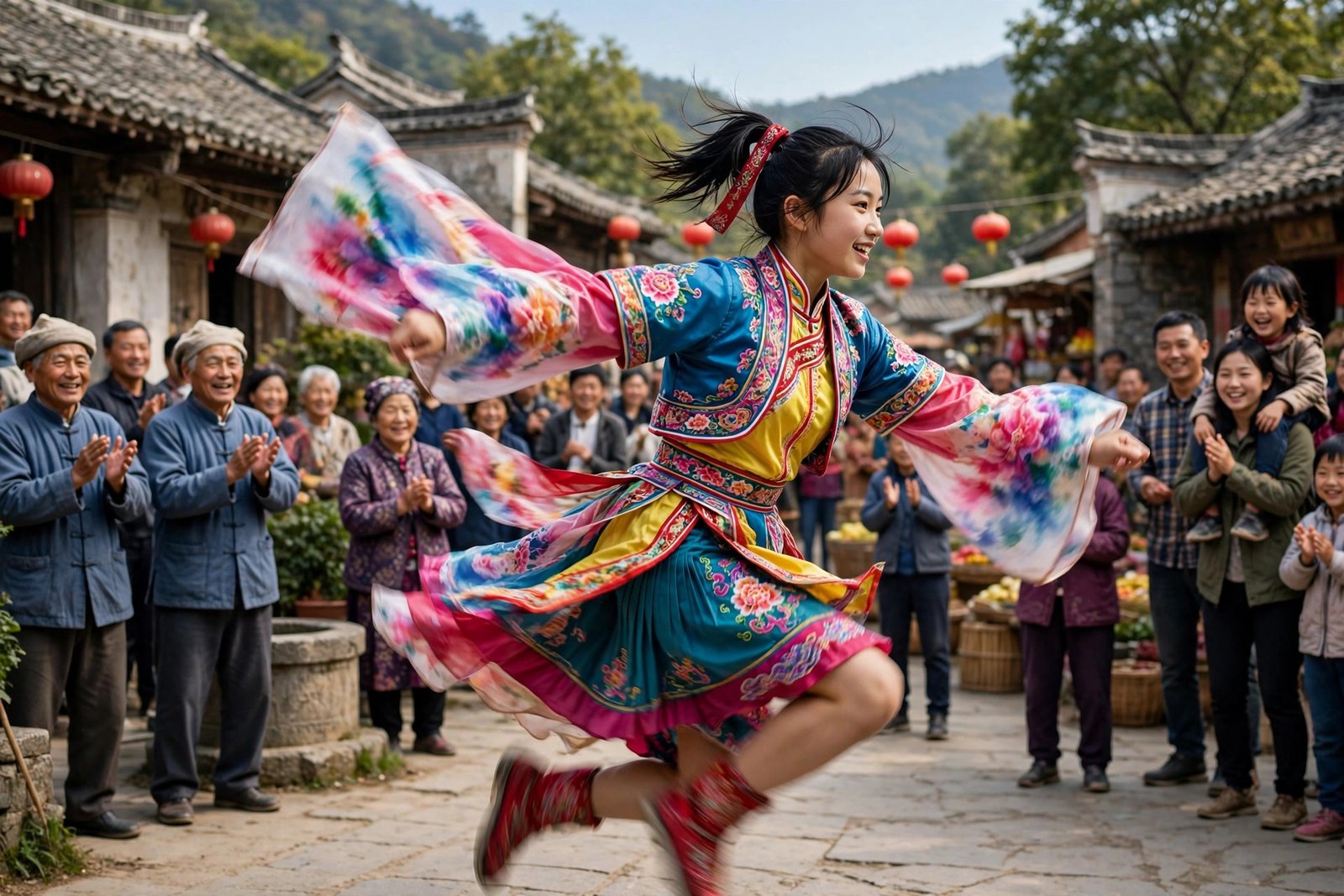
Some viral dances are invented in a choreographer’s studio. This one was filmed by an eight-year-old. The shanshenbu viral dance — a lightning-fast side-to-side “dodge step” — started as a child’s tutorial of a basic move from Anhui Flower Drum Lantern, a centuries-old Chinese folk dance. Within weeks, it had racked up hundreds of millions of views, pulled in a former Italian football star and one of the NBA’s most famous superfans, and turned into a full-blown creativity battle between humans and AI.
It is one of the strangest and most wonderful internet stories of 2026: a piece of China’s intangible cultural heritage, taught by a kid, remixed by the entire world.
What Is the Shanshenbu Viral Dance?
“Shanshenbu” translates roughly to “dodge step” or “flash step,” and the name tells you exactly what it looks like. It is a rapid side-to-side movement in which the dancer shifts their weight quickly while twisting the body and extending the arms — a sudden, sharp lateral dodge, as if slipping past an invisible opponent. Done well, it looks like a glitch in a video game made flesh: the upper body stays controlled while the lower body snaps from side to side.
As a meme, the shanshenbu viral dance usually appears in comedy skits. Participants perform the dodge as a way of “dodging” someone — an awkward question, an unwanted hug, a bill they don’t want to split. The move’s sharp, evasive quality makes it the perfect physical punchline, and creators have built entire sketch formats around the moment of the dodge.
But the move is far older than the meme. It is a foundational step in Anhui Flower Drum Lantern (Anhui Huagudeng), a traditional folk dance recognized as part of China’s national intangible cultural heritage and considered one of the most representative dances of the Han Chinese people. What the internet treats as a joke was originally a serious training exercise — which makes its second life as a comedy meme even more delightful.
The 8-Year-Old’s Tutorial That Made the Shanshenbu Viral Dance Explode
Every viral trend has an origin story, and this one is disarmingly simple: the shanshenbu trend started with a tutorial filmed by an eight-year-old, demonstrating the basic dodge-step move from the Flower Drum Lantern repertoire. A child, earnestly teaching a traditional dance step to the camera, turned out to be exactly the kind of content the internet cannot resist.
There is something about a kid teaching with total seriousness that makes adults pay attention. The tutorial wasn’t ironic, wasn’t a parody, wasn’t chasing a trend — it was just a young dancer showing a move they had learned. That sincerity is catnip for social media. Viewers shared it because it was charming, then tried the move themselves because it looked fun, then shared their attempts because the move is genuinely hard to do well — and watching people fail at it is half the entertainment.
The numbers tell the story. Related videos quickly pushed past 600 million views, turning what could have been a niche folk-dance clip into one of China’s biggest viral exports of the year — and then the trend jumped the language barrier entirely. By mid-October 2026, the shanshenbu had become a full-fledged TikTok meme in the West, with creators performing the dodge in comedy skits and racking up hundreds of thousands of views per video. One early Western example — TikToker @imjoeyreed’s September 25, 2026 skit built around the move — pulled in over 464,000 views in about three weeks, and a reuploaded compilation of the original tutorial passed a million views in two weeks.
Anhui Flower Drum Lantern: The Heritage Behind the Shanshenbu
To understand why this trend matters beyond the laughs, you need to know where the move comes from. The Anhui Flower Drum Lantern dance — known as a form of “Oriental ballet” — has been passed down along the Huaihe River region for generations, and it was inscribed as a national-level intangible cultural heritage of China in 2006. It is not a casual folk tradition; it is a formally recognized art form with professional training methods, codified movements, and master teachers.
The dodge step itself was never meant to be funny. According to Professor Tian Lu of the Beijing Dance Academy’s Department of Chinese Ethnic and Folk Dance, movements like the shanshenbu were isolated from longer dance sequences specifically for professional training — they teach students rapid changes in their center of gravity, precise body control, and posture. What younger viewers now see as playful internet choreography was designed as a serious teaching tool, drilled by dance students the way athletes drill footwork.
The move’s internet fame actually traces back to professional teaching materials. The viral clips originate from folk-dance training footage produced by the Beijing Dance Academy, featuring veteran dance teachers Zhao Tiechun and Ming Wenjun demonstrating the fundamentals with complete formal precision. Their dead-serious demonstrations — delivered with the gravity of master instructors — are a big part of why the videos became comedy gold for a new generation. The contrast between the solemn teaching style and the move’s meme afterlife is the joke, and it is a genuinely funny one.
This is what makes the shanshenbu viral dance more than a throwaway meme: it accidentally became a heritage relay. Millions of people who had never heard of Anhui Flower Drum Lantern now know its name, have seen its movements, and have some sense of its history. Cultural preservationists spend careers trying to get young audiences interested in traditional art forms; this trend did it in weeks, by accident, through comedy.
How to Do the Shanshenbu Move: Step by Step
Fair warning: the move looks simple and is surprisingly difficult. Professional dancers drill it for years. But here is the basic breakdown:
- Start grounded. Feet shoulder-width apart, knees soft, weight centered. The move’s power comes from the legs, not the arms.
- Shift your weight sharply to one side. The dodge is lateral and sudden — think of slipping past someone in a narrow hallway. Your center of gravity should snap, not glide.
- Twist the torso as you shift. The upper body rotates against the direction of the dodge, which is what gives the move its distinctive coiled-spring look.
- Extend the arms. Arms reach outward for balance and expression, framing the dodge. In the traditional form, arm placement is precise; in the meme version, dramatic flair is encouraged.
- Snap back and repeat. The real shanshenbu chains dodges together — left, right, left — with no pause between them. Speed and control together are what separate a good dodge from a stumble.
- Sell it with your face. The meme version demands a deadpan expression, as if dodging is the most natural response in the world. The comedy lives in the contrast.
The reason so many attempt videos are funny is that the move punishes hesitation. Half-commit to the weight shift and you wobble; over-commit and you lurch. The eight-year-old in the original tutorial makes it look easy because, for them, years of practice already made it easy. That gap — between how simple it looks and how hard it is — is the engine of the entire trend.
From Massimo Ambrosini to JigglyBoy: Who Joined the Shanshenbu Wave
A trend hasn’t truly gone global until celebrities start doing it badly, and the shanshenbu cleared that bar with style. Former Italian footballer Massimo Ambrosini — a Champions League winner with AC Milan — joined in, bringing the move to European football audiences who had never encountered Chinese folk dance. Then came JigglyBoy, the famous Minnesota Timberwolves superfan known for his courtside energy, who gave the dodge step the full arena treatment.
The celebrity participation matters because it signals the trend’s phase change: from Chinese social media phenomenon to genuinely worldwide meme. Each new participant brings their own audience, and each audience brings its own spin. Athletes do it as a warm-up joke. Dancers do it as a technical challenge. Comedians build sketches around it. Parents film their kids attempting it. The move is a blank enough canvas — and difficult enough to master — that every version feels fresh.
What is striking is how little the trend needed translation. Nobody had to explain the joke; the physical comedy of a sudden, sharp dodge is universal. A footballer in Milan and a basketball fan in Minneapolis understood the assignment immediately, which says something about how physical humor travels in the short-video era. Words need subtitles. A well-timed dodge does not.
The Companion Moves: “Prodigal Kicking the Ball” and “Black Bear Shaking Fur”
The shanshenbu didn’t go viral alone. Two companion moves from the same world of Chinese folk-dance training footage exploded alongside it — and their names are half the reason they spread.
The first is loosely translated as “prodigal kicking the ball” — a flexible hopping kick performed with the arms extended, another fundamental from the Flower Drum Lantern tradition. The second is “black bear shaking fur,” a vigorous full-body movement meant to evoke a bear shaking out its coat. That one comes from a different tradition: it is a basic training element of Guzi Yangge, the drum-beating yangge folk dance of Shandong province in eastern China.
The “black bear shaking fur” move has its own viral backstory. It resurfaced after an old instructional video — recorded years ago by dance teacher Ming Wenjun as part of a basic training course — was rediscovered and widely imitated online. The technique is genuinely demanding: dancers generate force from the waist and abdomen, transmit it through the arms and across the body, and coordinate it with the dance’s signature cross steps, maintaining a grounded posture while producing continuous full-body vibration. The result looks rugged and powerful on stage — it even appears in the finale of the dance drama Dye House — and absolutely hilarious when attempted by beginners in their living rooms.
The vivid names deserve a note, because they are not internet inventions. Professor Tian Lu has explained that these colorful names were already used within the traditional dance forms long before the memes. “Prodigal kicking the ball” and “black bear shaking fur” are the actual traditional names for these training movements — folk poetry baked into pedagogy. The internet didn’t rename them; it just finally noticed how great the names were.
Humans vs. AI: The Creativity Battle
As with every major 2026 trend, the shanshenbu quickly became a battleground between human creators and AI-generated content. Once the move went viral, AI video tools began churning out impossible versions — dancers with inhuman speed, surreal dodge sequences, cartoon characters performing perfect shanshenbu. Human creators responded by leaning into what AI can’t fake: the wobble, the failed attempt, the genuine surprise of nailing it on the tenth try.
This dynamic has become a defining feature of viral dance culture. AI can generate a flawless performance, but flawless is boring — the videos people actually share are the ones with personality, and personality lives in imperfection. An eight-year-old earnestly teaching a traditional step has something no generated video can replicate: the feeling that a real person is on the other side of the screen. In the humans-versus-AI creativity battle, sincerity keeps winning.
Why a Centuries-Old Dance Move Went Viral in 2026
Step back and the shanshenbu viral dance looks like a perfect case study in how internet culture works now. Several forces collided at once:
- The sincerity premium. Audiences in 2026 are exhausted by obviously manufactured content. A child seriously teaching a folk-dance move feels real in a way that cuts through the noise.
- Difficulty as entertainment. Moves that look easy but are hard create an infinite content loop: tutorials, attempts, fails, and finally triumphs. Each stage is its own video genre.
- Comedy utility. The dodge works as a physical punchline in sketches, giving the trend a life beyond pure dance videos. Trends that can be used as tools outlast trends that are just performances.
- The heritage halo. Learning that the silly meme is actually a protected cultural art form gives participants a feel-good story to tell. Sharing the video becomes sharing a discovery, not just a joke.
- Global remix culture. From Ambrosini to JigglyBoy to thousands of anonymous creators, every participant added a local flavor. The trend belongs to no one country now — which is exactly how a regional folk step becomes a world phenomenon.
There is also a bigger pattern here. The shanshenbu is part of a wave of traditional culture going viral through short video — folk crafts, regional recipes, heritage performances finding massive young audiences that museums and cultural programs struggled to reach. The pipeline runs both ways: the internet gets fresh content with real depth, and the traditions get something more valuable than funding — relevance.
The Takeaway
- The shanshenbu viral dance began with an eight-year-old’s tutorial of the “dodge step,” a basic move from Anhui Flower Drum Lantern — a Chinese national intangible cultural heritage dance.
- Related videos passed 600 million views, with the trend jumping from Chinese social media to global TikTok by mid-October 2026.
- The move comes from serious professional training: Beijing Dance Academy teaching footage featuring Zhao Tiechun and Ming Wenjun, designed to drill center-of-gravity control.
- Celebrity participants include former AC Milan star Massimo Ambrosini and Timberwolves superfan JigglyBoy; companion moves “prodigal kicking the ball” and “black bear shaking fur” went viral too.
- The real story: a heritage art form found millions of new young fans by accident — proof that tradition and the algorithm can be allies.
The shanshenbu viral dance will eventually be replaced by the next impossible move. But something will remain after the meme fades: millions of people now know that Anhui Flower Drum Lantern exists, that it is called “Oriental ballet,” and that its dancers train with the discipline of athletes. Not bad for a tutorial filmed by an eight-year-old.
If you love stories where the internet surprises you, check out these Reddit facts that feel fake but are 100% real, or these 8 space facts that sound fake but are real. And for a different kind of time-bending truth, read why Cleopatra lived closer to the iPhone than to the pyramids.