
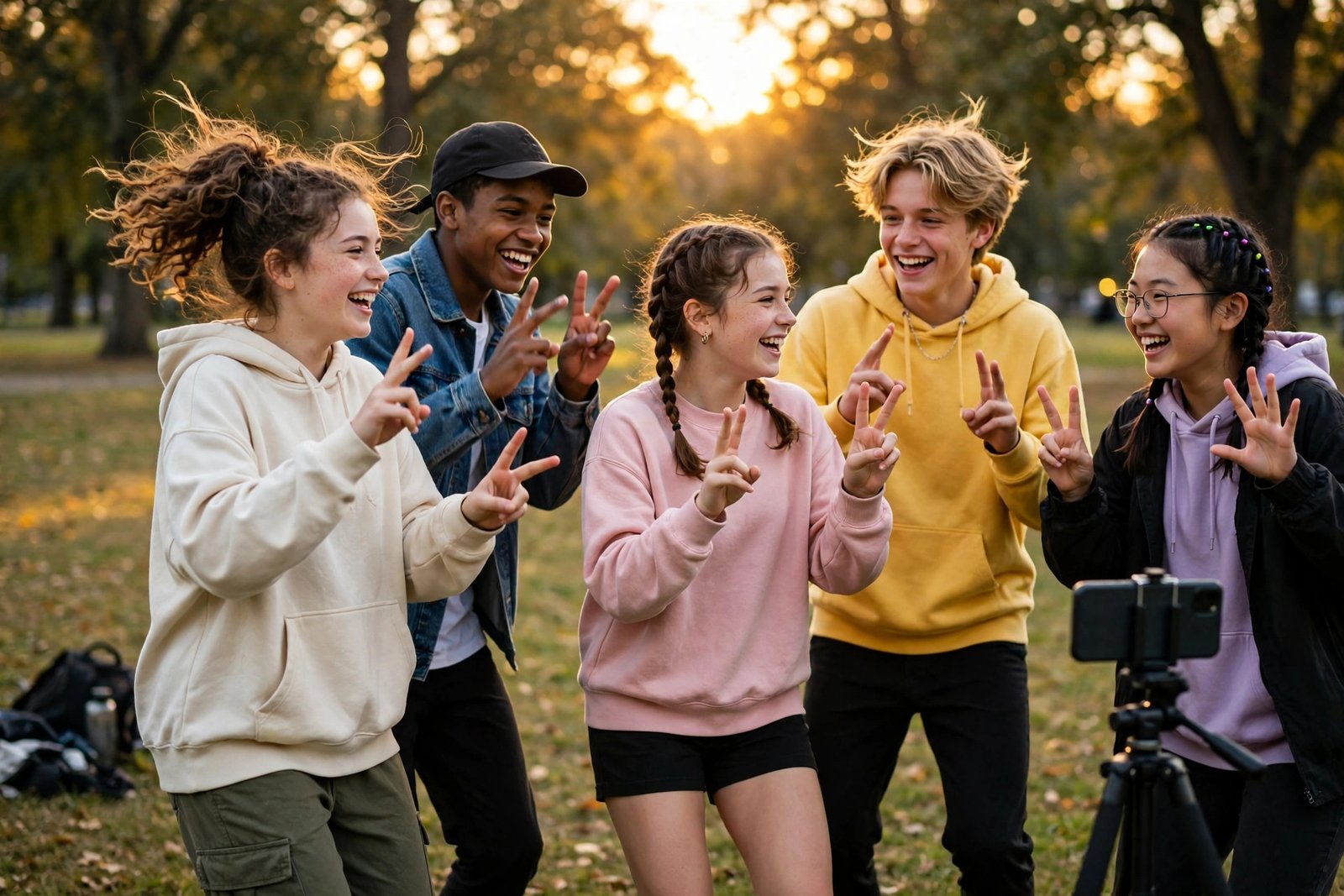
The biggest dance on TikTok right now did not come from a pop star’s choreographer, a movie musical, or a celebrity fitness routine. It came from a math lesson. The six seven TikTok dance — a finger-counting, shoulder-shrugging routine set to a Brazilian funk track — has spent October 2026 dominating For You pages around the world, and it might be the simplest viral dance the internet has ever produced.
Here is the part that sounds made up but isn’t: the song’s entire hook is a Portuguese addition problem. Twenty plus twenty plus twenty plus seven. The answer is sixty-seven. And millions of people are dancing to it.
What Is the Six Seven TikTok Dance?
The six seven TikTok dance is a short, endlessly repeatable routine built around counting. As the vocalist chants through the addition problem, dancers flash the numbers on their fingers in time with the lyrics — twenty, twenty, twenty, seven — and when the beat drops, everyone hits the same loose, unbothered shrug. That is the whole dance. No spins, no floor work, no complicated footwork. Just counting and a shrug.
According to Lightreel’s October 2026 TikTok trend report, the routine is the dominant trend on the platform this month, jumping from Brazilian dance floors into BTS fandom and then into living rooms, classrooms, school hallways, and wedding receptions everywhere. The genius of it is how little it asks of you. There is no choreography to memorize, no mirror-timed footwork to drill, and no need for a studio. If you can count on your fingers and shrug your shoulders, you already know the dance.
That low barrier to entry is exactly why the trend exploded the way it did. Most viral dances reward precision — hit the move at exactly the right frame or the video falls flat. This one rewards participation. Grandparents do it. Toddlers do it. Professional dancers do it with extra flair, and the algorithm loves all of them equally.
The Brazilian Funk Song Behind the Six Seven TikTok Dance
The track powering the trend is “Six Seven” by Brazilian singer Laurinha Costa, produced by DJ Cabello and DJ Tchouzen — a slice of Brazilian funk that arrived on YouTube back in April 2026 and has been climbing ever since. The lyric is essentially a classroom bit: the chant walks listeners through twenty plus twenty plus twenty plus seven, then lands on the answer, while the heavy funk beat carries the whole thing.
For listeners who don’t speak Portuguese, the language barrier barely matters, because numbers translate themselves. You can hear the count, you can see the fingers, and your brain fills in the rest. That universality is a huge part of why a regional Brazilian funk track — in a genre sometimes called brega-funk — managed to become a genuinely global sound. The beat does the heavy lifting, the math does the hook, and the listener does the rest.
The song’s structure is also perfectly built for TikTok. The chant builds anticipation with each number, the repetition makes the sound instantly recognizable within the first two seconds of a video, and the drop gives every creator the same satisfying payoff moment. Sounds that work on TikTok almost always have a clear “before and after” moment — a build and a release — and “Six Seven” has one of the cleanest examples of that formula in recent memory. It helps that the whole thing is short enough to loop without getting annoying, which matters more than most people realize for a sound’s survival on the For You page.
How the Six Seven Dance Works: The Moves Step by Step
There is no official rulebook, and that is the point — but almost every version of the routine follows the same skeleton:
- Face the camera and get in the groove. Most dancers start bouncing lightly to the funk beat, settling into the rhythm before the chant begins.
- Count along on your fingers. As the vocalist chants each number, hold it up — the twenties, then the seven. The exact finger styling varies by creator, which is half the fun; people show off their own flair here.
- Build the energy. With each number, dancers typically get bigger and more animated, milking the anticipation as the chant climbs toward the answer.
- Hit the shrug on the drop. When the beat lands, shoulders go up, palms turn out, and the whole body says “what can you do?” It is the signature moment — the move that makes the dance instantly recognizable even with the sound off.
- Loop it or tag a transition. Creators either loop the routine for the full video or use the shrug as a transition into something else — a location change, an outfit swap, a punchline.
The shrug deserves special attention, because it is doing more work than it looks like. A shrug is a universal gesture — it means the same thing in São Paulo, Seoul, and Seattle. That is why the dance traveled so fast across language barriers. You don’t need to understand the lyrics to understand the punchline.
Why Your Brain Can’t Resist the Finger-Counting Hook
There is real psychology behind why this dance burrowed into everyone’s head. First, counting along is participatory in a way most dance trends aren’t. Watching someone do a complicated routine makes you a spectator. Watching someone count on their fingers makes your own fingers twitch. The dance invites you in instead of showing off at you.
Second, the math gives your brain a tiny puzzle to solve. You hear the numbers stacking up — twenty, twenty, twenty, seven — and some part of your mind starts doing the addition before the song gives you the answer. That little moment of anticipation, the “wait, that’s sixty-seven” click, is a dopamine hit. Songs that make the listener’s brain do a small piece of work tend to stick around longer than songs that just wash over you.
Third, the routine is built for the group format that TikTok loves. Synchronized counting looks fantastic with two, four, or ten people, which means friend groups, sports teams, and families can all pile into one video. Every group video is effectively an advertisement for the trend, because each participant’s followers see it. The dance spreads the way a chain letter spreads — through personal networks, not just the algorithm.
How J-Hope Sent the Six Seven Dance to Another Galaxy
The trend was already big in Brazil, but it went stratospheric when BTS’s J-Hope joined in. When a member of the biggest boy band on the planet does your dance, the trend stops being regional and starts being global within hours. ARMY — BTS’s famously organized fanbase — picked up the routine immediately, and J-Hope’s version became the reference point that introduced the dance to audiences who had never heard of Brazilian funk.
This is a pattern worth noticing, because it keeps happening: a regional trend finds a global amplifier. K-pop idols have become some of the most powerful trend accelerators on TikTok, precisely because their fandoms are built for exactly this kind of coordinated participation. One J-Hope video does more for a trend’s global reach than weeks of organic growth. The six seven TikTok dance is just the latest example — and a particularly fun one, because watching one of the world’s best dancers do the world’s simplest dance is inherently entertaining.
It also says something about where TikTok culture is headed. The platform’s biggest moments increasingly come from collisions between scenes that used to be separate: Brazilian funk, K-pop fandom, American meme culture, all folding into one feed. The six seven dance is a Brazilian song, amplified by a Korean idol, performed by teenagers in Ohio. That is the modern internet in one routine.
Arthur Lima: The Brazilian Star Behind the Choreography
Before J-Hope, the dance’s biggest champion was Brazilian creator Arthur Lima, who commands an audience of around 15 million followers and became one of the faces of the trend’s breakout. His versions of the routine — including tutorials breaking down the moves — helped standardize what the dance looks like, giving millions of imitators a template to follow.
Tutorial videos were crucial to the trend’s spread. A dance this simple still benefits from someone showing you the rhythm, the attitude, the exact moment to hit the shrug. Lima’s tutorials, and the flood of copycat tutorials that followed, turned a fun video into a learnable skill — and “learnable in one minute” is one of the most powerful promises a TikTok video can make.
Wait — Isn’t “Six Seven” That American Meme From Last Year?
Good memory — and this is where it gets confusing. There are actually two completely unrelated “Six Seven” trends, and knowing the difference will save you from embarrassing yourself in the comments.
The American version came first: Skrilla’s “Doot Doot (6 7),” an English drill track that became a shouted catchphrase paired with a single hand gesture, popularized by creators like Taylen Kinney and Maverick Trevillian along with basketball edit accounts. By mid-2026, that version had largely burned out — adopted by brands, politicians, and eventually even the Pope, which is usually the moment teenagers decide a meme no longer belongs to them.
The Brazilian version — Laurinha Costa’s funk track with the math chant — is an entirely different piece of media that just happens to share a name. It had to be discovered rather than handed down, which is exactly why it felt fresh. The American “six seven” was a catchphrase you shouted. The Brazilian version is a routine you perform. Same numbers, completely different universe.
If someone tells you the trend is “dead” because the American version died, they are talking about a different song. The Brazilian version was still listed among TikTok’s dominant active trends through the late summer and into October 2026.
How to Learn the Six Seven TikTok Dance in Five Minutes
Want to join in? Here is the fastest path from confused to posting:
- Listen to the chant three times. Get the rhythm of the numbers in your head before you move. The count is the choreography.
- Practice the finger counting in a mirror. Flash each number in time with the lyric. Don’t overthink the styling — confidence matters more than precision.
- Nail the shrug. Shoulders up, palms out, face relaxed. The shrug should look effortless, like you just solved the math problem and you’re mildly proud of yourself.
- Film it with a friend. Synchronized versions outperform solo versions almost every time, because the counting looks better in unison.
- Use the trending sound. Search for the original “Six Seven” audio rather than a re-upload — the algorithm favors the canonical sound, and your video gets grouped with the trend.
- Add your own twist at the end. The best versions of the dance add one personal flourish after the shrug — a spin, a wink, a location reveal. That is what makes yours stand out in a sea of identical routines.
Why Brazil’s Funk Scene Keeps Taking Over TikTok
The six seven TikTok dance is not a fluke — it is part of a longer story. Brazilian funk has been quietly conquering global short-video platforms for years, because the genre is practically engineered for them: heavy, danceable beats, repetitive hooks, short song structures, and an endless supply of street-level creativity from the baile funk scene.
What makes funk exports like “Six Seven” work is that they don’t try to be universal. The song is unapologetically Brazilian — Portuguese lyrics, funk carioca DNA, local producers. And paradoxically, that specificity is what makes it travel. TikTok audiences are tired of content engineered for everyone; they respond to content that comes from somewhere real. A math chant from São Paulo feels more authentic than a focus-grouped pop single, and authenticity is the currency of the For You page.
There is also a practical lesson here for anyone watching trends for a living: the next global hit probably won’t come from a major label’s release calendar. It will come from a regional scene, a local producer, and a hook so simple a child could explain it. Twenty plus twenty plus twenty plus seven.
The Takeaway
- The six seven TikTok dance is October 2026’s dominant TikTok trend: a finger-counting routine set to a Brazilian funk math chant.
- The song “Six Seven” by Laurinha Costa (produced by DJ Cabello and DJ Tchouzen) hit YouTube in April 2026 and became a global sound.
- The routine is simple by design — count on your fingers, hit the shrug on the drop — which is why everyone from toddlers to J-Hope can do it.
- Don’t confuse it with America’s earlier “Six Seven” meme (Skrilla’s “Doot Doot (6 7)”) — different song, different trend, different universe.
- The trend’s real lesson: specificity travels. A Portuguese math chant from Brazil’s funk scene became a global phenomenon because it came from somewhere real.
This dance will eventually fade, as all trends do. Something simpler, weirder, or catchier will replace it. But for now, millions of people are united by the strangest thing: doing arithmetic together, on camera, to a funk beat. Twenty plus twenty plus twenty plus seven. You know the answer. Now shrug.
Love breaking down viral moments like this? Check out how Lisa’s “Sawadika” turned into a TikTok dance phenomenon, or see what made the Adela–Nicole Kidman song take over TikTok. For pure internet chaos, don’t miss the Punch macaque plushie craze.