
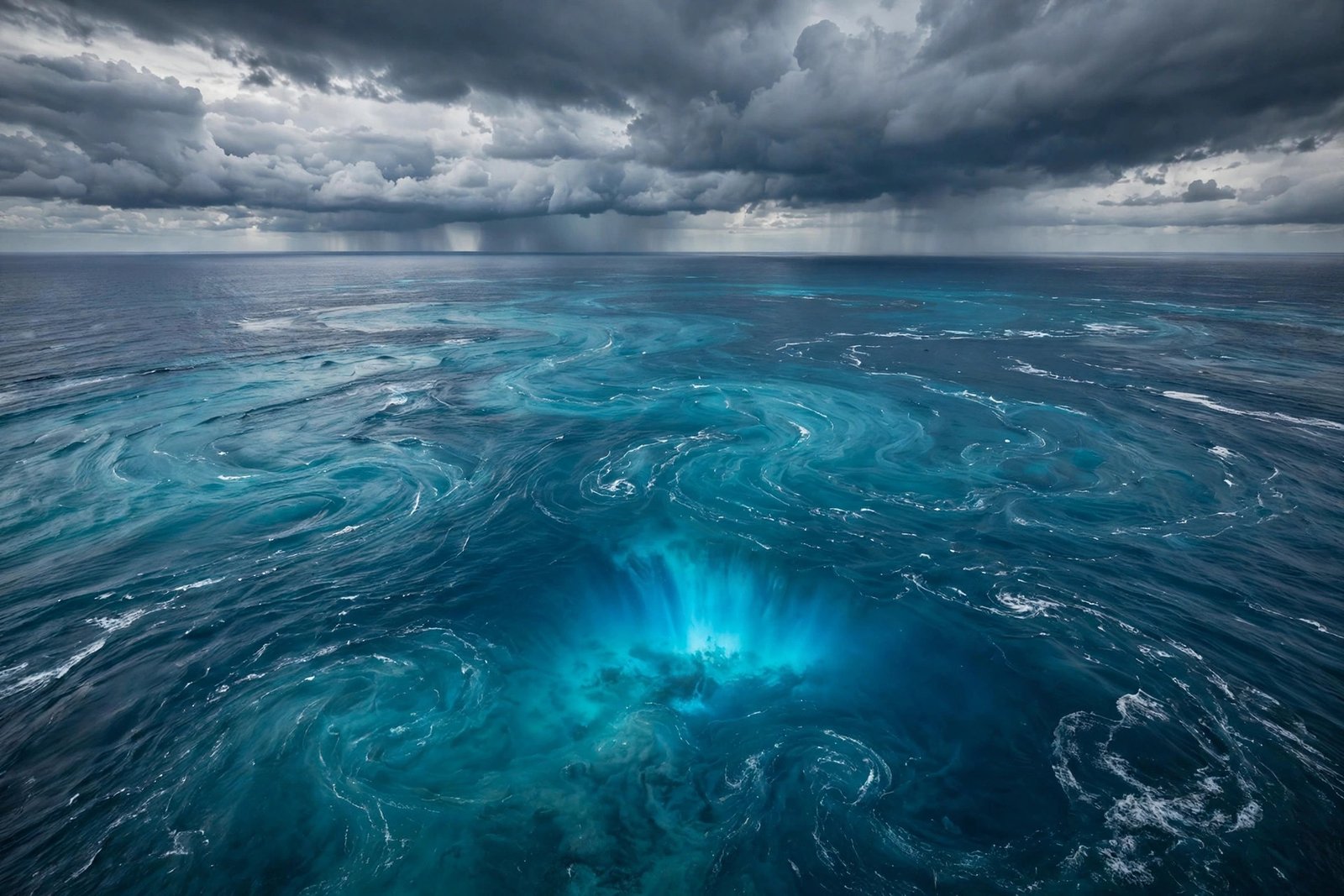
For more than half a century, the Bermuda Triangle has been the world’s favorite mystery. Ships vanish. Planes disappear. Theories range from freak weather to secret underwater bases. Now a real Bermuda Triangle discovery is setting the internet alight again, and this time the answer comes from deep underground, not from the skies above. Scientists have found a colossal layer of rock hiding beneath the island of Bermuda, a structure unlike anything ever seen on Earth, and it may finally explain why Bermuda refuses to sink. But before you jump to conclusions, here is the honest part up front: this Bermuda Triangle discovery does not explain the famous disappearances. What it does explain is something arguably stranger, a geological puzzle that has baffled scientists for decades.
What the Bermuda Triangle Discovery Actually Is
The Bermuda Triangle discovery at the center of the online buzz is a peer-reviewed scientific study, not a rumor or a viral video. Seismologist William Frazer of the Carnegie Institution for Science and Jeffrey Park of Yale University led the research, and their findings were published in the journal Geophysical Research Letters under the title ‘Thick Underplating and Buoyancy of the Bermuda Swell.’ The study reports a layer of rock roughly 20 kilometers thick, about 12.4 miles, sitting beneath Bermuda’s oceanic crust, in a place where the dense mantle should normally begin. According to the researchers, a layer this thick has never been reported beneath any other ocean island. The rock is about 1.5 percent less dense than the surrounding mantle material, and that small difference matters enormously. Because it is lighter, the layer acts like a giant raft, providing the buoyancy that holds Bermuda and the surrounding seafloor high above the deep ocean floor.
Bermuda itself is a small group of islands in the North Atlantic Ocean, sitting about 650 miles east of North Carolina and home to roughly 64,000 people. For decades, geologists were genuinely puzzled about why the island stays so elevated. Most volcanic islands slowly sink as they drift away from the hot mantle plume that built them, cooling and subsiding into the sea. Bermuda defied that pattern entirely. Its last volcanic eruption happened more than 30 million years ago, yet the island still sits roughly 1,600 feet above the surrounding ocean floor, and the broad underwater plateau around it, known as the Bermuda Rise, sits roughly 1,600 to 3,300 feet higher than the normal deep ocean floor. The new Bermuda Triangle discovery offers the first convincing explanation: the island is not being pushed up by heat from below, but held up by a lighter layer of rock frozen into place tens of millions of years ago.
How Scientists Found a Hidden Layer 12 Miles Down
Perhaps the most remarkable part of this find is how it was made. Nobody drilled 12 miles into the Earth. Nobody sent a submarine to look at the rock. Instead, Frazer and Park listened to earthquakes. They used a technique called receiver-function analysis, which turns distant earthquakes into probes of the planet’s interior. When a large earthquake happens anywhere on Earth, its seismic waves travel through the planet and speed up or slow down depending on the density and composition of the material they pass through, much like sound changing pitch as it moves through different substances. By studying recordings from a single seismic station permanently installed on Bermuda, the researchers were able to build a picture of the rocks beneath the island down to a depth of about 20 to 25 miles.
The team analyzed more than 20 years of natural earthquake vibrations recorded by that one station, processing hundreds of signals through specialized tools and high-frequency filters to sharpen faint echoes into a clear image. They identified the layers they expected to find: the oceanic crust, roughly 7 kilometers thick, and the boundary between the crust and the mantle, known as the Moho. But then they found something extra. Below the crust sat an additional layer of rock about 20 kilometers thick, with seismic wave speeds falling between those of typical crust and typical mantle. That layer is roughly two to three times thicker than similar features seen beneath other ocean islands, and the researchers say nothing like it has been reported anywhere else on the planet.
Frazer himself summed up why the finding matters. ‘Bermuda is an exciting place to study because a variety of its geologic features do not fit the model of a mantle plume, the classic way for deep material to be brought to the surface,’ he said, according to the Carnegie Institution for Science. ‘We observe thick underplating, something that is not observed at most mantle plumes.’ The process behind the layer is called underplating. Molten rock rises from the mantle but stalls before reaching the surface. Instead of erupting as lava, it spreads out beneath the crust and cools in place, thickening the rocky plate from below. The researchers believe this underplated layer formed during Bermuda’s volcanic period, around 30 to 35 million years ago, when carbon-rich molten mantle rock intruded into the base of the crust and cooled there.
Why Bermuda Refuses to Sink
To understand why this matters, picture how ocean islands normally age. A volcano erupts on the seafloor, builds an island, and then the tectonic plate carrying it drifts away from its heat source. The island cools, grows heavier, and slowly sinks. Hawaii is following this path, and many ancient Pacific islands have already slipped beneath the waves, becoming flat-topped seamounts. Bermuda should have done the same long ago. Its volcanoes fell silent more than 30 million years ago, and by every standard model, the island should be far lower than it is today.
The hidden rock layer changes that calculation. Because the underplated rock is slightly less dense than the mantle around it, it creates buoyancy, the same principle that lets a life raft float. The researchers calculated that the thickness and density contrast of the layer are sufficient, in principle, to support the observed height of the Bermuda Rise. In other words, Bermuda is not floating on heat. It is floating on rock. The discovery also challenges a long-standing assumption in geology: that not all ocean swells need constant deep heat to stay elevated. Some, it turns out, can be held up by permanent underground changes that happened tens of millions of years ago and never went away.
This is why the finding has excited geologists far beyond Bermuda. If one island can stay afloat on a hidden raft of light rock, others might too, and our maps of how the seafloor rises and falls may need revision. The deep ocean remains poorly understood in many of its physical processes, and the Bermuda findings are a reminder that some of the most significant discoveries are still hiding directly beneath our feet.
The Bermuda Triangle Discovery Does Not Explain the Vanishings
Here is where honesty matters most. A Bermuda Triangle discovery this dramatic was always going to attract wild theories, and within days of the story going viral, social media was full of claims that scientists had found the reason ships and planes disappear. Some posts suggested hidden magnetic forces, underwater structures, or even secret bases. None of that is what the study says. The researchers studied geology, not disappearances, and their paper says nothing about lost ships or planes. The rock layer sits miles beneath the island. It cannot swallow a ship, bend a compass, or pull a plane from the sky.
Scientists have been equally clear about the disappearances themselves. The United States National Oceanic and Atmospheric Administration has long stated that there is no evidence that mysterious disappearances occur with any greater frequency in the Bermuda Triangle than in any other large, well-traveled area of the ocean. The U.S. Navy and Coast Guard have reached similar conclusions. The Triangle, roughly bounded by Florida, Bermuda, and Puerto Rico, is one of the busiest shipping lanes on Earth, crossed by heavy commercial traffic, cruise ships, and small private boats, and it is swept by sudden storms, powerful currents, and the Gulf Stream. When huge numbers of vessels cross a storm-prone stretch of ocean, accidents happen, and a busy area will always produce more incidents than a quiet one.
Oceanographer Simon Boxhall of the University of Southampton has offered one of the most widely cited natural explanations: rogue waves. These are unusually large, sudden waves that can form when storms converge from multiple directions, and they can appear without warning in open ocean. In a related experiment, researchers reconstructed a scale model of the USS Cyclops, a ship that vanished in the region during World War I, to test how such waves might overwhelm a large vessel. The results supported the idea that extreme seas, rather than anything supernatural, could account for at least some of the historical losses.
The Disappearances That Built the Legend
Even so, the stories that built the Bermuda Triangle legend are genuinely haunting, and they deserve to be told accurately. The most famous is Flight 19. On December 5, 1945, five U.S. Navy TBM Avenger torpedo bombers took off from Fort Lauderdale, Florida, on a routine training flight over the Atlantic. The flight leader became disoriented, radio transmissions grew confused, and all five planes vanished. A rescue seaplane sent to search for them also disappeared. The official Navy investigation attributed the loss to navigational error and fuel exhaustion, but the mystery of five planes vanishing at once became the founding legend of the Triangle.
Another is the USS Cyclops, a Navy cargo ship that disappeared in March 1918 while sailing from Barbados to Baltimore with 309 crew members aboard. No distress call was ever received, and no wreckage was ever found. The Cyclops remains one of the largest non-combat losses of life in U.S. naval history, and its fate is still officially unexplained, though storms, structural failure, and wartime hazards have all been proposed. Then there is the Mary Celeste, found drifting crewless near the Azores in 1872, her cargo intact and her lifeboat gone. She was not lost inside the Triangle itself, but her story is so often folded into the legend that she has become part of it anyway. If you want the full background on these cases, our earlier guides cover them in depth: the Bermuda Triangle mystery explained and the ships and planes that vanished in the Bermuda Triangle. The ghost ship Mary Celeste mystery gets its own deep dive too.
What connects these stories is not a single cause but a pattern of human storytelling. A real tragedy happens at sea, details go missing, and the gap fills with imagination. The Triangle’s reputation was largely built in the 1960s and 1970s by books and magazine articles that collected the most dramatic cases while leaving out the ordinary explanations, and later writers repeated the collection without checking it. Researchers who have gone back through the original records have found that many supposed Triangle mysteries were misreported, exaggerated, or happened outside the Triangle entirely, in bad weather that was known at the time.
Why the Story Exploded Online Again in November 2026
If the study was published in late 2025, why is everyone talking about it in November 2026? The answer says a lot about how science news travels now. The research was covered by major outlets including NDTV, WION, and Moneycontrol when it first appeared, but in recent weeks it has been rediscovered and repackaged across social platforms, news aggregators, and video channels, some of which present the geological finding as though it were a brand-new announcement. Headlines promising that the Bermuda mystery ‘just got a real answer’ have racked up huge engagement, and each retelling adds a little more drama. That is the nature of viral science: a genuine discovery, a compelling image of something hidden 12 miles underground, and a mystery everyone already knows the name of.
Alongside the real study, less reliable claims have circulated too, including sensational posts about artificial intelligence scanning the Triangle and flagging structures that ‘do not look human.’ Readers should treat those claims with caution. They do not come from the peer-reviewed study, they are not backed by named research teams or published data, and the scientists involved in the real discovery have emphasized that there is no evidence of anything artificial or unexplained beneath Bermuda. The genuine story is exciting enough without embellishment: a hidden layer of rock, twice as thick as anything seen before, quietly holding an island above the sea for 30 million years.
What Scientists Still Do Not Know
For all its elegance, the underplating explanation still leaves open questions, and the researchers are the first to admit it. The exact composition of the hidden layer is unknown. Seismic waves can reveal that the layer exists, how thick it is, and how fast waves move through it, but they cannot identify minerals directly. The layer might be a simple slab of cooled basalt, or it might be a hybrid zone, part magmatic rock and part mantle rock altered by carbon- and water-rich fluids. Its precise origin is also still debated. The leading idea is that an ancient volcanic eruption was so massive that it injected mantle rock directly into the base of the crust, but other scenarios are still being considered.
There is also the question of whether Bermuda is truly unique. The researchers say this thick underplating has not been observed at most mantle plumes, but that may partly reflect how rarely anyone looks this closely. The Bermuda result came from a single seismic station and two decades of patient data collection. Similar hidden layers could exist beneath other islands and simply never have been detected. Future seismic surveys of other ocean islands will test whether Bermuda is a one-off or the first example of a wider phenomenon. Either answer would be important, and that is exactly why the study matters.
Key Takeaways
- Scientists found a rock layer about 20 kilometers (12.4 miles) thick beneath Bermuda, between the oceanic crust and the mantle.
- The layer is slightly less dense than the surrounding mantle, so it acts like a raft, holding Bermuda and the Bermuda Rise high above the deep ocean floor.
- The layer likely formed 30 to 35 million years ago during Bermuda’s volcanic period, and it explains why the island never sank after its volcanoes went quiet.
- The discovery was made by analyzing 20-plus years of earthquake data from a single seismic station on Bermuda.
- It does not explain the Bermuda Triangle disappearances, which scientists attribute to weather, rogue waves, heavy traffic, and human error.
- The study was published in Geophysical Research Letters and went viral again in November 2026 as the story was rediscovered online.
The real Bermuda Triangle discovery is not a portal, a vortex, or a secret base. It is something better: proof that our own planet still keeps secrets, and that patient science can find them. A single seismic station, two decades of earthquake echoes, and a layer of rock no one knew existed have rewritten what we understand about why islands float. The ships and planes of the Triangle remain a story of weather, human error, and the unforgiving sea. But the island at the Triangle’s eastern corner turns out to be standing on a hidden raft of stone, 12 miles thick, holding it above the abyss for 30 million years. That is a mystery solved, and a new one opened, all at once.
What was discovered beneath the Bermuda Triangle?
Who discovered the hidden rock layer beneath Bermuda?
Does the Bermuda Triangle discovery explain the missing ships and planes?
How did scientists find a rock layer 12 miles underground?
Why has Bermuda not sunk like other volcanic islands?
Sources: Carnegie Institution for Science; Frazer and Park, ‘Thick Underplating and Buoyancy of the Bermuda Swell,’ Geophysical Research Letters (DOI: 10.1029/2025gl118279); NDTV; WION; Moneycontrol; The Bermudian.