
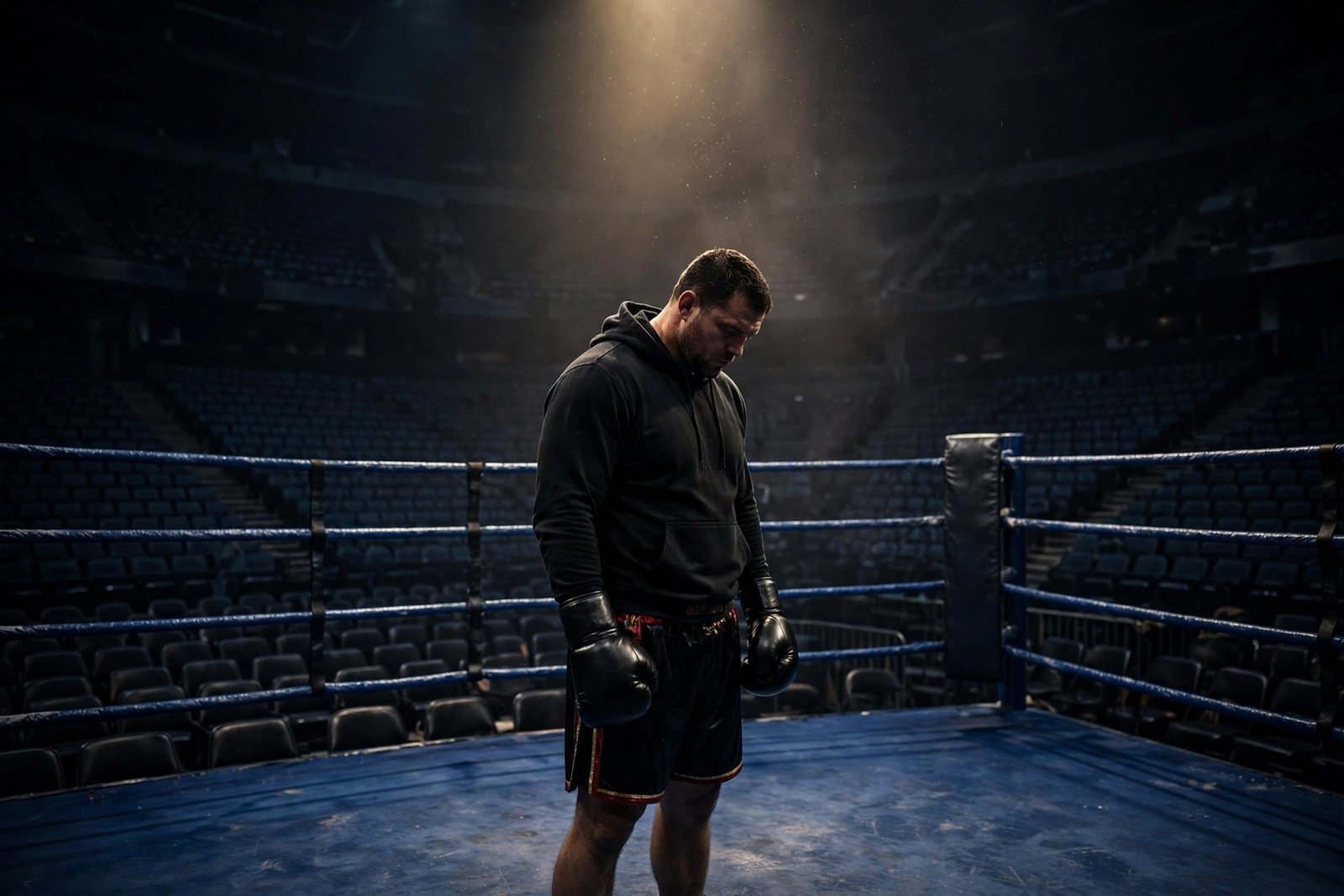
He is one of the most feared men in boxing, a two-time world heavyweight champion who has stared down the biggest punchers of his generation without flinching. But in a new Netflix documentary, Tyson Fury has revealed a fight nobody saw: a diagnosis of schizophrenia, delivered after a terrifying hospital episode in 2016 that left him convinced people were trying to kill him. The Tyson Fury schizophrenia revelation, reported in November 2026 ahead of the documentary’s release, is one of the most candid mental health disclosures ever made by an active elite athlete, and it has already changed the conversation about what strength looks like in professional sport.
Fury’s wife, Paris Fury, shares the story alongside him, describing the night she found her husband in a hospital bed, wired up to monitors and terrified, begging her to get him out because he believed a secret conspiracy wanted him dead. The details are raw, frightening, and deeply human. They are also, according to the couple, the reason Fury is speaking now: because staying silent nearly cost him everything, and because he believes other people living with the same symptoms need to know they are not alone. This is the story of what Fury has revealed, what his wife saw, what schizophrenia means in general terms, and why this disclosure matters far beyond boxing.
Tyson Fury Schizophrenia: What He Has Revealed
The Tyson Fury schizophrenia diagnosis was revealed in the Netflix documentary Tyson Fury, which is set to be released on November 27, 2026. According to reports of the film, Fury says he was diagnosed with schizophrenia and bipolar disorder after being admitted to hospital in June 2016 with what was first feared to be a heart attack. Doctors concluded he had suffered an anxiety attack, but the episode led him to seek psychiatric help in London, where the diagnoses followed. Fury is 38 years old, a father of seven, and he describes the period after his career-defining victory as a collapse into darkness.
In the documentary, Fury speaks about the severity of what he was experiencing in stark terms. He says, in words reported by the Times of India, “Words can’t explain the darkness I was in. It was like a living version of the pits of hell. I thought I would end up in a padded room with the door locked, and that scared me so much.” He describes hearing voices and believing that the radio was speaking directly to him. The New York Post reports that Fury said the voices in his head threatened his family, and that the radio seemed to be having a full conversation with him, saying, in the words reported, “No one’s untouchable, we can get you at any time, if you don’t behave yourself we’ll kill your father.”
Paris Fury, his wife, describes arriving at the hospital to find him frightened and desperate to leave. She recalls him telling her, as reported by multiple outlets covering the documentary, “Get me out of here. The Illuminati, they’re all in on it. They can’t make me be quiet so they’re going to kill me.” Paris has said that Fury is, in her words, “a mild schizophrenic,” and she has spoken openly about how little she understood the diagnosis at first. She told The Sun, as reported in coverage of the film, that when doctors explained the condition she thought, “Don’t be silly. What’s she on about? Maniacs are schizophrenic.” It was only when someone explained bipolar disorder to her, describing the swings between high energy and being unable to leave the house, that she recognized her husband in the description. As she put it, in words reported by NBC Sports Boston, “Like wow, that’s him to a T.”
Reports of the documentary also note that Fury was diagnosed with depression and anxiety alongside bipolar disorder, and some reports mention additional diagnoses, including obsessive-compulsive disorder and attention deficit hyperactivity disorder. What matters most is the picture the couple paints together: a man at the very top of his sport, privately living through fear, paranoia, and voices that no one else could hear.
The Rise, the Fall, and the Darkness After Klitschko
To understand why Fury’s revelation hits so hard, you have to understand where he was when it happened. On November 28, 2015, Tyson Fury achieved what he had dreamed about since childhood: he defeated the long-reigning heavyweight champion Wladimir Klitschko in Germany, winning a 12-round unanimous decision to become the unified heavyweight champion of the world. It was one of the great upsets in modern boxing, and it made Fury, then 27, the man at the top of the sport’s most glamorous division.
But the victory hollowed him out. In the documentary, Fury explains that he had spent his whole life dreaming of beating Klitschko, and once it happened, there was nothing left to chase. “I achieved all my childhood dreams,” he says, in words reported by NBC Sports Boston. “And then when I finally beat this man, it was like my whole point of existence had been taken away.” The months that followed brought the collapse: weight gain, drinking, drug use, and a deepening depression that he has spoken about in interviews for years. The June 2016 hospital admission was the crisis point, the night the private struggle became impossible to hide.
What followed was a long road back. Fury has said that he did not make a real effort to get well until a night out on Halloween in 2017, a turning point he has described before. Slowly, he rebuilt himself, returned to training, and in 2020 he reclaimed a world heavyweight title with his victory over Deontay Wilder, completing one of the most famous comebacks in boxing history. That comeback is why Fury’s story resonates so widely. He did not just fall and recover. He fell from the very top, disappeared from the sport for years, and then climbed all the way back to a world title.
His career since then has kept him at the center of heavyweight boxing. He announced his retirement in early 2025, but has since returned to the ring, winning two bouts earlier in 2026, and his professional record stands at 36 wins, 2 losses, and 1 draw. Now he is preparing for one of the biggest fights of his career: a long-awaited all-British heavyweight contest against Anthony Joshua, scheduled for December 11, 2026, at the Principality Stadium in Cardiff, a fight described in reports as a major stadium event. The documentary is released just weeks before that fight, which means Fury is walking into the biggest night of his recent career having just told the world about the darkest period of his life.
What Is Schizophrenia? The Condition in General Terms
Because the Tyson Fury schizophrenia disclosure has put the condition in headlines around the world, it is worth understanding what schizophrenia actually is, in general terms, and what it is not. According to the UK’s National Health Service, schizophrenia is a form of psychosis, a mental health condition in which a person can struggle to tell what is real from what is not. Its symptoms can include hallucinations, such as hearing voices, delusions, which are strongly held beliefs that are not based in reality, and confused thoughts or speech. Bipolar disorder, which Fury was also diagnosed with, is a separate condition involving extreme mood swings, from periods of high energy and elation to periods of deep depression.
It is important to be clear about a few things. Schizophrenia affects different people in different ways, and the severity and pattern of symptoms vary widely from person to person. Paris Fury’s description of her husband as a “mild schizophrenic” reflects how his doctors described his case to the family, not a formal medical category. The condition is a health condition, not a character flaw, and it is not the same as the frightening stereotypes that have long surrounded it in films and tabloid headlines. The outdated idea that people with schizophrenia are dangerous or, as Paris herself initially assumed, “maniacs,” is a stigma that mental health charities have spent decades trying to correct. In reality, people living with schizophrenia are far more likely to be harmed than to harm others, and many live full, working, family lives with the right support.
That support typically involves ongoing care from mental health professionals, and Fury himself has said that he now sees a psychiatrist every week as he continues to manage his mental health while preparing for the Joshua fight. This article does not describe a treatment plan for Fury or anyone else, because his specific care is a private matter between him and his doctors, and because treatment for schizophrenia is always individual. The general point is simpler: schizophrenia is a recognized, treatable health condition, and regular professional support is a normal and important part of living with it.
The Signs His Wife Noticed
One of the most powerful parts of the documentary is Paris Fury’s account, because it shows what a mental health crisis can look like from the outside, to the person who loves the patient most. Paris was pregnant at the time of the hospital episode, and she rushed to be by her husband’s side. What she found was a man she barely recognized: wired up to monitors, seriously frightened, and convinced that shadowy forces were conspiring against him and his family. “I get there and Tyson looks at me, he’s got wires around him. He looks seriously frightened,” she says in the film, as reported by the New York Post.
She recalls him looking her dead in the eyes and saying, “Paris, get me out of here, they’re trying to kill me.” In her account, he believed the Illuminati were involved and wanted to silence him. “I was so scared for him,” she says. “I could see he was gone, he’d flicked the switch.” Her description captures the disorientation that families often feel in these moments: the person in front of you looks the same, but the world they are experiencing is terrifyingly different from yours.
Paris has also spoken about the confusion that followed the diagnosis itself. She had never heard of bipolar disorder before, and she did not understand what schizophrenia meant. Her honesty about that confusion is valuable, because many families react the same way when a loved one is diagnosed. The medical words sound alarming, the reality is hard to grasp, and it takes time and explanation before the diagnosis starts to make sense. Her journey from “Don’t be silly” to “that’s him to a T” is, in miniature, the journey many families take.
Why the Tyson Fury Schizophrenia Disclosure Matters So Much
Tyson Fury is not the first athlete to speak about mental health, but his disclosure carries unusual weight for several reasons. First, he is a heavyweight boxer, competing in a sport built on an image of toughness, fearlessness, and invulnerability. The idea that the Gypsy King, a man whose nickname celebrates his Irish Traveller heritage and whose ring persona is all swagger and menace, lives with schizophrenia and bipolar disorder cuts directly against every stereotype of what a fighter is supposed to be. That is precisely why it matters. If Tyson Fury can say it, the logic goes, anyone can.
Second, Fury is speaking while still active, still training, and still preparing for a massive fight. This is not a retired athlete reflecting safely from a distance. He is a 38-year-old father of seven who will walk into a stadium in Cardiff on December 11 to face Anthony Joshua, and he is doing it with the whole world now knowing about his diagnoses. That takes a different kind of courage from the kind he shows in the ring, and it sends a message to young athletes in particular: a mental health condition does not disqualify you from competing at the highest level.
Third, the timing matters. Fury has spoken about his mental health before, including his depression after the Klitschko win, but the schizophrenia diagnosis is new public information. By sharing it in a Netflix documentary, with his wife beside him, he has put it in front of millions of viewers at once, not just boxing fans. For people living with schizophrenia, who often face stigma and isolation, seeing a world-famous athlete describe the same experiences, the voices, the paranoia, the fear, can be genuinely life-changing. It says: this happens to people like him, and it can happen to people like you, and it is nothing to be ashamed of.
The reaction so far has been largely supportive. Coverage of the revelation has focused on the courage of the disclosure and on the importance of the conversation it starts, rather than on sensationalizing the symptoms. Fans, fellow boxers, and mental health advocates have praised Fury and Paris for their openness. That response matters too, because every high-profile disclosure that is met with respect makes the next one easier.
What This Means for the Joshua Fight
The documentary’s release, on November 27, 2026, comes just two weeks before Fury’s fight with Anthony Joshua on December 11, and that timing has naturally raised questions. Is the disclosure a distraction? Will it affect his preparation? Or will it free him to fight without the weight of a secret?
Only Fury and his team know the answer, and it would be wrong to speculate about his mental state ahead of the fight. What can be said is that Fury has fought at the highest level while managing his mental health for years, including in his comeback victories, and that he has said he sees a psychiatrist every week. The Joshua fight is being billed as one of the biggest heavyweight contests of the generation, an all-British showdown years in the making, and it will be broadcast live on Netflix. Whether the documentary helps or hinders him, the Tyson Fury schizophrenia revelation guarantees the fight will be watched through a new lens: not just as a sporting contest, but as the next chapter in a story about resilience that Fury has now told in full.
For Joshua, the fight is equally huge, a chance to settle one of boxing’s longest-running debates about who is the best British heavyweight of their era. For the sport, it is a rare event that transcends boxing itself. And for the public conversation about mental health, it is a test of whether a fighter can be both a feared heavyweight and an open advocate for people living with schizophrenia. Fury seems determined to prove that he can be both.
Takeaways: What Fury’s Revelation Teaches Us
- The diagnosis: The Tyson Fury schizophrenia revelation confirms he was diagnosed with schizophrenia and bipolar disorder after a hospital admission in June 2016, following his 2015 victory over Wladimir Klitschko.
- What he experienced: He has described hearing voices, believing the radio was talking to him, and fearing that a conspiracy wanted to harm him and his family.
- His wife’s role: Paris Fury has spoken about the frightening hospital night, her initial confusion about the diagnosis, and how the explanation eventually made sense of what she had seen.
- What schizophrenia is: A form of psychosis, in general terms, that can involve hallucinations, delusions, and confused thinking. It affects people differently, and it is a health condition, not a character flaw.
- Why it matters: An active world-class athlete speaking openly about schizophrenia challenges stigma and shows that a mental health condition does not end a career or a life.
- What comes next: Fury’s Netflix documentary is released on November 27, 2026, and he faces Anthony Joshua in Cardiff on December 11, 2026.
If you or someone you know is struggling with mental health, the most important step is to speak to a doctor or a qualified mental health professional. In the UK, the Samaritans can be reached at 116 123, and in the US, the 988 Suicide and Crisis Lifeline can be reached by calling or texting 988. You do not have to face it alone, and asking for help is a sign of strength, not weakness.
Tyson Fury’s story is, in the end, a story about two kinds of comebacks. The first was the sporting one: from the darkness after Klitschko to a world title against Deontay Wilder, a return that boxing fans will talk about for decades. The second is the personal one, and it is still unfolding. By telling the world about his schizophrenia diagnosis, Fury has turned a private struggle into a public act of courage, and whatever happens in Cardiff on December 11, that act will outlast the fight. If you enjoy stories of extraordinary comebacks and unexpected turns, like the record-breaking GTA 6 first-day sales that stunned the entertainment world or the long wait behind the GTA 6 launch after 13 years, Fury’s journey belongs in the same conversation. And for more true stories that defy belief, our accounts of the dancing plague of 1518 and the Boston molasses flood of 1919 are waiting for you.
Has Tyson Fury been diagnosed with schizophrenia?
What did Tyson Fury say about hearing voices?
What is schizophrenia?
When is the Tyson Fury documentary released?
When does Tyson Fury fight Anthony Joshua?
Sources: New York Post, Tyson Fury heard voices in head as he reveals schizophrenia diagnosis; NBC Sports Boston, Tyson Fury reveals schizophrenia diagnosis; Times of India, Tyson Fury diagnosed with schizophrenia; Gulf News, Tyson Fury opens up about schizophrenia diagnosis; EssentiallySports, Tyson Fury on his mental health battle.