
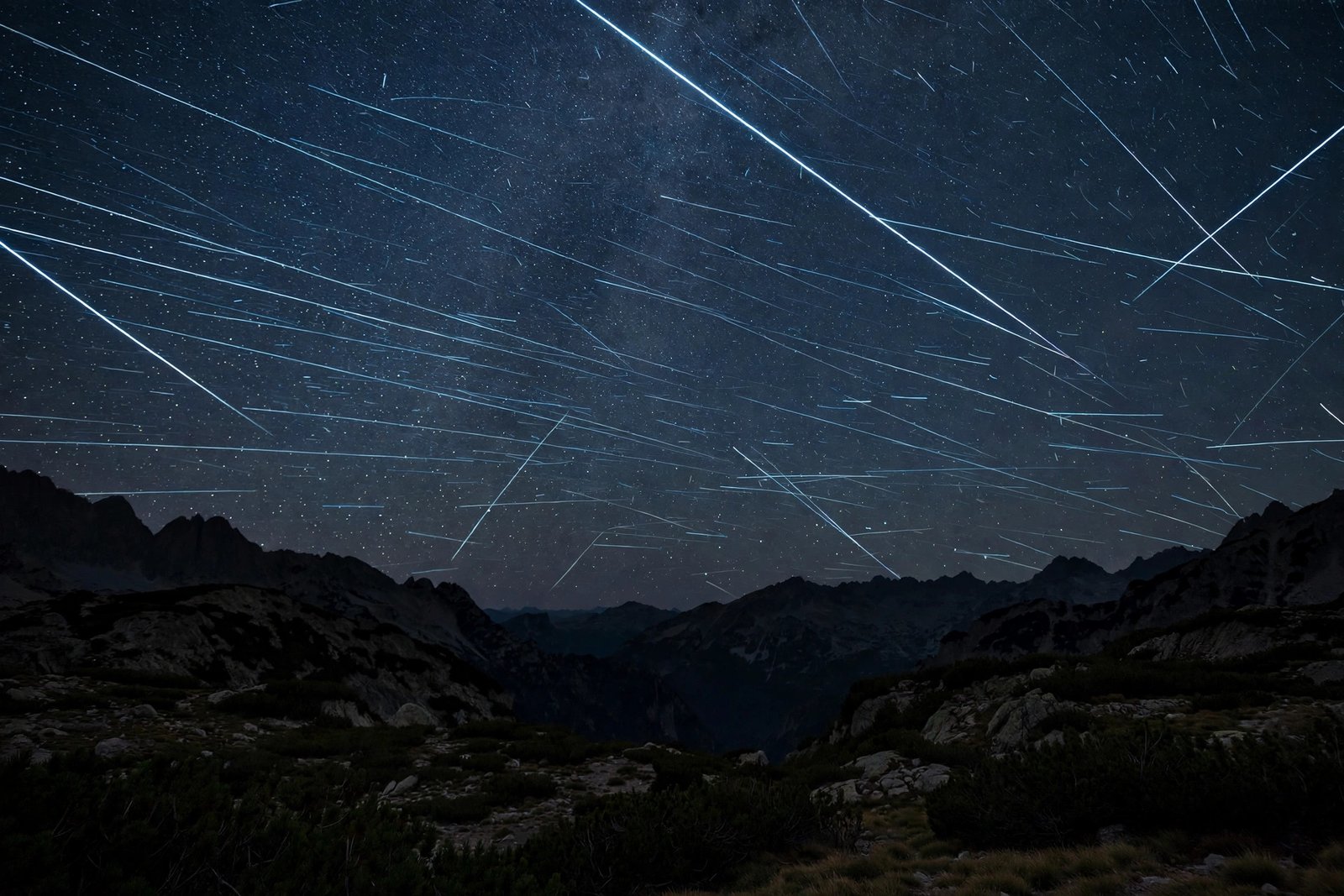
Look up at the night sky on a clear, dark evening and you might see a few thousand stars. Now look again, a little more carefully, and you may notice something else: steady points of light gliding silently across the darkness, one after another, in neat lines. Those are not stars. They are satellites, and astronomers are now warning that we may soon live in a world where there are satellites more than stars visible in the night sky. It sounds like science fiction, but the numbers behind it are very real, and the change is happening faster than almost anyone expected.
For most of human history, the night sky belonged to the stars. Poets wrote about them, sailors steered by them, and children learned their patterns before they learned to read. Today, the sky above us is filling up with machines. Thousands of satellites already circle the Earth, and tens of thousands more are planned. The question is no longer whether the night sky will change, but how much of the old sky we will still be able to see when the change is done.
Satellites More Than Stars: Counting What We Can See
The claim that there could soon be satellites more than stars in the night sky sounds impossible until you look at the two numbers side by side. On a perfectly dark night, far from city lights, the human eye can see roughly 2,500 to 3,000 stars at any one moment. Across the whole sky, over the course of a night, the total number of stars visible to the naked eye is around 9,000. That sounds like a lot, until you compare it with what is happening in orbit.
According to the Union of Concerned Scientists satellite database, the number of active satellites in orbit has passed 11,000, and it keeps climbing. SpaceX’s Starlink constellation alone accounts for more than 8,000 of them, and the company has permission to launch many thousands more. When you add the satellites operated by other companies and countries, including Amazon’s Project Kuiper and China’s planned constellations, the total number of satellites in low Earth orbit could reach 50,000 or more within a decade. That is far more than the number of stars any person can see with the naked eye.
Of course, not every satellite is visible from the ground at the same time. Most are too small or too dim to spot without a telescope, and only a fraction pass overhead on any given night. But the trend is unmistakable. In the early 2010s, a stargazer might see a satellite cross the sky every few minutes. Today, observers in dark-sky locations report seeing them constantly, sometimes several at once. The sky is getting crowded, and the crowd is growing every week.
The Rise of the Mega-Constellations
For decades, satellites were rare and expensive. Governments and a handful of companies launched a few hundred of them, mostly for television, weather forecasting, and military use. Then everything changed. A new generation of companies realized they could launch thousands of small, cheap satellites into low Earth orbit to beam internet down to the ground. SpaceX led the way with Starlink, launching batches of 60 satellites at a time on reusable rockets, and the pace has only accelerated since.
The promise of these mega-constellations is genuinely exciting. Starlink already brings high-speed internet to remote villages, ships at sea, and disaster zones where ground networks have failed. In parts of the world where laying fiber-optic cable is impractical, a satellite connection can be life-changing. Farmers, students, and doctors in rural areas can suddenly get online. That is a real benefit, and it is why regulators have approved so many launches. If you love cosmic surprises, check out our roundup of 8 space facts that sound fake but are real.
But there is a cost, and it is written across the sky. Each new satellite adds another moving point of light, and the constellations are designed to fly in organized trains that can be strikingly visible just after sunset. Skywatchers have photographed long strings of Starlink satellites marching across the sky like a line of glowing beads. For astronomers, those bright trails are more than a curiosity. They are a problem.
What Satellites Do to the Night Sky
Satellites shine because they reflect sunlight. After sunset, when the ground below is dark, satellites hundreds of kilometers overhead are still catching the sun’s rays. That is why they are brightest in the hours after dusk and before dawn, exactly when many people go outside to look at the stars. A satellite crossing the field of view of a telescope leaves a bright streak across the image, sometimes ruining hours of careful observation.
The effect is not limited to professionals. Amateur astronomers, astrophotographers, and anyone who simply loves a dark sky can see the change. Wide-angle photographs of the Milky Way now often include satellite trails, and time-lapse videos of the night sky show them drifting through frame after frame. Falling space hardware is a related worry: a chunk of space debris was found in a Minnesota cornfield. The Vera C. Rubin Observatory in Chile, one of the most powerful survey telescopes ever built, is expected to have satellite trails in a large share of its images once it reaches full operation.
There is also a subtler effect. All those satellites add a faint glow to the sky itself, a kind of artificial brightness that washes out the faintest stars. Researchers have measured a general brightening of the night sky over the past decade, and while city lights are still the main cause, satellite reflections are becoming a measurable part of the problem. The darkest skies on Earth are no longer as dark as they were a generation ago.
Why Astronomers Are Worried
Astronomers have been raising the alarm for years, and their concern goes beyond pretty pictures. Modern astronomy depends on catching extremely faint light from distant galaxies, exploding stars, and asteroids that might one day threaten Earth. A bright satellite streak can hide a faint object, or worse, be mistaken for one. Surveys that scan the whole sky every few nights are especially vulnerable, because they cannot simply wait for a satellite to pass.
The International Astronomical Union, the body that names planets and coordinates global astronomy, has set up a dedicated center to study the problem and work with satellite operators. SpaceX has tried to help by darkening its satellites and adding sunshades, and newer designs are dimmer than the first ones. But dimmer is not invisible, and with tens of thousands of satellites planned, even dim satellites add up.
The stakes are also cultural. The night sky is shared heritage. Indigenous communities around the world have star stories that go back thousands of years, and those stories depend on being able to see the stars clearly. Dark-sky tourism is growing too, with people traveling to remote places just to see the Milky Way. If the sky fills with satellites, something ancient and universal becomes harder to experience.
What Stargazers Can Still Do
The news is not all bad. There are still places on Earth where the night sky is breathtakingly dark, and there are still hours of the night when satellites are less visible. In the middle of the night, when satellites pass into Earth’s shadow, they go dark, and the stars take over again. The best stargazing still happens after midnight, far from city lights, under a moonless sky.
There are also practical steps. Satellite tracking apps can tell you when bright satellites will pass overhead, so you can plan around them, and our Leonid meteor shower guide for November 2026 can help you pick the best nights to look up. Astronomers are developing software that can detect and remove satellite trails from images. And satellite companies are under real pressure to keep their spacecraft as dim as possible, with regulators in some countries now asking about brightness before approving launches.
For anyone who loves the night sky, the most important thing is to go out and look while the old sky is still there. Visit a dark-sky park, learn a few constellations, and show a child the Milky Way. The sky is changing, but it is still one of the most beautiful things on Earth, and it is worth protecting.
The Future of the Night Sky
So will there really be satellites more than stars in the night sky? In terms of raw numbers in orbit, the answer is already close to yes. In terms of what your eye actually sees on a given night, the stars still win, for now. But the gap is closing fast. Within a few years, a person looking up on a clear evening could plausibly count more moving satellites than visible stars in some parts of the sky.
What happens next depends on choices made now. Regulators could set limits on how many satellites can fly and how bright they can be. Companies could design quieter, darker spacecraft. Astronomers and satellite operators could keep working together, as many already are. Or the launches could continue unchecked until the night sky is permanently changed.
The night sky has survived thousands of years of human history. It guided our ancestors across oceans and inspired our greatest stories. Whether it survives the satellite age in anything like its old form is up to us, and the decisions are being made right now, one launch at a time.
Key Takeaways
- Only about 2,500 to 3,000 stars are visible to the naked eye at any one moment, and around 9,000 across the whole sky.
- There are already more than 11,000 active satellites in orbit, with Starlink alone accounting for over 8,000 of them.
- Tens of thousands more satellites are planned, which could soon mean satellites more than stars in the visible night sky.
- Satellites reflect sunlight after sunset, leaving bright trails in telescope images and adding glow to the sky.
- SpaceX has dimmed newer satellites, and astronomers are working with operators, but the problem grows with every launch.
- The darkest hours after midnight are still the best time for stargazing, when many satellites fall into Earth’s shadow.
In the end, the story of the changing night sky is a story about trade-offs. Satellite internet connects people who have never been online, and that matters. But the stars belong to everyone, and they have belonged to everyone for as long as there have been people to look up. The challenge of the next decade is to keep both: a connected world below, and a sky above that is still worth looking at. Go outside tonight, look up, and decide for yourself what you want the future sky to look like.
How many satellites are in orbit right now?
There are more than 11,000 active satellites in orbit, according to the Union of Concerned Scientists satellite database. SpaceX’s Starlink constellation accounts for over 8,000 of them, and the total grows with nearly every rocket launch.
How many stars can you see with the naked eye?
On a clear, dark night you can see roughly 2,500 to 3,000 stars at any one moment. Across the entire sky, about 9,000 stars are bright enough for the naked eye to see, though light pollution hides most of them for city dwellers.
Why are satellites visible at night?
Satellites shine by reflecting sunlight. After sunset, satellites hundreds of kilometers overhead are still in sunlight, so they appear as steady points of light moving across the dark sky, brightest in the hours after dusk and before dawn.
Do satellites ruin astronomy?
Satellites leave bright trails in telescope images and can hide faint objects, which is a serious problem for sky surveys. Astronomers are developing software to remove trails, and operators like SpaceX have dimmed newer satellites, but the issue grows as more satellites launch.
When is the best time to stargaze with fewer satellites visible?
The middle of the night is best. Many satellites pass into Earth’s shadow after midnight and go dark, leaving the stars clearer. A moonless night far from city lights gives the darkest sky and the fewest visible satellites.