
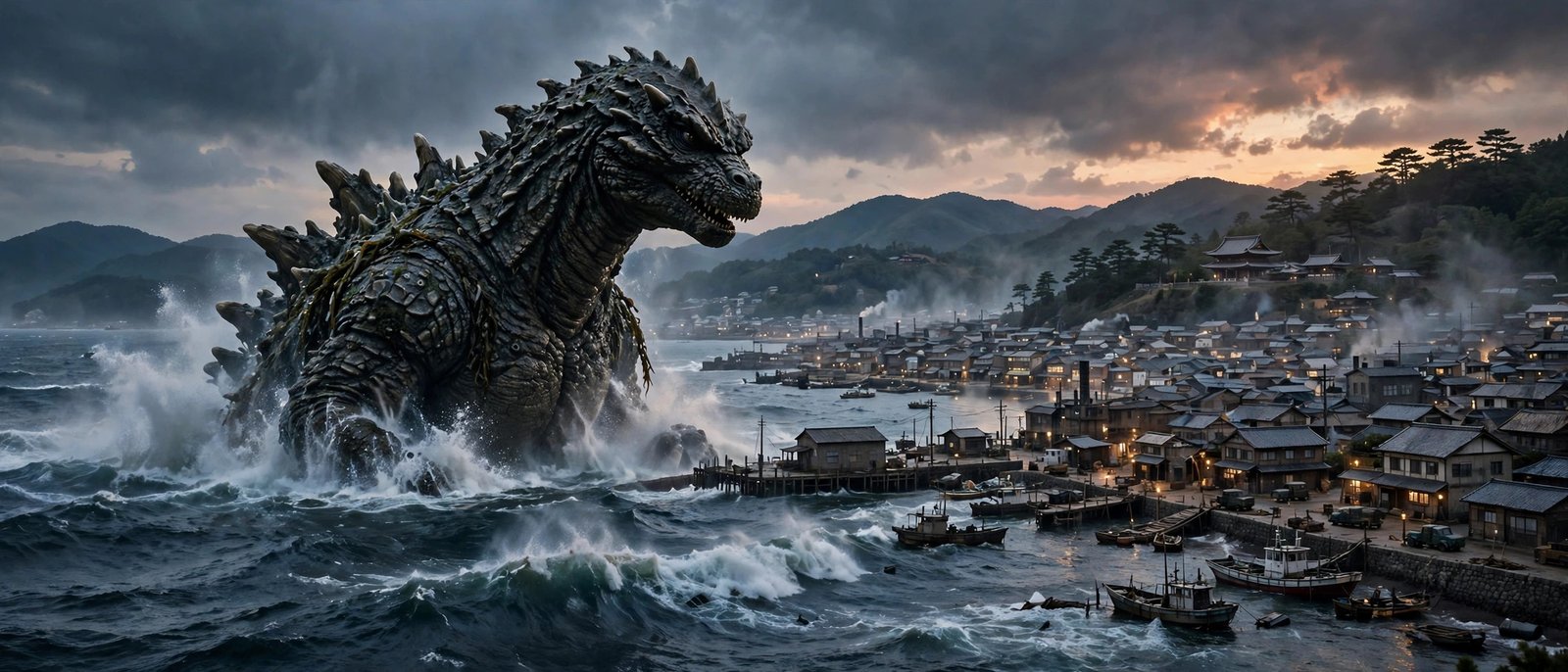
Three years ago, a small Japanese monster movie with a modest budget did the impossible. Godzilla Minus One turned a postwar story about guilt, survival and a giant radioactive lizard into a global hit, won an Oscar for Best Visual Effects, and left audiences everywhere with one burning question: what happens next? The answer has finally arrived. Godzilla Minus Zero, the direct sequel from writer-director Takashi Yamazaki, is now in cinemas, and it wastes no time raising the stakes. Set in 1949, two years after Godzilla was seemingly destroyed in Sagami Bay, the film brings back Koichi Shikishima and Noriko Oishi, and it introduces a monster so powerful that even Godzilla might not be enough to stop it. Early reviews are in, the trailers have pulled in millions of views, and fans are calling it one of the biggest kaiju events of the decade. Here is everything you need to know about the film, why it matters, and whether it lives up to its Oscar-winning predecessor.
Godzilla Minus Zero: What the Sequel Is About
The story picks up in 1949, two years after the events of Godzilla Minus One. Japan is still picking up the pieces. The war reduced the country to zero, and Godzilla plunged it into minus. That was the tagline that defined the first film, and the sequel starts from exactly that place: a nation trying to rebuild, families trying to heal, and a fragile peace that is about to be shattered all over again.
Former kamikaze pilot Koichi Shikishima, played once again by Ryunosuke Kamiki, has married Noriko Oishi, played by Minami Hamabe. Together with their adopted daughter Akiko, played by Sae Nagatani, they are trying to build the ordinary life that the war and the monster stole from them. But Noriko is hiding a frightening secret. After surviving Godzilla’s attack on Ginza, she has begun to show physical mutations caused by exposure to Godzilla’s cells. The monster may be gone, but it has left a mark on her body that nobody fully understands.
Then a new calamity arrives. A dragon-like creature capable of flight attacks the city of Matsumoto, firing electrical beams from its mouth and leaving destruction in its wake. Scientists and military planners scramble to understand what they are facing, and the answer is one of the most famous monsters in cinema history: King Ghidorah, the three-headed terror. As Ghidorah tears through Japan, the humans hatch a desperate plan. Godzilla, it turns out, was never truly destroyed. He has been regenerating in the depths, growing larger, and the only force that might stop Ghidorah is the monster himself. The plan is to lure the two titans into each other and hope that whatever survives can be dealt with afterwards. It is a gamble with the fate of the country, and as Toho’s own synopsis warns, there is no third time. Everything ends here.
Meet King Ghidorah, the Three-Headed Nightmare
If Godzilla is the king of the monsters, King Ghidorah has always been his greatest rival. First introduced in the 1964 film Ghidorah, the Three-Headed Monster, Ghidorah is a golden, three-headed dragon from space with enormous wings and the ability to fire gravity beams from its mouths. Over six decades of films, the creature has become one of the most recognisable villains in the entire Godzilla franchise, and fans have been waiting years to see Yamazaki’s version of him.
In this film, Ghidorah arrives as a storm. The opening sequence, described by reviewers, begins with a Ghidorah assault set to a score by composer Naoki Sato that evokes air raid alarms, a chilling reminder that for the people of 1949 Japan, the sound of sirens still meant death from above. Ghidorah brings hurricane-force winds with him, and his electrical beams can level whole city blocks. Unlike the slow, lumbering Godzilla, Ghidorah flies, which makes him almost impossible to pin down with conventional weapons.
What makes the creature so effective as a villain is that he is not just big. He is a force of nature that cannot be reasoned with, bribed or frightened. Reviewers have noted that Ghidorah is the main antagonist of the film, and that Godzilla himself appears only a handful of times in the first 90 minutes. That means the sequel is a slow-burn monster movie rather than a non-stop brawl, and when the two creatures finally meet, the film makes sure every second of it counts.
Who Returns in the Godzilla Minus Zero Cast
One of the smartest choices Yamazaki made was bringing back the human cast of Minus One. Monster movies live or die on whether the audience cares about the people running from the monsters, and the Shikishima family gave the first film its emotional core. Ryunosuke Kamiki returns as Koichi Shikishima, the former kamikaze pilot whose guilt and reluctant courage carried the first film. Minami Hamabe is back as Noriko Oishi, whose miraculous survival was one of the previous film’s most affecting turns, and Sae Nagatani returns as Akiko, the orphaned child who gave that fractured little family a reason to keep going.
Several other familiar faces return as well, including Hidetaka Yoshioka as Kenji Noda, the scientist who helped devise the plan to defeat Godzilla in the first film, along with Yuki Yamada, Kuranosuke Sasaki, Sakura Ando and Miou Tanaka. New characters join the story too, with Min Tanaka, Masami Nagasawa and Jun Kunimura in key roles. Nagasawa plays meteorologist Makoto Aoyama, whose ability to track storm systems becomes central to the plan to lure the two monsters together. Behind the camera, Yamazaki once again writes, directs and supervises the visual effects, with Shirogumi handling the effects work and Naoki Sato returning to compose the score.
The continuity matters because the sequel is not a soft reboot. It is a direct continuation, and it treats the events of the first film as real history that its characters are still living with. Koichi is no longer the broken man who could not bring himself to fly his plane into an enemy ship. He is a husband and a father now, and that gives him something to lose, which is exactly what makes his choices in the new film so tense.
Release Date, Runtime and IMAX
The film had its world premiere at the New York Film Festival on September 26, 2026, before opening in Japan on November 3, 2026, a date that carries special meaning because November 3 is Godzilla Day, the anniversary of the original 1954 film. The film then opened in North America on November 6, 2026, in regular cinemas and in IMAX, with GKIDS handling the North American distribution. Early-access IMAX screenings were held on November 3 in the United States, and the film also screened as a centrepiece presentation at the Tokyo International Film Festival.
The film runs 135 minutes, making it a substantial night at the movies, and it carries one notable distinction: it is the first Godzilla film ever rated R by the Motion Picture Association, for some violent content and bloody images. That rating signals a harder edge than the previous film, and reviewers have noted that the destruction sequences and the human cost of the monster attacks are shown more directly this time around.
The staggered release has created a wave of reactions rolling across the world. Japanese audiences saw it first, followed by North American viewers, with the film opening in cinemas in India on November 20, 2026. That rolling release is part of why the film has dominated monster-movie conversation for weeks, with each new territory adding fresh reviews, reactions and box office numbers to the story.
Why Fans Are So Excited About the Sequel
To understand the excitement around this sequel, you have to understand what Godzilla Minus One achieved. Made for a reported budget far smaller than a typical Hollywood blockbuster, the film became a global sensation, earning more than 100 million dollars worldwide and winning the Academy Award for Best Visual Effects. It was the first Godzilla film ever to win an Oscar, and Yamazaki became only the second filmmaker in history, after Stanley Kubrick for 2001: A Space Odyssey, to win the visual effects Oscar as a director. That kind of success raises expectations to an almost unfair level, and fans have spent three years wondering whether lightning could strike twice.
Part of the excitement is the sheer scale of the new threat. Godzilla versus King Ghidorah is one of the great rivalries in movie history, up there with any superhero showdown, and Yamazaki’s grounded, postwar style gives it a weight that the bigger, glossier Hollywood monster films sometimes lack. In his films, the monsters are not just spectacle. They are walking metaphors for war, for nuclear horror, and for the trauma that a nation carries long after the fighting stops. The sequel leans into that even more strongly, with reviewers noting that Godzilla’s origins in the horrors of Hiroshima and Nagasaki hang over the story more heavily than in the previous film, and that the American military presence in postwar Japan serves as a reminder of humiliation and defeat.
There is also the simple thrill of seeing Yamazaki’s visual effects on a bigger canvas. The director supervises the effects himself, and his team at Shirogumi delivered some of the most convincing giant-monster imagery ever put on screen in the first film, on a budget that Hollywood would consider pocket change. The trailers for the sequel show Godzilla’s dorsal plates cutting through the sea, cities crumbling under Ghidorah’s assault, and the atomic breath charging up in a way that made the first film’s version an instant classic. Fans have been freeze-framing every trailer shot for months, and the final trailer, released on October 11, 2026, pulled in more than a million views in its first few hours.
What the Early Reviews Say
The early reviews for the sequel are strong, though not without reservations, and that honesty is part of what makes them interesting. Scroll.in, in a review published on November 20, 2026, headlined its verdict as gigantic warring monsters do the trick, praising Yamazaki’s talent for suggesting massive scale and for bringing the creatures to the same eye level as the viewer, which creates the film’s most thrilling moments. The review noted that the battling monsters feature in only a handful of scenes, but that Yamazaki makes sure each one is special, and that Godzilla and Ghidorah feel simultaneously gargantuan and right in front of your face.
NDTV called the film a worthy follow-up to its predecessor, awarding it three stars and praising the epic kaiju action, the fabulous visual effects and the generous servings of human emotion. Its review suggested that the film comes tantalisingly close to the heights the first film scaled, and even wondered whether another Oscar might be lurking in the visual effects work. WION, meanwhile, described the sequel as bigger monsters and higher stakes, praising the visual spectacle and the aerial action while noting that the story can feel uneven in places.
The criticisms are consistent across the reviews, and they are worth knowing before you buy a ticket. Several reviewers felt the plot spends too many scenes on exposition, that the human drama leans heavily on sentimentality, particularly around the fate of little Akiko, and that the balance between the rampaging monsters and the harried humans below is less surefooted this time. The film is busier than its predecessor, and on close examination the plot can feel threadbare. But even the more mixed reviews agree on the central point: when the monsters fight, the film delivers spectacle on a scale that few movies this year can match, and as Scroll.in concluded, the sequel fulfils its purpose as a return on investment for fans who have waited three years for it.
How the Sequel Continues the Minus One Story
What sets Yamazaki’s Godzilla films apart from most monster movies is that the human story is not filler between the action scenes. It is the point. Minus One was a film about a man who survived the war by failing to die for it, and who had to learn that living could be a form of courage too. The sequel deepens that theme. Koichi has the family he wanted, but Noriko’s mutation is a reminder that the past cannot simply be buried. Godzilla’s cells are literally inside her, which means the monster is not just out there in the ocean. It is part of the family now, in the most frightening way possible.
The film also continues the first movie’s interest in how ordinary people fight back when the government and the military cannot protect them. In 1949, Japan is rebuilding with almost nothing, and the plan to stop Ghidorah depends on scientists, meteorologists and civilians working together, with Japanese and American forces cooperating uneasily. That uneasy cooperation, and the nationalistic messaging around sacrifice that some reviewers flagged, gives the film a political edge that the Hollywood monster movies rarely attempt. Yamazaki is not just making a film about two monsters fighting. He is making a film about a country deciding what it is willing to sacrifice to survive, and about a family deciding what it is willing to risk for each other.
That is also why the tagline lands so hard. There is no third time. Everything ends here. The film is positioned as the conclusion of the story that began with Minus One, and whether or not Toho eventually makes another one, this sequel is built to feel like a finale. The stakes are total, the monsters are bigger, and the family at the centre of it has more to lose than ever before.
Key Takeaways
- The film is the direct sequel to the Oscar-winning Godzilla Minus One (2023), written, directed and effects-supervised by Takashi Yamazaki.
- Set in 1949, the film follows Koichi and Noriko Shikishima as they try to build a family life while Noriko suffers mutations from Godzilla’s cells.
- The new threat is King Ghidorah, the three-headed flying monster, and the desperate human plan is to pit a regenerated Godzilla against him.
- The film premiered at the New York Film Festival on September 26, 2026, opened in Japan on November 3, and reached North America on November 6 in cinemas and IMAX.
- At 135 minutes, it is the first Godzilla film ever rated R, and early reviews praise the spectacle while noting a thinner plot than the original.
- Ryunosuke Kamiki, Minami Hamabe and Sae Nagatani return, joined by new cast members including Masami Nagasawa and Jun Kunimura.
Three years ago, nobody expected a Japanese Godzilla film with a modest budget to become one of the most beloved blockbusters of the decade. It did, and it won an Oscar for its trouble. The sequel had an almost impossible job: follow that act without simply repeating it. By bringing back the family audiences cared about, by introducing the greatest villain in the franchise’s history, and by raising the emotional and physical stakes to the point where everything ends here, Yamazaki has given fans exactly what they asked for: a bigger, bolder and more dangerous return to the world of Minus One. Whether it wins another Oscar or not, the roar of Godzilla is echoing through cinemas again, and this time he is not the only monster in the room. If you loved the first film, the second one is waiting for you, and it is best seen on the biggest screen you can find.
For more stories about films that almost never happened, read about the time Will Smith turned down The Matrix. And if you enjoy mysteries from deep history, don’t miss our look at the billion years of Earth history that went missing.
Sources: Wikipedia: Godzilla Minus Zero; Scroll.in review; NDTV review; WION review; 9to5Marvel: final trailer, release date and cast.
Frequently Asked Questions
When was the film released?
The film premiered at the New York Film Festival on September 26, 2026, opened in Japan on November 3, 2026, which is Godzilla Day, and was released in North America on November 6, 2026, in cinemas and IMAX through distributor GKIDS.
Who directed Godzilla Minus Zero?
Takashi Yamazaki directed the film, just as he did with Godzilla Minus One. He also wrote the screenplay and supervised the visual effects, with his company Shirogumi handling the effects work and Naoki Sato returning to compose the music.
Is Godzilla Minus Zero a direct sequel to Godzilla Minus One?
Yes. The film is a direct sequel set in 1949, two years after the events of Godzilla Minus One. It continues the story of Koichi Shikishima and Noriko Oishi, with Ryunosuke Kamiki and Minami Hamabe reprising their roles, and it follows the same family as they face a new threat.
Who is the villain in Godzilla Minus Zero?
The main villain is King Ghidorah, the three-headed flying monster and one of Godzilla’s most famous rivals. Ghidorah attacks Japanese cities with hurricane-force winds and electrical beams, and the human characters plan to lure a regenerated Godzilla into fighting him.
Is the sequel worth watching in IMAX?
Early reviews suggest the film’s biggest strength is its spectacle, with enormous monster battles, aerial action and destruction sequences that benefit from the largest screen possible. At 135 minutes and rated R for violent content and bloody images, it is a bigger and harder-edged film than its predecessor, and reviewers consistently praise the scale of the visuals.