
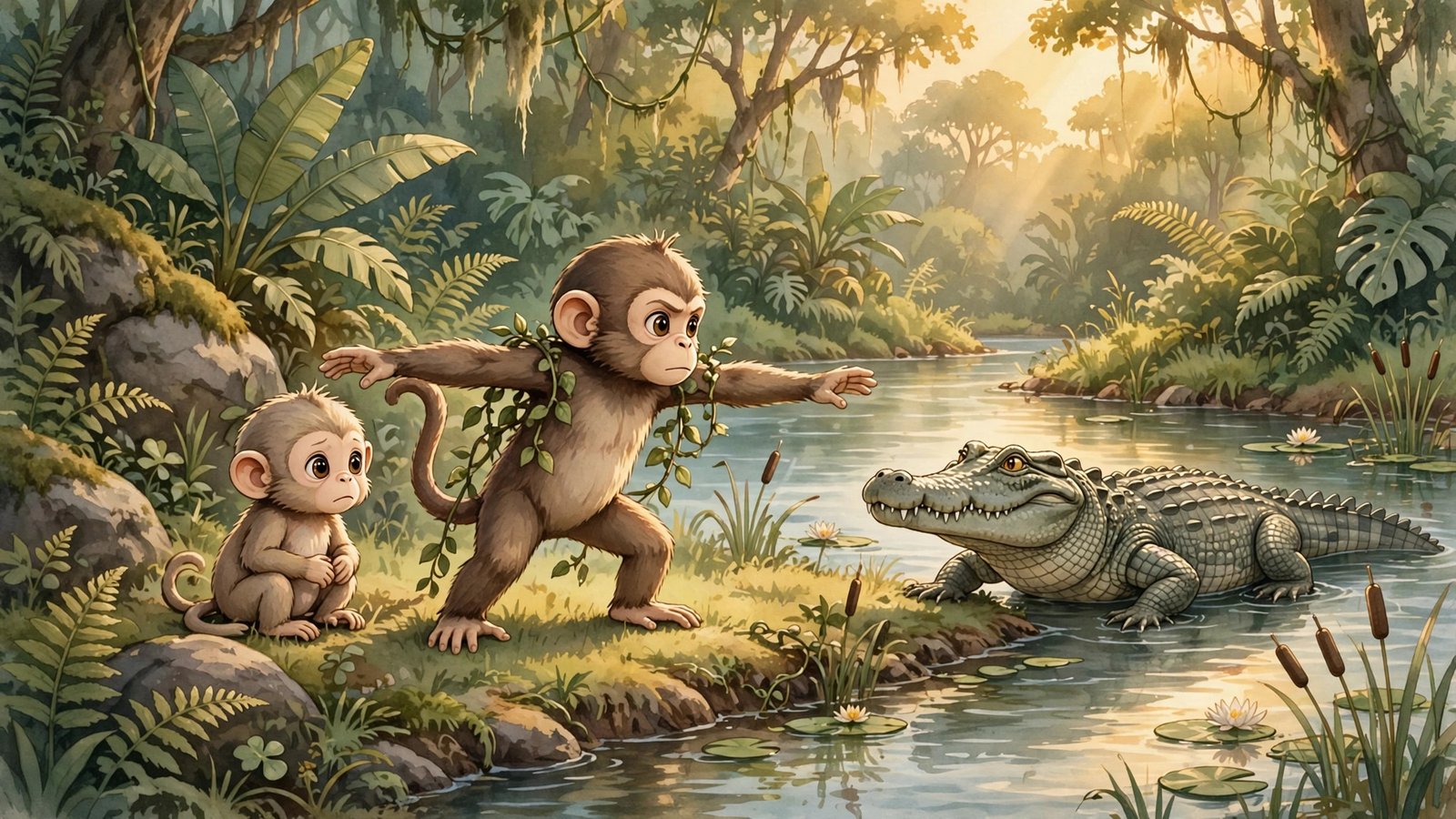
A note before the story begins: this is a work of fantasy. The tale below is fiction — invented characters, an invented river, and an invented adventure. It was inspired by a short viral clip teaser showing a crocodile approaching a small monkey near water while another monkey stepped forward, but nothing in this story happened in real life, and no part of it should be read as a true wildlife encounter. If you came here for a real animal rescue, this is not it. If you came for a story about courage, pull up a chair. That part is real enough.
The morning the river went quiet
In a jungle so green that the sunlight had to push its way down through the leaves, there lived a troop of monkeys in the branches of a great fig tree. The tree stood near a wide, slow river the monkeys called the River Temba, and every morning the troop woke to the same cheerful noise: birds arguing over breakfast, frogs clearing their throats, and the river itself humming along like it had somewhere pleasant to be.
Kito was a young monkey, not quite grown, with a tuft of hair that always stuck up no matter how often he smoothed it down. He was the troop’s lookout apprentice, which meant his job was to sit on the highest branch he could safely reach, watch the river, and call out if anything dangerous came near. It was an important job, and Kito took it very seriously, even though the most dangerous thing he had ever spotted was a particularly bold lizard.
Old Mara, the troop’s elder, had taught him the lookout’s rule. “Your eyes are not for yourself, Kito,” she would say, tapping his forehead with one wrinkled finger. “They are for everyone who is too small, too sleepy, or too busy to watch. A lookout who only watches for his own danger is just a monkey in a tree.”
That morning, the riverbank belonged to the smallest member of the troop: Nia, a baby monkey with round ears and more curiosity than sense. Nia had discovered butterflies the week before, and she had decided, with the confidence only a baby can have, that she was going to catch one. The butterfly had other plans. It danced over the grass, dipped toward the muddy bank, and floated out above the shallow water at the river’s edge, where the troop’s little ones were not supposed to go alone.
“Nia!” Kito called down from his branch. “Back from the bank! Butterflies are not worth wet feet!”
Nia waved a tiny hand at him without looking. “Almost!” she said. “He is the slowest butterfly in the whole jungle!”
Kito was about to climb down and fetch her himself when the river went quiet.
It was a small thing at first. The frogs stopped. The birds stopped. Even the river seemed to hold its breath. Kito knew that kind of quiet. Old Mara had taught him that, too. When the jungle goes quiet, something is coming, and it is your job to find out what it is before it finds you.
Then he saw it: a ripple in the water near the bank, slow and deliberate, like a shadow that had learned to swim. Two eyes rose above the surface. Then a long snout. Then the whole great shape of Mossback, the old crocodile who lived in the deep bend of the river, gliding toward the shallows where Nia stood chasing her butterfly.
The choice
Kito’s heart did a strange thing in his chest. It seemed to beat twice as fast and stop altogether at the same time. Fear, he learned in that moment, is not one feeling. It is two: the part of you that wants to run, and the part of you that wants to stay.
Mossback was enormous. His back was ridged like the bark of an old tree, and moss really did grow on it, which is how he got his name. He was older than the fig tree’s oldest root, or so the troop’s stories said, and he had a mouth full of teeth that did not need any stories at all to be frightening. He moved through the water without a splash, and his eyes never left the bank.
Nia still had not seen him. She was crouched in the mud, reaching for the butterfly, which had landed on a reed just out of her reach. The water lapped at her feet. Another hop, and she would be in the shallows. Another moment, and Mossback would be close enough to reach her.
Kito had three choices, and he felt all three of them arrive at once.
He could run for help. The troop was up in the fig tree, a whole family of strong monkeys, and Old Mara was there. But the tree was far, and help takes time, and time was the one thing Nia did not have.
He could scream. A lookout’s alarm cry would bring the whole troop running, and it might startle the crocodile. But it might also startle Nia — straight into the water.
Or he could go down there himself.
Kito’s hands were shaking. His tail was shaking. Even his tuft of hair seemed to be shaking. He was not a hero. He was a lookout apprentice who had never faced anything scarier than a lizard. But he remembered Old Mara’s rule: your eyes are for everyone who is too small to watch. And Nia was very small. And she was not watching at all.
So Kito did the bravest thing he had ever done. He took one breath, and he climbed down the tree.
Down to the bank
Kito did not run straight at the crocodile. Even in his fright, some small, sensible part of his mind was working, and it told him the truth: he could not beat Mossback in a fight. Mossback weighed more than the whole troop put together. A fight was not brave. A fight was just a quick way to lose.
So Kito did something better. He made himself the most interesting thing on the riverbank.
He dropped from the lowest branch onto the grass with a thump, landed on his feet, and shouted Nia’s name at the top of his lungs. “NIA! COME HERE! RIGHT NOW!”
Nia turned, startled, her butterfly forgotten. She saw Kito standing on the bank with his arms wide, and she saw his face, and she understood, in the way babies sometimes understand everything at once, that this was not a game. She took a step back from the water.
And Mossback turned his great head toward Kito.
The crocodile’s eyes were old and cold and patient, like the river itself. For a long moment, nobody moved. Kito could hear his own breathing. He could hear the mud squelching under Nia’s feet as she backed away. He could hear, very faintly, the sound of the troop waking up in the fig tree behind him, confused and alarmed by his shout.
Then Mossback began to move toward him instead.
The clever part
This is the part of the story where many tales would have the hero fight the monster. Kito did not. Kito had a different weapon, and it was the only one that had ever beaten a crocodile: a loud, surprising, confusing monkey.
First, Kito grabbed a fallen branch and banged it against the hollow log that lay near the bank. The hollow log was the troop’s drum. On festival days, the monkeys beat it to make music. That day, Kito beat it to make thunder. BOOM. BOOM. BOOM. The sound rolled across the water and bounced off the trees, and Mossback’s head came up in surprise. Crocodiles like quiet water and quiet prey. They do not like thunder.
Second, Kito threw fruit. Not at the crocodile — that would have been rude, and also useless — but into the water all around him, splashing and plopping and rippling in a dozen places at once. Figs and mangoes and one very squashed banana arced through the air and slapped into the river. Every splash was a question Mossback had to answer. Where is the prey? Where is the noise coming from? Which ripple matters? A hunter who cannot tell what is real and what is a trick is a hunter who hesitates. And hesitation was exactly what Kito needed.
Third, Kito shouted the lookout’s alarm cry — not the panicked shriek of a frightened monkey, but the long, rolling call that meant, “Everyone! To the trees! Danger at the river!” The call flew up into the fig tree, and the whole troop heard it. Mothers scooped up babies. Fathers bounded down the branches. Old Mara herself came swinging down with a stick in her hand and a look on her face that could have scared a thunderstorm.
And all the while, Nia kept backing away from the water, one small step at a time, her eyes fixed on Kito.
Mossback stopped. His great head swung slowly from side to side. The bank that had held one small, quiet monkey now held a drumming, shouting, fruit-throwing monkey, and behind that monkey a whole troop was pouring down out of the trees, yelling and waving sticks. The easy moment was gone. The surprise was gone. The riverbank was no longer a hunting ground. It was a commotion.
Crocodiles are patient hunters. They can wait for hours, for days, for the perfect moment. And Mossback, old as he was, knew a wasted effort when he saw one. He looked at Kito for one last long moment — and Kito, to his own amazement, looked back — and then the old crocodile sank slowly beneath the surface, ripple by ripple, until the river was just a river again.
The river belongs to everyone
The troop gathered on the bank, chattering and hugging and scolding all at once, the way families do when a scare is over. Nia ran to her mother and was scooped up and held very tight. Old Mara walked over to Kito, who was still standing on the bank holding the branch, breathing hard, his legs wobbly as new bamboo.
“You did not run,” Old Mara said.
“I wanted to,” Kito said. His voice came out small. “My feet wanted to run. My tail wanted to run. Everything wanted to run.”
“And yet,” said Old Mara, “here you stand.”
Kito looked out at the river. The water was calm again. Somewhere out there, Mossback was gliding back to his deep bend, and Kito found that he did not hate the old crocodile. That surprised him. Mossback had tried to catch Nia. But Mossback was also just an old river animal, hungry and doing what crocodiles do. The river belonged to him, too. It belonged to the fish and the frogs and the monkeys and the crocodile, and that was what made it a river and not a pond in somebody’s yard. Kito had not needed to defeat Mossback. He had only needed to make sure Mossback’s dinner was not his little sister of the troop.
“Is he gone?” Nia asked, peeking out from her mother’s arms.
“He is gone for today,” Kito said. “But he will be back, because this is his river too. So we will watch, and we will be careful, and we will never go to the bank alone.”
“And we will bring the drum,” Nia added solemnly, which made the whole troop laugh, and the laugh felt like sunshine after rain.
That evening, back in the fig tree, the troop told the story of the morning, the way troops always do — with the story getting a little bigger each time it was told, the drum a little louder, the fruit thrown a little farther, and Kito’s legs a little less wobbly. Old Mara let the story grow. Stories are allowed to grow. But when it was Kito’s turn to tell it, she asked him to tell it true.
So Kito told it true. He told them he had been afraid. He told them his hands had shaken. He told them he had not fought the crocodile, because fighting would have lost, and that instead he had used the loudest, cleverest, most confusing monkey trick he could think of. He told them that Mossback was not a villain in a story. He was a crocodile in a river. And he told them the thing he had learned standing on that bank, which was the most important thing a lookout can ever learn.
“Courage,” Kito said, “is not about not being afraid. It is about being afraid and choosing anyway — choosing to stand between the danger and someone smaller than you, even when your knees are knocking. And sometimes the bravest thing you can do is not the strongest thing. Sometimes it is the smartest thing. A drum and a shout and a handful of fruit saved Nia today. That is not nothing. That is everything.”
Nia, who was already half asleep in her mother’s lap, opened one eye. “And no more butterflies at the bank,” she murmured.
“And no more butterflies at the bank,” Kito agreed, and the whole troop laughed again, and the fig tree rustled its leaves like applause.
And from that day on, whenever a young monkey in the troop asked what a lookout was for, Old Mara would point down toward the river and say, “A lookout’s eyes are for everyone who is too small to watch. And a lookout’s courage is for everyone who needs it.” And Kito, sitting on his high branch with his tuft of hair sticking up, would watch the river — and the bank, and the butterflies, and the little ones — and he would be ready.
The moral of the story
Every story carries a lesson, and this one carries three, if you look closely.
The first is that courage is not the absence of fear. Kito was terrified. His hands shook. His tail shook. Everything shook. He was brave not because he felt no fear, but because he acted in spite of it. If you have ever been afraid and done the right thing anyway, you already know what courage feels like. It feels exactly like Kito felt: shaky, fast-hearted, and worth it.
The second is that cleverness can beat brute force. Kito could not have fought a crocodile and won. Nobody could. But he did not need to win a fight. He needed to buy time, break the crocodile’s advantage, and get Nia to safety — and for that, a drum, a shout, and a handful of fruit were better than all the strength in the jungle. The smartest solution is often the bravest one.
The third is the lookout’s rule, and it is the one that matters most: the strong look out for the small. Kito’s eyes were not only for himself. His courage was not only for himself. A troop — a family, a class, a neighbourhood, a world — works when those who can see danger warn those who cannot, and when those who can stand up, stand up for those who cannot yet stand up for themselves.
So the next time you see someone smaller than you heading toward trouble, remember Kito on the riverbank, drum in hand, knees knocking, standing his ground. You do not have to be the biggest or the strongest. You only have to be the one who steps forward.
FAQ
Is this a true story?
No. This is a fantasy story — pure fiction. The monkeys Kito and Nia, the elder Old Mara, the crocodile Mossback, and the River Temba are all invented characters and places. The story was inspired by a short viral clip teaser showing a crocodile approaching a small monkey near water while another monkey stepped forward, but the clip itself contained no verified facts, no location, and no confirmed outcome. Nothing in this tale happened in real life, and it should not be shared as a real wildlife encounter.
What inspired this story?
A short teaser page for a wildlife video, in which a crocodile approaches a small monkey near the water while other monkeys watch from the riverbank and one monkey appears to step forward. The teaser did not show what happened next, name any location, or provide any verifiable details — so rather than pretend to know what occurred, this article imagines a fictional version of the moment, with invented characters and a happy ending.
Who are Kito and Nia?
Kito is the story’s young hero: a lookout apprentice who is brave but frightened, clever rather than strong, and learning what it means to protect others. Nia is a curious baby monkey whose chase after a butterfly takes her too close to the river. Both are invented characters created for this story.
What is the moral of the story?
Three lessons: courage is acting despite fear, not without it; cleverness can beat brute force; and the strong should look out for the small. The story’s heart is the lookout’s rule — your eyes, and your courage, are for everyone who is too small to watch for themselves.
Why didn’t Kito fight the crocodile?
Because fighting would have lost, and the story is honest about that. A young monkey cannot beat a full-grown crocodile in a fight. Kito’s real bravery was choosing a smarter plan: noise, distraction, and an alarm that brought the whole troop — buying time and removing the crocodile’s advantage without anyone getting hurt.
Is Mossback the villain?
Not really. In this story, Mossback is an old crocodile doing what crocodiles do — hunting in his own river. The story treats him as a danger to respect, not a villain to hate. The river belongs to the crocodile as much as to the monkeys, and the happy ending comes from everyone staying in their own place, not from anyone being defeated.
How can I tell a real wildlife story from a fictional one?
Real wildlife stories come with verifiable details: a named location, a date, a named photographer or videographer, an identifiable source, and evidence that can be checked. Fictional stories like this one have invented characters with names, dialogue no one could have recorded, and no sources behind their events. If a wildlife post has a dramatic headline but no location, no date, and no source — and asks you to “watch until the end” — treat it as entertainment, not fact.
Sources
- Inspiration clip teaser: “Brave Monkey Risks Everything to Save a Baby Monkey From a Dangerous Crocodile! A Shocking Wildlife Encounter You Won’t Believe” — https://usabuzzarticlepsot.com/2026/10/15/brave-monkey-risks-everything-to-save-a-baby-monkey-from-a-dangerous-crocodile-a-shocking-wildlife-encounter-you-wont-believe/
- Note on sources: the story above is fictional and was invented for this article. The clip page linked here is the only source, and it is a short teaser with no verified facts, location, or confirmed outcome. No other sources are cited because no real events, experts, or locations are described.