
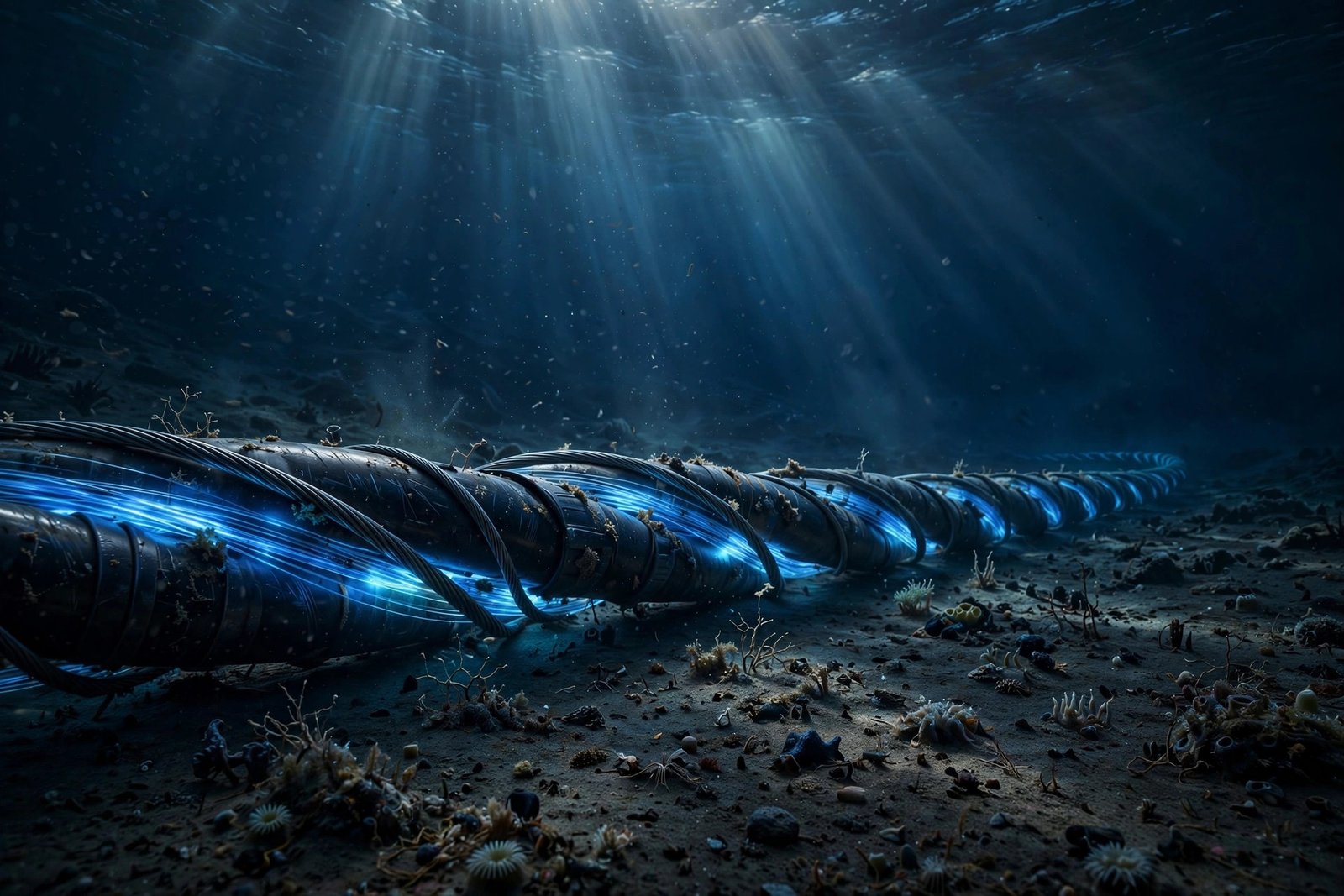
Right now, while you read this, nearly everything the internet does is traveling through glass threads lying on the bottom of the ocean. And Mark Zuckerberg wants to lay the biggest one yet. The Zuckerberg underwater internet cable — a 4,300-mile undersea line Meta is calling Petal — would be the first transoceanic cable in history to carry a full petabit of data per second, double the capacity of anything crossing an ocean today. It would link the United States and France, move the equivalent of 25,000 HD movies every single second, and go live in 2029. And here is the wildest part: when the story broke on October 18, 2026, it was almost completely drowned out by AI hype — because while the internet argued over Meta’s new Muse AI agent, this quiet engineering moonshot barely made a ripple outside telecom circles. So what is this 4,300-mile marvel, how does a cable this fast even work, and why is a social media company spending billions to wire the ocean floor? Let’s dive in — literally.
What Is the Zuckerberg Underwater Internet Cable?
Let’s start with the facts. According to Meta, Petal will stretch roughly 7,000 kilometers — about 4,300 miles — across the Atlantic Ocean, connecting the United States with France’s Atlantic coast. Meta announced the project on September 21, 2026, in an engineering post that described it as “the world’s first petabit-class transoceanic subsea cable.” Japanese tech giant NEC will handle the system’s design and construction as the turnkey supplier, Sumitomo Electric Industries will manufacture the specialized fiber, and French telecom Orange will manage the landing station where the cable comes ashore in France, as reported by Computer Weekly and TheStreet.
The headline number is one petabit per second — that’s 1,000 terabits, or one million gigabits, every second. It is expected to enter service in 2029. Meta has framed the project as the “single largest generational increase in capacity of any transoceanic subsea cable system, ever,” a line quoted by geo.tv. The cable will be funded and operated by Meta itself, continuing the company’s push from renting bandwidth on other people’s cables to owning the pipes outright.
One Petabit Per Second — What That Speed Actually Means
Numbers this big are hard to picture, so let’s translate. One petabit per second equals roughly 125 terabytes of data every second. Per Türkiye Today’s breakdown, that is the equivalent of about 25,000 high-definition movies — each five gigabytes in size — transferred in the blink of an eye, every eye-blink, nonstop. Meta’s own comparison is even more striking: the company says Petal’s capacity could let nearly three-quarters of the world’s population stream music at the same time.
But before you get too excited about your downloads, here’s the honest fine print: Petal’s advertised speed is its total planned capacity, not the speed you or I will see at home. As geo.tv noted, this is not the internet speed individual users receive on their laptops — it is the carrying capacity of the whole highway. What it does mean is enormous headroom for the data-heavy future: AI workloads, 4K and 8K streaming, cloud gaming, and the constant syncing of billions of devices all fighting for room on the same ocean-spanning lines.
And “double the best” is not hype language, either. Today’s most advanced transatlantic cables move around half a petabit per second. Petal is designed to leapfrog that entirely in one generation — the kind of jump the industry normally takes many years and several cables to achieve.
The Glass Trick: Two Cores Inside One Hair-Thin Strand
How do you double the world’s best undersea cable without making the cable fatter, hungrier for power, or harder to lay? Meta’s answer is a clever piece of physics: stop adding more glass, and start redesigning the glass itself.
Every Petal fiber strand is about 125 micrometers across — roughly the thickness of a human hair. But unlike conventional strands, which carry a single core of light, each Petal strand carries two independent optical cores traveling in opposite directions. This “multi-core fiber” approach lets one strand do the work that used to require a full pair of single-core fibers. The result, per Interesting Engineering, is a 24-fiber-pair system with 96 individual cores that carries as much data as 48 conventional fiber pairs — without a proportional surge in energy use or physical size.
- Two light paths, one strand: each fiber holds two cores carrying optical signals in opposing directions, effectively doubling the lanes inside the same glass.
- 96 cores total: 24 pairs of dual-core fibers deliver the capacity of 48 traditional pairs.
- Smarter repeaters: amplifiers along the route use “fan-in/fan-out” technology to split each core into separate single-core fibers for independent amplification before recombining them — a neat engineering workaround that keeps signals clean across 4,300 miles.
- Specialist glass: Sumitomo Electric developed the 2-core ultra-low-loss fiber specifically for Petal, achieving optical performance practically identical to single-core fiber.
Eduardo Mateo, chief strategy officer of NEC’s submarine network division, called the achievement “a major technological milestone in the history of global telecommunications,” in comments reported by Computer Weekly. Petal would be the first commercial subsea system to deploy multi-core fiber at transoceanic distances — moving the technology, as Meta put it, “from experimental to mainstream.”
Why the Zuckerberg Underwater Internet Cable Is Really About AI
To understand why Zuckerberg is building it, you have to stop thinking of Meta as a social media company. Meta, Alphabet, and Microsoft are now among the biggest builders of physical internet infrastructure on Earth — and the reason is three letters: AI.
Training and running AI models means moving staggering amounts of data between continents, constantly, at enormous speed. For years, tech companies rented space on cables built by telecom groups. That no longer works at AI scale. So the giants have shifted to owning the pipes outright. As Barchart put it, Meta “is trying to own every layer of the AI stack” — the data centers, the chips, the models, and now the ocean floor between the data centers.
The timing tells the story. Petal was announced just weeks after Meta launched Muse, its personal AI agent, on September 8 — an agent that climbed to number one on Apple’s U.S. App Store within two weeks, according to Alpha Leaders. Products like Muse depend on shuttling enormous volumes of data between Meta’s data centers and hundreds of millions of users around the world. Petal is the road those products drive on.
This is the same AI infrastructure boom reshaping everything about how we work — from AI doing days of entry-level work in hours, as stunned Reddit users reported, to robots now sprinting faster than Usain Bolt. The cables are simply the least visible — and arguably most important — layer of it all.
Big Tech Is Quietly Buying the Ocean Floor
Petal is not Meta’s first trip to the ocean floor — not even close. The company has backed more than 20 subsea cable projects over the past decade and helped deploy hundreds of thousands of kilometers of undersea cable globally, as TechX Media reported. The progression shows a company steadily learning to build bigger:
- Marea (2018): eight fiber pairs, 192 terabits per second — Meta’s early transatlantic collaboration.
- Amitié (2023): 24 fiber pairs, 384 terabits per second, connecting a Massachusetts landing station to the U.K. and France’s Le Porge station — built with Microsoft, Aqua Comms, and Vodafone.
- Anjana (2024): Meta’s first wholly owned transatlantic cable — 24 fiber pairs, 500 terabits per second, linking Myrtle Beach, South Carolina, with Santander, Spain.
- Project Waterworth: Meta’s 31,000-mile-plus cable spanning five continents — the single biggest bet in the company’s ocean strategy.
Why the ocean, though? Because despite all the satellites in the sky, undersea cables still carry roughly 99 percent of all intercontinental internet traffic, according to the International Telecommunication Union, as cited by Moldova 1. Satellites like Starlink are amazing for remote coverage, but for moving continents’ worth of data, glass on the seabed wins on capacity, latency, and cost — and it isn’t close. Just as SpaceX is quietly redefining what happens in orbit, Meta is quietly redefining what happens at the bottom of the sea.
What Petal Means for You
Let’s be honest about what changes and what doesn’t. Petal will not make your home Wi-Fi faster on its own. Last-mile speed depends on your local provider, your plan, and your router — not a transatlantic backbone. But here’s what Petal genuinely affects:
- Smoother everything: more backbone capacity means less congestion during peak hours, faster international video calls, and snappier cloud services.
- AI that actually works: as AI assistants, voice agents, and real-time translation grow hungrier, the capacity has to come from somewhere. Petal is some of that somewhere.
- Resilience: more cables mean more backup routes. When one cable is damaged — and it happens more often than you’d think, thanks to ship anchors and underwater landslides — traffic reroutes through others.
- Global access: Meta says expanded subsea investment helps bring better digital access to people and businesses worldwide, particularly in regions served by the cable’s landings.
There’s also a business story worth watching. Barchart reports Meta’s capital expenditures are guided as high as $145 billion this year, with free cash flow shrinking as the AI buildout accelerates. Petal alone won’t move the stock much, but it reveals how Meta’s leadership thinks: AI will be won on infrastructure, so keep spending even when the payoff is years away. Investors who understand the cable understand the strategy.
7 Things to Remember About the Ocean-Floor Internet
- 4,300 miles: Petal spans about 7,000 kilometers of Atlantic Ocean — roughly the distance from New York to Paris and back, underwater.
- 1 petabit per second: one million gigabits every second — double today’s best transoceanic cables.
- 25,000 movies a second: roughly 125 terabytes per second, or 25,000 five-gigabyte HD films, every second.
- Hair-thin glass: each 125-micrometer strand carries two light cores instead of one — the engineering trick that makes the leap possible.
- 2029 target: the cable is expected to enter service in 2029; it is still under development.
- 99% rule: undersea cables carry about 99% of intercontinental internet traffic — satellites are the backup act, not the show.
- AI is the reason: the real customer for this cable isn’t your phone — it’s the AI data centers moving oceans of data between continents.
The Bottom Line
The Zuckerberg underwater internet cable is one of those rare stories that is both a genuine engineering breakthrough and a window into where the world’s most powerful companies are quietly placing their bets. A petabit per second across an ocean, through glass thinner than a hair, carrying enough data for most of humanity to press play at once — that’s the kind of sentence that would have sounded like science fiction a decade ago. And while the internet debates chatbots and viral apps, the real race is happening 8,000 feet below the waves, where Meta, Google, and Microsoft are buying the ocean floor one cable at a time. Petal won’t speed up your Wi-Fi tomorrow. But every AI answer, every 4K stream, and every video call you make in the years ahead will likely ride, at some point, on glass exactly like this. The internet has an invisible backbone — and it just got a whole lot stronger.
Frequently Asked Questions
What is the Zuckerberg underwater internet cable?
The Zuckerberg underwater internet cable is Meta’s Petal project: a planned 4,300-mile (7,000 km) subsea fiber-optic cable across the Atlantic, connecting the United States and France. Announced on September 21, 2026, it is designed to carry one petabit per second — double the capacity of today’s best transoceanic cables — with service targeted for 2029.
How fast is Meta’s Petal cable?
Petal is designed for one petabit per second — one million gigabits, or about 125 terabytes, every second. That equals roughly 25,000 HD movies (5 GB each) per second. Meta says the capacity could let nearly three-quarters of the world’s population stream music simultaneously. Note this is total cable capacity, not home internet speed.
When will the Petal cable be operational?
The project is still under development and is expected to become operational in 2029. NEC is overseeing design and construction, with Sumitomo Electric supplying the fiber and Orange managing the French landing.
Why is Meta building an underwater cable?
Artificial intelligence. Training and running AI models requires moving enormous amounts of data between data centers on different continents. Renting space on telecom-owned cables no longer scales, so Meta — like Google and Microsoft — is building and owning its own subsea infrastructure, including Petal and the 31,000-mile Project Waterworth.
Do undersea cables really carry most of the internet?
Yes. Despite the growth of satellite internet, undersea cables carry approximately 99% of intercontinental internet traffic, according to the International Telecommunication Union. Meta alone has backed more than 20 subsea cable projects over the past decade.