
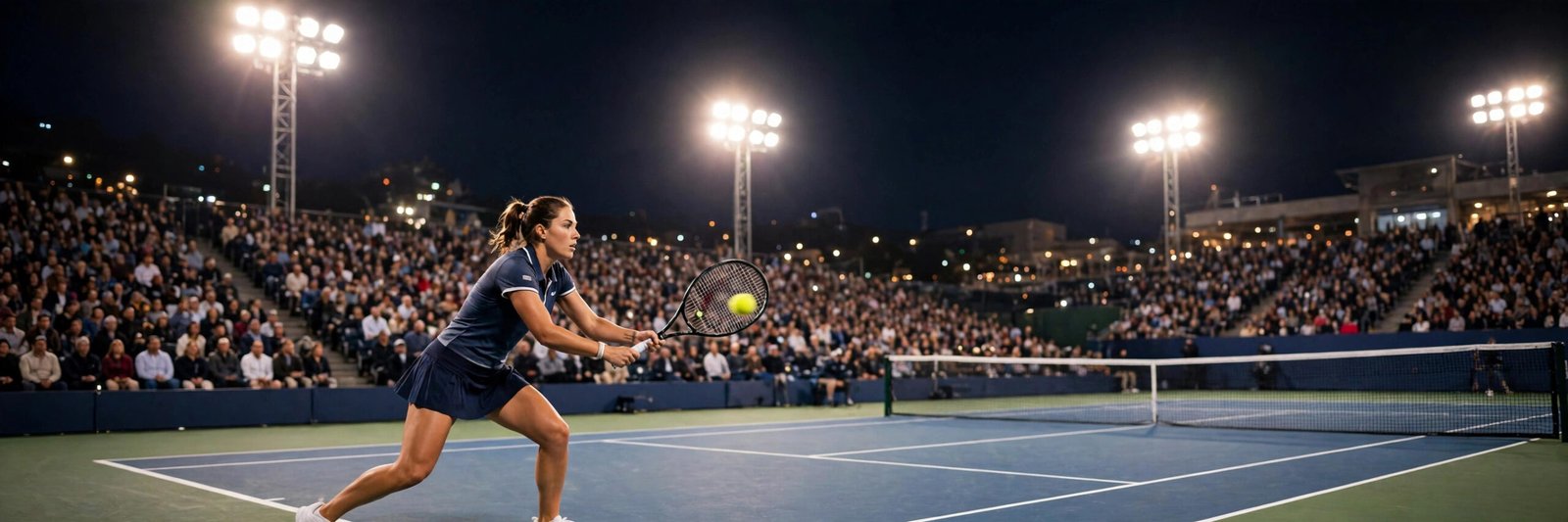
Tennis moves fast, but the internet moves faster. A three-second video — three seconds, with no clearly audible speech — was all it took to ignite a firestorm around the world’s top women’s tennis player at the 2026 WTA Finals. The Aryna Sabalenka apology that followed on Saturday, November 14, became one of the most talked-about stories in sports, a case study in how a fragment of footage can spiral into a global controversy before anyone has had time to establish what actually happened.
The episode raises questions that go far beyond one match: how do we judge athletes in the age of lip-reading and slow-motion clips? What counts as evidence when the audio is unclear? And what does a sincere apology look like when the person apologizing insists the worst interpretation of their words is wrong? This is the full story of what happened at Indian Wells, what Sabalenka actually said in her apology, and why the details matter.
What Happened at the WTA Finals in Indian Wells
The 2026 WTA Finals, held in Indian Wells, brought together the best women’s tennis players in the world for the season-ending championship. On Friday, November 13, 2026, Aryna Sabalenka — the powerful Belarusian who has dominated the women’s game in recent years — faced Elina Svitolina of Ukraine. The match was a hard-fought three-setter that ended 6-3, 3-6, 6-1 in Svitolina’s favor, a significant upset and a result that shook up the tournament.
During the match, a brief clip began circulating online. The video lasted only about three seconds and appeared to show Sabalenka swearing in Russian at a moment of frustration. The problem — and it is a crucial one — is that her voice is not clearly audible in the footage. Viewers could see her mouth moving, but they could not reliably hear what she said. That gap between what could be seen and what could be heard is where the entire controversy was born.
Some online commentators attempted to lip-read the clip and offered interpretations of what she might have said. One interpretation that spread widely suggested an anti-Ukrainian remark, roughly rendered in English as “Those f***ing Ukrainians, for f’s sake!” That reading was repeated across social media at high speed, often presented as though it were an established fact. It was not. The exact wording cannot be independently confirmed, and treating an unverified lip-reading interpretation as fact would be unfair to everyone involved — to Sabalenka, to Svitolina, and to the truth itself.
The Aryna Sabalenka Apology on Instagram
On Saturday, November 14, 2026, Sabalenka responded with an apology posted on Instagram. The Aryna Sabalenka apology was direct and specific: she firmly denied that her comments were directed at Elina Svitolina, and she explained that her frustration was aimed at spectators in the crowd who were celebrating her mistakes during the match.
That distinction matters. Tennis players are used to hostile crowds — it is part of the sport — but there is a difference between a crowd that cheers for your opponent and a crowd that openly celebrates your errors. Sabalenka’s account is that she was reacting to the latter, in a moment of competitive frustration, and that her words were not aimed at Svitolina at all. Her apology acknowledged that her behavior was wrong while contesting the most damaging interpretation of it.
The speed of the apology also matters. Sabalenka did not wait days for the story to develop, nor did she issue a vague statement through a spokesperson. She addressed it herself, on her own Instagram account, within about a day of the match. In the modern sports world, that kind of quick, personal response is often the best way to keep a controversy from growing — though as this case shows, it does not always stop the conversation.
Why a Three-Second Clip Caused Such a Storm
To understand why three seconds of unclear video caused such a storm, it helps to understand the context around Sabalenka and Svitolina. Sabalenka is from Belarus; Svitolina is from Ukraine. Since Russia’s full-scale invasion of Ukraine in 2022, the politics of Eastern Europe have loomed over professional tennis in ways the sport never asked for. Belarusian and Russian players have faced questions about the war, about their governments, and about their personal views — questions that athletes in most other sports never have to answer.
Ukrainian players, meanwhile, have competed under extraordinary emotional strain, carrying the weight of a war at home into every tournament. Svitolina herself has been one of the most visible Ukrainian athletes in the world, using her platform to raise awareness and support for her country. In that charged atmosphere, any suggestion of an anti-Ukrainian remark by a Belarusian player was bound to detonate online — whether or not the remark was actually made.
This is the danger of the lip-reading era. Social media now treats amateur lip-reading as evidence, and a confident-sounding interpretation can travel around the world before any expert has had a chance to examine the footage. The Sabalenka case is a reminder that seeing someone’s lips move is not the same as hearing their words, and that certainty is often the first casualty of a viral clip. The Aryna Sabalenka apology was, in part, an attempt to close that gap — to replace speculation with her own account of what she meant and whom she meant it for.
Sabalenka and Svitolina: A Rivalry With Real History
The match itself was significant even before the controversy. Svitolina’s 6-3, 3-6, 6-1 victory over Sabalenka was a statement result at a tournament where every match matters, and it continued a rivalry that has produced some compelling tennis over the years. The two players have met multiple times on the biggest stages, and their matches are often physical, emotional affairs — the kind of contests where frustration boils over.
It is also worth noting what Sabalenka’s apology did not do: it did not attack Svitolina, it did not minimize the match result, and it did not suggest any animosity between the two players. By firmly denying that her comments were directed at Svitolina, Sabalenka drew a clear line between her frustration with the crowd and her respect for her opponent. That distinction is important for the sport, because a controversy that pits two of its biggest stars against each other would have been far more damaging than a dispute about crowd behavior.
For Svitolina, the episode was an unwelcome distraction from a major victory. She had just beaten one of the best players in the world at the season-ending championship — a result that deserved to be the story. Instead, the headlines became about a three-second clip. That, too, is part of the modern sports landscape: the action on the court is sometimes overshadowed by the action on social media, and athletes have little control over which one the public remembers.
The Crowd Problem in Modern Tennis
Sabalenka’s explanation — that she was frustrated with spectators celebrating her mistakes — touches on a real and growing issue in tennis. Crowds at major tournaments have become louder, more partisan, and sometimes more hostile in recent years, and players have spoken openly about the difficulty of competing when sections of the audience are actively rooting for them to fail.
Tennis has always had a complicated relationship with crowd noise. The sport’s traditions demand silence during points, but the atmosphere at big matches increasingly resembles a football stadium, with chanting, singing, and coordinated cheering. Most players accept this as part of the modern game. But there is a line between supporting your favorite and mocking the other player, and when crowds cross it, players notice — and sometimes they react.
Sabalenka is not the first top player to lose her temper with a crowd, and she will not be the last. What made this incident different was not the frustration itself, which is common, but the fact that it was captured in a clip that invited the worst possible interpretation. The lesson for players is harsh but clear: in an era when every moment is filmed, a split-second reaction can define a tournament. The lesson for fans is equally clear: celebrating an opponent’s mistakes is poor sportsmanship, and it can turn a great match into an ugly story.
How the Aryna Sabalenka Apology Works in the Social Media Age
The Aryna Sabalenka apology also illustrates how the machinery of the modern sports apology works. The pattern is familiar by now: an incident goes viral, the athlete posts a statement on Instagram, news outlets report the statement, and the online debate shifts from “what happened?” to “is the apology good enough?” It is a cycle that can play out in a matter of hours.
What made Sabalenka’s apology notable was its specificity. Rather than issuing a generic “I apologize if anyone was offended” — the kind of non-apology that usually makes things worse — she gave a concrete account: she was frustrated with spectators, not with Svitolina, and she denied the specific interpretation that had spread online. Specificity is risky, because it gives critics something concrete to argue with, but it is also more credible than vagueness. A detailed apology signals that the person has actually thought about what happened.
Whether the apology will settle the matter remains to be seen. In the social media age, controversies rarely end with a single statement; they fade as the news cycle moves on, or they flare up again when new footage or commentary emerges. What is certain is that the episode will follow Sabalenka into future tournaments, and that every match she plays against a Ukrainian opponent will now carry an extra layer of scrutiny. That is the lasting cost of a three-second clip, even when the words in it cannot be confirmed.
What We Know — and What We Do Not Know
It is worth pausing to separate the verified facts from the speculation, because this story has generated more of the latter than the former. Here is what is solid: Sabalenka lost to Svitolina 6-3, 3-6, 6-1 at the 2026 WTA Finals in Indian Wells on Friday, November 13, 2026. A three-second video appeared to show her swearing in Russian. Her voice is not clearly audible in the clip. Sabalenka issued an apology on Instagram on Saturday, November 14, firmly denying her comments were directed at Svitolina and saying she was frustrated with spectators celebrating her mistakes.
Here is what is not solid: the exact wording of what Sabalenka said. Online lip-reading interpretations suggested an anti-Ukrainian remark, but those interpretations cannot be independently confirmed, and presenting them as fact would be wrong. Responsible reporting means saying clearly that the wording is unverified — and that is what we are doing here. Readers who encounter confident claims about what she said should ask a simple question: can you actually hear it? If the answer is no, then the claim is interpretation, not evidence.
This discipline matters beyond this one story. The same dynamics — a short clip, an ambiguous moment, a confident online interpretation — have driven countless controversies in sports and beyond. The Sabalenka case is a useful reminder to slow down, to distinguish between what we saw and what we heard, and to give people the chance to explain themselves before the verdict is delivered. For more on how viral moments can mislead, see our explainers on the science behind déjà vu and why we get goosebumps.
Key Takeaways
- A three-second video from Sabalenka’s WTA Finals match against Svitolina sparked controversy, but her voice is not clearly audible in the footage.
- Sabalenka lost the match 6-3, 3-6, 6-1 to Elina Svitolina at the 2026 WTA Finals in Indian Wells on Friday, November 13, 2026.
- Some online lip-reading interpretations suggested an anti-Ukrainian remark, but the exact wording cannot be independently confirmed and must not be treated as fact.
- Sabalenka issued an apology on Instagram on Saturday, November 14, 2026, firmly denying her comments were directed at Svitolina.
- She said her frustration was aimed at spectators who were celebrating her mistakes during the match.
- The episode highlights the risks of judging athletes on unclear video and the charged context around Belarusian and Ukrainian players since 2022.
The Aryna Sabalenka apology is a story about a moment that may never be fully resolved — because the evidence itself is ambiguous. What we know is that a great player lost a big match, reacted in frustration, and then owned her behavior while rejecting the worst reading of it. What we do not know is the precise wording of those three seconds, and honesty demands that we say so. In a sports world that increasingly runs on clips and hot takes, that kind of careful distinction is worth defending. The tennis will go on, the rivalry will continue, and the next time a short clip sets the internet alight, it is worth remembering Indian Wells — and asking, before sharing, whether we actually heard what we think we heard. For more sports stories making headlines, read our coverage of America’s measles situation explained and the Anthropic IPO and its $1.4 trillion valuation.
Sources: Athlon Sports: Aryna Sabalenka apologizes after viral WTA Finals outburst.