
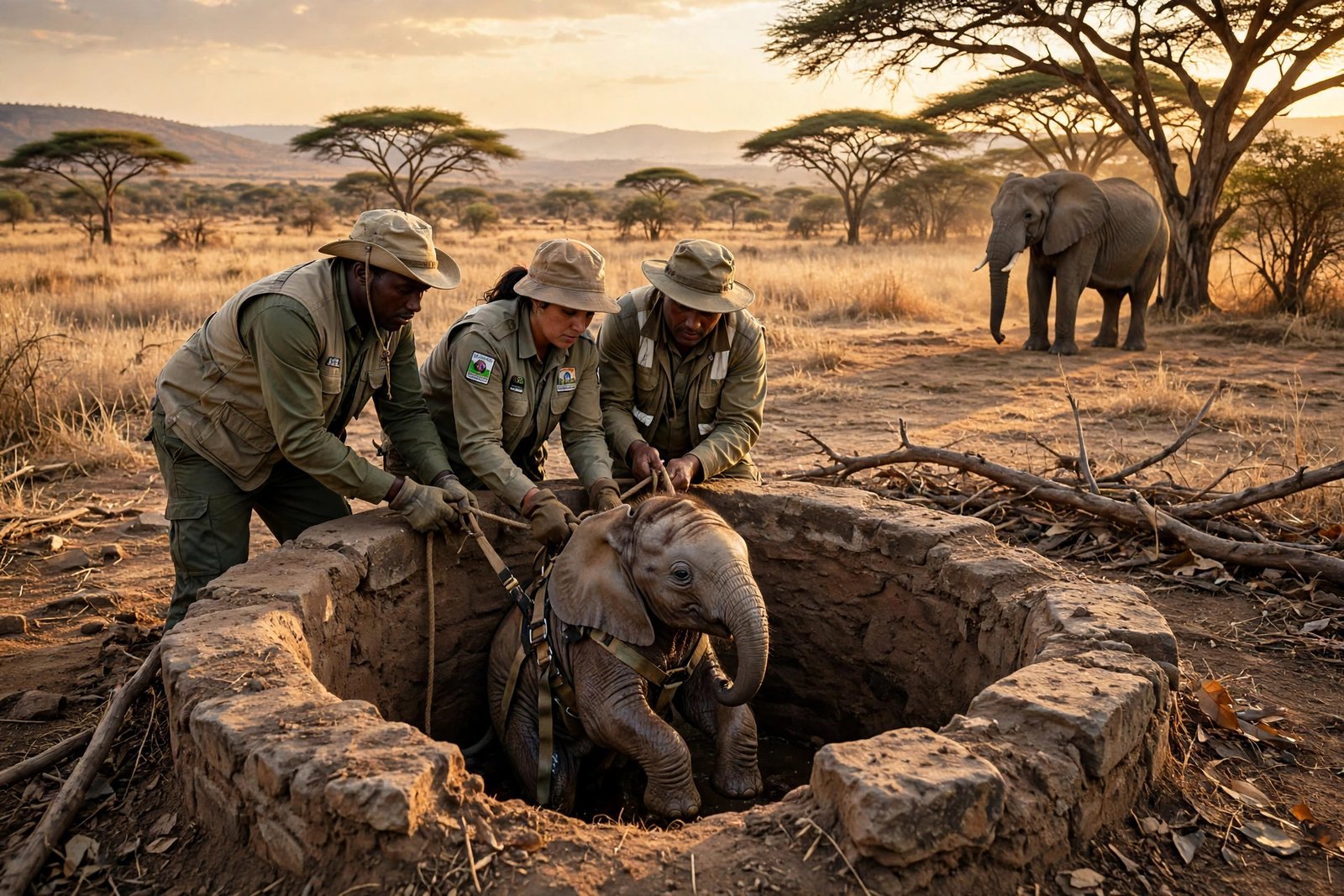
Imagine stumbling across a tiny elephant, no bigger than a large dog, trapped at the bottom of a well, crying out while her frantic mother stands guard above. That is exactly what rescuers in Kenya faced this month, and the ending is the kind of moment that reminds you why people fall in love with wildlife stories in the first place. A baby elephant rescued from well danger in Kenya is now safe, back on her feet, and back with her mother, all because a team of rescuers refused to walk away.
The rescue, shared by the Sheldrick Wildlife Trust on TikTok and published on November 16, 2026, has been watched and shared around the world. It is a short story with a big heart: a calf in trouble, a mother who would not leave her side, and a team that had to think fast, act gently, and quite literally jump in to save a life.
In this article, we will walk through exactly what happened, why the rescue was so tricky, why wells are a hidden danger for elephants in Kenya, and what the Sheldrick Wildlife Trust does every single day to keep animals like this one alive.
How the Baby Elephant Rescued From Well Was Found
Every rescue starts with someone being in the right place at the right time, and this one was no different. The Sheldrick Wildlife Trust explains that one of the most effective ways it can help wildlife is simply by being present, in the air and on the ground, so that emergencies can be acted upon quickly. That is how this little calf was discovered and rescued.
The Trust runs routine patrols across the areas it protects in Kenya. Its teams travel by vehicle and by aircraft, watching for animals in trouble, checking water sources, and keeping an eye out for the kinds of problems that can turn deadly in a matter of hours. During the dry season, when water is scarce and animals travel further to find it, those patrols matter more than ever.
When the team found the calf, the situation was urgent. She had fallen into a well and could not climb out on her own. Her mother was right there, standing guard, frantic but helpless. A mother elephant will not abandon her calf, and she will not let strangers walk up to her baby without a fight. That loyalty is beautiful, and it is also what made this rescue so complicated.
The calf herself weighed roughly 440 pounds, or in the region of 200 kilograms. That sounds enormous for a baby, and it is, but for an elephant it is still very small. She was young, frightened, and stuck in a hole that had not been dug with wildlife in mind. Time was tight, and the team knew it.
Why the Mother Had to Be Moved First
Before anyone could get near the well, the rescuers had to solve the first problem: the mother. As the Sheldrick Wildlife Trust put it, her mother was standing guard, frantic but helpless, so the first order of business was to drive her a safe distance away.
This step matters more than most people realise. An adult elephant is one of the strongest land animals on Earth, and a frightened mother protecting her calf is not an animal you can simply walk past. She was not being aggressive for the sake of it. She was doing exactly what elephant mothers have done for millions of years: standing between her baby and anything she sees as a threat.
Moving her away was not about pushing her out of the picture. It was about keeping everyone safe, including her. If the team had tried to climb into the well while she stood over it, someone could have been seriously hurt, and the calf could have panicked even more. By calmly driving the mother a safe distance away, the rescuers created the space they needed to work, while keeping her close enough that a reunion would still be possible the moment the calf was free.
It is a good example of how wildlife rescue really works. The dramatic moment, the jump into the well, gets all the attention. But the careful thinking before it, the decision to move the mother first, is what makes the dramatic moment possible at all.
The Moment the Baby Elephant Rescued From Well Was Lifted Out
Once the mother was at a safe distance, there was nothing left to do but jump in. The Sheldrick Wildlife Trust describes it simply: Roan and the team knew that time was tight, and then there was nothing left to do but jump in and haul the little calf out.
Rescuers climbed down into the well and lifted the trapped calf to safety. Think about that for a second. A baby elephant weighing roughly 440 pounds is not something one person can lift alone. It took teamwork, strength, and a willingness to climb into a dark, cramped space with a frightened wild animal. The calf would have been scared, slippery, and struggling, and every second counted.
Then came the moment everyone was waiting for. Once she found her feet, she ran off and reunited with her mother at the tree line. That single sentence, shared by the Trust, carries the whole story. The calf was not carried away to an orphanage. She was not kept in captivity. She was freed, she found her footing, and she ran straight back to her mother.
It is hard to imagine a better ending. The mother had waited nearby, worried and helpless, and within minutes of the rescue she had her baby back. The two of them disappeared together toward the tree line, and the team could finally breathe.
Why Wells Are a Hidden Danger for Elephants in Kenya
This rescue was not a freak accident. It was the result of a problem that the Sheldrick Wildlife Trust talks about openly. The baby elephant rescued from well danger in Kenya was lucky to be found in time, and many young elephants face the same risk. During the dry season, resources are scarce, and sometimes the quest for water can have life-threatening consequences. There are countless wells like these, dotted across private land and not dug with wildlife in mind.
That detail matters. These wells were dug by people, for people and livestock, to reach water underground. They were not designed with elephants in mind, and many of them have no covers, fences, or warning signs. To a thirsty elephant, especially a young one following its mother to water, a well can look like just another part of the landscape until the ground gives way.
Young elephants are the most at risk. They are curious, they stay close to their mothers, and they do not yet have the experience to judge where it is safe to walk. A calf that slips into a well cannot climb out alone. The walls are too steep, the space is too tight, and the animal quickly becomes exhausted from struggling.
The dry season makes everything worse. When rivers and waterholes shrink, elephants travel further and take more risks to find water. Wells become more attractive and more dangerous at the same time. It is a cruel trade-off, and it is one of the reasons the Trust says that being present on the ground and in the air matters so much. Finding a trapped animal early can be the difference between a rescue and a tragedy.
For readers who love stories about animals beating the odds, this rescue sits alongside other remarkable animal tales on BolanPost, including the story of a dog reunited with its owner after five years apart and the clever bear that escaped from a factory in Japan. Each one is a reminder that animals surprise us constantly.
Who Are the Sheldrick Wildlife Trust?
If you have never heard of the Sheldrick Wildlife Trust before this rescue, you are about to discover one of the most respected wildlife organisations in Africa. The Trust describes itself as an international wildlife conservation charity that pioneered the successful rescue, hand-rearing and rewilding of milk-dependent orphaned elephants, while also rescuing, rehabilitating and rewilding orphaned rhinos.
That word, pioneered, is important. When the Trust began its work, many experts believed it was impossible to keep an orphaned baby elephant alive without its mother. Elephant calves depend on milk for years, and they need constant care, warmth, and companionship. The Trust proved it could be done, and its methods have since helped save hundreds of elephants.
Today, the Trust works across Kenya and northern Tanzania, with major conservation programmes in Tsavo. Its work goes far beyond individual rescues. It protects endangered species through wildlife rescue and rehabilitation, mobile veterinary units, aerial conservation, anti-poaching initiatives, and habitat conservation. In other words, it does not just save one animal at a time. It tries to protect the whole landscape those animals depend on.
The mobile veterinary units are a big part of that work. When an elephant is injured, perhaps by a snare or a wound, a vet team can travel to the animal, treat it in the field, and give it a chance to recover in the wild. The aerial teams do the same from the sky, spotting trouble early and guiding ground teams to animals that need help. The well rescue is a perfect example of how those pieces fit together.
The Trust also makes a point of thanking its supporters. In the caption of the rescue video, it credited donations with making routine patrols and lifesaving operations like this possible. It is a simple message, but an honest one: without patrols, nobody finds the calf in the well. Without donors, there are no patrols.
What Happens After a Rescue Like This?
One of the happiest details of this story is what did not happen next. The calf was not taken into captivity. She did not need to be raised by hand. She went straight back to her mother, which is always the best outcome in a rescue like this.
That is not always possible. When a calf is orphaned, when its mother has died or cannot be found, the Trust steps in with its Orphans’ Project, raising the baby with round-the-clock care until it is old enough to return to the wild. The baby elephant rescued from well danger in Kenya did not need any of that, because her mother was alive and waiting nearby.
In this case, the team could watch the calf run to her mother and know the job was done. There was no need for medicine, no need for a long recovery, and no need to separate a family. The calf was tired and frightened, but she was alive, mobile, and back where she belonged.
That is also why the Trust shares these moments on TikTok and other platforms. A rescue like this does more than save one animal. It shows millions of people what conservation looks like in real life, not in a documentary filmed over months, but in a single afternoon, with real people doing difficult, physical work for an animal they will never see again.
What This Rescue Teaches Us About Wildlife and People
There are a few lessons tucked inside this story that go beyond one elephant and one well.
- Being there matters most. The Trust says it plainly: being present, in the air and on the ground, is one of the most effective ways to help. No rescue happens without someone noticing the problem in time.
- Calm thinking beats rushing in. Moving the mother first took patience and discipline. It would have been tempting to rush straight to the calf, but that could have ended badly for everyone.
- Small problems can be deadly. A well is an everyday object for the people who dug it. For a baby elephant, it can be a trap with no way out.
- Good endings are possible. Not every wildlife story ends well, which is exactly why the ones that do deserve to be celebrated and shared.
- Ordinary support creates extraordinary moments. Patrols, fuel, vehicles, and vet teams all cost money, and donations are what keep them running.
The story also says something about how we relate to wild animals. The mother elephant did not understand what the rescuers were doing. She only knew that strangers were near her baby, and she stood her ground. The rescuers did not blame her for that. They worked around her fear, respected it, and made sure she was part of the happy ending. That respect, for the animal and for the bond between mother and calf, is what separates a real rescue from a stunt.
Why Stories Like This Go Viral
It is no surprise that this rescue spread so quickly after the Sheldrick Wildlife Trust shared it on TikTok. Animal rescue videos are among the most shared content on the internet, and this one has everything people look for: danger, kindness, tension, and a joyful ending.
But there is something else going on too. In a news cycle that often feels heavy, a story about a baby elephant running back to her mother is a reminder that good things still happen, and that ordinary people can make them happen. Viewers are not just watching a rescue. They are watching proof that compassion still works.
That is also why it is worth reading beyond the video. The clip lasts a minute or two, but the work behind it, the patrols, the planning, the years of experience, and the donor support, has been going on for decades. The video is the visible tip of a much bigger effort to protect Kenya’s wildlife.
If this story made you smile, the best next step is a simple one: learn more about the organisations doing this work every day. The Sheldrick Wildlife Trust publishes regular updates about its rescues, its orphaned elephants, and its conservation programmes, and reading them is a good way to understand what wildlife protection actually looks like on the ground.
Key Takeaways
- A baby elephant weighing roughly 440 pounds fell into a well in Kenya and could not climb out alone.
- Her mother stood guard nearby, frantic but helpless, so rescuers first moved her a safe distance away.
- Rescuers climbed down into the well and lifted the calf to safety.
- Once she found her feet, the calf ran off and reunited with her mother at the tree line.
- The rescue was shared by the Sheldrick Wildlife Trust on TikTok and published on November 16, 2026.
- Wells dug for people and livestock, with no wildlife in mind, are a real danger for young elephants, especially in the dry season.
- The Trust’s patrols, aircraft, and mobile vet units exist so that emergencies like this can be found and acted on quickly.
A baby elephant rescued from well danger in Kenya could have become another sad statistic. Instead, because a patrol team was in the right place, because they thought carefully before acting, and because they were willing to climb into a well to lift a 440-pound calf to safety, she is back with her mother tonight. That is a story worth remembering, and a reminder that sometimes the most important thing any of us can do is simply show up, pay attention, and refuse to walk past someone in trouble.
Sources: Sheldrick Wildlife Trust, Diving Right into the Rescue of a Trapped Elephant Calf; Wisevoter, Rescuers Lift Trapped Baby Elephant From Well, November 16, 2026; The Cool Down, Rescuers jump into well to save 440-pound baby elephant.
How was the baby elephant rescued from the well in Kenya?
Rescuers from the Sheldrick Wildlife Trust first moved the mother elephant a safe distance away, then climbed down into the well and lifted the roughly 440-pound calf out. Once she found her feet, the calf ran off and reunited with her mother at the tree line.
How much did the baby elephant weigh?
The calf weighed roughly 440 pounds, or in the region of 200 kilograms, according to the Sheldrick Wildlife Trust rescue account.
Who rescued the baby elephant from the well?
The rescue was carried out by the Sheldrick Wildlife Trust, an international wildlife conservation charity working in Kenya and northern Tanzania. The team was led on the ground by Roan, and the Trust shared the rescue on TikTok.
When did the baby elephant rescue happen?
The rescue account was published on November 16, 2026, and shared by the Sheldrick Wildlife Trust on TikTok.
Why are wells dangerous for baby elephants?
During the dry season, elephants travel to find scarce water, and many wells are dotted across private land, dug for people and livestock and not with wildlife in mind. A young calf that falls in cannot climb out alone, which is why patrols that find trapped animals quickly are so important.