
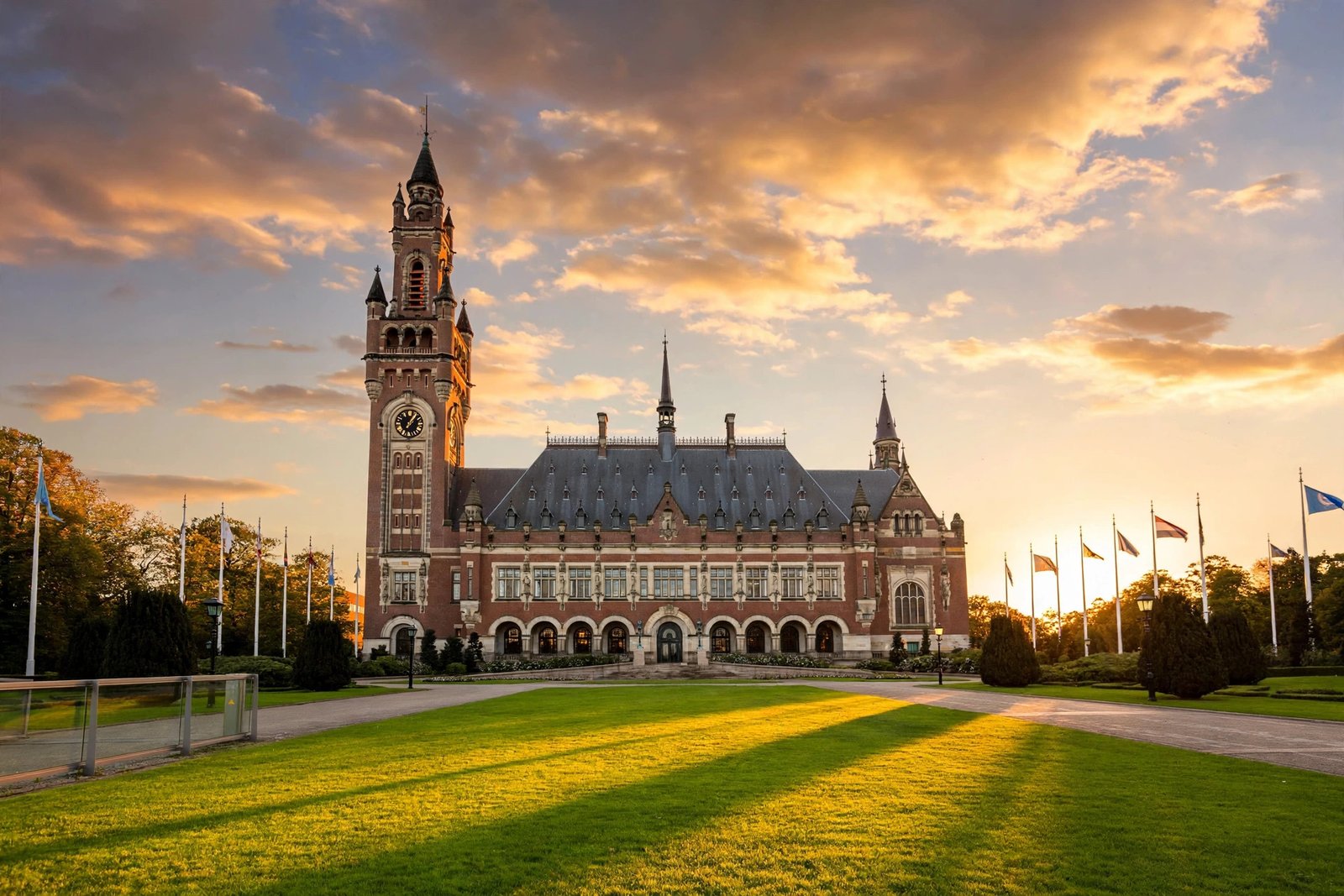
For nine years, the Rohingya people have waited for the world to call what happened to them by its true name. Villages burned, families scattered, and nearly a million people fled across a border into sprawling refugee camps — while the generals who ordered the crackdown insisted nothing criminal had taken place. On Thursday, November 19, 2026, the wait ended in a courtroom in The Hague. The ICJ Myanmar Rohingya ruling delivered the verdict survivors had dreamed of and diplomats had doubted would ever come: the International Court of Justice found that Myanmar committed genocide against the Rohingya, the first time in the court’s eighty-year history that it has held a state responsible for that crime.
The judgment, read aloud over three hours by the court’s president, Judge Yuji Iwasawa of Japan, landed like an earthquake in international law. It was not a cautious compromise or a narrow technical finding. By a nine-to-six majority, the fifteen-judge panel concluded that Myanmar’s security forces acted with the intent to destroy a substantial part of the Rohingya people — and that the state must now make amends through restitution and reparations. For the survivors in the camps of Cox’s Bazar in Bangladesh, many of whom watched the proceedings on shared phones, it was a moment of vindication nearly a decade in the making. For the rest of the world, it was a reminder that justice, however slow, can still arrive.
What the ICJ Myanmar Rohingya Ruling Actually Decided
The court found that Myanmar violated its obligations under the Convention on the Prevention and Punishment of the Crime of Genocide, the 1948 treaty adopted in the shadow of the Holocaust. The judges concluded that Myanmar’s security forces killed thousands of Rohingya civilians, carried out widespread acts of sexual violence, committed acts of extreme violence against children, and attacked fleeing Rohingya as they tried to escape in large numbers to Bangladesh. The evidence, the court said, supported the estimate that at least 10,000 Rohingya were violently killed during the military’s so-called clearance operations in 2017.
Crucially, the court found that these were not random excesses or the fog of war. The judges ruled that the only reasonable inference from the pattern of atrocities was that Myanmar’s forces acted with genocidal intent — the deliberate aim of destroying a substantial part of the Rohingya group in northern Rakhine State. The court found Myanmar responsible for three of the five categories of genocidal acts listed in the Genocide Convention, and found that the country had committed six violations of the treaty overall, in a judgment running to 191 pages.
The court also found that Myanmar failed in its duty to prevent genocide and failed to punish those responsible, a separate breach of the Convention. It ordered Myanmar to cease all acts of violence against the Rohingya, to investigate everyone suspected of culpability, to prosecute and punish the guilty, and to guarantee that such atrocities will never happen again. The decision is final. It cannot be appealed.
Perhaps the most striking part of the verdict is what it means historically. This is the first time the International Court of Justice — the United Nations’ top court, established in 1945 — has ever found a state guilty of genocide. It is only the fourth time since the Nazi Holocaust that any international court has ruled that the crime of genocide was committed. That alone explains why legal scholars around the world were watching The Hague so closely, and why the ruling is being described as a landmark in the truest sense of the word.
The Horror of 2017: What Led to the Case
To understand the ruling, you have to go back to August 2017, when the crisis exploded. On August 25 of that year, a small Rohingya militant group known as the Arakan Rohingya Salvation Army attacked police posts in Rakhine State, in western Myanmar. The military’s response was wildly disproportionate and, as the court has now found, genocidal in intent. Soldiers swept through Rohingya villages in what they called clearance operations, burning homes, shooting civilians, and driving entire communities toward the border with Bangladesh.
More than 730,000 Rohingya fled in a matter of weeks, joining hundreds of thousands who had already escaped earlier waves of persecution. They arrived in Bangladesh exhausted, traumatized, and carrying stories that shocked the world: mass killings, gang rapes, children thrown into fires, and villages erased from the map. A United Nations fact-finding mission that investigated the crackdown concluded in 2018 that the military’s actions showed genocidal intent — a finding that Myanmar’s government furiously rejected.
The Rohingya, a mostly Muslim ethnic minority, had long been treated as outsiders in their own country. Myanmar’s 1982 Citizenship Law effectively rendered most of them stateless, denying them citizenship and basic rights. Decades of discrimination, restrictions on movement, and periodic outbreaks of violence had already pushed many to flee before 2017. The crackdown that year was the most brutal chapter in a long history of persecution — and the one that finally brought Myanmar before the world’s highest court.
The Long Road to The Hague
The case itself was brought by an unlikely champion. In November 2019, The Gambia — a small, predominantly Muslim nation in West Africa, thousands of miles from Myanmar — filed the case at the International Court of Justice, accusing Myanmar of violating the Genocide Convention. The Gambia acted with the backing of the Organisation of Islamic Cooperation, and its argument was simple: under the Genocide Convention, any state party can bring a case against another state accused of genocide, even if it has no direct connection to the victims.
The hearings that followed drew extraordinary attention. In December 2019, Myanmar’s civilian leader at the time, Aung San Suu Kyi — once celebrated around the world as a democracy icon and Nobel Peace Prize winner — appeared before the court in person to defend her country. She argued that the military’s actions, while regrettable, were a legitimate response to an armed insurgency and did not amount to genocide. The images of Suu Kyi defending the generals who would later imprison her in a 2021 coup became one of the most striking ironies of the whole saga.
In January 2020, the court issued provisional measures, ordering Myanmar to take all steps within its power to prevent genocide, to prevent the destruction of evidence, and to report back on its compliance. It was an early signal that the judges took the allegations seriously. Myanmar then spent years raising preliminary objections, which the court rejected in 2022, clearing the way for the case to proceed to a full hearing on the merits. Seven years after The Gambia filed its case, and nine years after the atrocities themselves, the final judgment arrived on November 19, 2026.
What the Evidence Showed
The court’s findings were built on a mountain of evidence gathered over years: survivor testimony, satellite imagery of burned villages, reports from United Nations investigators, and documents from Myanmar’s own institutions. The judges found that entire villages had been systematically destroyed, with permanent structures later built in their place and non-Rohingya people resettled on the land — a pattern that suggested the displacement was meant to be permanent, not temporary.
The sexual violence documented by investigators was particularly harrowing. The court found that Myanmar’s forces perpetrated widespread acts of sexual violence against Rohingya women and girls as part of the campaign, alongside killings and acts of extreme violence against children. The judges also found that soldiers attacked fleeing Rohingya as they sought to escape to Bangladesh, shooting at columns of civilians making their way to the border.
What makes the ruling so significant legally is how the court handled the question of intent — the hardest element of genocide to prove. Genocide is not just mass killing; it requires the specific intent to destroy a group, in whole or in part. The court ruled that the pattern, scale, and systematic nature of the atrocities left no other reasonable explanation. The intent, the judges said, could be inferred from the evidence itself. That reasoning is likely to shape how future genocide cases are argued and decided.
Reparations: What Myanmar Must Do Now
The ruling does not stop at declaring what happened. The court ordered Myanmar to provide restitution and reparations to the Rohingya, a step campaigners have demanded for years. The restitution measures the court outlined are concrete and far-reaching: Myanmar must allow and facilitate the safe and voluntary return of Rohingya refugees to their places of origin; it must return or replace collective property that was damaged or destroyed; it must help find the disappeared and ensure proper burials for the dead; and it must provide for the physical and psychological rehabilitation of survivors and guarantee their protection from further persecution.
The judges acknowledged that they could not determine the exact amount of compensation owed, so they ordered Myanmar to submit a report to the court within two years setting out the restitution measures it has adopted and the amounts and modalities of compensation it will pay. The amount of compensation, and the arrangements for paying it, will be determined at a later stage. But the legal obligation is now clear and binding: Myanmar must repair, as far as possible, the damage its actions caused.
The United Nations’ Independent Investigative Mechanism for Myanmar, the body created in 2018 to collect evidence of the most serious international crimes committed in Myanmar, welcomed the judgment as a historic step toward justice. Its head, Nicholas Koumjian, said the ruling should give fresh momentum to efforts to hold the individual perpetrators and architects of the genocide criminally accountable. That points to a second track of justice running alongside the ICJ case: the International Criminal Court, which is separately examining alleged crimes against the Rohingya, including the forced deportation of hundreds of thousands of people across the border into Bangladesh.
Why the ICJ Myanmar Rohingya Ruling Matters Beyond Myanmar
The impact of this verdict reaches far beyond Myanmar’s borders. For one thing, it sets a powerful precedent for other genocide cases currently before the court. The most closely watched is South Africa’s case accusing Israel of genocide in Gaza, filed in 2023, where the court has already issued provisional measures but has not yet ruled on the merits. Legal experts say the Myanmar judgment’s reasoning on how to prove genocidal intent — and its treatment of evidence drawn from patterns of conduct — will be studied closely by lawyers on all sides of that case.
The ruling also matters for Ukraine’s case against Russia, and for the broader question of whether international law can still hold powerful states accountable. For decades, critics have argued that the Genocide Convention, for all its moral force, has been almost impossible to enforce against a state. Only three previous international rulings had ever found that genocide occurred, and none of them had held a state itself responsible at the ICJ. This judgment changes that. It shows that a small country with no army to speak of can haul a much larger one before the world’s highest court — and win.
There is also a message here for the Rohingya themselves and for refugee communities everywhere. For years, Rohingya activists have said that the world knew what was happening and did nothing. The ruling does not undo the suffering or bring back the dead, and it does not by itself rebuild a single village. But it does something that matters enormously to survivors: it puts the word genocide into a binding legal judgment, in the permanent record, issued by the highest court on earth. No government can now credibly claim that what happened in 2017 was merely a counter-insurgency operation that got out of hand.
What Happens If Myanmar Refuses to Comply?
Here is the hard truth that tempers the celebration: the International Court of Justice has no police force, no army, and no direct way to make a country obey its rulings. Its judgments are final and legally binding, but enforcement depends on political will. Under the United Nations Charter, a country that refuses to comply can be referred to the UN Security Council — but any enforcement action there could face a veto from a permanent member, and Myanmar has historically been shielded by powerful friends on the Council.
Myanmar’s military government, which seized power in a coup in February 2021 and has since been fighting a civil war against a broad resistance, has shown little respect for international law. It largely ignored the court’s provisional measures from 2020, and there is no reason to expect sudden enthusiasm for a judgment that brands the state a perpetrator of genocide. The country is also in the grip of a devastating internal conflict, which makes any organized program of restitution extraordinarily difficult in practice.
That does not make the ICJ Myanmar Rohingya ruling meaningless. International law often works slowly, through pressure, precedent, and the accumulation of legal findings rather than through sudden enforcement. The judgment strengthens the hand of countries considering sanctions, supports the work of prosecutors building cases against individual commanders, and makes it harder for any government or company to do business with Myanmar’s military as if nothing happened. It also keeps the door open for further proceedings if Myanmar fails to report on its reparations within two years. History shows that states sometimes comply with ICJ rulings years later, when political circumstances change. The judgment is now part of the permanent legal landscape, and it will not go away.
What It Means for the Rohingya Still in the Camps
Nearly one million Rohingya refugees now live in the camps around Cox’s Bazar in Bangladesh, one of the largest refugee settlements on earth. Life there is hard: overcrowded shelters, monsoon floods, limited work, and shrinking international aid. For many refugees, the ruling brought tears of relief — but also a clear-eyed question: what changes for us now?
The honest answer is that the ruling changes the legal and political picture, not the daily reality of camp life. Return to Myanmar remains the dream for many refugees, but the court itself said any return must be safe and voluntary, and right now Myanmar is in the middle of a civil war, with Rakhine State itself a battleground. Nobody can be sent back to danger, and the court’s restitution orders are designed to make sure that any future return happens with dignity, property restored, and citizenship and rights guaranteed — not as a forced transfer back into the same conditions that caused the exodus.
Still, survivors and advocates say the ruling gives them something they did not have before: an authoritative, final judgment that what was done to them was genocide, and that Myanmar owes them repair. That matters for negotiations over their future, for the funding of aid programs, and for the simple human need to be believed. As one advocate put it after the verdict, the Rohingya have spent nine years telling the world what happened. Now the world’s highest court has said it too.
Key Takeaways
- On November 19, 2026, the International Court of Justice ruled by nine votes to six that Myanmar committed genocide against the Rohingya — the first time the court has ever held a state responsible for genocide.
- The court found that Myanmar’s security forces killed at least 10,000 Rohingya, carried out widespread sexual violence, and acted with genocidal intent during the 2017 crackdown that drove more than 730,000 people to flee to Bangladesh.
- Myanmar was ordered to stop all violence, investigate and prosecute those responsible, and provide restitution and reparations, including the safe and voluntary return of refugees, the return of property, and compensation — with a report due to the court within two years.
- The Gambia brought the case in November 2019, and the ruling is final and cannot be appealed — but the court has no enforcement arm, so compliance will depend on international pressure.
- The judgment sets a major precedent for other genocide cases before the court, including the case concerning Gaza, and strengthens efforts to hold individual perpetrators criminally accountable.
Justice delayed is not always justice denied. Nine years after villages burned in Rakhine State, the world’s highest court has spoken with a clarity that leaves no room for doubt: what happened to the Rohingya was genocide, Myanmar is responsible, and Myanmar must make amends. The ICJ Myanmar Rohingya ruling will not rebuild a single burned home overnight, and it will not by itself bring a single refugee home. But it has done something that no speech, resolution, or report could do — it has written the truth into international law, permanently and finally. The long road to The Hague is over. The longer road — toward return, repair, and real accountability — has only just begun. For more landmark moments shaping world politics, see our coverage of Hakeem Jeffries becoming the first Black Speaker and the mysterious NSA network outage of 2026.
Frequently Asked Questions
What did the ICJ decide about Myanmar and the Rohingya?
The International Court of Justice ruled on November 19, 2026, by nine votes to six, that Myanmar committed genocide against the Rohingya minority in northern Rakhine State, violating the 1948 Genocide Convention. It also found that Myanmar failed to prevent and punish genocide, and ordered the country to cease all violence, investigate and prosecute those responsible, and provide restitution and reparations to victims.
When was the ICJ Myanmar Rohingya ruling delivered?
The judgment was delivered on Thursday, November 19, 2026, at the Peace Palace in The Hague. The court’s president, Judge Yuji Iwasawa, read the 191-page verdict aloud over three hours. The decision is final and cannot be appealed.
Who brought the genocide case against Myanmar?
The Gambia, a small West African nation, filed the case in November 2019 with the backing of the Organisation of Islamic Cooperation. Under the Genocide Convention, any state party can bring a case against another state accused of genocide, even without a direct connection to the victims.
Does Myanmar have to pay compensation to the Rohingya?
Yes. The court ordered Myanmar to provide restitution and reparations, including facilitating the safe and voluntary return of refugees, returning or replacing damaged property, helping find the disappeared, and providing rehabilitation for survivors. The court could not set the exact compensation amount, so Myanmar must submit a report within two years detailing the measures taken and the compensation to be paid, with the final amount to be determined later.
Can the ICJ enforce its ruling against Myanmar?
The ruling is legally binding and final, but the court has no police force or army of its own. Enforcement would run through the United Nations Security Council, where action could face a veto. Myanmar’s military government has previously ignored the court’s orders, so compliance will likely depend on sustained diplomatic pressure, sanctions, and the threat of further legal proceedings.