
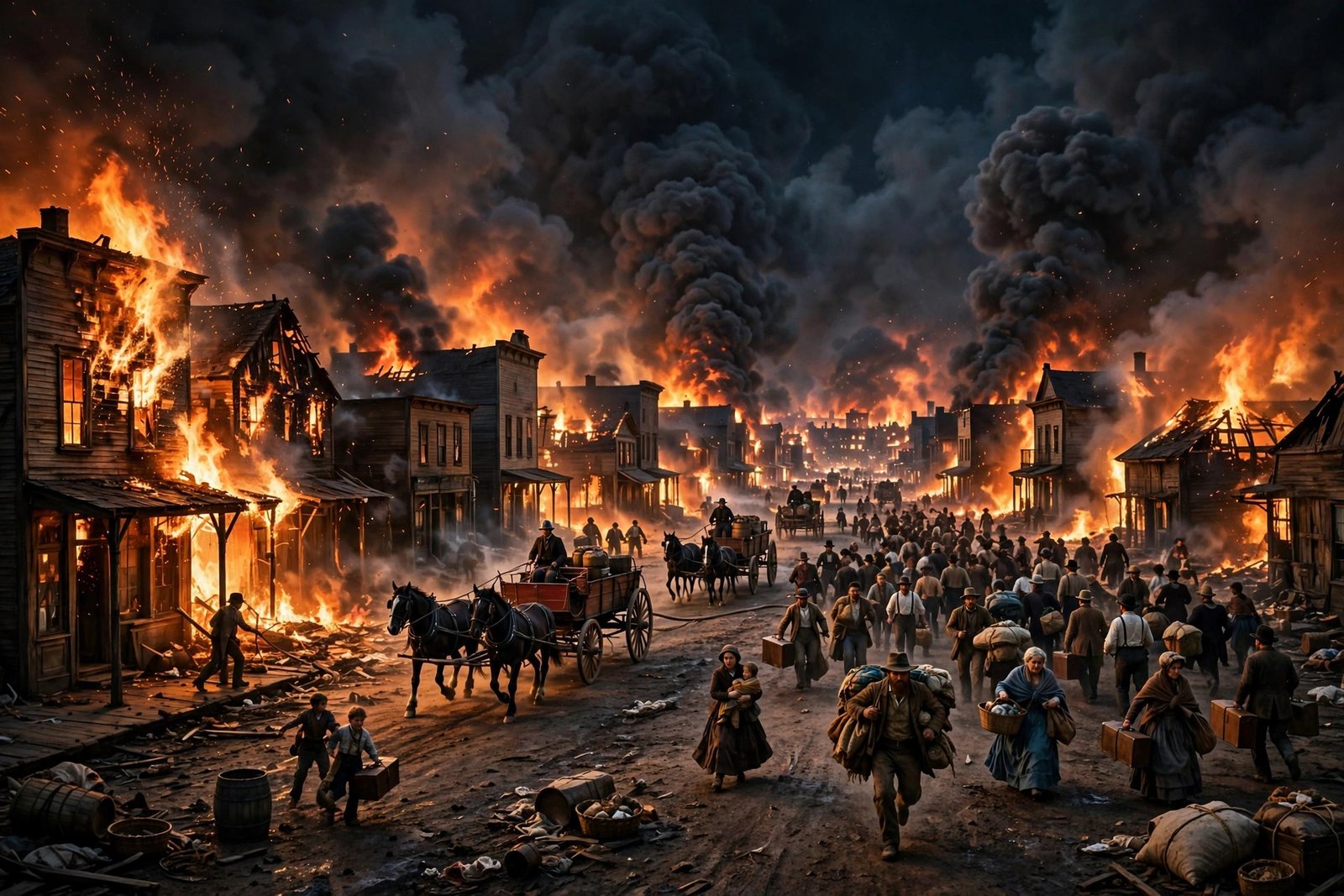
On a dry, windy Sunday night in October 1871, one of the most famous disasters in American history began in a small barn on the West Side of Chicago. The Great Chicago Fire 1871 would burn for three days, destroy a huge part of the city, and leave around 100,000 people homeless. Yet the most surprising part of the story is not only how much was lost. It is how quickly Chicago came back, stronger, taller, and more modern than before. This is the true story of that fire, the legend that grew up around it, and the city that refused to stay down.
Chicago in 1871 was a boomtown. It had grown from a small trading post on the shore of Lake Michigan into one of the fastest-growing cities in the United States. Railroads, lumber yards, grain elevators, and stockyards made it rich and busy. But the city was also built almost entirely of wood. Houses, shops, churches, sidewalks, and even many streets were made of timber. After a long, hot, dry summer, the whole city was like a box of matches waiting for a spark. That spark came on the evening of October 8, 1871.
A City Built of Wood
To understand why the fire became so large, you have to picture Chicago as it was in 1871. The city had about 300,000 residents, and most of them lived in wooden houses packed close together. Pine was cheap and plentiful, brought down from the forests of Wisconsin and Michigan, so builders used it for almost everything. Even the sidewalks were wooden planks, and some streets were paved with wooden blocks. When it rained, the streets turned to mud. When it was dry, dust and wood shavings filled the air.
The summer of 1871 had been unusually dry. Very little rain had fallen for months, and the wooden buildings had dried out completely. A smaller fire had already broken out in the city the day before, on October 7, and firefighters had spent many hours fighting it. They were tired, their equipment was worn, and their horses were exhausted. The city had a fire department, but it was small for a city of that size, and its water supply depended on a single pumping station. In short, Chicago was vulnerable, and almost everyone who lived there knew it. Newspapers had warned about the danger of fire, and insurance companies had raised their rates. Still, nobody expected what was about to happen.
The city was also divided by the Chicago River, with bridges connecting its different sides. The river itself was lined with lumber yards, coal yards, warehouses, and factories, all full of flammable material. On a windy night, a fire that started in one place could jump from roof to roof, carried by burning embers. That is exactly what happened. The wind that night came from the southwest, and it pushed the flames steadily toward the northeast, straight into the heart of the city.
The Night of October 8, 1871
The fire began on the evening of Sunday, October 8, 1871, in or near a barn owned by Patrick and Catherine O’Leary on DeKoven Street, on the city’s West Side. The exact cause has never been proven. What is known is that a fire started in the barn area at about 8:30 in the evening and spread quickly to nearby buildings. A neighbour raised the alarm, but the first firefighters were sent to the wrong place because of a mix-up in the alarm system. By the time they reached the right spot, the fire had already grown too large to control.
Within an hour, the blaze had crossed from the West Side toward the South Side. Flames leapt from house to house, and burning embers carried by the strong wind landed on roofs blocks away, starting new fires ahead of the main blaze. People woke to the smell of smoke and the sound of church bells ringing the alarm. Families grabbed what they could carry and ran into the streets. Some tried to save furniture, pets, and valuables. Others simply ran for their lives toward the river or the lake, hoping the water would stop the flames.
The fire moved with terrifying speed. Wooden sidewalks caught fire under people’s feet. Horses panicked and bolted. The heat was so intense that stone buildings cracked and iron beams bent. The city’s gas works exploded, adding to the chaos. Firefighters worked through the night, but their hoses could not reach far enough, and the water pressure dropped as the pumping station itself came under threat. By morning, much of the South Side was already gone, and the fire was moving toward the downtown business district and the North Side.
The Legend of Mrs. O’Leary’s Cow
No story about this fire is complete without the legend of Mrs. O’Leary’s cow, but it is important to be clear: the cow story is a legend, not a proven fact. According to the tale, Catherine O’Leary was milking her cow in the barn on the evening of October 8 when the cow kicked over a lantern, setting the hay on fire. The story spread quickly in newspapers after the fire, and it became one of the most famous anecdotes in American history. Songs, poems, and schoolbooks repeated it for generations.
Historians today do not accept the cow story as fact. There is no reliable evidence that a cow kicked over a lantern, and Catherine O’Leary herself denied it for the rest of her life. She said she had gone to bed early that night and was woken by the fire, not caused by it. Later research has suggested other possible causes, including a neighbour smoking in the barn, a meteor, or simple human accident, but none of these has been proven either. The Chicago History Museum notes that the true cause of the fire remains unknown, and the cow story survives because it is vivid and easy to remember, not because it is true.
Why did the legend stick? Partly because people needed someone to blame, and a poor Irish immigrant family made an easy target at a time when prejudice against Irish immigrants was common. Newspapers of the day were quick to repeat the tale without checking it. The O’Leary family suffered badly from the rumour. Their house was destroyed in the fire like so many others, and Catherine O’Leary lived the rest of her life under the shadow of a story she said was false. The legend is a reminder that a catchy story can outlive the truth, especially after a disaster when people are looking for simple explanations. For more on the legend and the evidence, see the Chicago History Museum’s account of the fire at chicagohistory.org and the overview at Britannica.
How the Great Chicago Fire 1871 Spread So Fast
The Great Chicago Fire 1871 spread so fast because almost everything in its path could burn, and the wind never stopped pushing it forward. The fire did not move in a neat line. It jumped. Burning shingles, sparks, and embers rode the wind for blocks at a time and landed on dry wooden roofs, starting fresh fires far ahead of the main front. Firefighters would put out one blaze only to find another starting behind them. The wooden sidewalks acted like fuses, carrying flames along the streets. Warehouses full of grain, coal, lumber, and liquor fed the fire with fresh fuel at every turn.
The Chicago River, which might have acted as a barrier, was itself lined with lumber yards and bridges made of wood. When the fire reached the river, it crossed on burning bridges and floating debris. The city’s water system also failed at the worst moment. The main pumping station was in the path of the fire, and when it burned, water pressure across the city collapsed. Fire hoses went limp. Firefighters had to watch helplessly as whole blocks burned without water to fight them. Some tried to use the lake, but the flames were too widespread and too hot.
By Monday morning, October 9, the downtown business district was burning. Banks, hotels, theatres, and newspaper offices went up in flames. The courthouse, with its tall bell tower, burned to the ground. The fire then crossed the river again into the North Side, where thousands of homes stood. People fled toward Lincoln Park and the lake shore, carrying children and whatever they could save. Some waded into the lake to escape the heat. Others hid in basements and cellars, hoping the fire would pass over them. The wind finally began to die down on Monday night, and rain began to fall on Tuesday, October 10. By then, the fire had burned itself out, but the damage was already done.
Three Days of Destruction in the Great Chicago Fire 1871
The scale of the destruction was staggering. The Great Chicago Fire 1871 burned for three days, from October 8 to October 10, 1871, and destroyed about 3.3 square miles of the city. Roughly 300 people lost their lives, though the exact number is still debated because many victims were never identified and records were destroyed in the fire. Around 100,000 people, about a third of the city’s population, were left homeless. More than 17,000 buildings were destroyed, including homes, businesses, churches, schools, and public buildings. The financial loss was enormous, running into hundreds of millions of dollars at the time.
The list of what burned reads like a catalogue of the whole city. The downtown business district was almost completely destroyed. The city’s main hotels, theatres, banks, and newspaper offices were gone. The waterworks, the gas works, and the courthouse were destroyed. On the North Side, entire neighbourhoods of wooden homes vanished. The fire spared the stockyards and some outlying areas, but the centre of the city was a wasteland of ash, twisted metal, and broken brick chimneys standing alone where houses had been.
For the survivors, the days after the fire were desperate. People camped in parks and open fields, in tents and makeshift shelters. Food, clean water, and clothing were scarce. Help arrived from across the country and even from overseas, with donations of money, food, and supplies pouring in. The city set up relief centres and temporary housing. Yet many families had lost everything: their homes, their businesses, their savings, and their family records. Rebuilding their lives would take years, even if rebuilding the city itself moved faster than anyone expected.
Human Stories From the Flames
Behind the numbers are human stories that make the fire feel real. One of the most famous is that of the city’s firefighters, who worked without rest for days, often without water, risking their lives to save people trapped in burning buildings. Some fire companies lost their equipment and their firehouses. Others kept fighting even after their own homes had burned. Their exhaustion after the fire the day before made the disaster worse, but their courage saved countless lives.
Ordinary people showed remarkable courage too. There are accounts of neighbours carrying elderly people and children out of burning houses, of shopkeepers trying to save their stock, and of families forming human chains to pass buckets of water. One well-known story tells of people fleeing across a bridge as it caught fire behind them, reaching safety moments before the bridge collapsed into the river. Another tells of a man who buried his valuables in his garden, hoping to dig them up after the fire, only to find the ground still too hot to touch days later.
Not every story is heroic. There was looting, confusion, and panic. Rumours spread faster than the fire itself, including false reports that the whole city was gone or that the lake was on fire. Some people refused to leave their homes until it was almost too late, convinced the fire would stop at the next street. Others fled in the wrong direction and had to double back through smoke and falling embers. The fire exposed both the best and the worst of a city under pressure, and those stories are part of why it is still remembered today. A good overview of the human impact can be found at History.com, and the scale of the disaster is summarised at Britannica.
How Chicago Rebuilt Into a Modern City
What happened next is almost as remarkable as the fire itself. Chicago did not just rebuild; it reinvented itself. Within days of the fire going out, plans for rebuilding were already under way. The city passed new building codes requiring fireproof materials such as brick, stone, and iron in the central districts. Wooden buildings were banned downtown. Streets were widened, and the water system was rebuilt with greater capacity. Architects and engineers from across the country came to Chicago to work on the rebuilding, and their ideas would change American architecture forever.
Within a year, much of the downtown area had been rebuilt in brick and stone. Within a few years, Chicago was booming again, bigger and busier than before. The rebuilding gave rise to the first skyscrapers, as architects learned to build tall with steel frames and fireproof materials. The Home Insurance Building, completed in 1885, is often called the first skyscraper, and it rose from the lessons of the fire. Chicago became a centre of modern architecture, and the city that had burned became known for its bold, innovative buildings.
The fire also changed how American cities thought about fire safety. Other cities adopted stricter building codes, better fire departments, and improved water systems. Chicago’s experience became a lesson studied by city planners everywhere. The city kept growing, and by the 1890s it was hosting the World’s Columbian Exposition, a grand world’s fair that showed the world how far Chicago had come in just over twenty years. The ruins of 1871 had become the foundation of a modern metropolis.
Key Takeaways From the Great Chicago Fire
The story of the fire holds lessons that still matter today. Here are the main ones to remember:
- Wooden cities were a disaster waiting to happen. Cheap timber, dry weather, and strong wind created the perfect conditions for a fire that no fire department of the time could stop.
- The cow story is a legend, not a fact. Catherine O’Leary denied it, and historians have found no evidence for it. The real cause of the fire is still unknown.
- About 3.3 square miles were destroyed. Roughly 300 people died, around 100,000 were left homeless, and more than 17,000 buildings were lost in three days.
- Rebuilding made Chicago stronger. New fireproof building codes, a better water system, and bold new architecture turned a disaster into the start of the modern city.
- Disasters change how cities are built. The fire influenced building codes and fire safety across the United States, not just in Chicago.
If you enjoy true disaster stories, you may also like our account of another famous American disaster, the Boston Molasses Flood of 1919, and our look at how everyday phrases got their names in the history of the name Black Friday.
Conclusion
The Great Chicago Fire 1871 remains one of the most famous fires in history because it was both a tragedy and a turning point. It destroyed a third of a great city, killed roughly 300 people, and left around 100,000 homeless. It also exposed the dangers of building a city entirely of wood, and it forced Chicago to rebuild smarter, with brick, stone, steel, and new ideas about safety. The legend of Mrs. O’Leary’s cow will probably never disappear, but the real story is more interesting: a dry summer, a windy night, a tired fire department, and a city that was ready to burn, followed by one of the fastest and most creative rebuilds in American history. Chicago did not just survive the fire. It used the fire as a fresh start, and the modern city that rose from the ashes is the lasting proof of that spirit.