
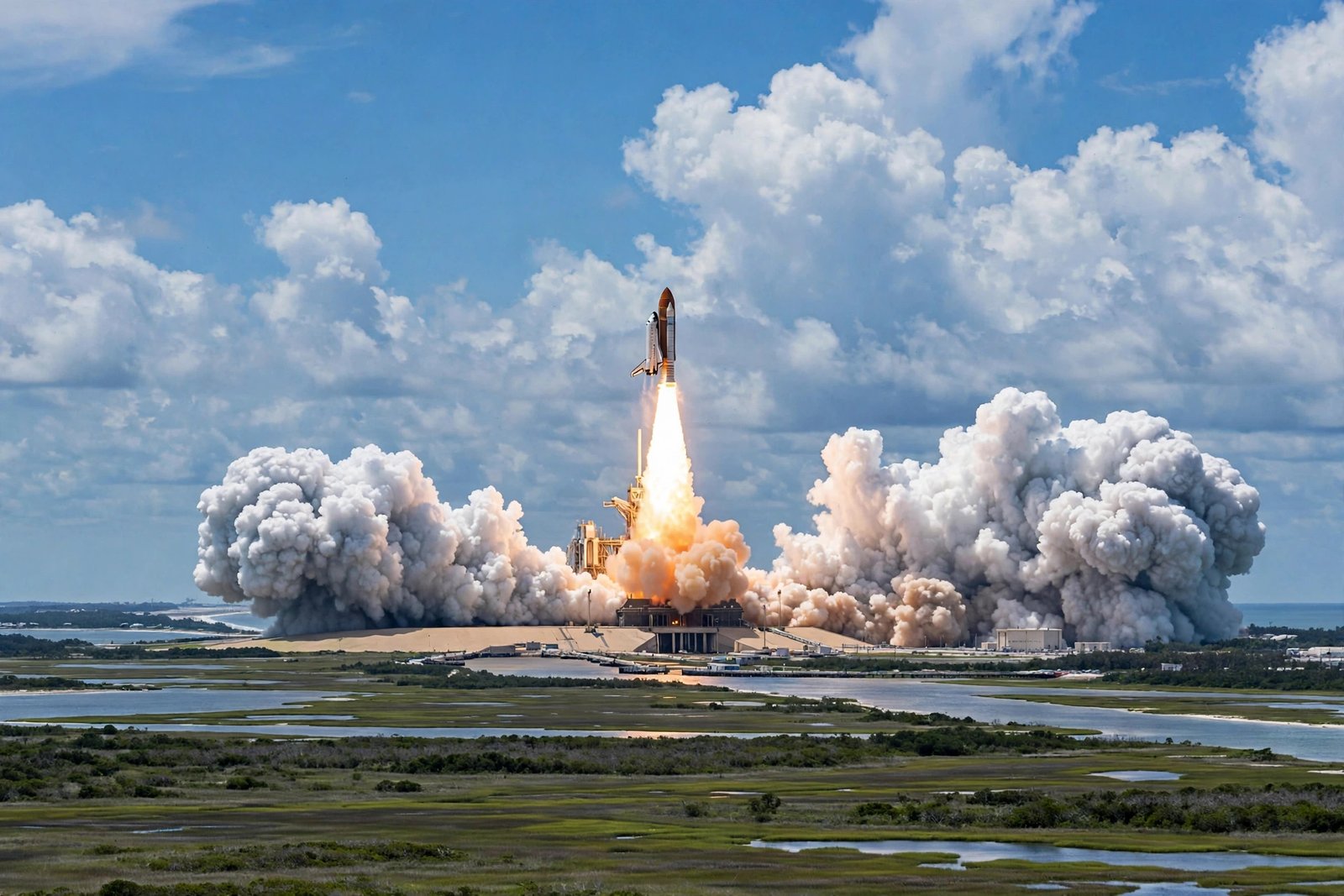
Imagine being 77 years old, a retired senator, and a national hero from a mission most people only read about in history books — and then strapping yourself into a space shuttle and blasting off again. That is exactly what John Glenn did. On October 29, 1998, John Glenn, the oldest astronaut to ever reach Earth orbit, returned to space aboard Space Shuttle Discovery, 36 years after he became the first American to orbit the Earth.
Glenn’s second flight was not a publicity stunt, though some critics at the time called it one. It was a genuine scientific mission, designed to study how the human body ages — and how spaceflight affects older people. His story spans the birth of American human spaceflight, a long career in the United States Senate, and one of the most extraordinary comebacks in history.
The Boy From Ohio Who Reached for the Stars
John Herschel Glenn Jr. was born on July 18, 1921, in Cambridge, Ohio, and grew up in the small town of New Concord. Like many boys of his generation, he was fascinated by flight. He learned to fly while in college, then served as a Marine Corps fighter pilot in World War II and the Korean War, flying combat missions in both conflicts.
After the wars, Glenn became a naval test pilot, pushing experimental aircraft to their limits. That experience — calm under pressure, precise under stress — made him an ideal candidate when NASA began looking for its first astronauts. In 1959, Glenn was selected as one of the Mercury Seven, America’s first group of astronauts.
At the time, the United States was locked in a space race with the Soviet Union, and the Soviets were winning. Yuri Gagarin had become the first human in space in April 1961, and the Americans were desperate to catch up. Glenn, already 40 years old, was about to become the face of America’s answer.
February 20, 1962: The First American to Orbit Earth
On February 20, 1962, John Glenn climbed into a tiny capsule named Friendship 7 and launched from Cape Canaveral, Florida. His mission, Mercury-Atlas 6, made him the first American to orbit the Earth — and only the third human being ever to reach space.
The flight lasted just under five hours, during which Glenn completed three orbits of the planet. It was not a smooth ride. During the flight, controllers worried that the capsule’s heat shield might have come loose, which could have meant disaster during re-entry. Glenn was told to keep the retrorocket package attached during re-entry to hold the shield in place — a tense, improvised solution that worked.
He splashed down safely in the Atlantic Ocean, and America erupted in celebration. Glenn received a ticker-tape parade in New York City, and President John F. Kennedy awarded him the NASA Distinguished Service Medal. Overnight, he became one of the most famous men on the planet.
Glenn’s 1962 flight was a turning point in the space race. It proved that America could put a human into orbit and bring him home safely, and it set the stage for the Apollo missions that would land astronauts on the Moon later that decade. For readers who love early space history, our article on NASA’s wooden Moon capsules and the Ranger missions of 1962 explores the same remarkable era, and 8 space facts that sound fake but are real is packed with surprises from the history of spaceflight.
From Astronaut to Senator
Glenn left NASA in 1964, partly because officials considered him too valuable — and too famous — to risk in another flight. He went into business, then into politics, and in 1974 he was elected to the United States Senate from Ohio. He served there for 24 years, until 1999, becoming a strong supporter of NASA and the American space programme throughout his tenure.
But Glenn never stopped dreaming about space. For decades, he lobbied quietly for another chance to fly. He argued that an older astronaut could help scientists understand ageing, because many of the changes the body undergoes in weightlessness — bone loss, muscle weakening, balance problems, sleep disruption — look strikingly similar to the changes that come with growing old.
In January 1998, NASA Administrator Dan Goldin announced that Glenn would join the crew of STS-95. At 77, John Glenn would become the oldest person ever to fly in space, and the oldest person to reach orbit — a record for orbital flight that he still holds today.
John Glenn, Oldest Astronaut, Returns to Space in 1998
On October 29, 1998, Space Shuttle Discovery launched from Kennedy Space Center in Florida on mission STS-95. John Glenn, the oldest crew member by a wide margin, flew as a payload specialist. The nine-day mission, which lasted until November 7, carried a Spacehab module filled with scientific experiments.
Glenn’s role was central to the mission’s human research. NASA and the National Institute on Aging planned to use him as a test subject, taking biometric measurements before, during, and after the flight. Some experiments compared his responses with those of younger crew members. He took part in experiments on sleep monitoring and protein use, and he was also in charge of the flight’s photography and videography.
During the mission, Discovery deployed the Spartan solar-observing spacecraft to study the Sun’s corona and the solar wind, and tested equipment for the Hubble Space Telescope. The mission also carried Pedro Duque, who became the first Spanish astronaut in space.
Glenn spent 213 hours and 44 minutes in space on STS-95, orbiting the Earth 134 times. The landing was far less dramatic than his 1962 splashdown: Discovery glided home and touched down safely at Kennedy Space Center. During the flight, President Bill Clinton even sent Glenn a congratulatory email aboard the shuttle, often cited as a milestone in presidential communications.
Was It Science or a Publicity Stunt?
Not everyone was convinced. Some members of the space community criticised Glenn’s flight as a favour to a famous politician, arguing that a single 77-year-old test subject could not produce statistically meaningful science. Others pointed out that Glenn was in extraordinary shape — doctors reportedly said he had the body of a 50-year-old — so he was hardly a typical senior citizen.
Both points have some truth to them, but they miss the bigger picture. Glenn’s flight offered something no laboratory on Earth could: a chance to study the effects of weightlessness on the same person at two points in life, 36 years apart — by far the longest interval between spaceflights by the same person in history. It also drew enormous public attention to ageing research and to NASA’s work, inspiring a new generation to care about science.
And Glenn took the science seriously. He trained like any other crew member, passed the same medical checks, and carried out his experiment duties diligently. Whether or not the data alone justified the mission, nobody who watched the launch could doubt his courage. At 77, he was willing to ride a controlled explosion into orbit in the name of knowledge.
The Legacy of John Glenn, the Oldest Astronaut to Orbit Earth
John Glenn died on December 8, 2016, at the age of 95, beloved as a hero, a senator, and a symbol of American perseverance. He remains the oldest person ever to reach Earth orbit — later age records in space, such as those set by Wally Funk, William Shatner, and Ed Dwight, were suborbital flights that did not circle the planet.
His legacy lives on in many places: NASA’s Glenn Research Center in Cleveland, Ohio, is named for him, as are schools, highways, and buildings across the country. But his greatest legacy may be the example he set. Glenn showed that curiosity does not retire, that courage has no age limit, and that a single life can contain more than one great adventure.
His story also sits at the heart of one of the most dramatic years of the 20th century. Readers curious about the tensions of the early 1960s may enjoy our account of Black Saturday and the Cuban Missile Crisis of 1962, the same year Glenn first orbited the Earth.
Key Takeaways
- John Glenn became the first American to orbit Earth on February 20, 1962, aboard Friendship 7, completing three orbits in just under five hours.
- After leaving NASA in 1964, he served 24 years in the United States Senate, from 1974 to 1999.
- On October 29, 1998, at age 77, John Glenn became the oldest astronaut to fly in space, returning aboard Space Shuttle Discovery on mission STS-95.
- The nine-day STS-95 mission studied the similarities between ageing and the body’s response to weightlessness, with Glenn as a test subject.
- Glenn orbited Earth 134 times on STS-95 and remains the oldest person ever to reach Earth orbit.
- He died on December 8, 2016, at age 95, and NASA’s Glenn Research Center in Cleveland bears his name.
John Glenn’s life reads like a novel: small-town boy, combat pilot, test pilot, Mercury astronaut, senator, and — at an age when most people have long retired — astronaut once again. The next time someone tells you it is too late to chase a dream, remember the 77-year-old who looked at the sky and decided to go back. That is the spirit of John Glenn, the oldest person to orbit our planet, and it is a story worth telling again and again.
Sources and further reading: Britannica on STS-95, John Glenn biography, The Hindu, AmericaSpace, and Space.com.
How old was John Glenn when he became the oldest astronaut?
John Glenn was 77 years old when he returned to space on October 29, 1998, aboard Space Shuttle Discovery, making him the oldest astronaut to fly in space at that time.
When did John Glenn first orbit the Earth?
John Glenn first orbited the Earth on February 20, 1962, aboard the Friendship 7 capsule on the Mercury-Atlas 6 mission, completing three orbits in just under five hours.
Why did NASA send John Glenn back to space in 1998?
NASA and the National Institute on Aging sent Glenn on STS-95 to study the effects of spaceflight on an older person, because many changes caused by weightlessness resemble the changes that come with ageing.
Is John Glenn still the oldest astronaut ever?
John Glenn remains the oldest person ever to reach Earth orbit. Later age records were set on suborbital flights that did not orbit the planet, so his orbital record still stands.
How long did John Glenn’s 1998 mission last?
The STS-95 mission lasted nine days, from October 29 to November 7, 1998. Glenn spent 213 hours and 44 minutes in space and orbited the Earth 134 times.