
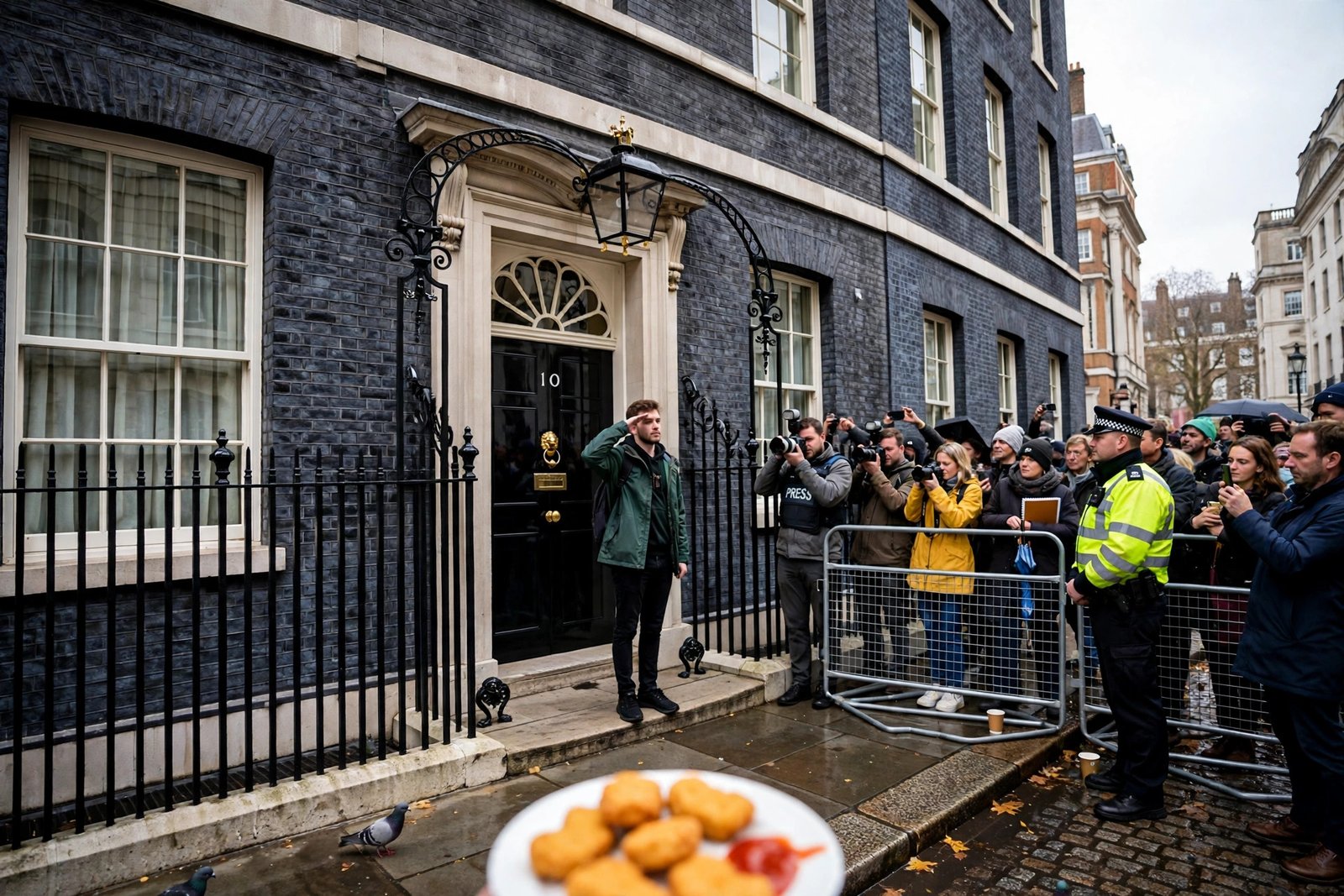
A five-second video of a TikTok star mouthing the words to a silly meme song outside the most famous front door in Britain has turned into one of the strangest political rows of the year. The chicken nugget song Downing Street storm began with a joke, escalated into a shouting match in the House of Commons, and ended with a deleted video, a scolding from the prime minister’s own office, and a national debate about what a single rude word really means. It is the kind of story that could only happen in the age of social media, where a sound clip recorded in a bedroom can travel all the way to the steps of 10 Downing Street and then straight into Prime Minister’s Questions.
The clip itself is almost absurdly simple. TikTok creator Max Balegde, who has around 3.6 million followers, stands outside the black door of Number 10, gives a salute, and mouths the words “bomboclaat pussywagon chicken nuggets” to a viral meme song. That is it. No speech, no protest, no stunt beyond a few seconds of lip-syncing. Yet within days of the video resurfacing, the leader of the Conservative Party was demanding an apology in Parliament, a Cabinet minister was calling it “not funny”, and linguists were being asked on national radio to explain the exact meaning of a Jamaican slang word. How did a chicken nugget joke become a political crisis? The answer says a lot about how politics, fame, and the internet now collide.
The Chicken Nugget Song Downing Street Moment: What Actually Happened
The video was filmed during a reception at 10 Downing Street on November 9, 2026. Prime Minister Andy Burnham, who took over from Keir Starmer as Labour leader and prime minister in July, had invited around 50 to 60 social media influencers to the prime minister’s official residence. The guest list was part of a deliberate strategy: Burnham’s team wanted to reach younger voters where they actually spend their time, and that means TikTok, YouTube, and Instagram rather than the evening news. The influencers in the room had a combined following reported at around 470 million people.
According to reports, guests were asked to hand in their personal phones and cameras when they entered the building, and Downing Street staff provided devices so they could film content for their followers. The footage was then sent to them afterwards. Balegde has said that no cameras were allowed inside the building. His now-famous clip was filmed on his way out, on the steps outside, using his own phone. He stood by the black door, saluted, and lip-synced to the viral sound as the camera rolled.
Here is the twist that makes the whole story stranger: the video was not new when the row erupted. Balegde posted it about three weeks before the controversy began, and it drew no complaints at the time. It was only when commentators picked it up in the week of November 23 that the clip exploded into the news. Balegde deleted the video on Tuesday, November 24, after the criticism mounted. Downing Street’s spokesperson said the post was “clearly not acceptable”, and reports suggested the prime minister’s social media accounts had even liked the post before it was taken down.
Balegde, whose real name is Max Trobe, is 27 years old and grew up in Darwen, a small working-class town in the north of England. He started posting on TikTok in January 2020 and now has about 3.6 million followers there, plus another 600,000 on Instagram. He is best known for his comedy videos and his interview show, and he had already interviewed the cast of Heartstopper earlier in the year. He was not a random guest at the reception. He was exactly the kind of creator Burnham’s team wanted in the room: young, funny, and followed by millions of people who rarely watch the news.
Where the Chicken Nugget Song Came From
To understand the row, you have to understand the song. The sound Balegde was miming to is an AI-generated meme track built around the phrase “bomboclaat pussywagon chicken nuggets”. The meme traces back to a YouTube creator who stacked 52 chicken nuggets, and the odd, catchy phrase took on a life of its own on TikTok, where users lip-sync it, dance to it, and remix it endlessly. Like many TikTok sounds, it means almost nothing on its own. It is funny precisely because it is nonsense: a jumble of slang words and fast food, delivered with total confidence.
That is the first thing to know about the chicken nugget song Downing Street controversy. For millions of TikTok users, the phrase is a joke, a sound, a piece of internet silliness with no deeper meaning. Balegde himself has said he was simply doing a trend, the same trend thousands of other creators had already filmed in their bedrooms, cars, and kitchens. He did not write the song. He did not invent the phrase. He just performed it in the most high-profile location possible, and that location changed everything.
But the words are not as innocent as they sound, and that is the second thing to know. “Bomboclaat” is a Jamaican profanity, a word referring to a sanitary cloth, and in recent years it has also become popular online slang for expressing surprise, anger, or frustration. The rest of the phrase is crude slang too. On TikTok, those words are usually treated as a joke, stripped of their literal meaning. In the House of Commons, they were treated very differently, and that gap between the two worlds is where the whole storm lives.
Why the Chicken Nugget Song Downing Street Clip Exploded
The clip hit the political agenda early in the week of November 23, 2026. Conservative leader Kemi Badenoch raised it at Prime Minister’s Questions on Wednesday, November 25, and she did not hold back. She told MPs that the words used on the steps of Number 10 were so offensive that she would not repeat them. She described them as disgusting comments about women’s private parts and as language that referred to white women as cheap meat, and she asked whether Burnham would apologise. She said it was a disgrace that Number 10, a door she called a symbol of British democracy, power, and authority in the world, was being degraded in this way.
Badenoch accused Burnham of turning the UK into “a joke” and of using Number 10 as his personal studio to carry out “silly TikToks”. She said she had been “pretty shocked” by the videos coming out of the event and questioned whether they were in good taste. She also pointed out that when she was a new MP, visitors had to hand in their phones as they stepped into 10 Downing Street, so seeing a Labour prime minister turn the building into a content backdrop felt jarring to her.
Burnham declined to apologise for engaging with the people young people look to for information. He said an inappropriate video had been taken down, that it was right to call it out, and that the video was not acceptable. But he also accused Badenoch of sneering at TikTokers and influencers, and of looking down on the platforms where millions of young voters get their news. The exchange turned a five-second joke into a full debate about who politicians should talk to and how.
A Cabinet minister weighed in too, calling the TikTok stunt and its lewd lyrics outside Number 10 “not funny”. The row also reached BBC Radio 4, where presenter Justin Webb discussed the meaning of the phrase on air, saying it described cheap white meat, in other words poor white girls. The Guardian, meanwhile, reported that the exact meaning of the phrase is disputed, with linguists and commentators disagreeing over whether it carries a hidden derogatory meaning at all. The argument over one word became a story in itself.
The Other Videos From the Night
The Balegde clip was not the only video from the November 9 reception to draw attention. TikTok personality Luke Hamnett recreated Hugh Grant’s famous prime ministerial dance from the film Love Actually inside Number 10, dancing through the building in a nod to the beloved 2003 movie scene. Hamnett also hosted Burnham on the 100th episode of his podcast at the start of the same week, a sign of how closely the prime minister’s team had woven influencers into its communications plan.
Critics pointed to the dance video as further proof that Downing Street had been turned into a “circus”, in the words of Balegde’s opponents. Supporters pointed out that politicians have been dancing, joking, and posing for photos at Number 10 for decades, and that the only thing new was the platform. The dance itself was harmless. It was the context, a prime minister hosting content creators in the seat of government, that made it controversial.
Balegde himself hit back at his critics. In comments reported by LADbible, he blamed “revolting right-wing people” for the fuss, and pointed out that Downing Street had hosted parties during lockdown, a reference to the partygate scandal that damaged the previous Conservative government. His defence was simple: he had done a popular trend, he had apologised in his own way, and the outrage was overblown. His critics’ answer was equally simple: the location matters, and the steps of Number 10 are not a TikTok stage.
Influencers in Politics: A Bigger Shift
Step back from the chicken nuggets, and the real story is about how politics has changed. Burnham has made social media central to how he talks to voters since taking office in July, and newspapers have started calling him “the TikTok Prime Minister”. The November 9 reception was the most visible expression of that strategy: invite the creators, give them access, and let them tell their followers what happened in their own words.
The logic is hard to argue with. Millions of young people get their news from TikTok and Instagram, not from newspapers or the evening news. A prime minister who never appears on those platforms is invisible to a whole generation of voters. Inviting influencers into Number 10 is a way to reach them, and the combined following of the guests, around 470 million, is larger than the audience of any television channel in the country.
But the risk is exactly what happened. Influencers are not journalists, and they do not follow the rules of a press conference. They film what is funny, they chase trends, and they perform for their audience, not for the institution hosting them. When you invite 60 creators into the most famous building in British politics, you are inviting 60 different versions of the event, and you cannot control all of them. One five-second clip, filmed on the way out the door, can undo weeks of careful planning.
Other countries have faced the same dilemma. Politicians around the world now court YouTubers, streamers, and TikTok stars, and the results are often chaotic. The creators bring huge audiences, but they also bring their own humour, their own slang, and their own idea of what is funny. Traditional media expects decorum. TikTok rewards the opposite. The Downing Street row is a vivid example of what happens when those two worlds meet in the same doorway.
What Happens Next
The video is deleted, the spokesperson has condemned it, and the prime minister has said it was right to call it out. But the questions raised by the row are not going away. Will Burnham keep inviting influencers to Number 10, or will the backlash make his team more cautious? Will other politicians learn from the episode and set clearer rules for creators, or will they decide the audience is worth the risk? And will the phrase itself, “bomboclaat pussywagon chicken nuggets”, survive as a meme, or will the political row kill the joke for good?
There is a good chance the song will outlive the scandal. TikTok trends are famously hard to kill, and controversy often makes a sound more popular, not less. The clip may be gone from Balegde’s account, but the sound itself is still circulating, and every news report about the row has introduced it to people who had never heard it before. That is the irony of the whole affair: a story about a song being inappropriate has made the song more famous than it ever was.
For Balegde, the episode is a reminder that fame on TikTok and fame in the news are very different things. On TikTok, he is a comedian with millions of fans. In the newspapers, he became the centre of a political scandal. He has apologised, in his own way, and moved on. Whether the row damages his career or simply adds to his notoriety is something only time will tell.
Takeaways: The Chicken Nugget Song Downing Street Storm in Brief
- TikTok creator Max Balegde filmed himself saluting and mouthing the viral meme song “bomboclaat pussywagon chicken nuggets” outside 10 Downing Street during an influencer reception on November 9, 2026.
- The video was posted about three weeks before the row erupted and was deleted on November 24, 2026, after Downing Street’s spokesperson called it “clearly not acceptable”.
- Conservative leader Kemi Badenoch raised the clip at Prime Minister’s Questions on November 25, calling it “extremely unserious” and demanding an apology from Prime Minister Andy Burnham.
- Burnham declined to apologise for engaging with influencers, but agreed the video was inappropriate and that it was right to call it out.
- The meme traces back to a YouTube creator stacking 52 chicken nuggets, and the word “bomboclaat” is a Jamaican profanity whose exact meaning in the song is disputed by linguists and commentators.
- Other videos from the same night, including Luke Hamnett recreating Hugh Grant’s Love Actually dance inside Number 10, also drew criticism from the prime minister’s opponents.
Conclusion
The chicken nugget song Downing Street storm will be remembered as one of the strangest political rows of 2026, and it deserves to be remembered, because it captures something real about the world we live in now. A joke made in a bedroom can reach the steps of the prime minister’s residence. A five-second lip-sync can become a question in Parliament. And a single slang word can be debated by linguists on national radio while millions of teenagers shrug and say it is just a sound.
Neither side in the row is entirely wrong. Badenoch is right that Number 10 is a symbol, and that the people who run it should treat it with respect. Burnham is right that politicians cannot ignore the platforms where young people actually are, and that refusing to engage with influencers means refusing to talk to a generation. The hard part is finding the line between the two, and the Balegde video shows how easy it is to cross it by accident.
In the end, the story is not really about chicken nuggets. It is about what happens when the internet’s sense of humour meets the oldest traditions of British politics, and neither side is willing to laugh at the other’s joke. The video is gone, but the debate it started, about who gets invited into Number 10 and what they are allowed to do once they are inside, is only just beginning. If you enjoy viral moments that spiral out of control, you will like our roundup of TikTok trends from the first week of November 2026, and our explainer on the bicep heart trend taking over TikTok.
To learn more, see the Firstpost explainer on the chicken nugget song storm, the LADbible report on Max Balegde hitting back, and the Tyla report on the deleted Downing Street video.
What is the chicken nugget song Downing Street storm about?
TikTok creator Max Balegde filmed himself saluting and mouthing the viral meme song “bomboclaat pussywagon chicken nuggets” outside 10 Downing Street during an influencer reception hosted by Prime Minister Andy Burnham. The clip drew political backlash, was deleted, and was raised in the House of Commons by Conservative leader Kemi Badenoch.
Who is Max Balegde?
Max Balegde, whose real name is Max Trobe, is a 27-year-old TikTok creator from Darwen in the north of England. He started posting on TikTok in January 2020 and has around 3.6 million followers there, plus about 600,000 on Instagram.
What does “bomboclaat pussywagon chicken nuggets” mean?
“Bomboclaat” is a Jamaican profanity referring to a sanitary cloth, and it has also become popular online slang for expressing surprise or frustration. The full phrase is a nonsense meme lyric that traces back to a YouTube creator stacking 52 chicken nuggets, and its exact meaning is disputed by linguists and commentators.
What did Kemi Badenoch say about the video?
At Prime Minister’s Questions on November 25, 2026, Badenoch said the words were so offensive she would not repeat them, called the incident “extremely unserious”, accused Burnham of degrading Number 10 and turning the UK into “a joke”, and asked him to apologise.
Did Andy Burnham apologise for the Downing Street video?
No. Burnham declined to apologise for engaging with influencers and the people young people look to for information, but he agreed the video was inappropriate, said it was right to call it out, and noted that the video had been taken down.