
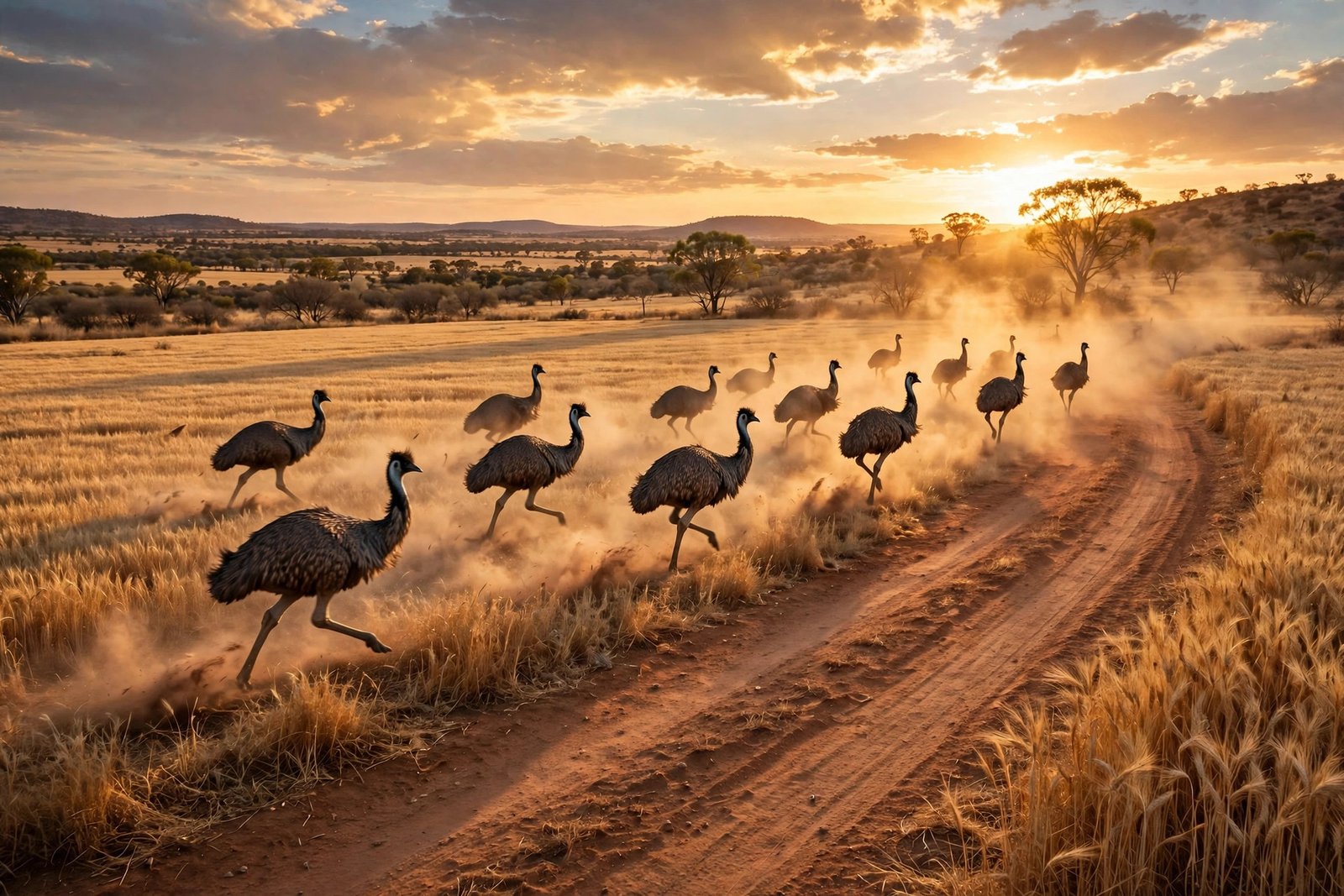
In late 1932, the Australian Army went to war. Its soldiers were veterans of the First World War, its weapons were machine guns, and its enemy was a bird. The Emu War is one of the strangest true stories in military history: three soldiers, two Lewis guns, and 10,000 rounds of ammunition were sent to defeat around 20,000 emus that were eating Western Australia’s wheat — and the birds won.
It sounds like a joke, and at the time newspapers around the world treated it as one. But for the farmers of the Campion district, it was deadly serious. Their crops were being destroyed, their fences were being torn down, and they were already struggling to survive the Great Depression. The emus were the final straw. So the government sent in the army — and discovered that a flightless bird can be a remarkably difficult enemy.
How It Started: Soldiers Turned Farmers
After the First World War, the Australian government settled thousands of returning soldiers on farmland in Western Australia as part of a soldier settlement scheme. More than 5,000 veterans were given blocks of land in the state’s Wheatbelt, including the Campion district, to grow wheat and build new lives. The idea was generous. The reality was harsh.
The land was marginal, the farmers were inexperienced, and wheat prices collapsed during the Great Depression. By 1932, around a quarter of the settlers in the region had already walked away from their farms. Those who stayed were barely holding on — and then the emus arrived.
Emus are Australia’s largest native birds. They stand nearly six feet tall, cannot fly, and can run at close to 50 kilometres per hour (about 30 miles per hour). Every year after breeding season, they migrate in large numbers toward the coast in search of food and water. In 1932, a severe drought pushed an unusually large migration — roughly 20,000 birds, according to contemporary estimates — into the farming districts around Campion and Walgoolan.
The emus ate the wheat, trampled what they did not eat, and smashed through fences as they moved. Every hole they tore in a fence was an open door for rabbits, which poured through and caused even more damage. The farmers, many of them ex-soldiers who knew exactly what a machine gun could do, decided to ask the government for military help. It is the kind of unbelievable-but-true story that sits comfortably alongside our roundup of 8 space facts that sound fake but are real — except this one really happened.
The Government Says Yes: Machine Guns Against Birds
The farmers’ deputation found a sympathetic ear in Sir George Pearce, Australia’s Minister of Defence. Pearce agreed to send military assistance, but with conditions: the guns would be operated by military personnel, the Western Australian government would pay for troop transport, and the farmers themselves would provide food and accommodation and pay for the ammunition.
The force he dispatched was tiny: Major Gwynydd Purves Wynne-Aubrey Meredith of the Royal Australian Artillery, in command, with Sergeant S. McMurray and Gunner J. O’Halloran — three men in total. They carried two Lewis light machine guns and 10,000 rounds of ammunition. The plan was simple. The soldiers would set ambushes near water sources, herd the emus toward the guns, and mow them down in large numbers.
Rain delayed the start of the operation, scattering the emus over a wider area. When the rain cleared, the troops were finally deployed on 2 November 1932, with orders to assist the farmers. According to one newspaper account of the time, they were also supposed to collect 100 emu skins so the feathers could be used to make hats for light horsemen — a detail that captures just how casually the whole operation was planned.
The Great Emu War Begins: The First Attempt Fails
The first days of the campaign went badly. The soldiers tried to herd the emus toward their guns, but the birds refused to cooperate. Instead of staying in large, dense flocks that would make easy targets, the emus scattered into small, fast-moving groups. They ran in zigzag patterns, changed direction without warning, and simply outran the soldiers’ attempts to corner them.
One early ambush illustrates the problem perfectly. Meredith set up near a dam where more than 1,000 emus had been spotted heading for water. It should have been a massacre. Instead, the machine gun jammed after only a few seconds of firing, and the emus scattered in every direction. In the first few days of the campaign, the soldiers killed only a few dozen birds — a tiny fraction of the 20,000 they had been sent to cull.
The soldiers also tried mounting a gun on a truck so they could chase the emus across the open ground. It failed too. The emus, capable of running at nearly 50 kilometres per hour, were faster than the truck over rough terrain, and the gunner could not aim the bouncing weapon accurately. The birds simply ran away, leaving the truck lurching behind them.
By 8 November, barely a week after it began, the first attempt was over. The military withdrew, and the press had a field day. The operation had used thousands of rounds of ammunition and achieved almost nothing. The farmers, however, were still desperate — and they begged for the soldiers to come back.
The Second Attempt: More Bullets, Same Result
Within days, Meredith and his men were sent back for a second attempt. The government agreed, partly because there were so few experienced machine gunners in Western Australia that Meredith was the only practical choice. The second phase of the operation began on 13 November 1932 and lasted until 10 December.
This time the soldiers had more success — at first. In the first two days they killed around 40 emus, and their methods improved as they learned to wait near water holes and fire at close range. But the fundamental problem never changed: the emus would not stand still in large groups, and the guns were designed for human targets that behave very differently from wild birds.
By early December, the soldiers were killing around 100 emus a week. Meredith was recalled on 10 December, and in his report he claimed 986 emus killed with 9,860 rounds of ammunition — almost exactly 10 rounds per confirmed kill. He also claimed a further 2,500 birds had died later from their wounds. Even accepting those figures, the campaign had barely dented a population of around 20,000, and it had consumed nearly all of the 10,000 rounds issued.
Meredith himself paid the emus an extraordinary compliment. He reportedly said that the birds could “face machine guns with the invulnerability of tanks,” and he compared their manoeuvrability to that of Zulu warriors, noting how the emus kept moving even when badly wounded. It was the closest thing to a surrender speech the campaign produced.
Why the Emus Won the Great Emu War
So how did a flightless bird defeat the Australian Army in the so-called war? The answer is a combination of biology, tactics, and bad planning:
- Speed. Emus can run at nearly 50 kilometres per hour, faster than a truck on rough ground and far faster than a soldier on foot. They could simply leave the battlefield whenever they wanted.
- Dispersal. Machine guns are devastating against dense formations. The emus scattered into small groups the moment they were threatened, so there was never a large target to shoot at.
- Unpredictable movement. Emus run in zigzags and change direction suddenly, making them extremely hard to track with a heavy, fixed weapon.
- Toughness. Emus are big, heavily built birds with thick feathers. Meredith reported that they could absorb several bullets and keep running, which is why he compared them to tanks.
- Sentries and alertness. Emu groups post lookouts, and the birds are wary of anything unusual. Ambushes rarely caught them by surprise.
- The wrong weapon for the job. A Lewis gun is designed to fire at human soldiers advancing in formation, not at fast, scattered wildlife across open scrub.
There was also a numbers problem. Three men with two guns were expected to control 20,000 birds spread over a huge area of farmland. No amount of ammunition could fix that arithmetic. As one modern summary puts it, the military’s objective was nowhere near accomplished — the operation was, in the plainest terms, a failure.
Aftermath: Bounties, Fences, and a Long Grudge
The failure of the campaign did not solve the farmers’ problem, and they kept asking for military help. They requested it again in 1934, 1943, and 1948 — and were turned down every time. The government had learned its lesson: sending soldiers after emus was expensive, embarrassing, and ineffective.
Instead, the authorities fell back on two older solutions, and both worked far better than the army had. The first was the bounty system, which had been introduced in 1923. Under it, people were paid for each emu killed, and it proved brutally effective: 57,034 bounties were claimed in just six months of 1934. Later figures are even starker — Australian Geographic has reported that around 284,700 emus were killed in Western Australia between 1945 and 1960.
The second solution was fencing. From 1930 onward, exclusion barrier fencing became the standard way to keep emus out of farming areas, and the state barrier fence — originally built against rabbits — was extended and strengthened, becoming known in places as the Emu Fence. A fence does not need to aim, reload, or chase anything. It simply stands there, and that turned out to be the answer the machine guns could not provide.
The conflict dragged on in quieter forms for decades. In November 1950, a Western Australian politician complained about emus in federal parliament and asked the Army Minister for ammunition for farmers; the minister agreed and released 500,000 rounds of .303 ammunition. The birds, meanwhile, kept coming back every season, as they had for thousands of years before any farm existed.
The Legacy of the Emu War
Today, the Emu War is remembered as one of history’s great absurdities — and as a cautionary tale about what happens when a government reaches for a military solution to an ecological problem. It has inspired documentaries, comedy sketches, songs, and countless articles, and it regularly tops lists of the strangest events in Australian history.
There are real lessons in it, though. The soldier settlement scheme had placed inexperienced farmers on marginal land during an economic collapse; the emus were only the last of many problems, including low wheat prices, drought, and rabbits. Blaming the birds was easier than fixing the system, and the “war” let the government look decisive without addressing any of the underlying causes.
The emus, for their part, are doing fine. Despite decades of bounties, fences, and ammunition, there are today around three-quarters of a million emus across Australia. In 1999, wild emus became formally protected under Australia’s Environment Protection and Biodiversity Conservation Act — a final twist in a story that began with the army trying to shoot them all. If you enjoy true stories that sound too strange to be real, our piece on the man who survived two atomic bombs is another remarkable tale of survival against impossible odds.
Key Takeaways
- The Emu War was a 1932 Australian military operation in the Campion district of Western Australia, ordered after around 20,000 emus migrated into wheat farms during a drought.
- Just three soldiers — Major G. P. W. Meredith, Sergeant S. McMurray, and Gunner J. O’Halloran — were sent with two Lewis machine guns and 10,000 rounds of ammunition.
- The first attempt (2–8 November 1932) failed badly: guns jammed, emus scattered, and a truck-mounted gun could not keep up with birds running at nearly 50 km/h.
- The second attempt (13 November–10 December) killed 986 emus by Meredith’s own count, at a cost of almost exactly 10 rounds per bird — barely denting the population.
- Meredith famously said the emus could “face machine guns with the invulnerability of tanks.”
- The aftermath worked better than the war: 57,034 bounties were claimed in six months of 1934, and exclusion fencing finally kept the birds out of the wheat.
- Today there are around 750,000 emus in Australia, and the species has been formally protected since 1999.
The Emu War lasted barely five weeks, cost almost 10,000 rounds of ammunition, and ended with the army withdrawing and the emus still standing in the wheat fields. It is funny, and it deserves to be laughed at — but it is also a reminder that nature does not care about our plans, our weapons, or our pride. The farmers needed help, and they deserved it. They just needed fences and fair prices, not machine guns. The emus knew that all along. They simply ran, scattered, and waited for the soldiers to go home — and then they carried on eating the wheat.
Sources: Wikipedia — Emu War; Britannica — Emu War; National Geographic — The Bizarre Story of When Australia Went to War With Emus, and Lost; HistoryExtra — What Was the Emu War?.
What was the Great Emu War?
The Great Emu War was an Australian military operation in late 1932 in which three soldiers with two Lewis machine guns were sent to cull around 20,000 emus that were destroying wheat crops in the Campion district of Western Australia. The operation failed, and the emus were widely considered the victors.
When did the Great Emu War happen?
The campaign ran from 2 November to 10 December 1932. The first attempt lasted about a week before the troops withdrew on 8 November; a second attempt ran from 13 November until the soldiers were recalled on 10 December.
How many emus were killed in the Great Emu War?
Major Meredith reported 986 emus killed with 9,860 rounds of ammunition between 12 November and 10 December, and claimed a further 2,500 died later from wounds. Against a population of around 20,000 birds, this barely made a difference.
Why did the Australian Army lose the Great Emu War?
The emus were faster than the soldiers’ truck, scattered into small groups instead of staying in dense flocks, ran in unpredictable zigzags, and could absorb bullets and keep moving. Three men with two machine guns simply could not cover a huge area against 20,000 fast, wary birds.
What happened after the Great Emu War?
Farmers’ requests for military help in 1934, 1943, and 1948 were refused. Instead, a bounty system proved far more effective — 57,034 bounties were claimed in six months of 1934 — and exclusion barrier fencing finally kept emus out of the wheat fields. Wild emus have been formally protected in Australia since 1999.