
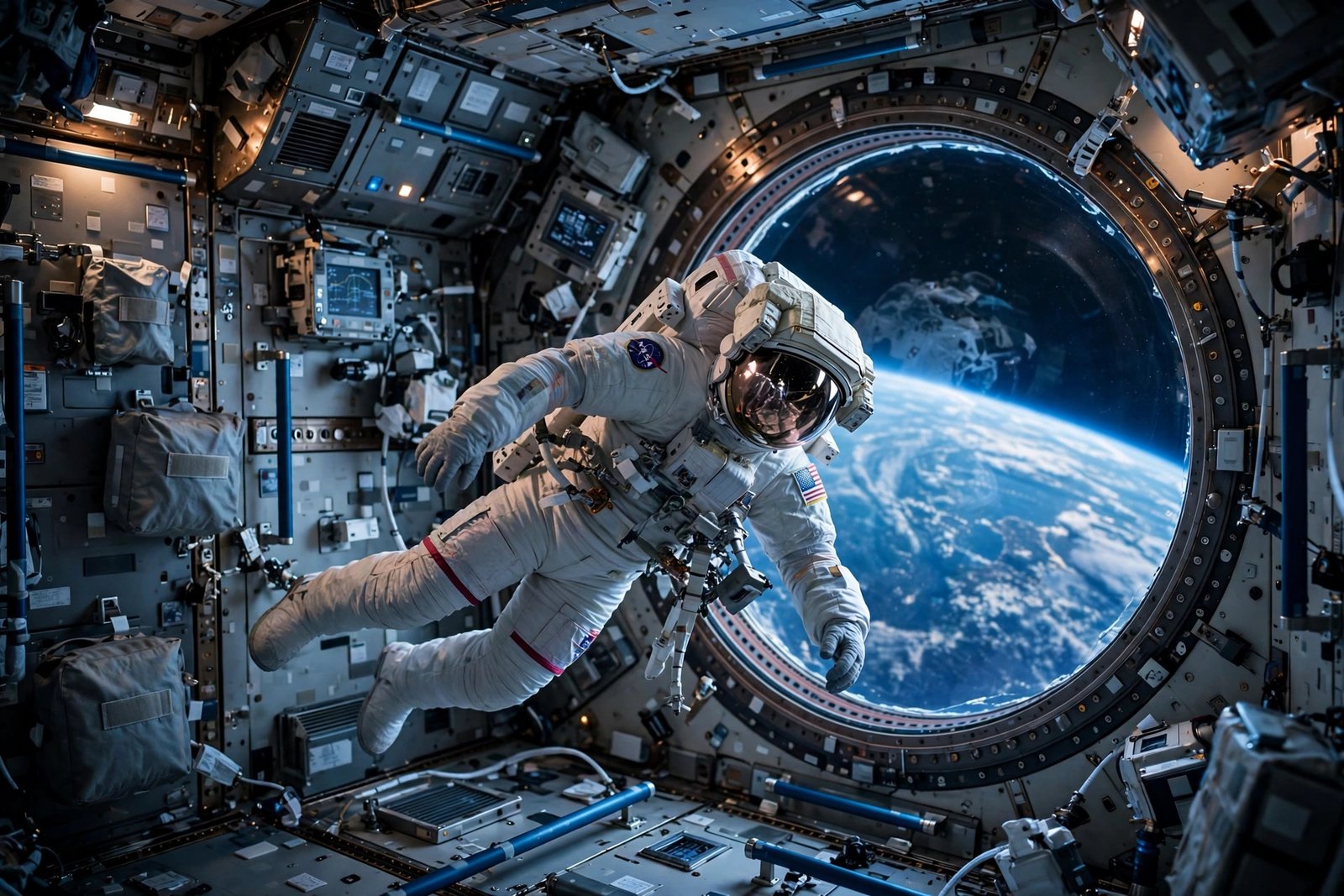
On Wednesday, November 25, 2026, a rocket rose over the Gobi Desert carrying three people and one enormous piece of history. Among them was a 40-year-old Pakistan Air Force pilot named Muhammad Zeeshan Ali, and by the end of the day he had done something no foreigner had ever done before. The Pakistani astronaut Tiangong space station story is now a real chapter in the history of human spaceflight, and it happened faster than almost anyone outside the space world expected.
China’s Shenzhou-24 spacecraft lifted off from the Jiuquan Satellite Launch Centre at 8:18 in the morning, Beijing time, on top of a Long March-2F rocket. A few hours later it docked with Tiangong, China’s space station, and Ali floated through the hatch as the first foreign crew member ever to board it. For Pakistan, a country that has dreamed about space for decades, it was the moment the dream finally left the ground.
Who Is Muhammad Zeeshan Ali?
Muhammad Zeeshan Ali is a wing commander in the Pakistan Air Force, born on August 22, 1986. He is a military pilot by training, not a career scientist, and that is exactly what makes his selection so interesting. In April 2026, he was one of two Pakistanis chosen as astronaut candidates for the China Manned Space Programme after three rounds of screening and assessment. The other candidate, Khurram Daud, trained alongside him and was named as his backup.
Ali spent about seven months training in Beijing at the Astronaut Centre of China before the launch. The training was intense, and it went far beyond flying and fitness. He took intensive Chinese-language classes, learned Chinese songs, and read Chinese poetry, because a crew that lives together in a space station the size of a small apartment needs to communicate without friction. The day before launch, he spoke to reporters in Mandarin at Jiuquan, saying, according to Nature, “My first [flight] not only represents myself, but also my country.”
That line captures why this flight matters so much back home. Pakistan’s Prime Minister Shehbaz Sharif congratulated the nation after the launch, saying Pakistan had begun its journey “beyond the stars” and describing the mission as the journey of 240 million Pakistanis, especially the younger generation and its scientists. The military’s public relations wing called it a defining moment in the country’s scientific and technological advancement.
There is one detail worth getting right. Ali is the first Pakistani to reach orbit as part of a government space mission, and the first Pakistani citizen selected and trained by a national space programme. He is not, however, the first person of Pakistani origin to leave Earth. That distinction belongs to Namira Salim, a Monaco-based adventurer who flew on Virgin Galactic’s Galactic 04 mission in October 2023. Her flight was a brief suborbital trip on a commercial spacecraft. Ali’s flight is different in kind: an orbital mission, aboard a government spacecraft, to live and work on a space station.
How the Pakistani Astronaut Tiangong Space Station Flight Happened
The Shenzhou-24 mission was crewed by three people. Commander Tang Hongbo led the mission, Wu Yi served as flight engineer, and Ali flew as payload specialist. That job title matters. A payload specialist does not fly the spacecraft. Instead, he is responsible for the scientific experiments carried on board, which is why a pilot with a science mission made sense for this seat.
The launch itself went exactly to plan. The Long March-2F rocket lifted off from Jiuquan in northwest China, and the spacecraft separated from its carrier rocket roughly ten minutes after blast-off, entering orbit as planned. About three and a half hours later, Shenzhou-24 docked with Tiangong. The three crew members entered the station later that afternoon, where they were greeted with hugs by the three Shenzhou-23 crew members already living there, who had even prepared a cake to celebrate the arrival.
China’s state broadcaster CCTV reported Ali’s own words as he boarded: “As the first foreign crew member to board the China Space Station, I am incredibly excited. China Space Station here I come!” It was a joyful, unguarded moment, and it travelled around the world within hours.
Ali is expected to stay aboard Tiangong for about a week, with reports putting the visit at five to ten days. When his time is up, he will return to Earth aboard the Shenzhou-23 spacecraft, travelling home with two of the crew members who were already on the station. It is a short visit by space station standards, where crews normally stay for months, but it is a deliberate first step rather than a full expedition.
What the Pakistani Astronaut Tiangong Space Station Crew Will Do in Orbit
Ali’s main job in orbit is science. Pakistan’s space agency, SUPARCO, said he would conduct experiments aboard the station, including cultivating microalgae as a potential food and oxygen source for future space missions, and testing the effects of spaceflight on quinoa seeds. According to Nature, the mission also aims to host four biotechnology experiments developed by universities in Pakistan, although the details of that research have not yet been made public.
That is a modest-sounding list, but it is exactly the kind of work a first flight should carry. Microalgae research is genuinely important for the future of space travel, because a spacecraft that can grow some of its own food and oxygen needs far less supply from Earth. Quinoa is a hardy, protein-rich crop that scientists want to understand in space conditions. For Pakistan’s universities, having experiments designed at home actually flown in orbit is a milestone in itself, and it gives young Pakistani researchers a direct connection to space science.
The short stay also serves a practical purpose. A five-to-ten-day visit lets Ali experience real space station life, run real experiments, and come home with knowledge that feeds directly into Pakistan’s own space programme. It is a training flight and a science flight at the same time.
Tiangong vs the International Space Station
To understand why this mission is such a big deal, it helps to know what Tiangong actually is. Tiangong means “heavenly palace” in Chinese, and it is China’s operational space station, orbiting Earth at an altitude of roughly 340 to 450 kilometres, about the same height as the International Space Station.
The station was built fast. Its core module, Tianhe, launched in April 2021. Two laboratory modules followed: Wentian in July 2022 and Mengtian in October 2022. The three modules form a T-shape in orbit, and the station has been continuously crewed since June 2022. China has said the station could eventually be expanded to six modules.
Compared with the International Space Station, Tiangong is small. Here is the comparison at a glance:
- Modules: Tiangong has 3, while the ISS has 16.
- Size: Tiangong is about 55 metres long; the ISS is about 109 metres long.
- Mass: Tiangong’s modules weigh roughly 70 tonnes, or about 100 tonnes with docked spacecraft; the ISS weighs about 420 tonnes.
- Typical crew: Tiangong normally hosts 3 people, rising to 6 during crew handovers; the ISS usually hosts 6 or 7.
- First occupied: Tiangong in 2021; the ISS in 2000, with its first module launched in 1998.
- Operator: Tiangong is run by China alone; the ISS is a partnership of the United States, Russia, Europe, Japan, and Canada.
Size is not the whole story, though. The Pakistani astronaut Tiangong space station flight shows what Tiangong offers that the ISS currently does not: a second crewed outpost in orbit, run by a single nation, that is now open to international partners. China was effectively shut out of the ISS partnership years ago, so it built its own station. Now it is using that station for space diplomacy, and Pakistan is the first guest.
Space fans who love this kind of comparison will enjoy our look at 8 space facts that sound fake but are actually real, and the story of BepiColombo arriving in orbit around Mercury shows how international teams explore the solar system together.
Pakistan and China: A Space Partnership Years in the Making
This flight did not come out of nowhere. In February 2025, SUPARCO and the China Manned Space Agency signed an agreement on cooperation in human spaceflight, opening the door for Pakistani astronauts to train and fly with China. The selection process that followed picked Ali and Daud from a pool of candidates, and the training in Beijing began soon after.
The partnership sits inside a much larger relationship. China and Pakistan describe themselves as close partners, and China has helped Pakistan with satellites before. But putting a Pakistani astronaut on a Chinese space station is a different level of trust. It means sharing a crewed spacecraft, a space station, and the training that goes with them.
For China, the Pakistani astronaut Tiangong space station flight is also a first. It is the first time the country’s human spaceflight programme has flown a foreign astronaut, and the China Manned Space Agency confirmed Ali’s place on the crew only the day before launch. For Pakistan, it is proof that a country without its own crewed space programme can still reach orbit through partnership, and that its pilots and scientists can hold their own at the highest level of spaceflight.
There is a wider pattern here too. As the ISS ages and its future is debated, Tiangong is positioning itself as a destination for countries that have never flown their own astronauts. Pakistan is the first, and it almost certainly will not be the last. Other nations are watching this flight very closely, because it shows what the invitation looks like in practice: train in Beijing, learn the language, fly as a payload specialist, and come home with real science.
What Happens Next
In the short term, all eyes are on the Pakistani astronaut Tiangong space station mission and Ali’s week in orbit. The experiments he runs will be watched by researchers in Pakistan and China, and his return aboard Shenzhou-23 will be its own moment of celebration. In the longer term, the flight raises a real question: does Pakistan now try to build toward its own crewed capability, or does it deepen the partnership with China and fly more astronauts?
For now, the achievement stands on its own. A Pakistani pilot trained for seven months in a foreign language, in a foreign city, strapped himself to a rocket, and floated into a space station as the first foreigner ever to do so. However the partnership develops, that first will always belong to Muhammad Zeeshan Ali.
If this story sparked your curiosity about the universe, do not miss our report on the James Webb telescope’s hidden exoplanet discovery, a reminder of how much is still out there waiting to be found.
Key Takeaways
- Muhammad Zeeshan Ali, a 40-year-old Pakistan Air Force wing commander, became the first foreign astronaut to board China’s Tiangong space station on November 25, 2026.
- He flew aboard Shenzhou-24 with commander Tang Hongbo and flight engineer Wu Yi, launching on a Long March-2F rocket from Jiuquan.
- As payload specialist, he is running science experiments in orbit, including microalgae cultivation and quinoa seed tests, plus biotechnology experiments from Pakistani universities.
- He is expected to spend five to ten days aboard Tiangong before returning to Earth on the Shenzhou-23 spacecraft.
- Tiangong is far smaller than the ISS, with 3 modules to the ISS’s 16, but it is now the world’s second crewed space station and is open to international partners.
- The flight follows a February 2025 agreement between Pakistan’s SUPARCO and the China Manned Space Agency.
The Pakistani astronaut Tiangong space station mission is more than a headline. It is the story of a pilot who learned a new language, trained for seven months far from home, and carried the hopes of 240 million people into orbit. It is also the story of a new era in spaceflight, in which the road to the stars is no longer limited to a handful of countries. Pakistan has arrived, and the view from up there will never look the same again.
Who is the Pakistani astronaut on the Tiangong space station?
Muhammad Zeeshan Ali, a 40-year-old wing commander in the Pakistan Air Force, became the first foreign astronaut to board China’s Tiangong space station. He flew as a payload specialist aboard the Shenzhou-24 mission, which launched on November 25, 2026.
When did the Pakistani astronaut launch to Tiangong?
Shenzhou-24 launched at 8:18 a.m. Beijing time on Wednesday, November 25, 2026, from the Jiuquan Satellite Launch Centre on a Long March-2F rocket. The spacecraft docked with Tiangong about three and a half hours after liftoff.
How long will the Pakistani astronaut stay on Tiangong?
Ali is expected to spend about a week aboard Tiangong, with reports putting the visit at five to ten days. He will return to Earth aboard the Shenzhou-23 spacecraft, travelling home with two of the crew members already stationed there.
What experiments is the Pakistani astronaut doing in space?
As payload specialist, Ali is conducting science experiments including cultivating microalgae as a potential food and oxygen source for future missions and testing the effects of spaceflight on quinoa seeds. The mission also carries four biotechnology experiments developed by universities in Pakistan.
How is Tiangong different from the International Space Station?
Tiangong is much smaller than the ISS, with 3 modules compared with 16, about 55 metres long versus 109 metres, and roughly 70 tonnes of modules versus about 420 tonnes. Tiangong is operated by China alone and normally hosts a crew of three, while the ISS is run by an international partnership and usually hosts six or seven astronauts.
Sources: Dawn, Nature, Arab News, Channel News Asia, Space.com.