
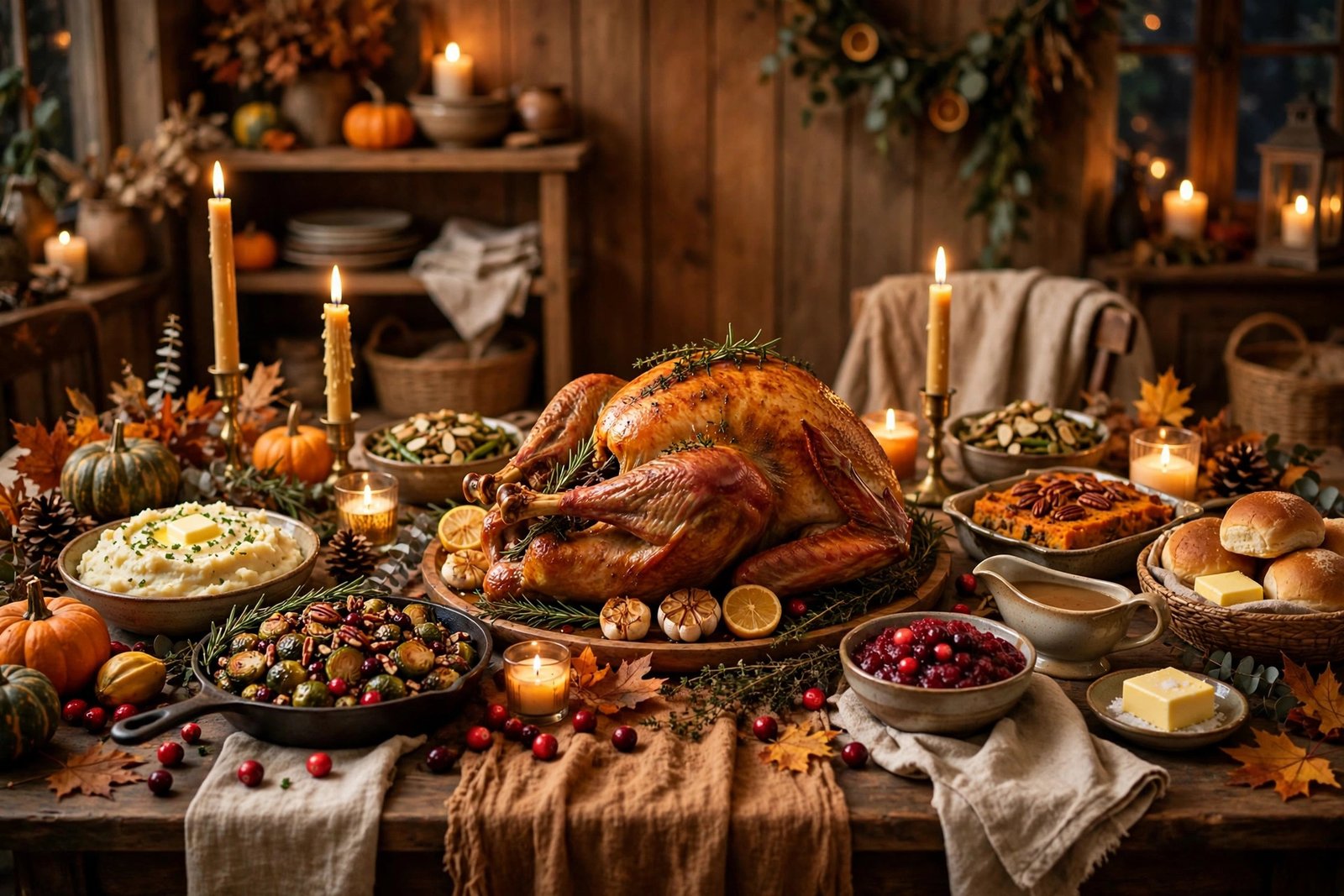
Every November, Americans sit down to a bird that, by rights, should never have become the star of the show. Roast turkey is so deeply tied to Thanksgiving that imagining the holiday without it feels almost un-American. Yet the honest answer to the question of why do we eat turkey Thanksgiving tables groan under each year is far stranger than the story most of us learned in school. Turkey was probably not the centrepiece of the first Thanksgiving, it was not the obvious choice for a feast, and it took a determined magazine editor, a Civil War president, and a children’s novelist to put it there.
This is the real story of how a gangly North American bird conquered the most important dinner in the country, and why the sleepy feeling you blame on the turkey is not the turkey’s fault at all.
Why Do We Eat Turkey on Thanksgiving? The Short Answer
The short answer to why do we eat turkey Thanksgiving after Thanksgiving is a mix of practicality, marketing, and mythology. Turkeys were abundant in North America, big enough to feed a whole family, and unlike cows or chickens, they were not needed for milk or eggs, so they could be slaughtered for a special occasion without hurting the farm’s daily output. By the early 19th century, turkey had become a popular festive dish in the United States, and in 1827 the writer Sarah Josepha Hale placed a roast turkey “at the head of the table” in her novel Northwood, a scene that helped fix the bird in the American imagination.
Hale then spent 36 years campaigning to make Thanksgiving a national holiday, and when President Abraham Lincoln finally proclaimed it in 1863, the turkey came along for the ride. As the holiday spread across the country, so did the idea that a proper Thanksgiving dinner meant a roast turkey. The bird’s rise was not a single decision but a slow cultural drift, and like many traditions, it feels ancient only because we have repeated it so many times.
What Was Really on the Table in 1621
The first problem with the traditional story is that there is no evidence turkey was served at the 1621 harvest feast at Plymouth at all. The only surviving eyewitness account is a letter written by the colonist Edward Winslow in December 1621, later published in London as part of a pamphlet known as Mourt’s Relation. Winslow wrote that the governor sent four men out fowling, and that in a single day they killed enough birds to feed the company for almost a week. He also wrote that the Wampanoag leader Massasoit arrived with about 90 men, and that for three days the two groups feasted together, with the Wampanoag bringing five deer to the celebration.
Winslow never names turkey. He writes only of “fowl,” a broad word that in 1621 most likely meant ducks, geese, swans, or passenger pigeons, all of which were plentiful around Plymouth in autumn. The five deer are the one menu item documented with certainty, which makes venison, not turkey, the true main course of the gathering we now call the first Thanksgiving. The foods historians can be sure were there, according to foodways experts at Plimoth Patuxet Museums, are wildfowl, corn in grain form for bread or porridge, and venison.
William Bradford, the colony’s governor, writing years later in Of Plymouth Plantation, did note that there was a “great store of wild Turkies” around Plymouth that autumn, and that the colonists took many of them. So it is entirely possible that a wild turkey ended up on the table. But possible is not the same as confirmed, and no contemporary record says so. Other foods often imagined on that table were definitely absent: there was no cranberry sauce, because the colonists had almost no sugar; no potatoes, sweet or otherwise; no pumpkin pie, because there was no oven for pastry; and no forks, which had not yet reached the colonial dining table.
It is also worth remembering that nobody at the feast called it Thanksgiving. That name was attached to the event only in 1841, more than 200 years later, when the Boston editor Alexander Young reprinted Winslow’s letter and added a footnote calling the meal “the first Thanksgiving.”
The Practical Case for Turkey
If turkey was not the original star, why did it win? The answer is mostly practical, and it is the same reason the bird made sense on farms across early America. Historians point to three advantages that set the turkey apart from every other animal on the farm.
- Abundance: Wild turkeys were everywhere. One expert cited by Britannica estimated there were at least 10 million turkeys in America at the time of European contact, and the birds were already familiar to settlers as a reliable food source.
- Size: A single turkey was usually large enough to feed an entire family, which made it ideal for a feast. A chicken was too small, and a cow was far too large and far too valuable.
- Expendability: Cows gave milk and hens laid eggs, so killing one meant losing a steady food supply. Turkeys were generally raised only for their meat, so they could be slaughtered for a celebration without damaging the farm’s everyday output.
By the turn of the 19th century, turkey had become a popular dish for festive occasions in the United States, well before it was tied specifically to Thanksgiving. It was cheap, it was filling, and it looked impressive carried to the table whole. For a young country inventing its own traditions, the turkey had one more advantage: it was uniquely North American. No other nation’s feast centred on this bird, and that made it feel like a fitting symbol for a distinctly American holiday.
The Woman Who Put Turkey on the Thanksgiving Table
No single person did more to make turkey the Thanksgiving bird than Sarah Josepha Hale, and most Americans have never heard of her. Hale was the editor of Godey’s Lady’s Book, the most influential women’s magazine in 19th-century America, and the author of the nursery rhyme “Mary Had a Little Lamb.” In her 1827 novel Northwood, she devoted an entire chapter to a New England Thanksgiving, describing a table groaning with food and a roast turkey “placed at the head of the table.” Millions of readers absorbed the image, and the idea of turkey as the Thanksgiving centrepiece began to spread.
At about the same time, Hale began a campaign that would consume the next 36 years of her life: making Thanksgiving a national holiday. She believed a shared day of gratitude could help hold the country together as it drifted toward civil war, and she wrote editorials and letters to five different presidents pressing her case. Her crusade finally succeeded in 1863, when President Abraham Lincoln, in the middle of the Civil War, issued a proclamation setting Thanksgiving for the last Thursday in November. Hale’s vision of the holiday, roast turkey included, became the national template almost overnight.
Lincoln’s proclamation fixed Thanksgiving in the American calendar, and the turkey came with it. As the holiday spread from New England across the whole country, cookbooks, magazines, and newspapers repeated the same menu, and the association hardened into tradition. By the late 19th century, the link between Pilgrims, turkeys, and Thanksgiving was being taught to American schoolchildren as if it had always been true.
Dickens, Magazines, and the Turkey Myth Machine
Hale was not the only writer who helped the turkey. Charles Dickens’s A Christmas Carol, published in 1843, features a Christmas turkey so prominently that some historians credit it with boosting the idea of turkey as a holiday meal in the English-speaking world. The Cratchit family’s goose is replaced by a prize turkey sent by Scrooge, and the image of a great roasted bird as the symbol of generosity and celebration stuck.
The 19th century also saw the rise of women’s magazines, cookbooks, and newspaper food columns, all of which repeated the same Thanksgiving menu year after year. Each repetition made the turkey feel more inevitable. The story of the 1621 feast was retold with a turkey quietly added to the table, and because almost nobody checked the original sources, the invention passed into folklore. It is a reminder that traditions are often not as old as they look: sometimes they are the work of a few determined writers with a printing press.
There is a similar story behind the bird’s very name. The turkey is native to North America, but Europeans first knew a similar-looking bird, the guinea fowl, which reached Europe through Turkish merchants. When settlers encountered the big American bird, they called it a “turkey” by association, and the name stuck even after everyone knew better. The bird named after Turkey is, in fact, entirely American.
The Tryptophan Myth: Turkey Is Not Why You Feel Sleepy
Every Thanksgiving, somebody at the table blames the turkey for the wave of drowsiness that follows dinner. The claim is that turkey is rich in tryptophan, an amino acid the body uses to make serotonin and melatonin, and that eating it makes you sleepy. It sounds scientific, and it is repeated so often that most people accept it without question. It is also mostly wrong.
Turkey does contain tryptophan, but so does chicken, beef, pork, cheese, and just about every other protein-rich food, and turkey contains no more of it than chicken or beef. An ordinary serving of turkey is very unlikely to produce a special sedative effect on its own. Food scientists have pointed out that the real culprits behind the post-dinner slump are far more mundane: a huge meal, rich in carbohydrates, washed down with wine or beer, eaten after a long day of cooking and travelling.
The carbohydrates are the key. Stuffing, mashed potatoes, rolls, and pie cause a spike in insulin, which helps tryptophan enter the brain more easily, but the tryptophan in that chain comes from the whole meal, not from the turkey alone. Add alcohol, overeating, an early start, and a warm room full of relatives, and a nap becomes almost inevitable. The turkey is innocent; the feast as a whole is guilty.
So if you find yourself dozing on the couch after dinner, do not blame the bird. Blame the second helping of mashed potatoes, the third glass of wine, and the fact that you have been awake since dawn basting something.
Fun Facts About the Thanksgiving Turkey
- A presidential pardon: Every year, the president “pardons” a Thanksgiving turkey in a ceremony formalised by George H. W. Bush in 1989. This year’s birds, Freedom and Feathers, were pardoned on November 24, 2026.
- A famous admirer: Benjamin Franklin, in a 1784 letter to his daughter, called the turkey “a much more respectable Bird” than the bald eagle, though he never formally proposed it as the national bird.
- A happy accident: In 1953, the Swanson company was left with 260 tons of surplus frozen turkey after overestimating holiday demand, and the effort to use it up helped create the TV dinner.
- A near-extinction: The wild turkey was considered endangered in the early 20th century after overhunting and habitat loss, but conservation efforts brought its population back into the millions.
- A three-day feast: The 1621 gathering lasted three days, not the single afternoon of a modern Thanksgiving dinner.
- A different bird entirely: In parts of 19th-century England, goose was the traditional festive bird, and the turkey only took over after the Dickens era made it fashionable.
If you enjoy traditions with surprising origin stories, you will love our history of the Eiffel Tower, which was almost demolished before it became the most famous landmark on Earth. For more facts that sound too strange to believe, see our round-up of 8 space facts that sound fake but are completely real, and for a true story of survival against impossible odds, read about the man who survived two atomic bombs.
Key Takeaways
- There is no evidence turkey was served at the 1621 feast; venison and wildfowl were the documented foods.
- Turkey won the holiday because it was abundant, big enough to feed a family, and expendable on a working farm.
- Sarah Josepha Hale’s 1827 novel Northwood put roast turkey at the head of the Thanksgiving table, and her 36-year campaign led Lincoln to proclaim the holiday in 1863.
- The tryptophan myth is mostly false: turkey has no more tryptophan than chicken or beef, and the post-dinner slump comes from the whole feast.
- The bird is named after Turkey by a centuries-old case of mistaken identity, and it is entirely North American.
So why do we eat turkey Thanksgiving? Because a practical farm bird met a determined magazine editor, a wartime president, and a century of cookbooks, and the combination stuck. The turkey was never the food of the first Thanksgiving, but it became the food of every Thanksgiving after, and that is a stranger and more interesting story than the legend on the schoolroom poster. This year, when the bird arrives at the table, you will know exactly how it got there, and you will know that the nap afterwards is not its fault.
Sources: Smithsonian Magazine, What Food Was Served at the First Thanksgiving in 1621?; Britannica, Why Do We Eat Turkey on Thanksgiving?; Smithsonian National Museum of American History, 5 Questions With a Colonial Culinarian; American Council on Science and Health, A Toxin-Free Thanksgiving.
Why do we eat turkey Thanksgiving?
We eat turkey on Thanksgiving because the bird was abundant, large enough to feed a family, and expendable on a farm, and because the writer Sarah Josepha Hale popularised roast turkey as the Thanksgiving centrepiece in her 1827 novel Northwood before campaigning for the national holiday Lincoln proclaimed in 1863.
Was turkey served at the first Thanksgiving in 1621?
There is no evidence turkey was served at the 1621 feast. The only eyewitness account, Edward Winslow’s letter, mentions wildfowl and five deer brought by the Wampanoag. Turkey was plentiful in the area and may have been eaten, but it was not the documented centrepiece.
Who made turkey the Thanksgiving bird?
Sarah Josepha Hale did more than anyone. Her 1827 novel Northwood placed a roast turkey at the head of the Thanksgiving table, and her 36-year campaign to make Thanksgiving a national holiday succeeded when Abraham Lincoln proclaimed it in 1863.
Does turkey really make you sleepy?
Not on its own. Turkey contains tryptophan, but no more than chicken or beef. The post-dinner drowsiness comes from the whole feast: large portions, carbohydrate-rich sides, alcohol, and a long day, rather than the turkey itself.
Why is the bird called a turkey?
The name comes from a case of mistaken identity. Europeans knew the guinea fowl, which arrived through Turkish merchants, and when settlers met the similar-looking North American bird they called it a turkey. The name stuck even though the bird is entirely American.