
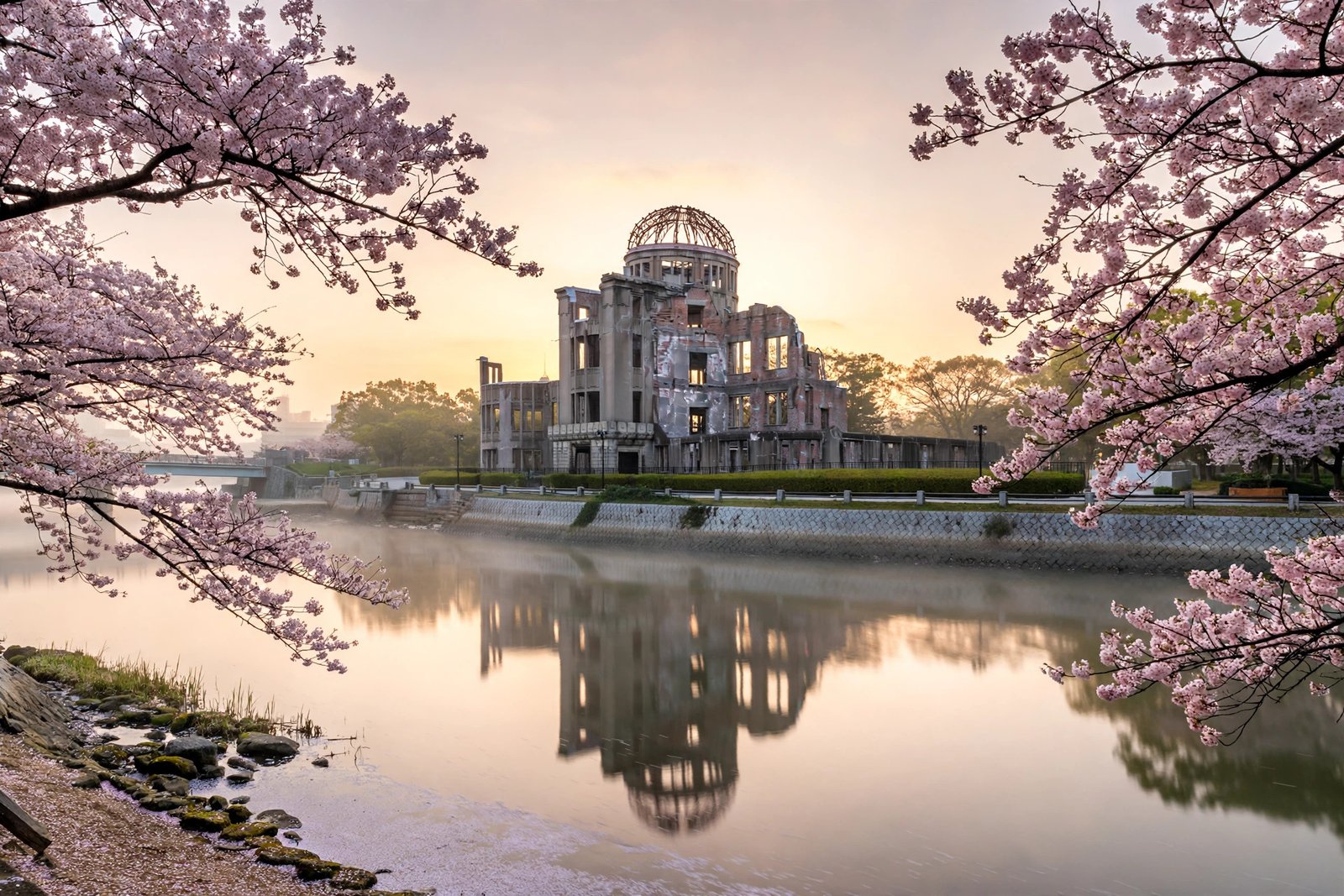
On the morning of August 6, 1945, a 29-year-old engineer named Tsutomu Yamaguchi was walking to work in Hiroshima, Japan, when the sky turned white. Three days later, after travelling home to Nagasaki, he was describing that impossible experience to his supervisor when the sky turned white again. The man survived two atomic bombs — and lived to the age of 93. His name was Tsutomu Yamaguchi, the only person officially recognised by the Japanese government as having survived both atomic bombings of the Second World War.
It is a story that sounds too extraordinary to be true, yet every part of it is documented. He was about three kilometres from the centre of each blast. He was burned, deafened in one ear and temporarily blinded, and still he lived to the age of 93. In his final years, he became a campaigner against nuclear weapons, carrying his message to the United Nations. This is his story, told with the respect it deserves.
The Man Survived Two Atomic Bombs: A Business Trip to Hiroshima
Tsutomu Yamaguchi was born on March 16, 1916, in Nagasaki, Japan. He joined Mitsubishi Heavy Industries in the 1930s and worked as a draftsman, designing oil tankers at the company’s Nagasaki shipyard. He was an ordinary young engineer with a wife and a young family, living an ordinary life in a country at war.
In the summer of 1945, Yamaguchi was sent to Hiroshima on a three-month business trip for Mitsubishi, along with two colleagues, Akira Iwanaga and Kuniyoshi Sato. By early August, the trip was almost over. On the morning of August 6, the three men were preparing to leave the city and return home to Nagasaki. Yamaguchi was on his way to the station when he realised he had forgotten his hanko, the personal stamp he needed for travel documents, and he turned back to his workplace to collect it.
That small, ordinary decision, going back for a forgotten stamp, placed him about three kilometres from the centre of Hiroshima when the first atomic bomb used in warfare exploded above the city at 8:15 in the morning. His two colleagues, who had gone on ahead, also survived.
August 6, 1945: Hiroshima
The bomb dropped on Hiroshima, known by its codename Little Boy, destroyed much of the city in an instant. Yamaguchi was thrown to the ground by the blast. He suffered burns to the left side of his face, his left arm and his neck, his hair was scorched, and the eardrum in his left ear burst. He was also temporarily blinded by the flash.
Despite his injuries, Yamaguchi survived the night in the ruins of the city. The next day, with his burns bandaged, he boarded a train back to Nagasaki. The journey itself, through a devastated landscape, must have been almost unbearable, but he was determined to get home to his wife and family. Around 140,000 people in Hiroshima had died by the end of 1945 as a result of the bombing, a figure that makes his survival all the more remarkable.
He arrived in Nagasaki on August 8, and although he was heavily bandaged and in pain, he reported for work the next morning, August 9. It was, by any measure, an extraordinary act of duty.
August 9, 1945: Nagasaki
On the morning of August 9, Yamaguchi was at the Mitsubishi office in Nagasaki, telling his supervisor what had happened in Hiroshima. He was explaining how a single bomb had destroyed an entire city when his supervisor told him he must be mistaken, that one bomb could not possibly do such a thing.
At that very moment, at 11:02 in the morning, the second atomic bomb, codenamed Fat Man, exploded over Nagasaki. Yamaguchi was again about three kilometres from the centre of the blast. He saw another flash, and the office around him was blown apart. Once again, he survived.
The bombing of Nagasaki killed around 74,000 people by the end of 1945. Yamaguchi’s wife, who was in the city, also survived the blast, although she suffered radiation exposure. That Yamaguchi stood within a few kilometres of the centre of both explosions, three days apart, and lived, is one of the most astonishing survivals in recorded history. The man survived two atomic bombs, not in a single city, but twice, in two different cities, three days apart.
Life After the Bombs
After the war ended, Yamaguchi returned to work at Mitsubishi and lived a quiet life with his family. The man survived two atomic bombs, yet for decades he said almost nothing about what had happened to him.
Survivors often faced discrimination and suspicion, and many chose silence rather than relive what they had seen.
Yamaguchi’s health, remarkably, held up for many years. He lost the hearing in his left ear from the Hiroshima blast, and he later developed cataracts and other radiation-related illnesses, but he went on to live a full and active life. He and his wife raised their family in Nagasaki, and for most of his life he was, to his neighbours, simply an ordinary retired engineer.
It was not until he was in his eighties that he began to speak openly about what had happened to him. He wrote a book about his experiences and a book of poetry, and he began to tell younger generations what the atomic bombings had really been like. In 1957, he had been officially recognised as a hibakusha for his exposure in Nagasaki, but his Hiroshima experience was not part of his official record.
Official Recognition: A Double Hibakusha
Yamaguchi was not, in fact, the only person to have been in both cities. Around 165 people are believed to have survived the Hiroshima bombing and been present in Nagasaki three days later. In Japanese they are called niju hibakusha, double atomic bomb survivors. But Yamaguchi became the only one officially recognised as a survivor of both bombings, because he was the one who applied for that formal recognition.
On March 24, 2009, the city of Nagasaki announced that Yamaguchi’s exposure in Hiroshima had been entered into his official hibakusha certificate, which until then had recorded only his exposure in Nagasaki. A city official confirmed that, as far as anyone knew, he was the first person officially recognised as a survivor of both atomic bombings.
Yamaguchi was 93 years old at the time. He told reporters that his double radiation exposure was now an official government record, and that the record could tell younger generations the horrifying history of the atomic bombings even after he died. It was a quiet, dignified statement from a man who had waited more than sixty years for the world to acknowledge the full truth of what he had lived through.
His Message to the World
In his final years, Yamaguchi became a passionate campaigner against nuclear weapons. In 2006, at the age of 90, he obtained his first passport and travelled to New York, where a documentary film about double survivors, called Twice Survived, was screened at the United Nations headquarters. He spoke there about his experiences, telling the world that having survived two atomic bombings, it was his destiny to talk about what had happened.
His message was simple and direct: nuclear weapons must never be used again. He met with schoolchildren, spoke to journalists, and lent his name to the cause of nuclear disarmament, not for fame, but because he believed that the only good that could come from his suffering was to help prevent anyone else from ever going through it.
In December 2009, just weeks before his death, the film director James Cameron and the author Charles Pellegrino visited him in Nagasaki to discuss a film about his life. He died of stomach cancer on January 4, 2010, in Nagasaki, at the age of 93, surrounded by his family. His final words, according to his family, were a request to take good care of his great-grandchildren.
Why the Man Survived Two Atomic Bombs Matters
Tsutomu Yamaguchi’s story matters for several reasons. First, it is a reminder of the sheer scale of what happened in Hiroshima and Nagasaki, where hundreds of thousands of people died and many more were injured. Behind every statistic was a person, and Yamaguchi’s life puts a human face on numbers that are otherwise hard to grasp.
Second, his story shows how fragile the line between life and death can be. He survived because he was about three kilometres from each blast, because he was shielded by buildings, and because of a series of small chances, like the forgotten stamp that sent him back to his office in Hiroshima. Change any one of those details, and history would have no record of him at all.
Third, his later life is an example of what survivors can do with their pain. He kept silent for decades, then chose, in his eighties and nineties, to speak, to write, and to travel across the world to warn others. The man survived two atomic bombs and spent his final years making sure the world did not forget what two atomic bombs can do.
Key Takeaways
- Tsutomu Yamaguchi is the only person officially recognised by the Japanese government as having survived both the Hiroshima and Nagasaki atomic bombings.
- He was in Hiroshima on a business trip for Mitsubishi Heavy Industries on August 6, 1945, about three kilometres from the blast, and was burned and deafened in one ear.
- He returned home to Nagasaki and was at work on August 9, 1945, when the second bomb exploded, again about three kilometres away.
- Around 165 people are believed to have been in both cities, but Yamaguchi was the only one who applied for and received official recognition as a double survivor, in March 2009.
- He lived to the age of 93, dying of stomach cancer on January 4, 2010, in Nagasaki.
- In his final years he became an anti-nuclear campaigner, speaking at the United Nations in 2006 at the age of 90.
Conclusion
Tsutomu Yamaguchi survived the two most destructive single moments of the Second World War and lived for another 64 years. He could have stayed silent, as so many survivors did, but instead he chose to spend his final years telling the world what he had seen. His story is not just a remarkable tale of survival; it is a warning. The man who survived two atomic bombs wanted only one thing from the rest of us: that no one should ever have to survive a third.
If you found this story moving, you may also like these pieces from BolanPost: the year without a summer in 1816, when a volcanic eruption changed the climate of the whole world; the time fact about Cleopatra and the iPhone, a reminder of how strange history can be; and facts that feel fake but are 100 percent real, more true stories that are hard to believe. For further reading on Yamaguchi’s life, see the obituary and reporting in the Encyclopaedia Britannica and the coverage from Japan’s Hiroshima Peace Media Center at hiroshimapeacemedia.jp.
Who was the man survived two atomic bombs?
The man survived two atomic bombs in August 1945: Tsutomu Yamaguchi lived through the atomic bombing of Hiroshima on August 6, 1945, and the bombing of Nagasaki on August 9, 1945, and he is the only person officially recognised by the Japanese government as a survivor of both.
How did Tsutomu Yamaguchi survive both atomic bombs?
He was about three kilometres from the centre of each blast, far enough from the immediate destruction, and he was partly shielded by buildings. He was badly burned and lost hearing in one ear in Hiroshima, but he survived both explosions and lived to the age of 93.
What was Tsutomu Yamaguchi doing in Hiroshima?
Yamaguchi was in Hiroshima on a three-month business trip for his employer, Mitsubishi Heavy Industries, where he worked as a draftsman designing oil tankers. He was preparing to return home to Nagasaki when the bomb exploded on August 6, 1945.
When was Tsutomu Yamaguchi officially recognised as a double survivor?
He was officially recognised on March 24, 2009, when the city of Nagasaki added his Hiroshima exposure to his official hibakusha certificate. Around 165 people are believed to have been in both cities, but he was the only one officially recognised as a survivor of both bombings.
How old was Tsutomu Yamaguchi when he died?
Tsutomu Yamaguchi died of stomach cancer on January 4, 2010, in Nagasaki, at the age of 93. In his final years he campaigned against nuclear weapons and spoke at the United Nations in 2006.