
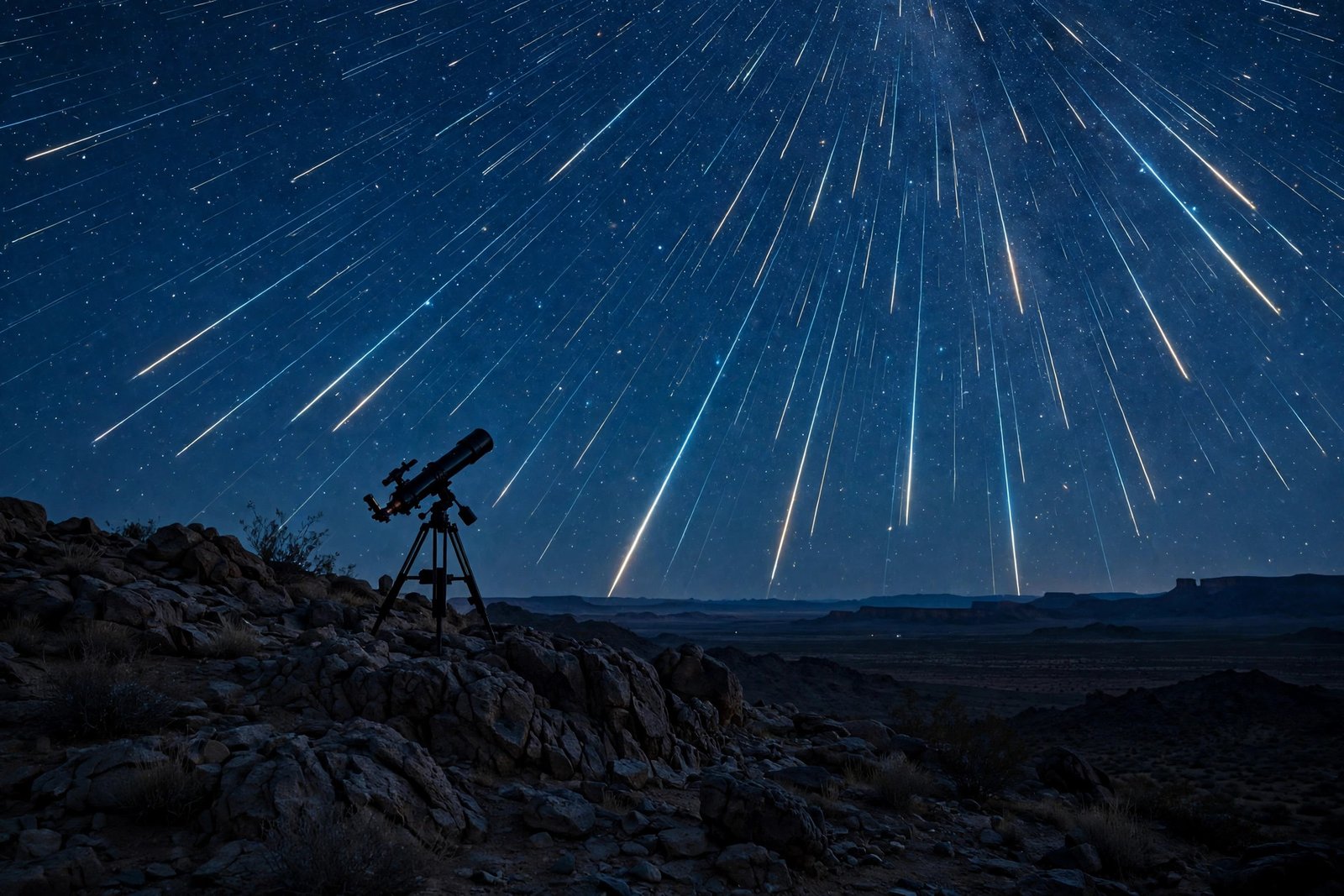
Tonight, the sky is putting on a show older than every civilization on Earth. The Orionid meteor shower 2026 reaches its peak on the night of October 21 into October 22 — meaning the best meteors will streak across the sky in the dark hours before dawn. Every one of those shooting stars is a speck of dust shed by the most famous comet in history: Halley’s Comet.
There is a catch this year, and you need to know it before you set your alarm. A bright, nearly full Moon will be glaring most of the night, washing out the fainter meteors. But astronomers say there is still a golden window of true darkness before dawn — and if you hit it, you could watch debris from Halley’s Comet burning up at 41 miles per second. Here is everything you need to know to catch the Orionid meteor shower 2026 at its best.
When Does the Orionid Meteor Shower 2026 Peak?
The Orionid meteor shower 2026 reaches its predicted peak around 18:00 UTC (2 p.m. Eastern) on October 21, according to the RASC Observer’s Handbook cited by EarthSky — which means the prime viewing nights for skywatchers are the nights of October 21 and October 22. Because the peak lands during daylight hours for North America, the best action comes after midnight, in the early morning hours of Thursday, October 22.
The good news is that the Orionids don’t have a razor-thin peak. Unlike some showers that flare and fade in a single night, the Orionids build to a broad, plateau-like maximum that lasts several nights. EarthSky notes that several mornings around October 21 could deliver good meteor counts, so if clouds ruin tonight, the mornings of October 23 and even October 24 are solid backup plans.
The shower is active for a long stretch overall. NASA’s figures, summarized in annual meteor guides, list the Orionids as active from about October 2 to November 7 each year, while EarthSky extends the window from late September to late November. Either way, the period around October 21–22 is when Earth is plowing through the densest part of the dust trail.
Why This Shower Is Special: Debris From Halley’s Comet
Every Orionid meteor you see tonight is a tiny piece of Halley’s Comet — officially designated 1P/Halley. The comet swings around the Sun roughly every 76 years; it last visited in 1986 and won’t return until 2061. But it leaves behind a trail of dust and grit every time it passes, and each October Earth sweeps through that debris field.
These particles are small — often no bigger than a grain of sand — but they slam into Earth’s upper atmosphere at about 66 kilometers per second (roughly 41 miles per second), making the Orionids one of the fastest meteor showers of the year. The violent friction superheats the air around each particle, creating the bright streak of light we call a shooting star. That extreme speed is also why Orionids are famous for leaving persistent trains: glowing trails of ionized gas that can linger in the sky for a few seconds after the meteor itself has burned out.
The same parent comet feeds a second shower. When Earth crosses the other side of Halley’s dust trail each May, we get the Eta Aquariids. Two meteor showers a year, both from the same comet — a neat cosmic bonus.
The Moon Problem in 2026 (and How to Beat It)
Here’s the honest truth about this year’s show: the Moon is going to be a nuisance. On peak night, the Moon will be a waxing gibbous roughly 77 to 83 percent illuminated, and it won’t set until the small hours of the morning. A full moon falls on the night of October 25–26, so moonlight will grow worse with each passing day of the peak window.
That doesn’t mean the shower is a bust. It means timing matters. EarthSky’s advice is blunt: in 2026, watch in the hours before dawn, or you’ll be watching in bright moonlight. The Moon sets several hours before sunrise on the peak mornings, opening a dark window between moonset and first light. From the New York area, the Moon sets around 3:12 a.m. EDT on peak morning, leaving roughly an hour and a half of truly dark sky before dawn begins to brighten the horizon. Similar math applies elsewhere — check your local moonset time on a sky app or timeanddate.com.
Pro tip: if you head out before the Moon sets, put it behind a building, a tree, or a hill, and scan the part of the sky farthest from it. You’ll still catch the brightest fireballs even in moonlight, and the American Meteor Society notes the Orionids sometimes produce brilliant fireballs that punch right through moon glow.
How to Watch the Orionid Meteor Shower Tonight
Meteor watching is gloriously low-tech. You don’t need a telescope, binoculars, or any gear at all — in fact, your naked eyes are the best instrument for the job, because they take in the whole sky at once. Here’s your game plan:
- Go out between about 3 a.m. and dawn local time. This is the dark window after moonset, and the shower’s radiant is climbing high by then, which means more meteors visible per hour.
- Get away from city lights. Light pollution is the single biggest enemy of meteor watching. A dark rural site can show 10 to 20 meteors an hour at peak; from a bright city, you might see only the brightest handful.
- Give your eyes 20 to 30 minutes to adapt. Night vision takes time. Avoid looking at your phone — or switch it to the dimmest red setting if you must check the time.
- Bring a reclining chair or a blanket. You’ll be looking up for a long time, and a sore neck is the fastest way to cut a meteor session short. Dress warmly — October nights before dawn get cold.
- Be patient. Meteors arrive in bursts and lulls, not on a schedule. Give it at least an hour.
Where to Look in the Sky
Orionid meteors appear to radiate from a point near Orion’s club, just north of the bright red star Betelgeuse — hence the name “Orionids.” The radiant rises in the east before midnight and climbs higher through the night, reaching its best position in the hours before dawn. By 2 to 4 a.m., it’s high in the south-southeastern sky from mid-northern latitudes.
But here’s the key insight experienced meteor watchers share: don’t stare directly at the radiant. Meteors streak across the entire sky, and the longest, most dramatic trails appear some distance away from the radiant point. Face roughly southeast, tilt your gaze about halfway up from the horizon to the zenith, and let your peripheral vision do the work. Relax, look at a wide patch of sky, and wait.
Finding Orion is easy even for beginners: look for the three bright stars in a row that form Orion’s Belt. On October mornings before dawn, the constellation stands tall and unmistakable in the southern sky.
What to Expect: Rates, Fireballs, and Persistent Trains
Set realistic expectations and you won’t be disappointed. Under a dark, moonless sky, the Orionids typically deliver 10 to 20 meteors an hour at peak — a solid, steady show, though not the hundreds-per-hour storm of the December Geminids. In exceptional years (2006–2009), the Orionids surged to 50–75 meteors an hour, rivaling the Perseids, but the American Meteor Society says recent displays have produced low to average activity. For 2026, expect around 10 to 20 per hour from a dark site in that pre-dawn window — and be delighted if the shower overdelivers.
What the Orionids lack in sheer numbers, they make up for in drama. Their extreme speed produces bright, sharp meteors, many of them white or pale yellow, with occasional green or orange fireballs. Roughly half of Orionids leave persistent trains — those glowing ionized trails that hang in the sky for seconds after the meteor dies. If you see a fireball, consider reporting it to the American Meteor Society’s fireball reporting system; it’s quick, fun, and it helps scientists track meteor activity.
Can You Photograph the Orionids?
Yes — and tonight’s shower is a great target for beginners because you don’t need fancy equipment to try. A camera that can shoot in manual mode, a tripod, and a wide-angle lens are all you need:
- Set your lens to its widest aperture (f/2.8 or lower is ideal) and focus manually on a bright star or the Moon’s edge.
- Use ISO 1600–3200 and exposures of 15–25 seconds. Point the camera about 45 degrees away from the radiant, toward a dark part of the sky.
- Take continuous shots for an hour or more. Most frames will be empty — that’s normal. The keepers will make it worth it.
Smartphone users can try too: prop the phone steady (a tripod adapter helps), use a night mode or a manual camera app with long exposure, and shoot toward the darkest sky you can find.
If tonight’s sky show leaves you hungry for more cosmic weirdness, don’t miss our roundup of 8 space facts that sound fake but are 100% real, the still-unsolved Wow! signal mystery from deep space, and the story of WASP-17b, the deformed exoplanet with a bizarre atmosphere.
Key Takeaways for Tonight
- Peak night: October 21 into October 22, 2026, with a broad maximum lasting several nights.
- Best viewing window: after moonset until dawn (roughly 3 a.m. to first light), when the Moon’s glare is gone.
- Expected rate: about 10–20 meteors per hour from a dark site; more if the shower surprises us.
- What you’re seeing: dust from Halley’s Comet burning up at 66 km/s, some leaving glowing trains.
- Gear needed: none — just dark skies, warm clothes, and patience.
There’s something quietly humbling about watching the Orionids. The dust burning above you was shed by Halley’s Comet centuries ago — some of it may have been floating in space since before the comet’s famous 1066 appearance recorded in the Bayeux Tapestry. Tonight, it ends its journey in a flash of light over your backyard. Set the alarm, find a dark spot, and look up. The universe is doing the rest.