
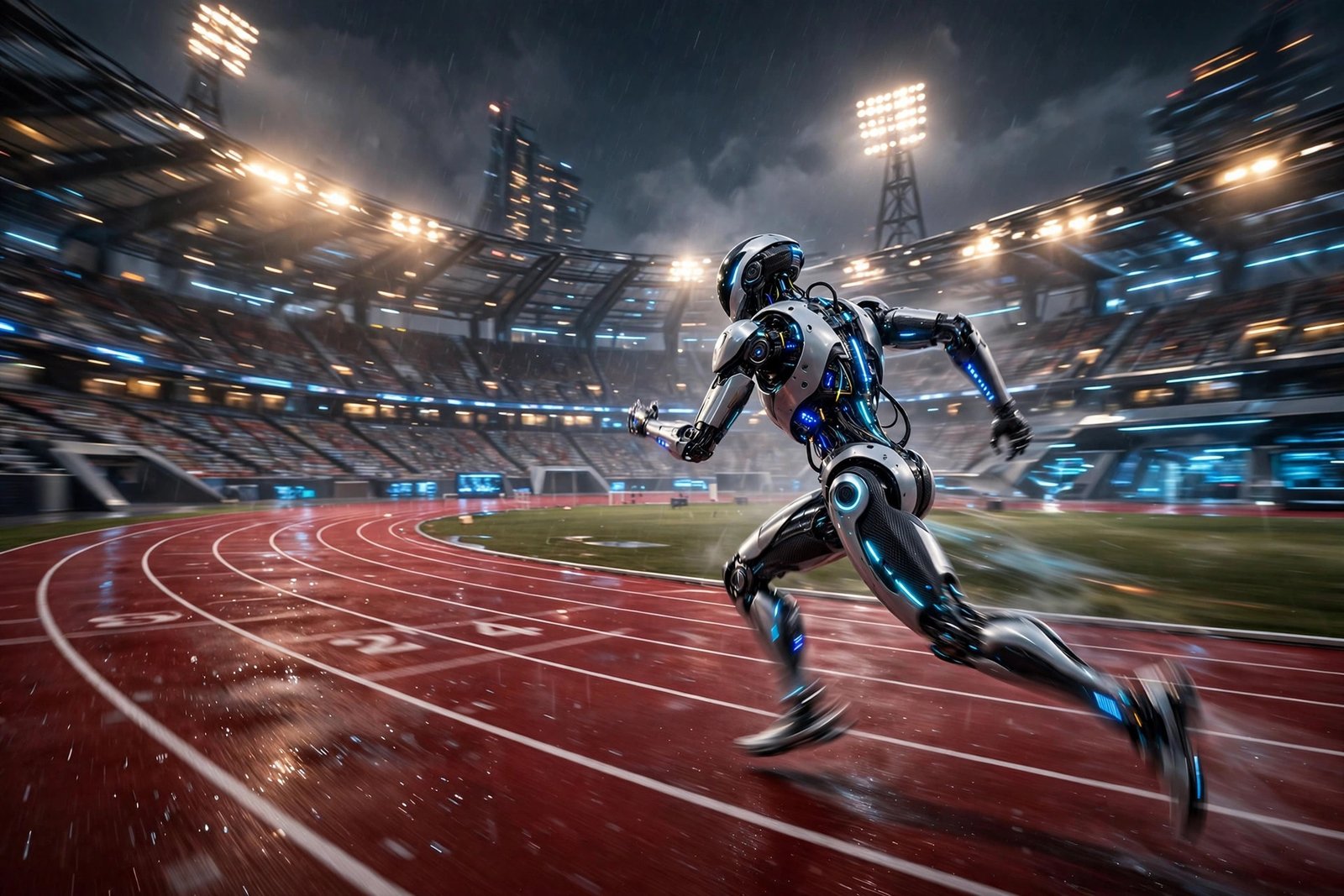
For seventeen years, 9.58 seconds has been the most untouchable number in sports. That is how long it took Usain Bolt to run 100 meters at the 2009 World Championships in Berlin — the official human world record, a mark many believed would stand for a generation. Now, according to offbeat-news coverage out of China, a robot faster than Usain Bolt has arrived: the humanoid Tiangong Ultra reportedly sprinted 100 meters in just 8.64 seconds.
Let that sink in. A machine on two legs — upright, balanced, striding — covered the sport’s most famous distance nearly a full second quicker than the fastest human who ever lived. The report, published by offbeat-news outlet PhotoNews on August 28, 2026, says the run averaged nearly 42 kilometers per hour, a pace no human being has ever sustained over 100 meters.
But before anyone rewrites the record books, there is a catch — several, actually. Sports scientists who reviewed the performance are urging everyone to pump the brakes on the headline. This is the story of what really happened in Beijing, why Bolt’s record still stands untouched, and what a sprinting robot genuinely means for the future.
A Robot Faster Than Usain Bolt? The Viral 8.64-Second Run
Here is what was reported. In Beijing, China, the Chinese humanoid robot Tiangong Ultra clocked 8.64 seconds over 100 meters, beating Bolt’s 9.58-second human world-record time on the stopwatch. The performance was reviewed by Reuters, and photos from the event show Tiangong Ultra racing alongside Honor robots in a 100-meter semifinal at the 2026 World Humanoid Robot Games in Beijing.
The run went properly viral. On August 26, 2026, China’s Xinhua News posted race footage on X with the caption: “Watch how, in less than 3 years, China’s humanoid robots have gone from stumbling steps to breaking human running records.” That framing — three years from clumsy to superhuman — is what turned a robotics demo into a global talking point.
The raw numbers are startling. Divide 100 meters by 8.64 seconds and you get about 11.57 meters per second, or roughly 41.7 kilometers per hour — matching the reported average of nearly 42 kph. Bolt’s legendary 9.58 works out to about 10.44 meters per second, or roughly 37.6 kph. On pure clock time, the robot was moving at a speed no human sprinter has ever reached.
There is another telling detail in the stride counts. Reuters’ review of the race footage showed Tiangong Ultra taking more than 50 short, rapid steps to cover the distance, compared with Bolt’s 41 long, powerful strides during his record run. The robot did not beat Bolt by running like Bolt — it beat his time by running like a machine: high-frequency, metronomic, and utterly tireless.
It is the kind of story that belongs on the list of facts that feel fake but are 100 percent real — except this one comes with some very important asterisks.
The Honest Truth: Why Bolt’s 9.58 Still Stands
Now for the honesty check, because this is where the viral headline meets reality. Sports scientists who examined the run stressed that Tiangong’s performance does not represent a like-for-like athletic contest with Usain Bolt — not even close.
Start with the start. Bolt exploded out of starting blocks, driving low with every muscle in his body. The robot started upright, already standing, with no blocks and no crouch — a completely different event, biomechanically speaking. Iain Hunter, a professor of exercise science at Brigham Young University, estimated that Bolt would have reached the five-meter mark almost two seconds ahead of the robot because of his vastly superior start.
Then there is the machinery. Bolt’s speed came from muscles, tendons, and a nervous system tuned by millions of years of evolution. Tiangong Ultra runs on electric motors, control software, and mechanical joints. As the reporting notes, these are fundamentally different propulsion systems, and comparing their times is a bit like comparing a speedboat’s crossing time to a swimmer’s — interesting, but not the same sport.
The robot’s biggest advantage is one no human can ever have: it does not get tired. Human sprinters decelerate in the final meters as neuromuscular fatigue sets in; Bolt himself was slowing slightly as he crossed the line in Berlin. Matt Bundle, a biomechanics expert at the University of Montana, explained that the robot gained ground later in the race precisely because it was not constrained by the same fatigue that slows human sprinters near the end.
And then there is the matter of the record books themselves. Official athletics records are governed by strict rules — certified tracks, wind gauges, starting blocks, drug testing, and ratification procedures — and they apply to human athletes. A robotics demonstration, however impressive, is not an athletics competition. Bolt’s 9.58 remains the official men’s 100m world record, full stop.
None of this diminishes what the engineers achieved — it just puts it in the right category. The robot faster than Usain Bolt on paper has not dethroned him in any official sense; it has simply shown what machines can do outside the rules of sport. Jung Moon-hyun, a sports science professor at South Korea’s Chungnam National University, described the run as a major technological advance in maintaining balance at speeds beyond human capability. That is the real story: not a stolen record, but a balance-and-control milestone.
From Stumbling Steps to Sprint: Three Wild Years
The most jaw-dropping part of this story is not the 8.64 seconds — it is the timeline. As Xinhua’s viral post put it, China’s humanoid robots went from stumbling steps to record-chasing sprints in less than three years. For anyone who remembers the early days of humanoid robots — the faceplants, the wobbling, the engineers hovering with kill switches — the transformation is genuinely astonishing.
So how did Tiangong Ultra get so fast? According to the developers, the gains came from a combination of physical and software upgrades: they reduced the weight of the robot’s torso and waist, improved the motors, expanded the range of motion in its joints, and refined the control software that keeps it balanced at speed. Every gram shed from the upper body means less mass swinging around with each stride; every improvement in motor response means the feet can strike and push off faster.
The deeper breakthrough is balance. Running is, at its core, a controlled series of falls — you tip forward and catch yourself, dozens of times, without ever quite falling. Doing that at 42 kilometers per hour on two legs, with more than 50 foot strikes in under nine seconds, requires the control system to solve an incredibly complex physics problem in real time, every few milliseconds. That Tiangong Ultra can do it at all is the engineering marvel. The stopwatch time is just the headline-friendly wrapper.
Like the best facts that sound fake but are real, the timeline needs its caveats too — these are purpose-built demo machines, not general-purpose athletes. But the rate of progress is real, and it is accelerating.
The Crash at the Finish Line
Here is the detail that tells you everything about where this technology really stands: Tiangong Ultra maintained its speed through the finish of an earlier record run — and then crashed straight into a padded wall.
That crash is arguably more informative than the 8.64 seconds. Sprinting in a straight line on a flat track is one thing; stopping is another. The researchers themselves said that future progress will depend not only on speed but on braking, changing direction, and making independent decisions while moving. A sprinter who cannot stop is not an athlete — it is a projectile.
Think about what a human sprinter does after crossing the line: decelerate smoothly, stay in lane, jog out the speed, celebrate. Every one of those actions requires the same exquisite balance and control as the sprint itself, run in reverse. For humanoids, the “easy” part — going fast in a straight line — is arriving first. The hard parts — stopping, turning, reacting, deciding — are still on the to-do list. The padded wall at the end of the track is a perfect metaphor for the state of the art: breathtaking speed, with the brakes still under development.
What a Robot Faster Than Usain Bolt Really Means
So if this is not about athletics, what is it about? Everything else.
A humanoid robot that can balance at 42 kilometers per hour is a robot that will not fall over when a warehouse floor is slippery, when a disaster site is uneven, or when it is carrying a heavy load down a corridor. Speed is the stress test; robustness is the product. The same control systems that keep Tiangong Ultra upright at a sprint are the systems that will one day let humanoids work safely alongside people — in factories, in elder care, in search and rescue.
There is also a cultural meaning. For decades, the 100-meter dash has been humanity’s purest benchmark of physical capability — ten seconds of absolute human limit. A machine beating that number on a stopwatch, even with every asterisk attached, marks a psychological threshold. We are entering an era where “faster than the fastest human” is an engineering spec, not a fantasy.
The honest framing matters. Tiangong Ultra did not take anything from Usain Bolt — his 9.58, set in Berlin in 2009, remains one of the greatest athletic achievements in history, earned with blocks, spikes, and a human heart hammering at its limit. What the robot did was arguably more interesting: it showed us a glimpse of machines learning to move through our world at our speed — and beyond it.
The Mind-Blowing Takeaways
- 8.64 seconds beats 9.58 on the clock — but not in the record books. The robot’s time is faster than Bolt’s mark, but it was not an athletics competition, so the human world record stands.
- The robot ran at nearly 42 kph. That is about 11.57 meters per second — a pace no human has ever sustained over 100 meters (Bolt averaged about 37.6 kph).
- It won with frequency, not power. Tiangong Ultra took 50+ short, rapid steps versus Bolt’s 41 long strides — machine running, not human running.
- No fatigue is the ultimate performance enhancer. The robot gained ground late because, unlike humans, its “muscles” never tire.
- It still cannot stop properly. After an earlier record run, the robot crashed into a padded wall — braking, turning, and decision-making are the next frontiers.
- Three years from stumbling to sprinting. The speed of progress in humanoid robotics is the real headline.
Conclusion: The Stopwatch Doesn’t Lie — But It Doesn’t Tell the Whole Truth Either
A robot ran 100 meters in 8.64 seconds. That is a real, measured, astonishing fact — and it deserves its viral moment. But the fuller truth is more interesting than the headline: a machine built for balance demos, starting upright and never tiring, beat a human time set under the strictest conditions in sports history. A robot faster than Usain Bolt on the stopwatch is a milestone — just not the one the viral posts claim.
Usain Bolt is still the fastest human who ever lived. Tiangong Ultra is something else entirely — the fastest hint yet of a future where machines move among us at speeds we can barely imagine. Both can be true. And honestly, that is more exciting than any single record. The robot faster than Usain Bolt is not coming for the record books — it is coming for the warehouse, the disaster zone, and the factory floor.
Frequently Asked Questions
Did a robot really run 100 meters faster than Usain Bolt?
According to offbeat-news coverage published August 28, 2026, China’s Tiangong Ultra humanoid robot clocked 8.64 seconds over 100 meters, faster than Bolt’s 9.58-second human world record on the stopwatch. However, it was a robotics demonstration, not an official athletics race.
Why doesn’t the robot’s time count as a world record?
Athletics world records apply to human athletes competing under strict rules — starting blocks, certified tracks, wind measurement, and ratification. The robot started upright instead of from blocks, runs on motors rather than muscles, and never experiences fatigue, so sports scientists say it is not a like-for-like contest.
What is Tiangong Ultra?
Tiangong Ultra is a Chinese humanoid robot that competed in events including the 2026 World Humanoid Robot Games in Beijing. Its developers improved its speed by reducing torso and waist weight and upgrading its motors, joint range of motion, and balance-control software.
How fast is 8.64 seconds over 100 meters in kph?
About 41.7 kilometers per hour (11.57 meters per second). By comparison, Bolt’s 9.58-second record averages about 37.6 kph — which is why the robot’s reported time is so startling.
What comes next for sprinting robots?
According to the researchers, the next frontiers are braking, changing direction, and making independent decisions while moving — the robot crashed into a padded wall after one record run. Speed is arriving first; control is catching up.