
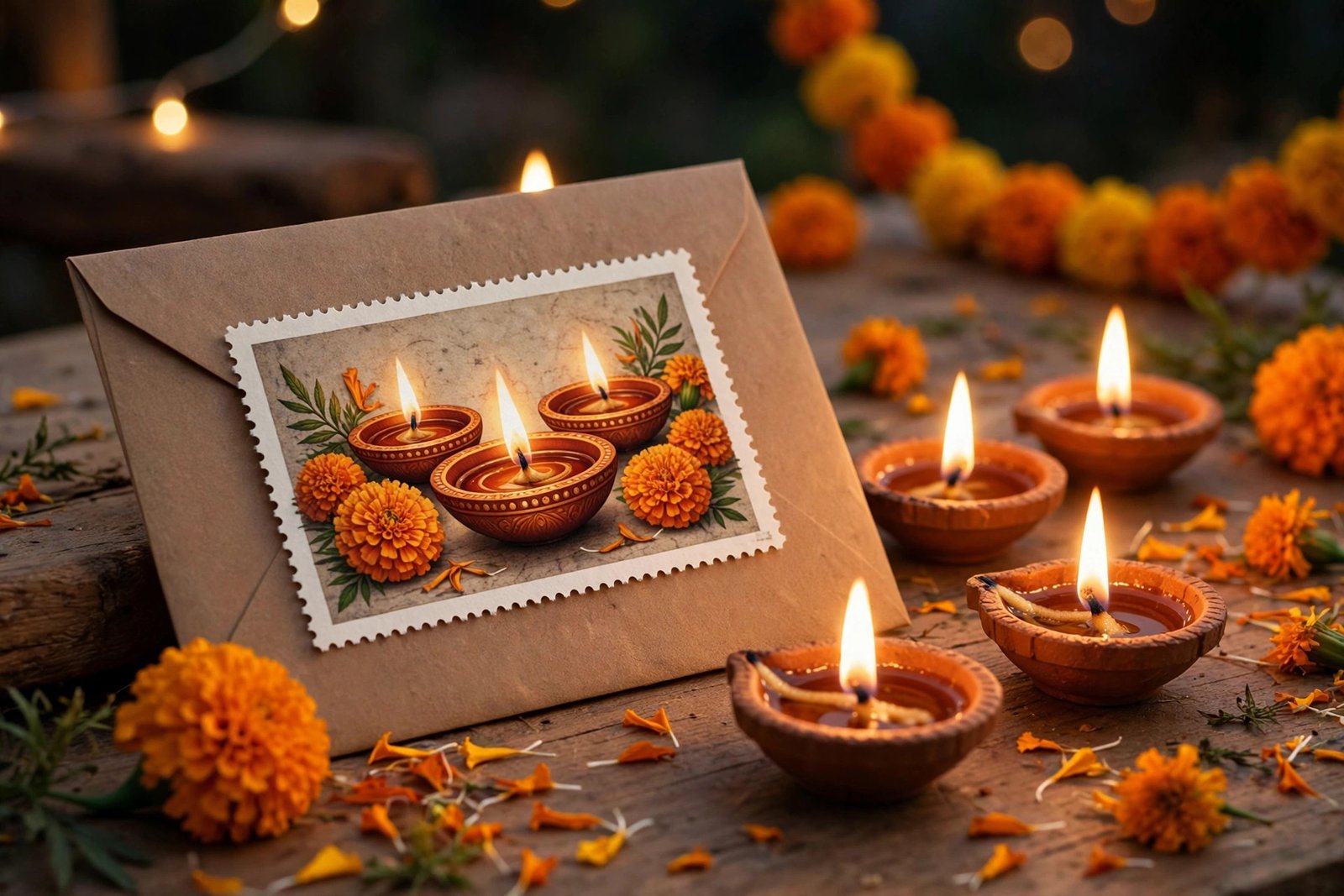
It took ten years, a mountain of fan letters, and one very determined community to make it happen — but the wait is finally over. The United States Postal Service has released a brand-new USPS Diwali stamp, its first stamp honoring the Festival of Lights in a full decade, and it printed a staggering 20 million copies. Unveiled this week at the Indian Embassy in Washington, D.C., the stamp features a radiant rangoli design glowing with diyas — and it is already being called one of the most beautiful commemorative stamps the Postal Service has ever issued.
Why does a postage stamp matter this much? Because for the nearly five million Indian Americans in the United States, Diwali isn’t just a holiday — it is the holiday. And for the first time since 2016, they can send their cards, invitations, and love letters bearing a symbol of the festival itself. This is the story behind the stamp: the design, the artist, the ceremony, and why 20 million copies tells you everything about how badly people wanted this.
What the New USPS Diwali Stamp Looks Like
The new USPS Diwali stamp is a Forever stamp built around a vibrant rangoli — the traditional Indian floor art made from colored rice powder, chalk, flower petals, and sand, believed to bring good luck and welcome guests into the home. The design shows a symmetrical, kaleidoscopic rangoli in rich reds, oranges, and jewel tones, ringed with glowing diyas, the small oil lamps that give the Festival of Lights its name.
According to the Free Press Journal, the stamp was designed by Jennifer Arnold, with William J. Gicker serving as art director. The USPS describes rangoli as a vibrant floor pattern traditionally crafted from materials like colored rice powder, chalk, and flower petals — a description that barely does justice to how intricate the real thing is. The artist behind the artwork created an actual rangoli measuring 8 feet in diameter, working on the floor over several days, before it was photographed for the stamp.
The result is a miniature work of art you can stick on an envelope. As a Forever stamp, it will always be valid for First-Class Mail postage regardless of future price increases — meaning these stamps will be lighting up mailboxes for years to come. The USPS Diwali stamp is sold in panes of 20 at post offices nationwide and through the Postal Service’s online store.
Why 20 Million Copies Makes This USPS Diwali Stamp Historic
Twenty million. Let that number sink in. For a commemorative stamp — a category that usually sees far more modest print runs — 20 million is a statement. And the Postal Service said the quiet part out loud: the number is, in an official’s words, “a little bit on the higher side,” precisely because of overwhelming demand from the Indian American community.
As Telangana Today reported, a USPS vice president told the IANS news agency at the unveiling ceremony: “There was so much advocacy on behalf of the Indian community to create a second stamp. And we just knew that this one was gonna be super popular like the first one, and hence we printed a little bit higher quantities for folks to enjoy.”
The official added: “We have printed 20 million Rangoli stamps, and we’re very excited for the Indian community to enjoy these” — noting that stamp collectors were also expected to snap them up. That last point matters: commemorative stamps live two lives. Millions will be used on actual Diwali mail this season, and millions more will disappear into albums and collections, never to be licked at all. The 20-million print run is the Postal Service betting that both audiences will show up in force.
For context, the first Diwali stamp in 2016 was, in the same official’s words, “wildly popular.” The Postal Service said it sold “so many millions and millions of stamps.” A decade later, the Indian American community has only grown — and so has its voice.
Inside the Dedication Ceremony at the Indian Embassy
The ceremonial first-day-of-issue unveiling took place on Wednesday, October 21, 2026, at the Embassy of India in downtown Washington, D.C. — a fitting venue for a stamp celebrating an Indian festival on American postage. IANS reported that a USPS vice president served as the dedicating official, with India’s Ambassador to the United States, Vinay Mohan Kwatra, headlining the reception.
Ambassador Kwatra struck a note that went beyond philately. He said the festival was “first and foremost” about “the millions of Indian Americans who call this country their home — students, professionals, the artists, families.” He described Indian Americans as “the living bridge” between the two countries, and called the stamp “one thread, important thread” in the relationship.
In an interview, Kwatra said the stamp was a chance “for us to celebrate our cultural strengths, our cultural heritage with the Indian American diaspora and with the larger US society here.” He also confirmed the timing: the main Diwali festival falls on Sunday, November 8, this year — meaning the stamp arrives just in time for the season’s peak mailing period.
The USPS itself celebrated the launch on social media, posting: “Celebrate the Festival of Lights in style: with the 2026 Diwali stamp, featuring a vibrant rangoli. Diyas light the way as we celebrate light over darkness. Bring a little of that light to your mail by ordering these stamps today.”
The Artist Behind the Rangoli: Sangita Bhutada
Every great stamp has a human story behind it, and this one belongs to Sangita Bhutada — a Houston-based, Indian-born artist who has been creating rangolis for nearly 30 years. Born in Maharashtra, Bhutada is a longtime Texas resident and a traditional practitioner of the art form.
Her path to a U.S. postage stamp began, wonderfully, with an email. According to Lokmat Times, the Postal Service contacted her asking whether she could create a rangoli for a stamp. After signing a contract, she sent design sketches, then created the rangolis on the floor in different colors. Her photographer friend Bijay Dixit was then contracted to photograph the artwork — and that photograph became the basis of the stamp the whole country will see.
Bhutada told reporters she chose vibrant colors like red and orange because they are significant to Diwali — colors of celebration, prosperity, and light. She used starch-based colored powder and colored sand to build the 8-foot design, working over several days. Think about the journey of that artwork: from powder on a Houston floor to a photograph to a printing press to 20 million tiny canvases traveling across America. That is the kind of story that makes a stamp more than postage.
The First Diwali Stamp: 2016’s Wild Success
To appreciate why the new USPS Diwali stamp is such an event, you have to go back to 2016. That year, after years of campaigning by Indian American organizations and lawmakers, the Postal Service issued its first-ever Diwali commemorative — a Forever stamp featuring a diya (oil lamp) glowing against a dark background, designed to honor the festival.
It was a landmark. For the first time, one of America’s biggest holidays for one of its fastest-growing communities was recognized on federal postage. And the public response was extraordinary — the stamp sold in the millions and became a fixture of Diwali-season mail for years.
But commemorative stamps are, by design, limited engagements. Once the 2016 stamp’s moment passed, the community started asking: when is the next one? The answer took a decade of advocacy — petitions, community campaigns, and persistent engagement with the Postal Service’s Citizens’ Stamp Advisory Committee, the body that decides which subjects get honored. The 2026 rangoli stamp is the payoff: only the second Diwali stamp in USPS history, and the first in ten years.
That ten-year gap is part of what makes the 20-million print run so telling. The Postal Service isn’t guessing about demand anymore. It watched the 2016 stamp fly off the shelves, listened to a decade of requests for a sequel, and printed accordingly.
Diwali 2026: Why the Timing Is Perfect
Diwali, observed by Hindus, Sikhs, Jains, and others, celebrates the triumph of light over darkness and good over evil. This year, the main festival day falls on Sunday, November 8 — and the stamp’s October 21 unveiling lands it squarely in the sweet spot for holiday mailing. Diwali cards, party invitations, and gifts are all moving through the mail system right now, and every one of them can now carry the festival’s own symbol.
The timing also reflects something bigger: Diwali’s arrival as a mainstream American celebration. Major U.S. cities now host public Diwali festivals drawing tens of thousands. The White House has celebrated Diwali for years. Schools in districts with large South Asian populations close for the holiday. A postage stamp is both a recognition of that reality and an accelerant — a small, everyday object that normalizes the festival for millions of Americans who have never celebrated it.
October has been a packed month for feel-good American traditions, from the viral Mississippi Halloween display that stopped traffic, to the giant inflatable pumpkin that went rogue on a farm, to Lindsay Lohan’s October 3 Mean Girls recreation. The Diwali stamp fits right into that spirit: a celebration, made shareable, arriving exactly when people want to share it.
How to Get the Stamps
If you want them — and judging by the 2016 precedent, many people will — the details are simple. The 2026 Diwali Forever stamp is sold in panes of 20 at post offices across the country and through the USPS online store. Because it is a Forever stamp, it will always cover the current First-Class Mail one-ounce rate, no matter how prices change in the future.
Collectors take note: first-day-of-issue postmarks from the October 21 dedication ceremony are the kind of detail that makes a cover valuable decades from now. And if the 2016 stamp’s aftermarket is any guide, pristine panes of the 2026 issue won’t stay cheap forever. Twenty million sounds like a lot — until a few million collectors each tuck away a pane or two.
Key Takeaways
- What: A new USPS Diwali Forever stamp featuring a vibrant rangoli with diyas — the first Diwali stamp in 10 years.
- How many: 20 million printed, a deliberately large run driven by Indian American advocacy.
- When: Unveiled October 21, 2026, at the Indian Embassy in Washington, D.C.; Diwali peaks November 8.
- Who: Rangoli by Houston artist Sangita Bhutada; stamp designed by Jennifer Arnold; art director William J. Gicker.
- Why it matters: Only the second Diwali stamp in USPS history — a milestone for nearly five million Indian Americans.
The Bottom Line
A postage stamp is a small thing — about an inch square, worth a few dozen cents. But the new USPS Diwali stamp carries a decade of advocacy, an 8-foot work of floor art, and the hopes of a community that finally sees its brightest festival reflected in the nation’s mail. Twenty million copies is the Postal Service’s way of saying: we heard you. And somewhere this week, a kid in New Jersey or Texas is sticking a rangoli on an envelope and sending a little light across the country — which is exactly what Diwali is about.