
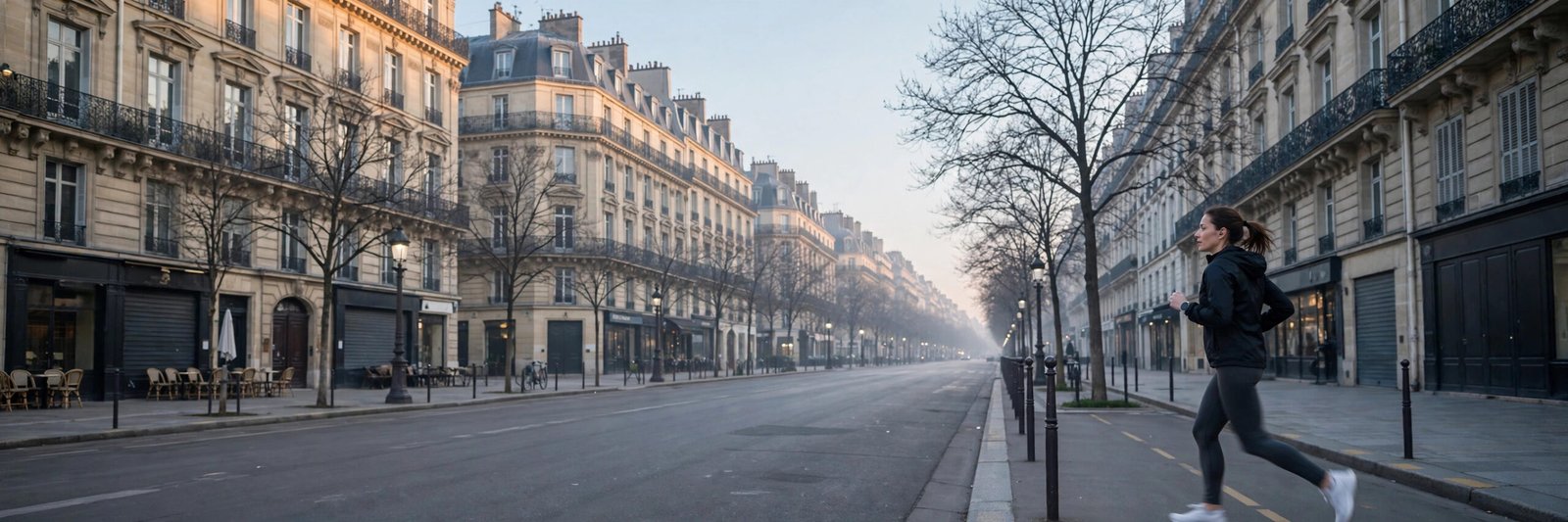
Picture this: a street in Paris, thick black smoke curling into the sky, flames chewing through a barricade of burning debris, protesters and riot police somewhere in the haze — and right through the middle of it all, a woman in a sports bra and running shorts, jogging. Not sprinting away. Not ducking for cover. Just jogging, steady pace, earbuds probably in, as if the burning barricade were nothing more than an ordinary Tuesday obstacle on her running route.
That surreal clip — a woman jogging past a burning barricade amid Paris unrest — has become one of the most viral videos of October 2026, and it has split the internet clean in half. To some viewers, she is the ultimate symbol of “main character syndrome”: a woman so locked into her own storyline that a riot is merely background scenery. To others, she is a hero of normalcy — a person refusing to let chaos steal her routine, her health, and her peace of mind. According to WION’s reporting on the viral video, the footage triggered a heated debate over her apparent indifference to the chaos around her, and that debate is still raging.
But the jogger is not even the only Parisian who went viral for staying calm while the city burned. As the woman jogging past the burning barricade divided the internet, another clip showed a couple sipping wine at a café terrace near the Arc de Triomphe while flames rose directly behind them. Together, these videos have become a kind of Rorschach test for the internet age: what do you see when ordinary life collides with extraordinary chaos?
The Woman Jogging Past Burning Barricade: What the Video Actually Shows
Let’s start with what is confirmed. The video, which surfaced amid demonstrations in France over the rising cost of living — including increasing expenses for fuel, food, and other essential goods — shows a woman continuing her morning run despite smoke, flames, and disruption on the streets around her. Images of burning barricades, disrupted roads, and damaged shops have further highlighted the unrest surrounding the protests, per WION’s report published October 20, 2026.
In the viral clip, the woman can be seen jogging past a barricade engulfed in flames, moving through thick black smoke as though the surrounding disturbances have not interrupted her workout. One user who shared the footage on X highlighted the striking contrast between a city experiencing unrest and an individual seemingly determined to finish her daily exercise. That user accused the woman of displaying “main character syndrome” — the internet’s favourite diagnosis for anyone who appears to treat real life as the backdrop of their personal movie — suggesting she seemed more focused on hitting her daily step target than paying attention to the unfolding protests.
According to the New York Post’s coverage of the Paris unrest on October 19, the young female runner, wearing a sports bra and running shorts, wove among a bonfire of burning e-bikes and protesters as she made her way through the ongoing unrest. A separate report by 24NewsHD described a woman jogging calmly between burnt-out vehicles during the France protests. The details vary slightly between clips — there may be more than one jogging video circulating — but the core image is the same: athletic calm in a landscape of fire.
Here is the important honesty note: a short viral clip tells us almost nothing about this woman’s actual circumstances. We do not know her name. We do not know whether she was aware of the scale of the unrest, whether she had another route available, whether she was running toward safety or simply through her own neighbourhood on a routine she has followed for years. The internet, however, has never let a lack of information stop it from rendering a verdict.
Why the Woman Jogging Past Burning Barricade Broke the Internet
The video hit a nerve because it stages a collision the internet cannot look away from: total chaos versus total composure. Psychologists might call it a violation of expectations — our brains are wired to expect people to react to danger, so watching someone not react feels uncanny, almost glitch-like. It is the same reason videos of people calmly eating while something wild happens behind them reliably go viral. The contrast is the content.
The “main character syndrome” accusation is worth unpacking, because it reveals more about the accusers than the accused. The term describes the perception that someone views themselves as the protagonist of life while everyone else is an extra. Applied to the jogger, the argument goes: only someone pathologically self-absorbed could run through a riot without breaking stride. She must see the burning barricade as set dressing for her fitness journey.
But the defence of the woman jogging past the burning barricade is just as passionate, and arguably more grounded. As WION reported, one social media user suggested the woman might simply have been exercising to manage stress or maintain a familiar routine, pointing out that outsiders could not know what she was thinking. Another praised her for concentrating on herself rather than attempting to change the behaviour of others. A third argued she should not be expected to participate in the unrest or allow the actions of rioters to dictate her daily activities — that continuing her routine could be one way of coping with an unpredictable and stressful situation.
There is also a very practical defence that rarely makes it into the hot takes: she may have had no safe alternative. If you live in a neighbourhood where unrest erupts around you, the streets are your streets. Jogging through them might be less a statement of indifference than a simple refusal to be held hostage by other people’s chaos. And frankly, a lone jogger is not obligated to join a protest, condemn it, or perform concern for an audience of millions. She was, as one defender put it, free to go for a jog.
“Main Character Syndrome” vs. The Right to Your Routine
The debate over the jogger taps into one of the defining anxieties of the social media era: the feeling that everything must be a statement. In 2026, simply existing in public near a newsworthy event can turn you into content, and content invites judgment. The woman did not post the video herself — she was filmed, uploaded, and tried by millions of strangers who will never know her name.
Consider the double standard at play. When a man kept delivering pizzas during a flood years ago, the internet called him a hero of dedication. When nurses danced on TikTok during the pandemic, some called it joyful resilience and others called it tone-deaf. The line between “admirable composure” and “shocking indifference” is drawn almost entirely by the viewer’s mood, not the subject’s intent. The woman jogging past the burning barricade did not choose to become a symbol; the internet chose it for her.
Mental health professionals have long noted that maintaining routines during crises is a legitimate coping strategy. Exercise, in particular, is one of the most evidence-backed tools for managing stress and anxiety. Running regulates the nervous system, burns off stress hormones, and restores a sense of agency when the world feels uncontrollable. From that angle, the jogger is not ignoring reality — she is managing it, the same way millions of people kept walking their dogs, baking bread, and going for runs during far worse upheavals in history.
And there is a quieter, more human possibility the hot takes miss: maybe she was scared, and running was the only thing that felt normal. Courage does not always look like confrontation. Sometimes it looks like putting one foot in front of the other.
The Café Couple: Wine and Cigarettes While Paris Burned
If the jogger divided the internet, the couple finished the job. In a second viral clip filmed in Paris, a man and a woman were seen calmly enjoying a glass of wine and a cigarette at an outdoor bistro table while fires raged just feet behind them, close to the iconic Arc de Triomphe. The New York Post reported on October 19 that the relaxed-looking couple had been identified, and described the scene with a very French shrug: “C’est la vie.”
The footage, captured on Saturday, October 17, shows the couple chatting and smoking on a café terrace as flames from a burning bin flickered in the background, according to the Economic Times. The Free Press Journal added that Reuters cameras had recorded the footage and uploaded it to its servers after a delay — meaning this was not a staged influencer stunt but a genuine moment captured by a news agency. Despite the unrest in the vicinity, the couple appeared unperturbed, continuing their conversation as if nothing unusual were happening around them.
Reactions split along familiar lines. One X user described the moment as a symbol of resilience amid chaos, writing that “amid the chaos and protests, this serene scene in one of Paris’s cafés stands out as a symbol of resistance and resilience” — arguing that the scene demonstrated how people could find moments of peace even in turbulent circumstances, and calling calmness itself a powerful response to chaos. Others saw it as privilege on display: the luxury of sipping wine while other people’s grievances literally burn.
A 24NewsHD roundup of the viral Paris moments noted that the scenes went further still — some demonstrators added humour to the rallies by dressing up as Captain America, Spider-Man, and Napoleon, while other protesters danced in the streets and local musicians played tunes in support of the demonstrations. Orchestra performers reportedly joined in, playing popular film melodies and protest songs. France, it seems, protests the way it does everything: with flair.
What’s Actually Happening in Paris: The Unrest Behind the Flames
It is easy to get hypnotised by the viral clips and forget that real grievances are burning underneath them — literally. The unrest comes amid demonstrations over the rising cost of living, including increasing expenses for fuel, food, and other essential goods, with protesters also voicing concerns about inequality and France’s strained social model. What began last month with student protests over teacher shortages and poor school facilities has grown into a wider movement against inequality, public spending cuts, and declining standards, drawing in students, trade unionists, and members of the Yellow Vest movement.
The New York Post reported that some 2,500 arrests were made over the weekend as violence and looting broke out across the country, with 855 arrests in Paris alone as violent groups clashed with officers and looted luxury stores. These figures, reported in the Post’s October 19 coverage, describe the most intense weekend of the unrest — the same weekend both viral videos were filmed.
A note of caution is warranted here: viral clips are not journalism. A 30-second video of a jogger or a café couple tells you nothing about the scale, causes, or human cost of the demonstrations. Social media’s algorithm rewards the most visually striking moments, not the most representative ones. The woman jogging past the burning barricade is fascinating precisely because she is an outlier — she is not the story of the protests, she is a footnote that accidentally became the headline. Readers looking for a full picture of the French demonstrations should follow established news outlets’ ongoing coverage rather than drawing conclusions from viral fragments.
The Psychology of Normalcy: Why We Can’t Stop Watching
There is a reason these clips travel so far, and it is not really about Paris. Videos of calm amid chaos scratch a deep psychological itch. They offer a fantasy of control: the idea that when everything falls apart, you could still be the person sipping wine, finishing your run, unruffled. In an era of constant crisis footage, composure feels almost superhuman — and therefore endlessly watchable.
They also function as moral inkblots. Your reaction to the woman jogging past the burning barricade probably says more about your relationship to disruption than about her. If you find her inspiring, you may value resilience and personal boundaries. If you find her appalling, you may value solidarity and collective awareness. Neither reaction is wrong; both are incomplete. She is a stranger in a 30-second clip, not a referendum on civic virtue.
This is also why the “main character syndrome” label caught on so fast. The phrase gives people a tidy, slightly witty box for a feeling that is actually complicated: discomfort at watching someone opt out of a shared emotional reality. But opting out of the spectacle is not the same as opting out of society. The jogger did not start the fire. She just ran past it.
Key Takeaways
- A viral video shows a woman jogging past a burning barricade amid Paris unrest over the cost of living — and the internet is fiercely divided over whether she displayed “main character syndrome” or simply her right to keep her routine.
- Defenders argue she may have been managing stress, coping with unpredictability, or simply had no alternative route; critics say jogging through a riot shows shocking indifference.
- A second viral clip shows a couple sipping wine at a café terrace near the Arc de Triomphe on October 17 while flames from a burning bin rose behind them — footage captured by Reuters cameras.
- The unrest stems from demonstrations over rising fuel, food, and living costs, growing from student protests into a wider movement involving unions and Yellow Vest activists; reporting cites ~2,500 arrests over the weekend, 855 in Paris alone.
- Viral clips are outliers, not journalism: they reveal our own anxieties about chaos and control far more than they explain the protests themselves.
Conclusion
So which is she — the embodiment of main character syndrome, or a quiet icon of resilience? The honest answer is that we will never know, and that not knowing is the point. The woman jogging past the burning barricade never asked to be a symbol. She was filmed without her consent, uploaded without her context, and judged without her side of the story by millions of people who will forget her by next week.
What endures is the question she accidentally posed: when the world around you catches fire, what do you owe the moment? Must you stop, stare, and perform concern — or are you allowed to just keep going? There is no universally correct answer, which is exactly why the video broke the internet. We are all, in the end, minor characters in one another’s feeds, searching the footage for a reflection of ourselves.
Perhaps the most French response to the whole affair came not from the jogger or the commenters, but from the café couple near the Arc de Triomphe, wine glasses in hand, smoke in the air: c’est la vie. Life, it turns out, goes on — sometimes at a jog, sometimes over a glass of wine, even when the barricades are burning.
For more viral moments that broke the internet, see the scariest Halloween display in Mississippi that went viral, Lindsay Lohan’s October 3 Mean Girls recreation, and the Adela Nicole Kidman song that became a TikTok trend.
Frequently Asked Questions
What is the viral video of the woman jogging past a burning barricade?
It is a widely shared clip filmed during unrest in Paris, France, showing a woman continuing her jog past a barricade engulfed in flames, moving through thick black smoke. The video surfaced amid demonstrations over the rising cost of living and sparked a heated online debate, with some viewers accusing the woman of “main character syndrome” and others defending her right to maintain her daily routine. WION reported on the viral video on October 20, 2026.
Why are people protesting in Paris?
According to news reporting, the demonstrations began with student protests over teacher shortages and poor school facilities and grew into a wider movement over the rising cost of living — including fuel, food, and essential goods — as well as inequality, public spending cuts, and concerns about France’s social welfare model. Students, labour unions, and Yellow Vest movement members have taken part. The weekend of October 17–18, 2026 saw significant unrest, with reporting citing around 2,500 arrests nationwide and 855 in Paris alone.
What is “main character syndrome”?
“Main character syndrome” is internet slang for the perception that someone views themselves as the protagonist of life while treating everyone and everything else as background extras. It was applied to the Paris jogger by social media users who felt she treated a riot as mere scenery for her workout. Psychologists note, however, that a short clip cannot reveal someone’s actual mindset, and maintaining routines during crises is a well-documented coping strategy.
Who is the couple seen dining near the Arc de Triomphe during the riots?
Their identities have been reported by outlets including the New York Post, which noted the relaxed-looking man and woman have been identified, though their names were not widely published in the coverage reviewed. They were filmed on October 17, 2026, calmly drinking wine and smoking at a café terrace near the Arc de Triomphe while a bin burned behind them. The footage was captured by Reuters cameras, according to the Free Press Journal.
Is it safe to jog through a protest or riot area?
Generally, no — it is not advisable. Burning barricades produce toxic smoke, and protest areas can turn violent or be met with police action like tear gas and crowd dispersal without warning. Safety experts advise avoiding unrest zones entirely. The viral video shows one individual’s choice in one moment; it should not be taken as an endorsement of jogging through dangerous areas.