
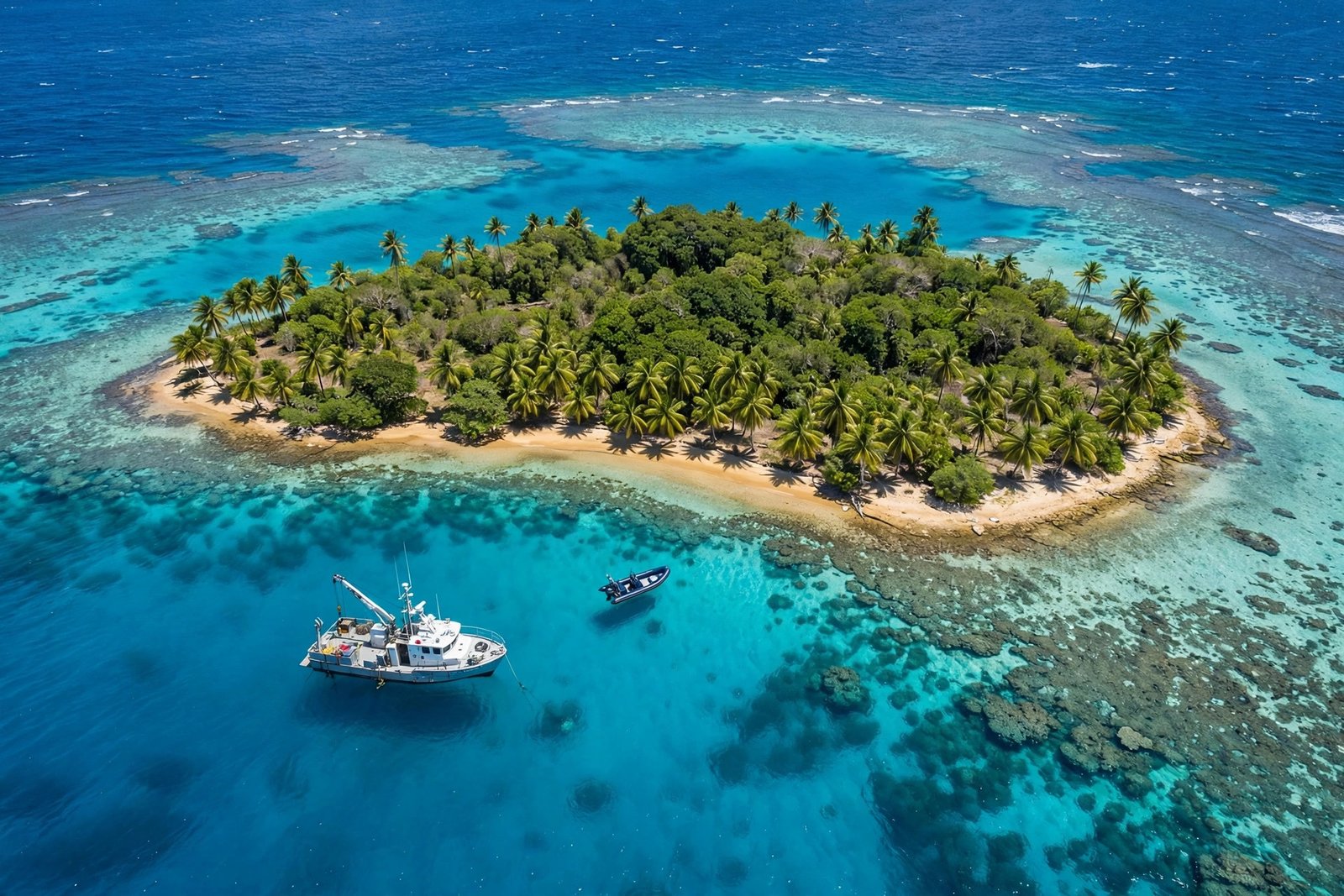
A $900,000 expedition just sailed home from one of the most remote islands on Earth with an answer nobody wanted to hear. The Amelia Earhart Purdue expedition spent a week on Nikumaroro, a lonely coral atoll in the Pacific nation of Kiribati, investigating a strange shape spotted in satellite images that some researchers hoped was the wreckage of Earhart’s lost Lockheed Electra. On October 19, 2026, the team announced its verdict: the mysterious object was not an airplane at all. It was a pile of trees. After nearly 90 years of searching, Amelia Earhart’s plane is still missing, and the island keeps its secret.
The Disappearance That Started It All
On July 2, 1937, Amelia Earhart and her navigator Fred Noonan took off from Lae, in what is now Papua New Guinea, in a twin-engine Lockheed Electra 10-E. They were attempting the most ambitious flight of the era: to become the first woman to pilot a plane around the world, and the first aviator of any gender to circle the globe at the equator. Ahead of them lay the longest and most dangerous leg of the journey, a roughly 2,500-mile hop over open ocean to tiny Howland Island, a speck of land in the central Pacific where a refueling stop awaited.
Radio contact was maintained for much of the flight, with Earhart reporting her position to the U.S. Coast Guard cutter Itasca, stationed off Howland Island to guide her in. Then the messages grew strained. Earhart, 39, reported that she was running low on fuel. Her final known transmission gave a navigational line of position. Then, silence. Despite one of the largest search efforts in history at the time, no trace of Earhart, Noonan, or the Electra was ever found. She was declared lost, and the mystery became one of aviation’s most enduring obsessions.
Earhart was already a legend before she vanished. She had been the first woman to fly solo across the Atlantic, a bestselling author, a fashion designer, and a tireless advocate for women in aviation. Her disappearance at the height of her fame froze her in time, and the unanswered question of what happened on that July morning has fueled expeditions, books, films, and fierce debate for nearly nine decades.
Why Nikumaroro? The Castaway Theory
Of the many theories about Earhart’s fate, the one that has driven the most field research centers on Nikumaroro, then known as Gardner Island. The hypothesis holds that Earhart and Noonan, unable to find Howland Island, flew south along their navigational line and crash-landed on or near the uninhabited atoll, where they survived for a time as castaways before perishing.
The evidence, while circumstantial, is tantalizing. In the days after the disappearance, radio operators across the Pacific and even in North America reported hearing faint distress calls on Earhart’s frequencies, calls that some analysts believe could only have been transmitted from land, since the Electra’s radio could not have operated for long from the water. In 1940, a British colonial officer on Gardner Island discovered a partial human skeleton, a sextant box, and signs of a castaway camp. The bones were later lost, and a 1941 analysis concluded they belonged to a stocky European man, but a 2018 re-examination of the original bone measurements by forensic anthropologist Richard Jantz concluded the remains were more consistent with a female of Earhart’s height and build.
Two previous underwater searches around Nikumaroro also came up empty, and a much-publicized plane-shaped sonar image captured by another expedition on the deep ocean floor turned out to be a pile of rocks. The island has a habit of raising hopes and dashing them. Which brings us to the object that launched the 2026 mission.
How the Amelia Earhart Purdue Expedition Reached Nikumaroro
The 2026 mission was a joint effort of the Archaeological Legacy Institute, the Purdue Research Foundation, and Purdue University, and it was years in the making. The Amelia Earhart Purdue expedition had originally been planned for 2025 but was delayed while organizers waited for clearances from the government of Kiribati; cabinet approval finally came in July 2026, setting up an October departure.
The 17-person team was led by Rick Pettigrew, executive director of the Archaeological Legacy Institute, and included Purdue’s general counsel Steve Schultz as the university’s team lead, along with three representatives from Kiribati. Some team members flew out of the Amelia Earhart Terminal at the Purdue University Airport in early October, the full team assembled in Tarawa, Kiribati, on October 6, and the group departed by sea on October 7 for the roughly 830-nautical-mile voyage to Nikumaroro. They spent seven days at the atoll, four of them working onshore, conducting both maritime and land archaeology in the lagoon.
The expedition was funded by private donors and Purdue University at a reported cost of about $900,000, a measure of how seriously the institution takes the Earhart legacy. And that legacy connection is no accident. Earhart was not just a famous aviator to Purdue; she was a member of its faculty. In the 1930s she served as a career counselor for women students and an advisor in aeronautics, and the Purdue Research Foundation funded her Lockheed Electra through the Amelia Earhart Fund for Aeronautical Research. Her husband George Putnam and Earhart herself both said they intended to return the plane to Purdue after the around-the-world flight. Nearly a century later, Purdue is still trying to bring it home.
The Taraia Object: Satellite Clue or Mirage
The target of the expedition was an elongated shape in the lagoon near the Taraia Peninsula, first spotted in satellite imagery from 2020 and dubbed the Taraia Object. What made it exciting was its appearance: from above, the object looked reflective and metallic, with a shape that some researchers thought could be aircraft wreckage. Even more intriguing, researchers later found something in the same position in aerial photographs taken in 1938, just a year after the disappearance, suggesting the object had been sitting in the lagoon for a very long time.
Nobody had ever examined it in person. The lagoon at Nikumaroro is shallow but treacherous, and reaching the atoll requires serious logistics and government permission. The Amelia Earhart Purdue expedition went specifically to put eyes and instruments on the anomaly, with the hope that it might be the Electra, or at least a piece of it. Before the team left, organizers cautioned that the mission might end up ruling out a theory rather than confirming one. That caution proved wise.
What the Amelia Earhart Purdue Expedition Found Instead
When the team reached the site, much of what the satellites had seen was already gone. The debris had fragmented and washed away in the years since the 2020 images were taken, leaving a smaller Y-shaped segment. Up close, the object’s supposedly metallic sheen had a mundane explanation: a carbonate veneer, a shiny, concretized coating of coral sand that had formed over the debris. The same reflective coating was found on other natural debris in the lagoon, and it can make ordinary drift material look like aluminum from above.
The team’s conclusion, announced on October 19, 2026, Nikumaroro time, was blunt: the visual anomaly was likely a collection of large trees and debris wedged in the lagoon’s sand, not aircraft wreckage. “Unfortunately, we weren’t able to find that smoking gun,” Steve Schultz said in a video message recorded on the island, quoting Earhart herself: “Adventure is worthwhile in itself.” Rick Pettigrew put it more simply: “This mystery has been ongoing for 90 years. And the mystery continues.”
The expedition was not a total loss. The team recovered numerous artifacts through its maritime and land archaeology, including a steel tube about 30 inches long found in the lagoon near the Taraia Peninsula. Purdue has not linked the tube to Earhart’s Electra, and the finds will be studied to understand how objects drift across the lagoon from the Tatiman Passage. Science advanced, even if the mystery did not shrink.
Why Purdue Keeps Looking
It is worth pausing on the question of why a major American university keeps spending money to find a plane lost in 1937. The answer is part history, part institutional identity. Purdue’s connection to Earhart runs deeper than nostalgia. The university helped put her in the air: the Amelia Earhart Fund for Aeronautical Research, backed by donors including Purdue trustee David Ross, financed the Electra itself. Her papers, her legacy, and her name are woven into Purdue’s story, from the airport terminal that bears her name to the archives that preserve her letters.
There is also a harder-headed logic. Each expedition, even the unsuccessful ones, narrows the search. Ruling out the Taraia Object eliminates one more candidate site. The artifacts recovered, the lagoon mapped, the drift patterns studied: all of it feeds the next attempt. And the public attention these missions generate keeps the mystery alive for a new generation, which is its own kind of mission for a university.
The Mystery Lives On
So where does the search go from here? The castaway hypothesis still has its believers, and Nikumaroro still holds unanswered questions. The 1940 bones may be lost, but the sextant box, the camp traces, and the radio distress reports remain unexplained. Other theories persist too: that the Electra went down in the open ocean near Howland Island, that Earhart was captured by the Japanese (a theory historians have largely debunked), or that the plane rests in deep water somewhere along the flight path, waiting for better sonar technology to find it.
What the 2026 expedition proved, above all, is how easily hope can masquerade as evidence. A carbonate coating on driftwood looked like polished aluminum from orbit. A 1938 aerial photograph seemed to confirm a 2020 satellite image, until the object itself dissolved into trees. In the age of satellite archaeology, the lesson of Nikumaroro is humility: the ocean is very good at making trash look like treasure.
Conclusion
Amelia Earhart took off from Lae on July 2, 1937, and never came home. Eighty-nine years later, the Amelia Earhart Purdue expedition sailed 830 nautical miles to stare at a pile of trees in a lagoon, and the world watched anyway, because some mysteries refuse to be boring. The Taraia Object was not the Electra. But somewhere out there, in the vast blue between Papua New Guinea and Howland Island, the real answer is still waiting. And as long as Purdue and the searchers keep looking, the adventure remains worthwhile in itself.
Love unsolved mysteries? Read about the Wow! signal from deep space, check out 8 space facts that sound fake but are real, and explore historical coincidences that feel made up.
Sources: Reuters: search for Amelia Earhart’s plane ends with tree debris; FLYING Magazine: expedition finds no evidence of the Electra at Nikumaroro; MiGFlug: Taraia Object was trees, not Earhart’s Electra; Coast to Coast AM: This Week’s Weird News (10/16/26).
What did the 2026 Amelia Earhart Purdue expedition find?
The October 2026 expedition to Nikumaroro found no evidence of Amelia Earhart’s Lockheed Electra. The satellite anomaly known as the Taraia Object turned out to be a collection of large trees and debris with a shiny carbonate coating that had made it look metallic from above.
Where is Nikumaroro and why is it linked to Amelia Earhart?
Nikumaroro is an uninhabited coral atoll in Kiribati’s Phoenix Islands. The castaway hypothesis holds that Earhart and navigator Fred Noonan landed there after missing Howland Island in July 1937. A 1940 skeleton find and reported post-loss radio distress reports keep the theory alive.
Why is Purdue University involved in the Amelia Earhart search?
Earhart served on Purdue’s faculty in the 1930s as a career counselor and aeronautics advisor, and the Purdue Research Foundation funded her Lockheed Electra. The university has supported the search for decades, including the 2026 joint mission with the Archaeological Legacy Institute.
What was the Taraia Object?
The Taraia Object was an elongated shape in Nikumaroro’s lagoon near the Taraia Peninsula, first seen in 2020 satellite imagery. Its reflective surface suggested metal, but the October 2026 expedition found the shine came from a carbonate veneer of coral sand over tree debris.
Was Amelia Earhart’s plane ever found?
No. Despite decades of searches, including the 2026 Nikumaroro expedition and earlier deep-ocean sonar surveys, no confirmed wreckage of Earhart’s Lockheed Electra 10-E has ever been found. The mystery of her July 1937 disappearance remains unsolved.