
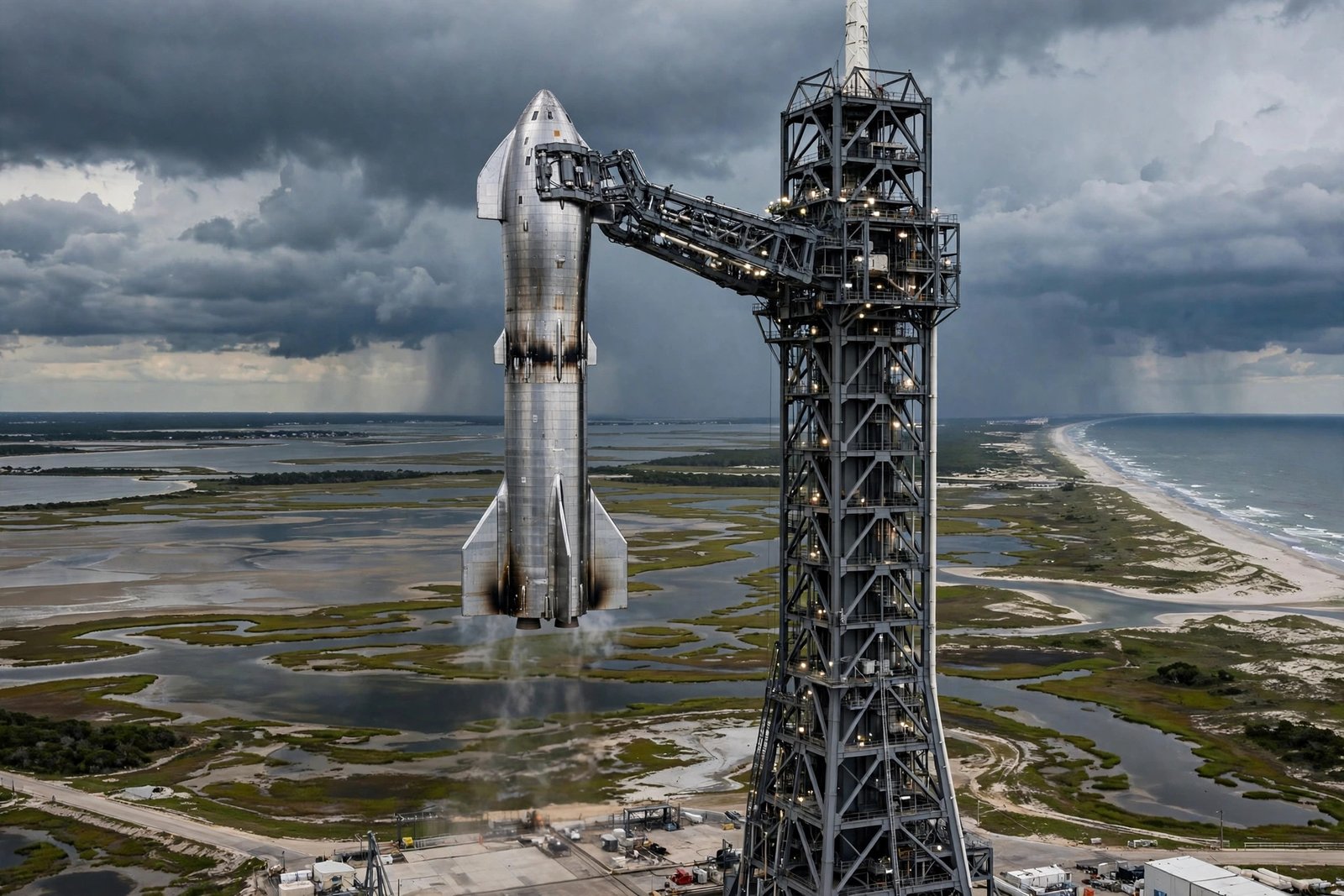
On Saturday, November 14, 2026, a spacecraft the size of a 17-storey building fell out of the sky over Texas, flipped itself upright in mid-air, and was caught by two giant mechanical arms like a pair of chopsticks picking up the world’s largest egg roll. It was the first time anyone had ever caught a spaceship returning from orbit, and the crowd watching along the Gulf of Mexico erupted. The SpaceX Starship return was not just a spectacular piece of theatre. It was a milestone that spaceflight engineers have been chasing for decades: proof that the largest rocket ever built can come home in one piece and be caught, ready to fly again.
The spacecraft was Ship 42, the upper stage of SpaceX’s Starship system, and the flight was Flight 15, the fifteenth test of the giant rocket since April 2023. It had lifted off the day before, on Friday, November 13, at 5:47 p.m. EST from Starbase, the SpaceX facility in South Texas near the U.S.-Mexico border. Over the next 22 hours it circled the Earth 14 times, released 26 Starlink internet satellites, and then came home. At about 4:20 p.m. EST on Saturday, it slid between the arms of the launch tower and stopped, hanging in the air above Launch Pad 2. SpaceX’s own message on X said it simply: “Mechazilla catches Starship!” The SpaceX Starship return had worked, and the age of catching spaceships had begun.
To understand why this matters, you have to understand what Starship is. At 407 feet tall when fully stacked, it is the largest and most powerful rocket system ever flown. It has two parts: the Super Heavy booster, the giant first stage with 33 Raptor engines that lifts the whole stack off the pad, and the Starship spacecraft itself, the upper stage, which is 171 feet (52 metres) tall and carries satellites, cargo, and eventually people into orbit. Both stages are designed to come back. Both are designed to be caught by the launch tower. And both are designed to fly again, quickly, with minimal refurbishment. That is the dream of full reusability, and until Saturday, nobody had ever caught the upper stage at all.
What Happened on Flight 15?
Flight 15 began like a textbook launch. All 33 Raptor engines on the Super Heavy booster fired at liftoff, pushing the stack toward orbit before the two vehicles separated. The booster was then expected to return to Starbase about six and a half minutes after liftoff for a precision catch by the tower’s awaiting arms. But that part of the plan did not work. One engine in the booster’s outer ring was out for the boostback burn, and the boostback burn ended early. SpaceX managers said early indications pointed to a low fuel mass alarm, and the booster’s guidance system sensed it was not in the right position for a catch. Automatically, it diverted to a watery landing zone offshore in the Gulf of Mexico and was lost. SpaceX is still investigating the exact cause, and its explanation of the sequence changed over the following day, but the outcome was clear: the dream of a double catch, both stages on one flight, would have to wait.
The Starship spacecraft, meanwhile, was having a very different day. After separating from the booster, Ship 42 reached orbit for the second time and settled in for a long mission. It completed 14 laps around the Earth at an altitude of about 265 kilometres (165 miles), far more than the one or two laps of earlier flights, and released 26 Starlink V3 satellites. Before committing to the return, SpaceX checked the heat shield: three of the Starlink satellites carried cameras that photographed the ship’s tiles as it turned in front of them, and the team reviewed those images and footage from ground cameras before confirming the heat shield was in a good posture for re-entry and the return to the launch site. It was a careful, deliberate mission, and it showed in the result.
The return began with a short burn of a single Raptor engine, lasting roughly ten seconds, that slowed the spacecraft just enough to drop it out of orbit and onto a path back into the atmosphere. Then came the hard part. Travelling at an orbital speed of about 17,000 miles per hour, Ship 42 had to shed almost all of that speed, survive the extreme heat of re-entry, and arrive over Starbase on a precise, controlled path. It emerged from the clouds visibly charred from the heat, reignited its engines to turn vertically, and descended slowly over the launch site. In the final seconds, it performed a belly-flop manoeuvre, turning end over end and swivelling its fiery engine plumes downward to slow and slide precisely between the awaiting arms. The arms swung closed around it. The engine shut down. The spacecraft hung there, caught, intact, home.
How Do You Catch a Spaceship?
The catching machine has a nickname: Mechazilla. It is the launch tower at Starbase, fitted with two enormous steel arms that SpaceX calls the chopsticks. The arms are mounted on the tower and can move up and down its height and swing open and closed. When a returning vehicle approaches, the arms wait open, and at the right moment they close around load-bearing fittings on the vehicle and take its weight. It sounds simple, and it is anything but. The spacecraft has to arrive at exactly the right place, at exactly the right speed, at exactly the right angle. Too fast, too low, or off to one side, and the tower cannot save it. That is why the booster diverted on Friday: its guidance system decided it was not correctly positioned for a catch, and an automated system made the safe choice to head for the sea instead.
SpaceX had already caught Super Heavy boosters with the same type of hardware on earlier flights, so the tower itself was proven. Catching the Starship spacecraft was the new challenge, because the upper stage is a different vehicle returning from a much longer and faster journey. It had spent nearly a full day in space, circled the planet 14 times, and come back through the atmosphere at orbital speed. The catch on November 14 was the first successful capture of a Starship upper stage returning from orbit, and it proved that the same tower can catch both parts of the system. SpaceX’s official livestream accompanied the final descent with the 1977 hit song “Baby Come Back,” a joke that landed perfectly with the watching crowd.
It is worth pausing on what the word “catch” really means here. This was not a net, and it was not luck. It was a guided, powered landing onto a fixed capture mechanism, with the spacecraft flying itself to a precise point in the sky and the arms closing around it at the right instant. In engineering terms, it is one of the most demanding things ever attempted in flight, and it worked on the first try for the upper stage.
Why Catching Matters: The Reusability Revolution
The SpaceX Starship return matters because of one word: reusability. For most of space history, rockets were thrown away after a single flight. The boosters, the tanks, the engines: all of it burned up or fell into the sea. That made every launch enormously expensive, because you were building a new rocket every time you wanted to go to space. SpaceX changed that first with the Falcon 9, whose first-stage booster lands itself on a pad or a drone ship and flies again. Starship is meant to take that idea to its logical conclusion: both stages return, both are caught, and both can be refuelled and flown again quickly, like an aeroplane rather than a firework.
That is why SpaceX officials said Saturday’s catch demonstrates Starship’s full reusability, which they describe as crucial for rapid, low-cost recycling of the vehicle. If a rocket can be caught, inspected, refuelled, and launched again in days rather than months, the cost of each flight falls sharply, and the number of flights that are possible each year rises just as sharply. More flights mean more satellites, more science, more cargo, and eventually more people going to space. It also means the giant rocket stops being a one-off stunt and starts being a working transport system, which is the whole point of building it at that scale.
There is an honest caveat, and the reporting on Flight 15 includes it. Recovering the spacecraft does not yet prove that it can be flown again without extensive refurbishment. The ship came back charred from re-entry, and engineers will need to inspect it carefully to see what survived, what needs replacing, and how quickly it could realistically fly again. A catch is a milestone, not a finish line. But it is the milestone everything else depends on. You cannot reuse a spacecraft you cannot bring home, and now SpaceX has brought one home.
One Step Closer to the Moon
NASA was watching, and NASA was delighted. The space agency is paying billions of dollars for Starship to land Artemis astronauts on the Moon later this decade and help build a permanent lunar base, so a successful catch is directly relevant to its plans. NASA Administrator Jared Isaacman posted on X after the catch: “Congrats to Elon Musk and the SpaceX team! It was almost magic. Making more believers by the day… one step closer to the Moon.” The message, complete with Moon and U.S. flag emojis, was shared widely, and it captured the mood of the day. For NASA, this was not just a SpaceX achievement. It was a step toward its own goal of returning humans to the lunar surface.
The Moon connection is concrete. Under the Artemis programme, Starship is being developed as the lunar landing system that will carry astronauts from lunar orbit down to the surface of the Moon. SpaceX has invested more than 15 billion dollars in Starship’s development, according to Reuters, and NASA committed 3.2 billion dollars through a contract worth more than 4 billion dollars awarded in 2021 to develop that lunar landing system. The next Artemis mission is expected to skip the Moon and remain in orbit around Earth for lunar lander practice, and Artemis III’s four astronauts will attempt to dock their capsule with not only Starship but also Blue Origin’s Blue Moon lander. NASA is targeting as soon as 2028 for Artemis IV, which would be humanity’s first Moon landing since the Apollo era more than half a century ago. Every successful Starship test brings that date a little closer to reality.
Starship is also central to SpaceX’s own ambitions beyond the Moon. The company intends to develop different versions of the spacecraft to deploy internet satellites and orbital data centres, and to transport astronauts and equipment to the Moon and eventually to Mars. That is the long-term vision that has driven the programme since the beginning: a fully reusable rocket big enough to carry people and cargo to another planet. Saturday’s catch does not get us to Mars. But it does prove that the vehicle designed to take us there can come home.
What Comes Next?
The SpaceX Starship return is a beginning, not an ending, and the work ahead is substantial. First, engineers need to understand what happened to the booster. The low fuel mass alarm, the engine that was out during the boostback burn, and the guidance system’s decision to divert are all under investigation, and SpaceX will want answers before the next flight attempts another double catch. The booster was lost in the Gulf of Mexico, and the company will be working through the data to find out whether the problem was a sensor, a fuel system issue, or something else entirely.
Second, the caught spacecraft itself needs a thorough inspection. How did the heat shield hold up after 14 orbits and a full re-entry? What condition are the engines in? How much work would it take to fly Ship 42 again? The answers will tell SpaceX how close it really is to rapid reusability, and how much work remains. The company has not yet said whether this particular ship will fly again, and it would be a mistake to assume that a catch automatically means a quick turnaround. The inspection is part of the test.
Third, the programme is expanding geographically. SpaceX expects to begin launching Starships from Florida’s Kennedy Space Center within the next few months, and the company said during the Flight 15 webcast that its Starship tower at Launch Complex 39A at Kennedy will be ready later in November. A second launch site matters because it gives the programme more capacity and more flexibility, and because Kennedy is the starting point for NASA’s next Artemis mission. The Texas catch was a proof of concept. Florida will be where the concept starts doing real work.
There will be more test flights, and there will almost certainly be more failures along the way. That is the nature of a test programme that pushes this hard. Flight 15 itself was a reminder: a historic first and a lost booster on the same mission. But the direction of travel is clear. In less than four years, Starship has gone from its first flight in April 2023 to an orbital flight, a satellite deployment, and a mid-air catch of the spacecraft itself. The pace is extraordinary, and Saturday’s catch is the clearest sign yet that the system is maturing from an experiment into a vehicle.
Why the Whole World Watched
There is a simple reason the SpaceX Starship return was watched around the world, and it is the same reason people gather to watch any great engineering feat: it looks impossible until someone does it. A 171-foot spacecraft falling from orbit, flipping upright, and being caught by mechanical arms is the kind of thing that belongs in science fiction. Watching it happen on a livestream, in daylight, with a crowd cheering on the Texas coast, makes the future feel a little closer. It is the same feeling people had when the first Falcon booster landed, or when the first humans walked on the Moon: the quiet realisation that something you thought was impossible is now just something that happened.
For the United States, the catch is also a point of national pride and a practical step toward the Moon. For SpaceX, it is validation of a bet worth more than 15 billion dollars. For NASA, it is reassurance that its lunar lander is real and flying. And for everyone else, it is a reminder that spaceflight is not a finished story. It is still being written, one test flight at a time, by engineers willing to try something no one has ever tried before and accept that sometimes the booster will be lost and sometimes the spaceship will be caught. On November 14, 2026, the spaceship was caught. The next chapter is already being written.
- The flight: Flight 15 lifted off November 13 at 5:47 p.m. EST and returned November 14 after about 22 hours and 14 orbits.
- The catch: Ship 42 was caught by the Mechazilla tower’s chopstick arms above Launch Pad 2 at Starbase, Texas, the first ever catch of a Starship upper stage from orbit.
- The payload: 26 Starlink V3 satellites were deployed during the mission, and the heat shield was inspected in orbit before the return.
- The setback: the Super Heavy booster diverted to an offshore splashdown after an engine issue and a low fuel alarm, and was lost.
- The goal: full reusability, with Starship serving as NASA’s Artemis lunar lander and, one day, a vehicle for Mars.
Read the full reporting on the flight from Al Jazeera, Scientific American, and USA Today, and the detailed flight account at SpaceQ. If you enjoy stories of people who beat impossible odds, read the man who survived two atomic bombs, and for another story of an idea that refused to die, see how the Eiffel Tower was almost demolished. For more tales of strangers and second chances, these Reddit stories of strangers changing lives are well worth your time.
Frequently Asked Questions
What is the SpaceX Starship return?
The SpaceX Starship return refers to the November 14, 2026, recovery of Ship 42, the upper stage of SpaceX’s Starship rocket, which was caught mid-air by the Mechazilla launch tower’s mechanical arms at Starbase, Texas, after a 22-hour flight and 14 orbits around Earth. It was the first time a Starship spacecraft returning from orbit had been caught.
How does Mechazilla catch a Starship?
Mechazilla is the launch tower at Starbase, fitted with two large steel arms nicknamed the chopsticks. The returning spacecraft flies itself to a precise point beside the tower, and the arms close around load-bearing fittings on the vehicle and take its weight, allowing the engine to shut down while the ship hangs from the tower.
Did the whole Flight 15 mission succeed?
Only partly. The Starship upper stage was caught successfully after completing 14 orbits and deploying 26 Starlink satellites, but the Super Heavy booster did not return to the tower. After an engine issue and a low fuel alarm, its guidance system diverted it to an offshore splashdown in the Gulf of Mexico, and the booster was lost.
Why does catching Starship matter for the Moon?
NASA has selected Starship as the lunar landing system for its Artemis programme, which aims to return astronauts to the Moon. A reusable Starship that can be caught, inspected, and flown again would make lunar missions cheaper and more frequent. NASA Administrator Jared Isaacman called the catch “almost magic” and “one step closer to the Moon.”
What happens next for Starship?
SpaceX will investigate the booster failure, inspect the caught spacecraft to assess its condition, and continue test flights. The company also expects to begin launching Starships from Kennedy Space Center in Florida within the next few months, with its tower at Launch Complex 39A due to be ready later in November 2026.