
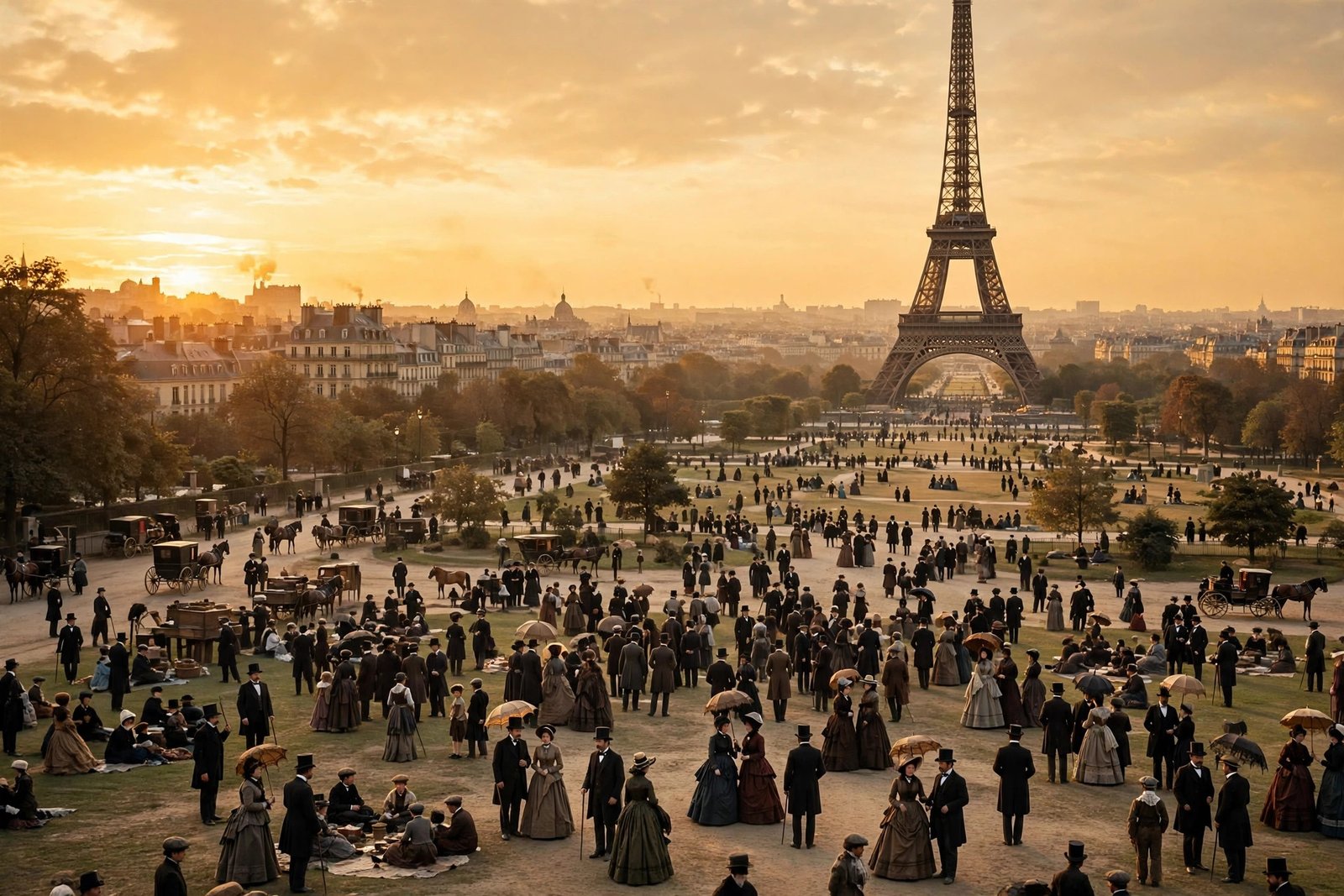
It is hard to imagine Paris without it. The Eiffel Tower rises above the rooftops, appears in a million photographs, and has become the single most recognizable symbol of France. Yet there was a time when the most famous tower in the world was almost torn down — and not by accident. The Eiffel Tower almost demolished story is one of the strangest near-misses in architectural history: a monument built to be temporary, hated by many of the artists of its day, and saved at the last moment by an invention almost nobody had predicted.
How does a structure go from public enemy to national treasure? The answer involves a World’s Fair, a fierce protest by some of France’s most celebrated writers and painters, a twenty-year deadline, and a military experiment with invisible waves that changed everything. This is the true story of the tower that was supposed to disappear — and the unlikely reason it is still standing today.
The Tower Built for a Party — and Meant to Leave
The Eiffel Tower was built for the Exposition Universelle of 1889, the World’s Fair held in Paris to mark the centenary of the French Revolution. The fair was a showcase of industry, science, and national pride, and its organizers wanted a centerpiece that would astonish the world. A competition was held for a monumental entrance arch, and the winning design came from the engineering firm of Gustave Eiffel, whose team of engineers Maurice Koechlin and Émile Nouguier had developed the concept of a great iron tower.
Construction began in 1887 and took a little over two years. Around 300 workers assembled more than 18,000 iron parts, held together by some two and a half million rivets, into a lattice tower 330 metres tall including its antennas. When it opened on March 31, 1889, it was the tallest structure in the world — a title it would hold for more than four decades. For more on the tower’s construction and measurements, see the official site at toureiffel.paris and the Britannica entry on the Eiffel Tower.
But here is the detail most visitors never learn: the tower was never supposed to stay. It was granted a twenty-year permit. The agreement was that after two decades, the structure would be dismantled and the land returned. In the eyes of the city, the tower was a fairground attraction with an expiry date, not a permanent monument. The countdown began the day it opened.
Paris Hated It: The Artists’ Protest
Long before the tower was finished, it had powerful enemies. In 1887, a group of prominent French artists and writers published a famous open letter — often called the Artists’ Protest — denouncing the project. They called the tower useless, monstrous, and an insult to Paris. Among the signatories were writers and painters whose names still fill French museums and libraries, men who believed the iron giant would ruin the beauty of the city they loved.
The criticism was not only aesthetic. Many Parisians thought the tower was an eyesore, a piece of industrial scaffolding that clashed with the stone elegance of Paris. Newspapers mocked it. Cartoonists drew it as a monster looming over the city. Even Gustave Eiffel himself had to defend the project in print, arguing that the tower was not merely decorative but a feat of engineering that demonstrated what iron could do.
And yet the public came. During the 1889 fair, visitors queued to ride the lifts to the top, and the tower quickly became one of the fair’s great attractions. The crowds were a first hint that the tower might have a future beyond its twenty-year permit — but popularity alone would not be enough to save it. The permit still said twenty years. As the deadline approached, the question of demolition was taken seriously.
The Twenty-Year Deadline Approaches
By the early 1900s, the clock was running out. The tower’s permit was due to expire in 1909, and the city had every right to order it dismantled. The structure that had once been a fairground marvel was now a large, aging iron tower in the middle of the capital, and its original purpose — marking the centenary of the Revolution — was long past.
What saved the tower was not nostalgia, and not tourism. It was science. In the years after the tower opened, a new technology was emerging: wireless telegraphy, the transmission of signals through the air using radio waves. And the Eiffel Tower, simply by being the tallest structure in Paris, was the perfect place to put an antenna.
The Eiffel Tower Almost Demolished — Saved by Radio
The French military quickly grasped the tower’s value. From its summit, wireless signals could be sent and received over long distances, far beyond what a low antenna could manage. The army installed radio equipment at the tower and began using it for military communications. Experiments in wireless telegraphy were carried out from the summit, and the tower became an important station in the early days of radio.
This changed the political calculation completely. A tower that had been a temporary fairground ornament was now a piece of military infrastructure. Tearing it down would have meant destroying a working radio station that the army relied on. The twenty-year permit, which had once looked like a death sentence, was effectively set aside — the tower’s usefulness had outgrown its original purpose.
The story is a reminder that survival is often about reinvention. The Eiffel Tower did not survive because everyone suddenly loved it. It survived because it became useful in a way nobody had planned. The same height that made it a target for critics made it invaluable to the people experimenting with radio. And once the military was using it, no city official was going to order it dismantled.
From Eyesore to Icon: How the Tower Won Paris Over
Once the demolition threat had passed, something slower and quieter happened: Paris fell in love with the tower. Artists who had once denounced it began to paint it. Writers set scenes beneath it. Photographers made it their favorite subject. The tower that had been called monstrous became the image of the city itself, reproduced on postcards, posters, and film.
Part of the change was familiarity. A structure that dominates a skyline every single day eventually becomes part of how people understand home. But part of it was also the tower’s own adaptability. Over the decades it has been repainted, re-lit, and re-imagined: its lights sparkle on the hour at night, it has hosted exhibitions and restaurants, and it remains a working broadcast antenna to this day — a direct continuation of the radio role that saved it.
Today the tower is one of the most visited monuments in the world, drawing millions of visitors every year. It appears on the official tower website as a symbol of Paris and France, and it remains, more than 130 years after it opened, the first thing many people picture when they hear the word Paris.
What the Near-Demolition Teaches Us
The tale of the Eiffel Tower almost demolished carries a few lessons worth keeping:
- Temporary does not mean unimportant. The tower was built for a fair and given twenty years. It outlasted its permit by more than a century.
- Usefulness can be a better defense than beauty. The artists’ protest attacked the tower’s looks. What saved it was its value as a radio antenna.
- Public opinion changes slowly, then all at once. The same Parisians who mocked the tower in 1887 now regard it as untouchable.
- Reinvention beats preservation. The tower survived because it found a new job — first radio, then broadcasting, then tourism — not because anyone froze it in time.
It is worth remembering that other World’s Fair structures were not so lucky. Many fair buildings were always intended to be temporary, and most were dismantled as planned. The Eiffel Tower is the exception that proves the rule — the fairground attraction that refused to leave, because it turned out to be good for something nobody had foreseen.
If you enjoy stories about how familiar things came to be, you may also like our look at how the Great Wall of China was built, or our piece on why we get goosebumps — another everyday mystery with a surprising scientific explanation.
The Eiffel Tower Almost Demolished — A Story Worth Remembering
Next time you see a photograph of the Eiffel Tower, remember the version of history that almost happened: a Paris skyline without it, the iron dismantled and sold for scrap after 1909, the most famous tower in the world reduced to a footnote in a fairground catalogue. The tower survived by a mixture of luck, engineering, and timing — and by being tall enough to catch a radio signal.
The Eiffel Tower almost demolished is more than a fun fact for a pub quiz. It is a reminder that the landmarks we take for granted were once controversial, temporary, and very nearly lost. The things we assume will always be there are often the things someone once tried to tear down — and the things that survive are the ones that find a new reason to exist.