
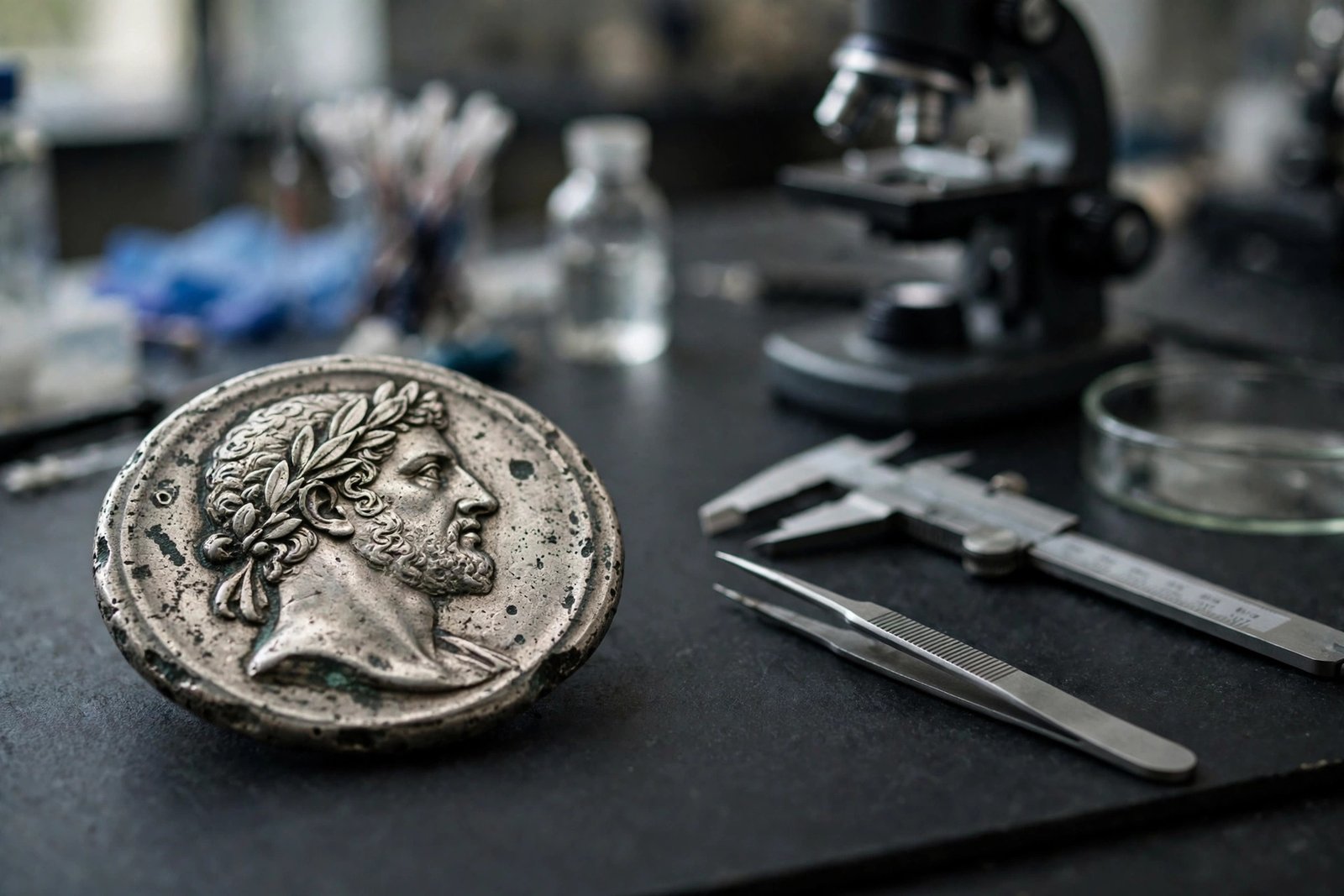
Here is a riddle for collectors, curators and anyone who loves a good mystery: what do you call a fake Greek coin that is made from real ancient metal? The answer, according to scientists at the British Museum, is a very clever forgery — and a very dangerous one. A group of coins from Ithaca, the island of Odysseus, sat in the museum’s collection for years before chemical analysis revealed the truth: at least one of them was a modern fake, struck from metal that was genuinely ancient. The forger had melted down real ancient coins to make a false one, giving the forgery an “ancient” chemical fingerprint that could fool almost every traditional test. It was a fake Greek coin made from real ancient metal — and it took X-ray science to catch it.
The trick is diabolically smart. For decades, museums and collectors have relied on chemical analysis to separate genuine ancient coins from modern fakes. Modern silver is too pure; ancient silver carries tiny traces of gold and other elements picked up from ancient ores and ancient refining. Test the metal, and the forgery usually gives itself away. But what happens when the forger uses ancient metal itself? The usual test suddenly stops working — and that is exactly what makes this case so important. It is a warning that science must keep evolving, because forgers evolve too.
The Fake Greek Coin That Fooled Everyone
The story begins quietly, in the British Museum’s collection of ancient Greek coins. Researchers selected six coins attributed to Ithaca, a small island in the Ionian Sea famous in legend as the home of Odysseus. On the surface, nothing was obviously wrong. The coins looked right, felt right and carried designs that matched known ancient types. They had sat in the collection as genuine antiquities, studied and catalogued like their neighbours in the trays.
But when the coins were examined more closely, something did not add up. Stylistically, the six coins could be divided into two variants — two slightly different versions of the same type. That alone is not unusual; ancient mints changed dies often, and hand-struck coins vary. What made researchers suspicious was that the two variants were also chemically different. Coins from the same mint and the same period should share a similar metal recipe. When two groups of supposedly identical coins have different chemistry, at least one group deserves a much closer look.
Real Ancient Metal, Fake Greek Coin: How the Forger Did It
The paper’s hypothesis is as simple as it is audacious: the forger melted down other, more common ancient coins — or other ancient artefacts — and used that metal to strike new, rarer coins. A common ancient coin might be worth a modest sum. Melt a handful of them, strike a rare Ithaca type that collectors will pay far more for, and the profit is enormous. And because the metal itself genuinely came from the ancient world, the coin’s chemical fingerprint would look ancient too.
This is why the researchers titled their paper “The bad side of recycling.” Recycling is usually a virtue, but here it was weaponised. The forger recycled antiquity itself, destroying real ancient objects to create fake ones. Every common coin that went into the melting pot was a piece of history lost forever — and every rare coin that came out was a lie that could poison a museum collection, a scholarly study, or a collector’s life savings.
Think about what the forger needed to pull this off. First, the skill of a master smith: melting silver without ruining it, casting or striking a blank, and engraving dies that imitate an ancient design closely enough to fool experts. Second, the knowledge of a numismatist: knowing which rare types were valuable, what genuine examples looked like, and where the tiny stylistic details matter. Third, the nerve to sell the result into the antiquities market of the 19th century, when rich collectors and young museums were competing for Greek treasures. It was a crime that required both hands and a library.
How X-Ray Science Caught the Forgery
So how did scientists catch a fake made from real ancient metal? The answer is X-ray fluorescence, or XRF — a technique that reads the chemical composition of a coin without damaging it. The British Museum researchers analysed the six Ithaca coins using a bench Bruker Artax X-ray fluorescence spectrometer, taking measurements from a polished surface on each coin. The machine fires X-rays at the metal, and the metal responds by giving off its own X-rays at energies that are unique to each element — a kind of chemical fingerprint. It is fast, non-destructive and sensitive enough to detect trace elements present in tiny amounts.
That fingerprint is where forgeries usually fail. Modern silver, produced by electrolysis, is extremely pure and contains no traces of gold. Ancient silver, by contrast, almost always contains small amounts of gold, because ancient refining could not remove it completely. So a “Greek” silver coin with no gold in it is almost certainly a modern fake. Similarly, ancient bronze is an alloy of copper and tin that almost always contains some lead, while a modern forger might reach for brass — copper and zinc — which betrays a modern origin. These are the chemical tells that XRF is designed to catch.
But the Ithaca forgeries were designed to beat exactly those tells. Because the metal came from melted-down ancient coins, it carried the right trace elements — including gold — in the right proportions. The XRF results still revealed the crime, but in a subtler way: the two stylistic variants of the coins were chemically different from each other in a pattern that did not match genuine minting. Genuine coins from one mint share a metal recipe; these did not. The chemistry, combined with the stylistic differences and the 19th-century records, built a case that no single test could have made alone. It was detective work, with the spectrometer as the star witness.
This is a lesson that goes far beyond one group of coins. Scientific analysis is powerful, but a single test is never enough. The researchers had to combine chemistry with style, history and the paper trail — and even then, they present their conclusion carefully, as a hypothesis supported by the evidence. Good science, like good detective work, is honest about what it can and cannot prove.
Why This Matters for Museums and Collectors
The Ithaca case matters because it attacks the trust that the whole ancient coin world runs on. Museums display coins as historical evidence. Scholars use them to date sites, trace trade routes and reconstruct ancient economies. Collectors pay thousands — sometimes hundreds of thousands — of dollars for rare pieces. If a fake can pass a chemical test, every one of those uses is at risk.
For collectors, the practical lesson is simple and old-fashioned: buy from reputable dealers, ask for provenance, and never rely on a single test or a single opinion. For museums, the lesson is to keep re-testing old collections with new techniques, because a coin that passed every test fifty years ago might fail the tests of today. The British Museum’s Ithaca coins sat in the collection for generations before anyone looked at them this way. How many more are waiting?
How to Spot a Fake Greek Coin: Lessons from the Science
You do not need a laboratory to learn from this story. The principles that caught the Ithaca forgeries are the same ones any careful collector or curious reader can use as a starting point:
None of these checks is foolproof on its own. Together, they are the best defence we have — and the reason the work of museum scientists matters to everyone who cares about the ancient world.
Key Takeaways
The Ithaca coins remind us of a strange truth about the ancient world: sometimes the metal tells the truth and the coin lies. A fake Greek coin made from real ancient metal is not just a curiosity — it is a challenge to every museum, scholar and collector who trusts chemistry to separate the real from the false. The forger who melted down ancient coins understood the science of his day; the scientists who caught him understood it better. But the race is not over. Somewhere, another forger is studying the latest paper, and somewhere else, another scientist is building a better test. If you enjoy mysteries where science unmasks the past, do not miss the Voynich manuscript, the book nobody can read, or the story of the con man who sold the Eiffel Tower twice. And for a treasure that was real beyond doubt, read how Tutankhamun’s tomb was discovered in 1922.
Sources: British Museum, “The bad side of recycling: the use of ancient coins as a source of material for modern forgeries”; Royal Society of Chemistry, “Ancient coins”; Forum Ancient Coins, “Fourrée — Ancient Plated Counterfeits”; Journal of Synchrotron Radiation, “Synchrotron X-ray tomography and spectroscopy in numismatics” (2026).
How can a fake Greek coin be made from ancient metal?
The forger melted down other, more common ancient coins or artefacts and used that metal to strike a rarer coin type. Because the metal genuinely came from the ancient world, the forgery carried an “ancient” chemical fingerprint that could fool standard tests.
Which coins did British Museum scientists study?
Researchers analysed six ancient Greek coins attributed to Ithaca, the island of Odysseus, held in the British Museum collection. The coins fell into two stylistic variants that were also chemically different, and one variant is suspected of being a modern forgery.
How does X-ray fluorescence (XRF) detect fake ancient coins?
XRF reads the chemical fingerprint of a coin’s metal without damaging it. Ancient silver usually contains trace amounts of gold, while modern silver made by electrolysis contains none. Ancient bronze contains lead, while modern brass contains zinc. A coin with the wrong chemistry is exposed as a fake.
Why did the Ithaca forgery fool chemical testing for so long?
Because the forger used melted-down ancient coins, the metal contained the right trace elements, including gold, in ancient proportions. The forgery was only caught when scientists noticed that the two stylistic variants had different chemistry, which genuine coins from one mint should not have.
What should collectors do to avoid buying a fake Greek coin?
Buy from reputable dealers, check the coin’s style and weight against genuine examples, ask for XRF analysis and full provenance, and never rely on a single test. The Ithaca case shows that even correct chemistry is not a guarantee, so style, weight, provenance and chemistry must all agree.