
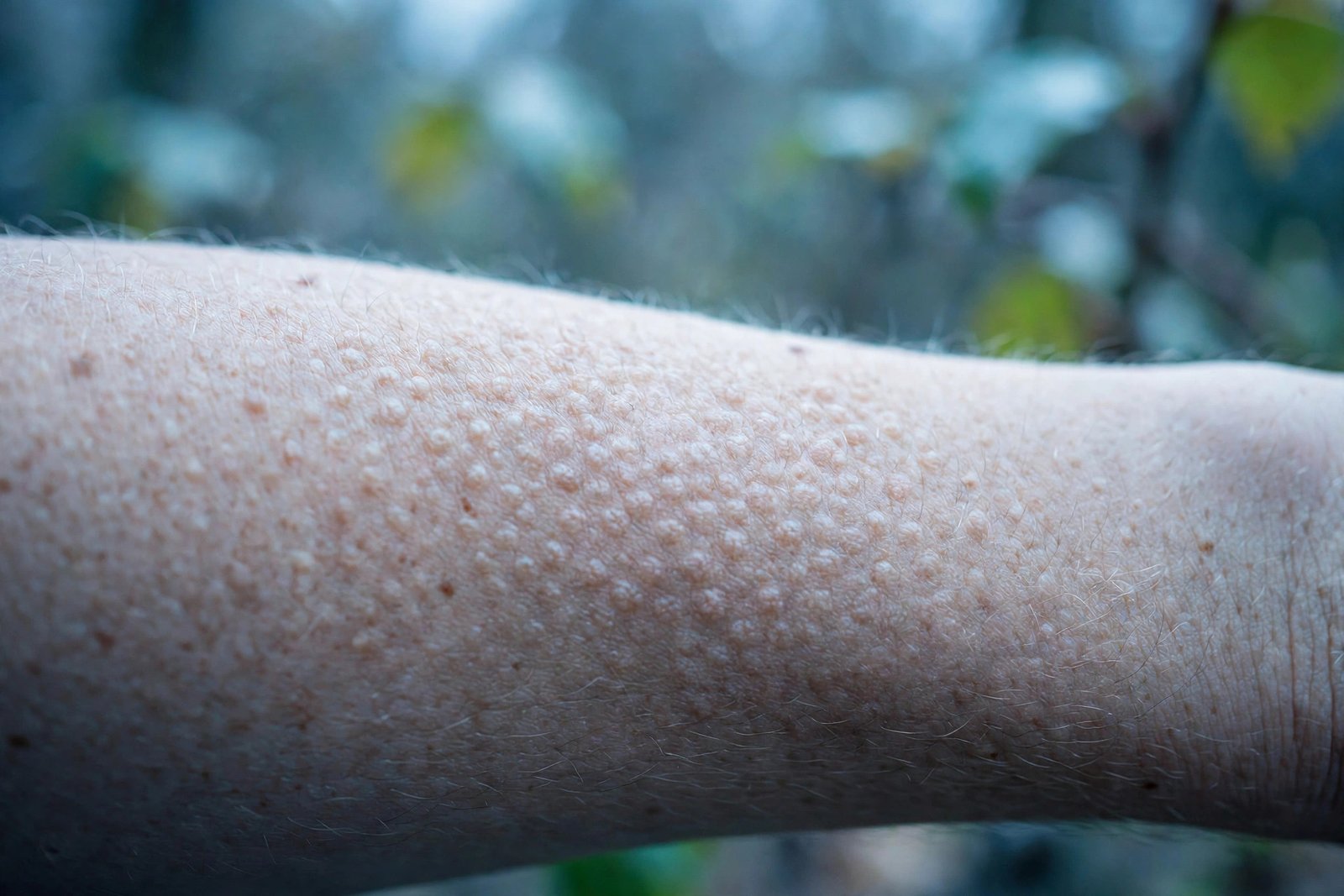
You step outside on a cold morning and the hairs on your arms stand up. A song hits its peak and a shiver runs down your spine. A scary movie scene makes your skin prickle. Three very different moments, one identical reaction. So why do we get goosebumps, and what is your body actually doing when they appear?
The short answer is that goosebumps are an ancient reflex, left over from our furry ancestors, and they are controlled by the same part of your nervous system that handles fear and excitement. The longer answer is far more interesting, because it connects your skin to your brain’s reward system, your evolutionary past, and even the health of your hair. Here is the science, explained simply.
What Are Goosebumps, Exactly?
Goosebumps have a scientific name: piloerection. The word comes from Latin, pilus meaning hair and erectio meaning to stand up. The bumps appear when tiny muscles attached to each hair follicle contract and pull the hair upright, puckering the skin around it into a small raised dome. The bumps reminded people of the skin of a plucked goose, and the name stuck.
The muscles behind the reflex are called arrector pili muscles. Each one is a tiny band of smooth muscle connecting a hair follicle to the upper layers of the skin. They are smooth muscle, the same kind found in your gut and blood vessels, which means you cannot consciously control them the way you flex your arm. They answer only to the sympathetic nervous system, the branch of your nervous system that runs the fight-or-flight response.
When that system fires, nerve fibers release a chemical messenger called norepinephrine onto the arrector pili muscles. The muscles contract, the hair tilts upright, and the skin dimples around the follicle. The whole chain of events takes a fraction of a second, and it happens without you thinking about it at all. That is why you cannot give yourself goosebumps on command, no matter how hard you try. If you enjoy simple explanations of everyday mysteries, our guide to why the sky is blue works the same way.
Why Do We Get Goosebumps When We Are Cold?
Cold is the most familiar trigger. When your skin temperature drops, cold-sensing nerves send a signal to the brain, and the brain answers through the sympathetic nervous system, firing the arrector pili muscles across large patches of skin.
The reason is heat. In furry mammals, standing the hairs upright traps a thin layer of air close to the skin, and trapped air is a good insulator. A puffed-up animal loses less heat to the cold air around it. Think of a cat on a winter morning, its fur fluffed out to twice its normal size, or a bird ruffling its feathers against the wind. The same reflex is at work in you.
Humans, however, have a problem. Our body hair is short, fine, and sparse compared with the thick coats of our ancestors and most other mammals alive today. When our hairs stand up, they trap almost no air at all, so the warming effect is tiny. The reflex still fires faithfully every time we get cold, but the benefit is mostly gone. That is why scientists describe human goosebumps as vestigial: a structure or reflex that persists from an earlier evolutionary state after its original function has become nearly useless.
Interestingly, the reflex is not completely useless. A 2020 study by researchers at Harvard University, published in the journal Cell, found that the arrector pili muscle does more than move hair. It physically anchors sympathetic nerve endings next to the stem cells that live in the hair follicle, and that connection helps regulate the growth of new hair. So the tiny muscle that gives you goosebumps also plays a quiet role in keeping your hair growing. Evolution rarely throws anything away completely.
An Evolutionary Leftover With a Second Job
Warmth was only half of the original job. The other half was looking dangerous. When an animal feels threatened, its sympathetic nervous system surges, and piloerection makes the animal look bigger. A cat with its fur standing on end looks much larger than a relaxed cat. A porcupine raises its quills. A dog’s hackles rise along its back.
The message is simple: I am bigger than you think, and I am ready for a fight. For a small animal facing a predator, that bluff can be the difference between being attacked and being left alone. Humans kept the same wiring. When you are frightened, the same sympathetic surge fires your arrector pili muscles, even though your sparse body hair makes you look no bigger at all.
This is why fear and cold produce the exact same bumps. Your body does not have separate systems for the two triggers. It has one ancient reflex, wired to one branch of the nervous system, and both a cold wind and a jump scare pull the same lever. The reflex made perfect sense for a furry ancestor on a cold night or facing a predator. For a modern human in a heated room watching a horror film, it is mostly a ghost of evolution, firing exactly as designed.
Why Do We Get Goosebumps From Music and Emotion?
The strangest trigger of all is beauty. A soaring chorus, an unexpected harmony, a powerful speech, or the final scene of a beloved film can raise the hairs on your arms even when you are warm and safe. Scientists call this response frisson, from the French word for a shiver or thrill.
Frisson works through the same muscle and the same nervous system as a cold chill, but it starts in a different place: the brain’s reward system. Brain-imaging studies have shown that when people experience musical chills, activity changes in regions tied to reward, motivation, and emotion, including the ventral striatum, the amygdala, and the orbitofrontal cortex. A famous 2011 study by Valorie Salimpoor and colleagues at McGill University, published in Nature Neuroscience, used PET scans to show that dopamine is released in the brain’s striatum during peak musical emotion.
The timing is revealing. Dopamine is released in two phases: first in the caudate nucleus during the build-up, as the brain anticipates the emotional peak, and then in the nucleus accumbens at the climax itself. In other words, your brain rewards both the anticipation and the payoff. A 2019 study strengthened the case further: when volunteers took levodopa, a drug that raises dopamine, music felt more pleasurable, and when they took risperidone, which blocks dopamine, the pleasure dropped. The link between dopamine and musical chills is not just a correlation.
Not everyone experiences frisson. Brain scans have found that people who get chills from music tend to have stronger connections between the brain areas that process sound and the areas that process emotion. The wiring differs from person to person, which is why the same song can give one listener goosebumps and leave another completely unmoved. There is nothing wrong with either listener. Their brains are simply wired a little differently. For more on how the brain creates strange experiences, see our explanation of why we dream.
What Goosebumps Reveal About Your Nervous System
Goosebumps are a small window into the autonomic nervous system, the part of your nervous system that runs your body without conscious thought. It has two branches that work like a gas pedal and a brake. The sympathetic branch is the gas pedal: it speeds up your heart, sharpens your senses, and prepares you to act. The parasympathetic branch is the brake: it slows you down, aids digestion, and helps you rest.
Goosebumps belong entirely to the gas pedal. They appear alongside a faster heartbeat, wider pupils, and sweaty palms, all signs that the sympathetic system is active. That is why they show up in such different situations. Cold, fear, awe, excitement, and embarrassment all press the same pedal, and the arrector pili muscles respond every time.
Researchers have even used piloerection as a precise marker of peak emotion. In laboratory studies, goosebumps appear specifically at peak emotional moments, making them a more specific signal than general measures like sweaty skin, which rise during many kinds of intensity. Your skin, in other words, can tell scientists exactly when a piece of music moved you most.
There is also a social side to the reflex. Humans are deeply tuned to the emotions of other people, and shared moments of awe, a crowd singing together, a stadium erupting, a moving speech, can trigger frisson in many people at once. Some researchers think this shared physical response helps bind groups together, a faint echo of the way animals use piloerection to signal to their own kind. The science here is still debated, but the experience is familiar to anyone who has felt a crowd’s energy raise the hairs on their arms.
Can You Control Goosebumps, and When Should You Worry?
Most people cannot trigger goosebumps deliberately, because the arrector pili muscles are smooth muscle under involuntary control. Some people report that they can raise goosebumps by focusing on a memory or imagining a chill, and a small number of people seem able to do it at will, but this is uncommon and not well understood. For the rest of us, the reflex arrives uninvited and leaves on its own schedule.
For most people, goosebumps are completely harmless and need no attention at all. They are a normal, healthy reflex, and they fade within seconds or minutes once the trigger passes. Warming up, calming down, or simply waiting is all it takes.
There is one exception worth knowing. Frequent, unexplained piloerection that appears without cold, emotion, or any clear trigger can sometimes be a symptom of an underlying medical condition, and it is listed as a possible sign of certain neurological conditions. This is rare, and a single episode of goosebumps means nothing on its own. But if you notice persistent goosebumps appearing for no reason, again and again, it is worth mentioning to a doctor. A normal reflex happening at normal times is nothing to worry about, and the vast majority of goosebumps fall into that category.
Key Takeaways
- Goosebumps are caused by arrector pili muscles contracting and pulling each hair upright, a reflex called piloerection.
- The reflex is driven by the sympathetic nervous system, the same branch behind fight-or-flight, using the messenger norepinephrine.
- In furry ancestors, raised hair trapped warm air and made the animal look bigger to predators. In humans, both benefits are mostly gone.
- Music and awe trigger the same reflex through the brain’s reward system, with dopamine released during anticipation and at the emotional peak.
- A 2020 Harvard study found the arrector pili muscle also helps regulate the stem cells that grow new hair.
- Goosebumps are harmless for most people and fade quickly once the trigger passes.
So the next time the hairs on your arms stand up, you will know what is happening. A tiny muscle, older than humanity itself, is pulling a lever wired straight into your fight-or-flight system. It once kept your ancestors warm and made them look fierce. Today it mostly tells you that you are cold, scared, or deeply moved, and sometimes all three at once. It is a small, strange reminder that evolution never really lets go. You can read the scientific background in the article on piloerection and the research on frisson and musical chills. And for more stories about the hidden workings of everyday life, our collection of real Reddit stories shows how ordinary people react when life surprises them.
Frequently Asked Questions
Why do we get goosebumps when we are cold? Cold triggers the sympathetic nervous system, which contracts the arrector pili muscles at the base of each hair. In furry animals this traps warm air, but in humans the effect is tiny, so it is mostly an evolutionary leftover.
Why do we get goosebumps from music? Music can trigger frisson, a response in which the brain’s reward system releases dopamine during anticipation and at the emotional peak. The same sympathetic pathway then fires the arrector pili muscles.
What is the scientific name for goosebumps? The reflex is called piloerection, and the bumps themselves are sometimes called gooseflesh. The muscles involved are the arrector pili muscles.
Can you control goosebumps? Most people cannot, because the arrector pili muscles are smooth muscle controlled involuntarily by the sympathetic nervous system. A small number of people report being able to trigger them deliberately, but this is uncommon.
Are goosebumps a sign of a health problem? Almost never. Goosebumps are a normal reflex. Only frequent, unexplained piloerection with no trigger is worth mentioning to a doctor, as it can rarely be linked to neurological conditions.