
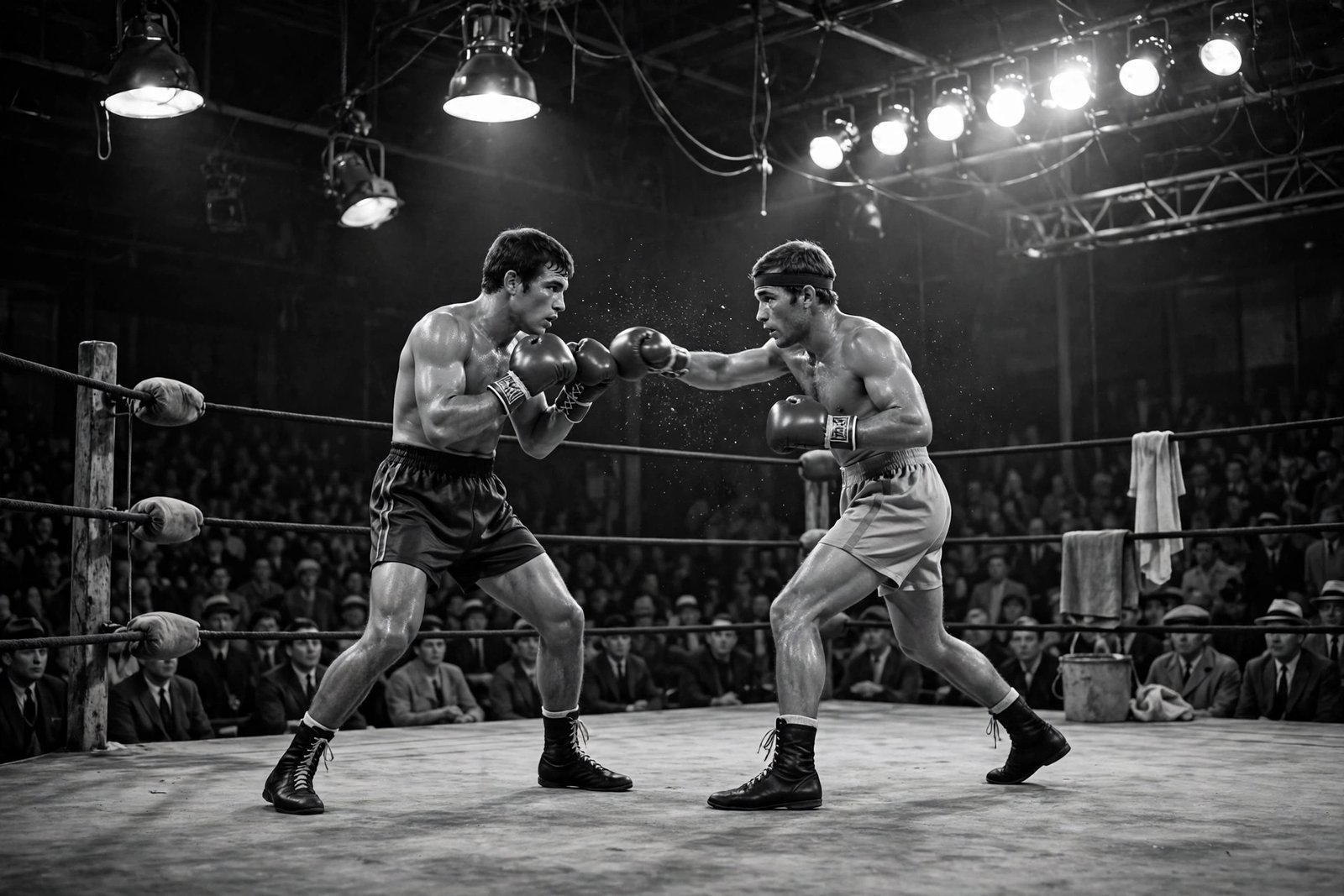
What if the greatest boxing career of all time began not in a glittering Las Vegas arena, but in a hometown gym in Louisville, Kentucky, in front of a modest crowd, against a police chief who boxed on the side? That is exactly what happened on October 29, 1960, when the Muhammad Ali first fight took place. The young man in the ring was not yet Muhammad Ali. He was Cassius Clay, an 18-year-old Olympic gold medallist with a loud voice, fast feet, and a confidence that sounded, to many listeners, almost unbelievable. By the end of the night, he had won his professional debut, and the first chapter of a story the whole world would eventually know had quietly been written.
Clay had arrived in Louisville as a hero. Only weeks earlier, at the 1960 Summer Olympics in Rome, he had won the light heavyweight gold medal. For a teenager from Louisville, that victory changed everything. It gave him a platform, a reputation, and a choice: stay amateur, or turn professional and test himself against grown men who fought for money. Clay chose the professional path, and he chose to begin it at home, where the people who had watched him grow up could watch him take his first step.
His opponent that night was Tunney Hunsaker, a man whose life story sounds almost like fiction. Hunsaker was the police chief of Fayetteville, West Virginia, and an experienced boxer in his own right. He was older than Clay, and he came into the bout with professional experience. On paper, he was a sensible first opponent: tough enough to be a real test, but not a world-beater. For Clay, though, the fight was about more than winning. It was about showing that his Olympic success was not a fluke, and that his unusual style — dancing on his toes, jabbing from distance, slipping punches rather than absorbing them — could work in the professional ranks.
The Muhammad Ali First Fight in Louisville
The bout was held on October 29, 1960, at Freedom Hall in Louisville, Kentucky. It was scheduled for six rounds, the standard length for a professional debut at the time. Clay, fighting as a heavyweight, entered the ring as the local favourite. The crowd knew him. Many had followed his amateur career, and the Olympic gold medal had made him a local celebrity. Yet a professional debut carries its own pressure. There are no second chances in a first impression, and every young fighter knows that the record books will remember the result forever.
From the opening bell, Clay fought the way he would become famous for fighting. He moved constantly, used his long jab to keep Hunsaker at a distance, and circled away from danger. Hunsaker, to his credit, kept coming forward and tried to make it a fight. He was durable and game, and he did not fold under the bright lights. But Clay was faster, sharper, and more accurate. Round by round, he piled up points, landing clean combinations and then sliding out of range before Hunsaker could answer.
When the final bell rang after six rounds, there was little doubt about the outcome. The judges awarded Clay a unanimous decision, meaning all three officials scored the fight in his favour. It was not a knockout, and it was not a spectacular finish. It was something more useful for a debut: a clear, professional, controlled victory against a real opponent. Clay had shown that he could go the distance, follow a plan, and handle the occasion. His professional record now read 1-0, and the journey had officially begun.
From Olympic Gold to the Professional Ranks
To understand why that night mattered, it helps to rewind to Rome. At the 1960 Olympics, Clay won the light heavyweight gold medal, defeating Zbigniew Pietrzykowski of Poland in the final. Olympic gold has always been a launching pad for boxers, but it does not guarantee professional success. The amateur game, with its shorter bouts and different scoring, rewards different skills. Many Olympic champions have struggled to adapt. Clay adapted quickly, in part because his style was already unusual for an amateur: he relied on speed, movement, and reflexes rather than raw power alone.
Turning professional also meant entering a business. Clay signed with a group of Louisville businessmen known as the Louisville Sponsoring Group, who backed his early career. That support mattered. It gave him stability, good training, and time to develop without being rushed into fights he was not ready for. In that sense, the Muhammad Ali first fight was a carefully chosen beginning, not a reckless gamble: a hometown debut, a credible opponent, and a team built to support a long career.
For readers who love stories about long careers built one step at a time, the pattern is familiar. A single debut rarely makes a legend, but it sets the tone. Think of how fans still celebrate performers who have stayed beloved for decades, as in the story of Rajinikanth fans marking 40 years of devotion in Chennai. Longevity starts with a first step that is taken seriously, and Clay took his very seriously indeed.
Who Was Tunney Hunsaker?
It is easy to forget the other man in the ring, but Tunney Hunsaker deserves his place in this story. He was not a nobody picked to fall over. Hunsaker was a respected figure in his community, serving as police chief in Fayetteville, West Virginia, while also pursuing boxing. He had professional experience and a reputation as a tough, honest competitor. Facing an Olympic champion in his hometown, in front of a crowd cheering for the other man, took real courage.
Hunsaker later spoke with pride about having shared the ring with Clay on that historic night. In the years that followed, as Clay became Muhammad Ali and then became the most famous athlete on the planet, Hunsaker could say something almost no one else could: he was there at the very beginning. That is a strange and wonderful kind of fame — the man who stood across the ring when history started. Every great career needs a first opponent, and Hunsaker played his role with dignity, lasting the full six rounds against a fighter who would go on to stop far more celebrated names.
There is also a lesson in Hunsaker’s story about how sports history is remembered. The winner gets the headlines, but the full story belongs to both men. Without a willing, credible opponent, there is no debut at all. Hunsaker gave Clay a genuine test, and in doing so, he became a permanent footnote that boxing fans still look up more than six decades later.
What Happened Next for Cassius Clay
After the win over Hunsaker, Clay kept winning. He fought regularly through 1961 and 1962, beating a series of increasingly challenging opponents and building a reputation as a fast, talkative, and entertaining heavyweight. His confidence, which some people found shocking at the time, became part of the show. He predicted the rounds in which he would win, recited poems about his opponents, and insisted, loudly, that he was the greatest. At first, many dismissed it as bragging. Then he kept backing it up.
The defining moment came in February 1964, when Clay, still undefeated, challenged Sonny Liston for the world heavyweight championship in Miami Beach. Liston was feared as one of the most dangerous punchers in boxing history, and Clay was a heavy underdog. Clay won when Liston did not come out for the seventh round, and in the aftermath, he announced that he had changed his name to Muhammad Ali. The teenager from the Louisville debut was now the heavyweight champion of the world, and the world would never look at boxing the same way again.
What followed is one of the most celebrated careers in sports: the fights with Floyd Patterson, the rivalry with Joe Frazier, the Rumble in the Jungle against George Foreman in Zaire in 1974, and the Thrilla in Manila in 1975. Ali became famous far beyond boxing — for his stance on civil rights, his opposition to the Vietnam War, his humour, his poetry, and his humanitarian work. He was named Sportsman of the Century by Sports Illustrated and remains, for many fans, simply The Greatest.
None of that was visible on October 29, 1960, and that is precisely why the debut matters. Legends are easy to admire in hindsight. The harder, more human story is the young man who had to win a six-round fight in his hometown before anyone believed the big talk. He did, and then he kept doing it, again and again, until belief was no longer optional.
Why the Muhammad Ali First Fight Still Matters
More than sixty years later, why should we still care about a six-round decision over a police chief from West Virginia? First, because beginnings matter. Every icon, athlete, and artist has a first night when the future is unwritten and the outcome is uncertain. Remembering that night keeps legends human. Ali was not born The Greatest. He became The Greatest, one fight at a time, starting in Louisville.
Second, the fight captures a moment in American history. In 1960, a young Black athlete from Kentucky winning Olympic gold and turning professional in his hometown carried meaning beyond sport. Ali would go on to become a global figure in the civil rights era, and his journey from Louisville gyms to world stages mirrors a larger story about talent, opportunity, and voice. The debut is the quiet opening scene of that much larger drama.
Third, the fight is a reminder about style and courage. Clay fought differently from the heavyweights of his era. He danced, he jabbed, he talked, and he trusted his speed. Coaches and critics warned that such a style would not last against big punchers. Clay proved them wrong, not by abandoning his style, but by refining it. That willingness to be different — visible even in his first professional outing — became his signature.
Finally, the story endures because it is wonderfully relatable. Everyone has a first day, a first performance, or a first attempt at something that matters. Most first attempts are not perfect. Clay’s was not a knockout, and it was not flawless. It was a solid, professional win, earned the hard way, against a man who would not quit. That is a useful model for any beginning: you do not need a perfect debut. You need a real one.
Takeaways From the Night It All Began
- On October 29, 1960, Cassius Clay beat Tunney Hunsaker by unanimous decision in a six-round bout at Freedom Hall in Louisville, Kentucky.
- Clay had won Olympic light heavyweight gold in Rome only weeks earlier, making his professional debut one of the most anticipated in American boxing.
- Hunsaker, the police chief of Fayetteville, West Virginia, lasted the full distance and earned a permanent place in boxing history as Ali’s first professional opponent.
- The win launched a career that led to the world heavyweight title in 1964, the name Muhammad Ali, and a legacy as one of the most influential athletes of the twentieth century.
- The Muhammad Ali first fight is remembered not for a knockout, but for what it started: a journey from hometown debut to global icon.
The same fascination with stars who capture the public imagination runs through today’s viral culture, from heartfelt fan moments like Salman Khan’s hug for a little fan at IIFA to striking transformations such as Demi Lovato’s Dorothy Gale Halloween look. Audiences have always loved watching a star emerge — and on October 29, 1960, they watched one emerge in Louisville, whether they fully realised it or not.
So the next time someone asks where the legend of Muhammad Ali began, you can give them a date, a place, and a name: October 29, 1960, Freedom Hall, Louisville, against Tunney Hunsaker. It was six rounds, a unanimous decision, and the start of everything, and the Muhammad Ali first fight remains the perfect place to start telling his story. The Greatest did not arrive fully formed. He arrived as an 18-year-old with gold around his neck, speed in his feet, and a future he was determined to claim. That night, he took the first step — and boxing was never the same again. Learn more from Britannica’s biography of Muhammad Ali, Olympics.com on Muhammad Ali, and the International Boxing Hall of Fame.
When was Muhammad Ali’s first professional fight?
His first professional fight was on October 29, 1960, when Cassius Clay, later Muhammad Ali, faced Tunney Hunsaker in Louisville, Kentucky.
Who did Cassius Clay fight in his professional debut?
Clay fought Tunney Hunsaker, the police chief of Fayetteville, West Virginia, who was an experienced professional boxer.
Who won the fight between Clay and Hunsaker?
Clay won by unanimous decision after six rounds, meaning all three judges scored the bout in his favour.
Had Clay won Olympic gold before turning professional?
Yes, Clay won the light heavyweight gold medal at the 1960 Summer Olympics in Rome, only weeks before his professional debut.
When did Cassius Clay become Muhammad Ali?
Clay announced the name Muhammad Ali in 1964, after winning the world heavyweight championship from Sonny Liston.