
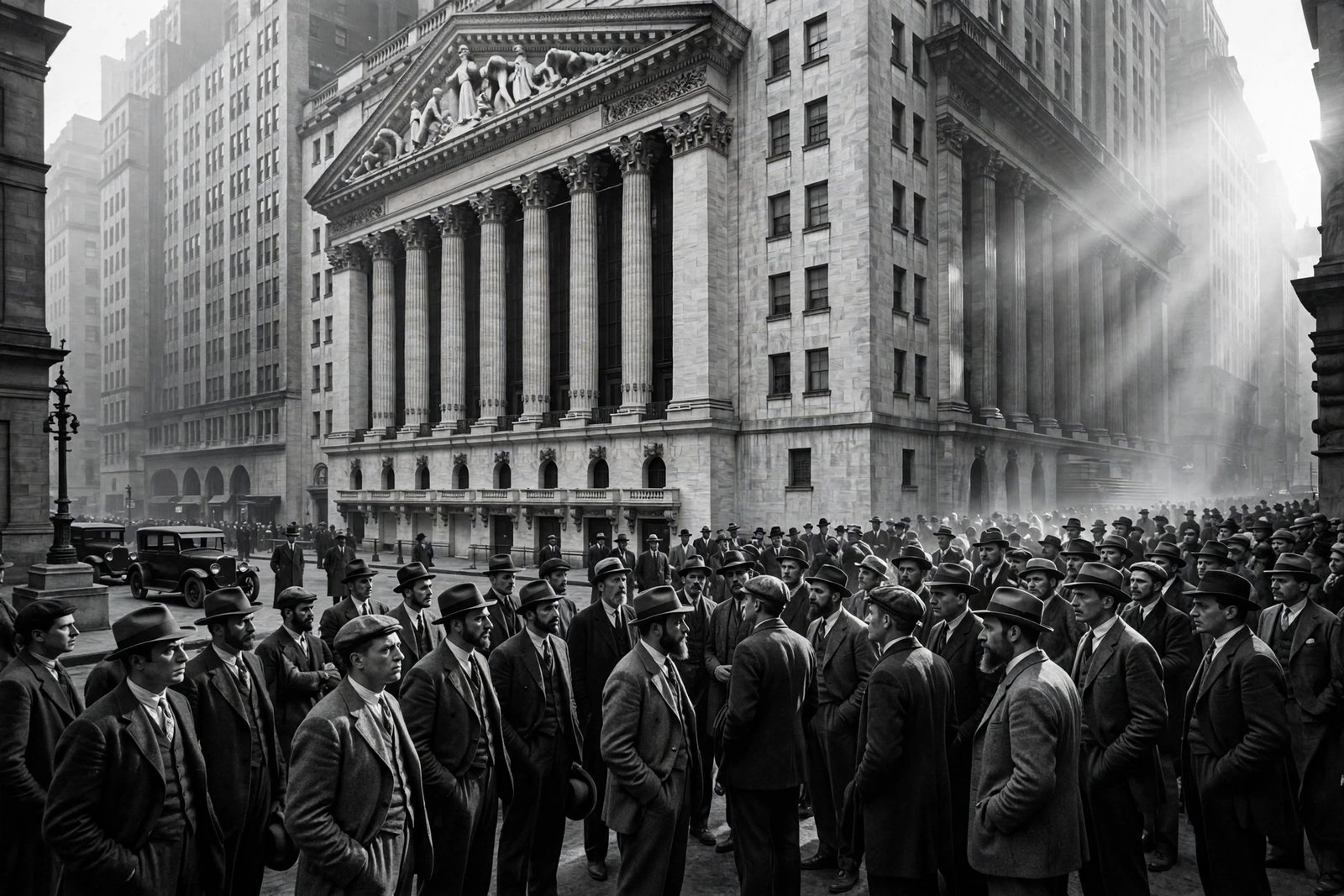
Imagine walking into a crowded room where everyone suddenly decides to leave through the same door at the same time. That is, in human terms, what happened on Wall Street in late October 1929. Prices that had climbed for years began to fall, fear spread faster than any news bulletin, and ordinary investors watched their savings shrink in a matter of hours. Black Tuesday 1929 remains one of the most famous dates in American history, not only because of the money that was lost, but because of what it revealed about confidence, speculation, and the fragility of a boom.
It is also a date that carries a warning and a lesson at the same time. The crash did not arrive out of nowhere, and the Great Depression that followed was not caused by a single day of trading alone. Yet that Tuesday became the symbol of a turning point, the moment when the carefree optimism of the 1920s collided with reality. Understanding how it happened helps explain why modern financial rules exist, why bank deposits are protected, and why economists still study the events of 1929 so closely.
This is the story of a decade of excitement, a market built on borrowed money and borrowed confidence, and a day of panic that changed the way America thought about wealth, work, and security.
What Happened on Black Tuesday 1929?
In simple terms, Black Tuesday was the day the American stock market suffered a dramatic collapse after days of heavy selling. On Tuesday, October 29, 1929, sell orders flooded the New York Stock Exchange. Investors who had hoped prices would recover instead rushed to sell, and that rush pushed prices down further. More than 16 million shares changed hands that day, an enormous volume for the time, and the sight of the trading floor in chaos became an enduring image of the era.
The crash is often described as the start of the Great Depression in popular memory. Historians are careful to make a distinction here: the crash did not single-handedly create the Depression, which had deeper causes in banking, agriculture, trade, and consumer spending. But the crash shattered confidence, wiped out paper wealth, weakened banks, and made businesses and families far more cautious. It was the spark that helped turn an economic slowdown into a decade-long crisis.
For a clear overview of the event, Britannica’s account of the stock market crash of 1929 places the collapse in its wider historical context, while History.com’s explanation of Black Tuesday walks through the panic selling and its immediate aftermath.
The Roaring Twenties: A Decade Built on Optimism
To understand the crash, you first have to understand the mood of the 1920s. After the First World War, the United States entered a period of rapid change. Factories produced cars, radios, and household appliances at a pace that would have seemed impossible a generation earlier. Cities grew, jazz filled dance halls, films became a mass pastime, and new consumer goods promised a more modern life.
For many Americans, prosperity felt permanent. Wages rose for some workers, credit became easier to obtain, and buying on instalment plans allowed families to purchase goods before they had fully paid for them. The stock market became part of this excitement. Newspapers printed share prices, brokers opened offices in smaller towns, and people who had never invested before began to talk about stocks at dinner tables and in barbershops.
Stock prices rose for much of the decade, and that rise created its own momentum. When prices go up, more people want to join in, and when more people join in, prices can rise further. The danger is that the market can stop reflecting what companies are actually earning and start reflecting what people hope they will earn. By the late 1920s, many shares were expensive compared with company profits, but optimism made that warning easy to ignore.
There were warning signs. Some economists and bankers cautioned that speculation had gone too far. Farm incomes had already been weak for years, and not every part of the economy was sharing in the boom. Yet the general mood remained confident. The market had survived earlier dips, and many investors assumed it would always recover quickly. That assumption would be tested in October 1929.
Buying on Margin: Investing With Borrowed Money
One of the most important features of the 1920s market was buying on margin. In plain language, this meant buying shares with a small amount of your own money and borrowing the rest from a broker. If the price rose, you could make a large profit on a small cash investment. If the price fell, however, the losses could be just as large, and you still owed the borrowed money.
Here is a simple example. Suppose an investor bought shares worth 100 dollars but paid only 10 dollars of their own money and borrowed 90 dollars. If the shares rose to 120 dollars, the investor could repay the loan and keep a handsome gain. But if the shares fell to 50 dollars, the investor would still owe the broker far more than the shares were now worth. In a falling market, brokers could also demand extra money, known as a margin call, to cover the loan. Investors who could not pay were forced to sell, which pushed prices down even further.
Margin buying helped inflate the boom because it allowed far more money to flow into shares than investors actually owned. It also made the market more fragile. When confidence slipped, forced selling by margin investors added to the downward pressure. The system worked beautifully while prices rose and painfully when they fell.
Modern rules now limit how much investors can borrow to buy shares, and regulators watch margin lending far more closely. Those safeguards trace directly back to lessons learned from the 1920s. The crash showed what happens when borrowed money, rising prices, and mass optimism combine without enough protection for ordinary investors.
Black Tuesday 1929: A Day of Panic Selling
The trouble did not begin on Tuesday morning alone. Prices had already fallen sharply in the previous week, including a severe drop on Thursday, October 24, often called Black Thursday, and another fall on Monday, October 28. Bankers had tried to calm the market by buying large blocks of shares, and for a brief moment that intervention seemed to steady prices. But confidence had already cracked, and by Tuesday morning the selling resumed with even greater force.
On Black Tuesday 1929, the scale of trading overwhelmed the systems of the day. Ticker tapes, which printed share prices, fell far behind actual trading, so investors did not know the latest prices for hours. Rumours spread on the street outside the exchange, crowds gathered, and the noise and confusion added to the sense of crisis. Brokers shouted orders, clerks struggled to keep records straight, and many investors discovered only later how much value they had lost.
It is important to remember that not everyone on Wall Street was a wealthy speculator. Teachers, shopkeepers, clerks, and small business owners had also put savings into the market, sometimes on margin. For them, the crash was not an abstract financial event. It meant lost savings, delayed plans, and in some cases debts that would take years to repay. The human cost of the crash is part of why the date still resonates nearly a century later.
The Federal Reserve History account of the stock market crash of 1929 explains how the collapse affected banks and credit, and why the damage spread far beyond the trading floor. When banks failed or tightened lending, businesses found it harder to borrow, workers lost jobs, and families cut spending, which in turn hurt more businesses.
What Changed After the Crash
The years that followed were harsh. Unemployment rose sharply, banks failed in large numbers, farms struggled, and soup kitchens and breadlines became familiar sights in American cities. President Franklin D. Roosevelt, who took office in 1933, introduced the New Deal, a wide set of programmes intended to provide relief, recovery, and reform. Public works created jobs, new agencies regulated banks and markets, and Social Security later provided a safety net for older Americans.
Among the lasting reforms were new rules for the stock market itself. The Securities Act of 1933 and the Securities Exchange Act of 1934 required companies to share more honest information with investors and created the Securities and Exchange Commission to oversee the markets. The Banking Act of 1933, often called Glass-Steagall, separated commercial and investment banking and created federal deposit insurance, so that ordinary savers would not lose everything if a bank failed. These changes did not end market booms and busts, but they made the system fairer and more transparent.
On Black Tuesday 1929, few people could have predicted how long recovery would take. The American economy did not fully return to its earlier strength until the late 1930s and the mobilisation for the Second World War. That long shadow explains why economists, teachers, and policymakers still return to 1929 whenever markets rise quickly or borrowing grows rapidly. The crash is a reminder that prosperity built on debt and speculation can unravel with surprising speed.
There is also a cultural legacy. The crash helped end the carefree image of the Jazz Age and replaced it with a more cautious, frugal mood. Writers, filmmakers, and musicians reflected that change in stories about hardship, resilience, and the search for security. The phrase Black Tuesday entered everyday language as shorthand for a sudden, devastating collapse, and it is still used today whenever a market falls sharply.
BolanPost regularly explores turning points like this one. Readers who enjoy American history may also like the story of how the Statue of Liberty marked 140 years as an American symbol, the invention of the first electric generator, and NASA’s early wooden moon capsules from the Ranger programme, each a reminder that history is shaped by ideas, inventions, and moments of crisis alike.
Takeaways: Lessons That Still Matter Today
- Borrowed money magnifies both gains and losses. Margin buying made the 1920s boom bigger and the crash far more painful.
- Confidence is a powerful economic force. When confidence vanished in October 1929, selling fed on itself and prices fell faster than anyone expected.
- A market crash can spread through banks and jobs. The damage was not limited to shareholders; it affected lending, businesses, and families across the country.
- Rules and transparency matter. Black Tuesday 1929 helped lead to disclosure laws, market regulation, and deposit insurance that still protect savers today.
- Booms deserve healthy scepticism. When everyone believes prices can only rise, that belief itself becomes a warning sign worth noticing.
These lessons do not mean that investing is foolish or that markets should be feared. They mean that investing works best when it is based on real information, realistic expectations, and money you can afford to leave invested for the long term, rather than on borrowed funds and the hope of a quick profit.
Conclusion
Nearly a century later, Black Tuesday 1929 still holds our attention because it combines drama, human emotion, and lasting consequences in a single day. It was a day of noise, crowds, and panic, but also the end of an era of unquestioned optimism. The crash exposed weaknesses in banking, in market practice, and in the belief that prosperity would never end.
The most useful way to remember it is not as a distant disaster, but as a case study in how economies actually work. Markets reflect human hopes and fears as much as company profits. Borrowing can accelerate growth and accelerate collapse. And the reforms that follow a crisis, from honest disclosure to deposit insurance, can protect millions of people who never set foot on a trading floor.
If there is one sentence to carry away from this story, it is this: wealth built slowly on solid foundations lasts longer than wealth built quickly on borrowed confidence. That is why a single Tuesday in October 1929 still teaches us something in every decade since.
What was Black Tuesday?
Black Tuesday was October 29, 1929, the day panic selling caused a dramatic collapse in American share prices, with more than 16 million shares traded on the New York Stock Exchange.
Did Black Tuesday cause the Great Depression?
It did not cause the Depression on its own, but it shattered confidence, weakened banks, and helped turn an economic slowdown into a much deeper and longer crisis.
What is buying on margin?
Buying on margin means buying shares with a small amount of your own money and borrowing the rest from a broker. It increases potential profits when prices rise and potential losses when prices fall.
What reforms followed the 1929 crash?
Later reforms included laws requiring companies to disclose honest financial information, the creation of the Securities and Exchange Commission, and federal insurance for bank deposits.
Why do people still study the 1929 crash today?
People study it because it shows how speculation, borrowed money, and lost confidence can combine to damage an entire economy, and because its reforms still shape modern financial markets.