
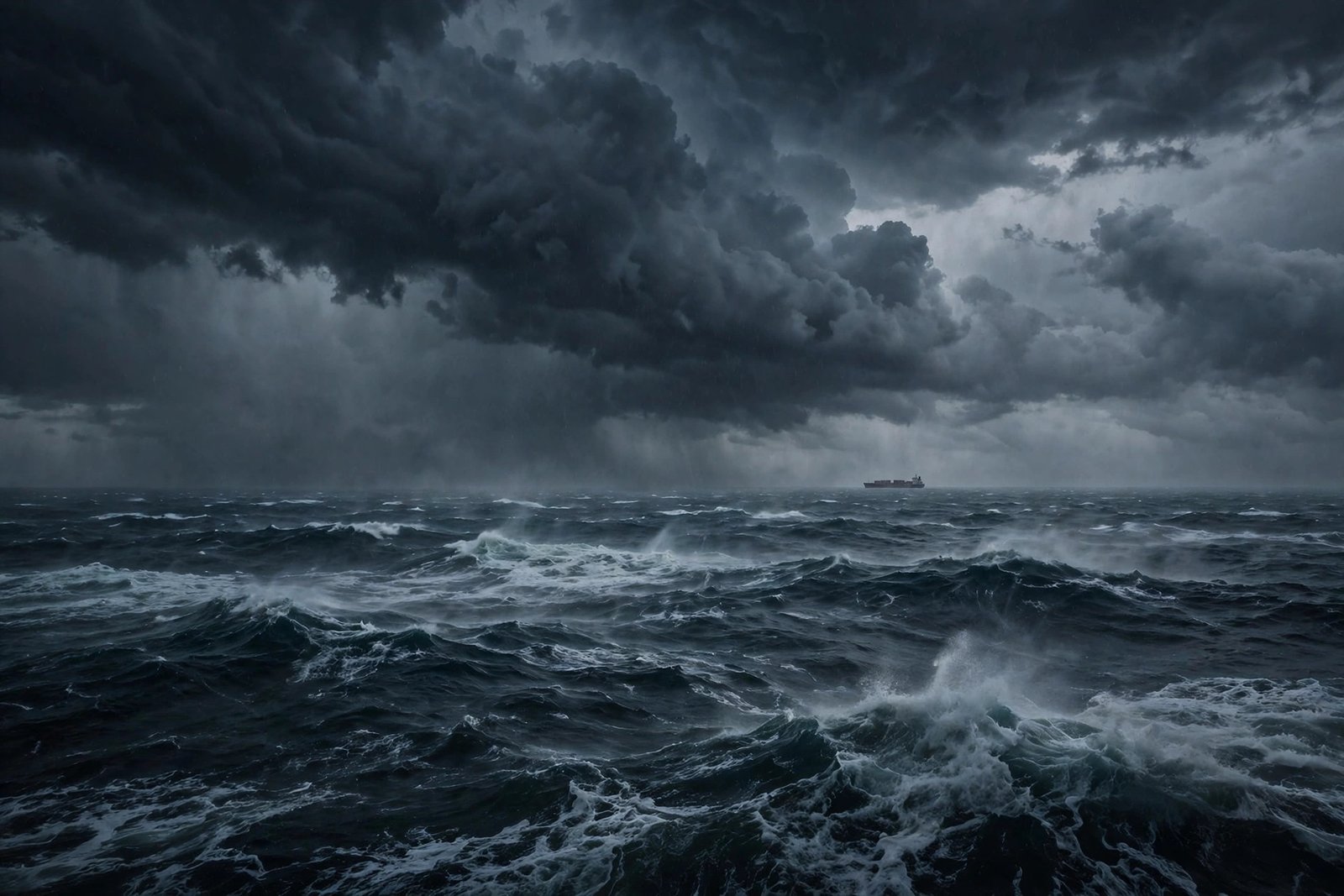
Somewhere between Miami, Bermuda, and Puerto Rico, ships and planes have vanished without a trace — or so the legend goes. The bermuda triangle mystery has filled books, documentaries, and late-night conversations for decades, promising portals to other dimensions, lost Atlantean technology, and alien abductions. But what happens when you separate the documented facts from the storytelling? The real story turns out to be stranger in one way and far more ordinary in another: the disappearances are real, but the mystery mostly is not.
In this article, we walk through what the Bermuda Triangle actually is, the two disappearances that built its reputation, and what scientists and the United States Navy say really happened. Spoiler: there is no evidence of anything supernatural — but there are powerful lessons about weather, navigation, and how a good story can outrun the facts.
What Is the Bermuda Triangle Mystery?
The Bermuda Triangle is a loosely defined region of the North Atlantic Ocean, roughly bounded by Miami in Florida, the island of Bermuda, and Puerto Rico. It is not an official geographic region, and it appears on no official world map. The United States Board of Geographic Names does not recognize the name, and the U.S. Navy and U.S. Coast Guard have both stated that there are no supernatural explanations for disasters at sea in the area.
According to Britannica, the region covers parts of the southeastern United States coast, Bermuda, and the Greater Antilles, including Cuba, Hispaniola, Jamaica, and Puerto Rico. It is also one of the busiest stretches of ocean on Earth. Cruise ships, cargo vessels, and aircraft cross it every single day, almost always without incident. That heavy traffic matters, because it changes the math: when thousands of vessels pass through a region every year, even a normal accident rate produces a long list of wrecks over a century.
The phrase itself was coined in 1964, when writer Vincent Gaddis used “Bermuda Triangle” in an article for Argosy magazine, describing a region that had supposedly destroyed hundreds of ships and planes without a trace. A decade later, Charles Berlitz’s bestselling 1974 book, The Bermuda Triangle, turned the idea into a global phenomenon. The legend was born not from a single discovery, but from a stack of dramatic retellings — each one smoothing over inconvenient details like bad weather and human error.
Flight 19: The Disappearance That Built the Legend
The single most famous Bermuda Triangle incident is Flight 19. On December 5, 1945, five U.S. Navy TBM Avenger torpedo bombers took off from Naval Air Station Fort Lauderdale in Florida on a routine training flight. Fourteen men were aboard. The flight leader was Lieutenant Charles Taylor, an experienced instructor. Within hours, all five planes were gone — and so was the rescue aircraft sent to find them.
What the radio transcripts show is not a supernatural event but a slow-motion navigational disaster. Taylor reported that his compasses seemed to be malfunctioning and that he was unsure of the flight’s position. He believed the squadron was over the Florida Keys, when investigators later concluded the planes were actually far to the east, over the Bahamas. As fuel ran low and darkness fell, the weather that had been calm at takeoff turned violent. The last transmission came in the early evening, and then there was silence.
The search effort added a second tragedy. A PBM Mariner flying boat, carrying thirteen crew members, took off to look for Flight 19 and exploded roughly twenty minutes later. Witnesses reported seeing a fireball. The Mariner had a known vulnerability: fuel vapor could accumulate in the aircraft, and the type had a reputation among crews as a flying gas tank. The likely explanation for its loss is a catastrophic fuel explosion, not a mysterious force.
No wreckage from Flight 19 has ever been conclusively identified, which is part of why the story endures. But the ocean is deep, the search area was enormous, and aircraft that ditch at sea in rough weather can sink quickly and scatter. The absence of wreckage is not evidence of a portal; it is evidence of how hard the sea makes recovery. If you enjoy unsolved puzzles, you will love our look at the Voynich manuscript, a book nobody has been able to read — a genuine mystery that has resisted every codebreaker for a century.
The Bermuda Triangle Mystery and Its Other Ghost Ships
Flight 19 was not the first disappearance tied to the region, and the second most cited case is even older. In March 1918, the USS Cyclops, a large U.S. Navy cargo ship, vanished while traveling from Brazil toward Baltimore. More than 300 people were aboard, making it the largest non-combat loss of life in U.S. Navy history. No distress call was ever sent, and no wreckage was ever found.
What do we actually know about the Cyclops? The ship was carrying a heavy load of manganese ore, which made it ride low in the water, and it had stopped in Barbados before disappearing. Beyond that, the record is thin, which is exactly why speculation rushed in to fill the gap. Theories have ranged from a sudden storm capsizing the overloaded vessel to a structural failure. What is documented is the loss itself; the cause remains unknown, and honest accounts say so rather than inventing one.
Other cases often folded into the legend are weaker still. The Mary Celeste, found adrift and abandoned in 1872, is a favorite of Bermuda Triangle books, but the ship was discovered near Portugal, far outside the triangle, and its story belongs to maritime history, not to this region. The same pattern repeats across the list: incidents get borrowed from other oceans, dates get blurred, and ordinary explanations — storms, groundings, mechanical failure — get edited out of the retelling.
Researchers who have checked the original records found something telling. When writer Lawrence David Kusche examined the famous cases for his 1975 book The Bermuda Triangle Mystery — Solved, he discovered that many of the “mysterious” disappearances had documented explanations all along: ships lost in known storms, vessels that were already unseaworthy, or incidents that happened nowhere near the triangle. The mystery, in other words, was partly manufactured by sloppy retelling.
Why Scientists Say There Is No Supernatural Mystery
The United States National Oceanic and Atmospheric Administration (NOAA) has addressed the legend directly. On its Bermuda Triangle explainer, NOAA notes that there is no evidence that mysterious disappearances occur with any greater frequency in the Bermuda Triangle than in any other large, well-traveled area of the ocean. The U.S. Navy and U.S. Coast Guard agree: the combined forces of nature and human fallibility explain the losses.
NOAA points to several ordinary hazards that make the region genuinely dangerous, just not supernaturally so. The majority of Atlantic tropical storms and hurricanes pass through the area, and before modern weather forecasting, those storms claimed many ships. The Gulf Stream, a powerful ocean current, can cause rapid and sometimes violent changes in weather. The Caribbean’s many islands create extensive shallow waters that are treacherous for navigation. And in parts of the region, a magnetic compass can point toward true north rather than magnetic north — a real phenomenon, known as the agonic line, that can confuse a navigator who is correcting for a difference that is not there.
Put together, the picture is clear. A busy shipping lane plus hurricane alley plus tricky currents plus shallow reefs plus human error equals a steady toll of accidents over a century. No portals required. As with the underground world beneath Paris — see our tour of the Paris Catacombs and their hidden tunnels — the real story is fascinating enough without inventing monsters.
The Methane Hypothesis and Other Theories
One scientific idea that regularly makes headlines is the methane hydrate hypothesis. Vast deposits of methane hydrate sit beneath the seafloor, and if a large pocket were suddenly released, the theory goes, the bubbling gas could reduce the water’s buoyancy enough to sink a ship, or disrupt an aircraft’s instruments. It is a vivid image, and it is sometimes presented as the answer to the whole legend.
Here is the honest status: the hypothesis is unproven. No methane eruption has ever been observed sinking a ship in the Bermuda Triangle, and no wreck has been linked to such an event. Scientists treat it as an interesting possibility for isolated incidents, not as an established explanation. The same caution applies to rogue waves, which are real and can reach enormous heights, and to waterspouts, which are common off Florida. Both can destroy a vessel. Neither has been shown to make this one patch of ocean special.
The supernatural theories, by contrast, have no supporting evidence at all. There is no verified evidence of Atlantis rising from the seafloor, no confirmed alien abductions, and no measured vortex or time portal. These ideas survive because they are entertaining, not because they explain anything. A good rule for any mystery: if a theory cannot be tested and predicts nothing, it is a story, not an explanation.
What the Bermuda Triangle Mystery Teaches Us
The legend endures because it tells us something about ourselves. Here are the takeaways worth keeping:
- Check the original record. Many famous cases collapse when you read the primary sources instead of the retellings. Storms, overloads, and navigation errors were often documented from the start.
- Busy places produce long accident lists. A region crossed by thousands of vessels will rack up more wrecks than an empty ocean, even at a normal accident rate.
- Absence of wreckage is not evidence of the paranormal. Deep water, strong currents like the Gulf Stream, and rough weather make recovery genuinely difficult.
- Real hazards deserve respect. Hurricanes, shallow reefs, and fast-changing weather in this region are dangerous. Modern forecasting and navigation have made the area far safer than it was a century ago.
- Enjoy the mystery, but label it honestly. There is nothing wrong with loving a spooky story — as long as we do not mistake it for a fact.
Conclusion: The Real Bermuda Triangle Mystery
So is the Bermuda Triangle dangerous? In the ordinary sense, yes: it is a hurricane-prone, heavily traveled stretch of ocean with reefs, currents, and sudden weather, and it deserves the same respect as any open sea. Is it supernaturally dangerous? Every major scientific and naval authority that has examined the question says no. The disappearances that built the legend — Flight 19, the USS Cyclops, and the rest — are tragedies with mostly ordinary causes, amplified by decades of dramatic retelling.
The most curious thing about the Bermuda Triangle may be how a story becomes a fact in the public mind. A magazine article coins a name, a bestseller repeats it, and soon a busy shipping lane is famous for swallowing ships. The next time a mystery sounds too strange to be true, ask the question that dissolves most of them: what does the original record actually say? In this case, it says the sea is dangerous enough on its own — and that is a mystery worth respecting, not fearing. For another case where science is closing in on a cosmic puzzle, read our explainer on the interstellar comet 3I/ATLAS, a genuine visitor from beyond our solar system.
What is the Bermuda Triangle?
The Bermuda Triangle is a loosely defined region of the North Atlantic Ocean, roughly bounded by Miami, Bermuda, and Puerto Rico. It is not an official geographic region and does not appear on official maps.
What happened to Flight 19?
On December 5, 1945, five U.S. Navy Avenger bombers on a training flight from Fort Lauderdale became disoriented, ran low on fuel, and were lost with all 14 men aboard. A rescue aircraft carrying 13 crew members also disappeared, most likely after a fuel explosion. No wreckage has been conclusively found.
What happened to the USS Cyclops?
The USS Cyclops vanished in March 1918 while traveling from Brazil toward Baltimore, with more than 300 people aboard. No distress call or wreckage was ever found, making it the largest non-combat loss of life in U.S. Navy history. The cause remains unknown.
Is there any scientific evidence for supernatural causes?
No. NOAA, the U.S. Navy, and the U.S. Coast Guard all state there is no evidence of supernatural explanations, and no evidence that disappearances happen more often in the Bermuda Triangle than in other busy ocean areas.
What is the methane hydrate hypothesis?
It is the unproven idea that a sudden release of methane gas from the seafloor could reduce water buoyancy and sink a ship. No such event has ever been observed sinking a vessel in the Bermuda Triangle, so it remains speculation, not an established explanation.