
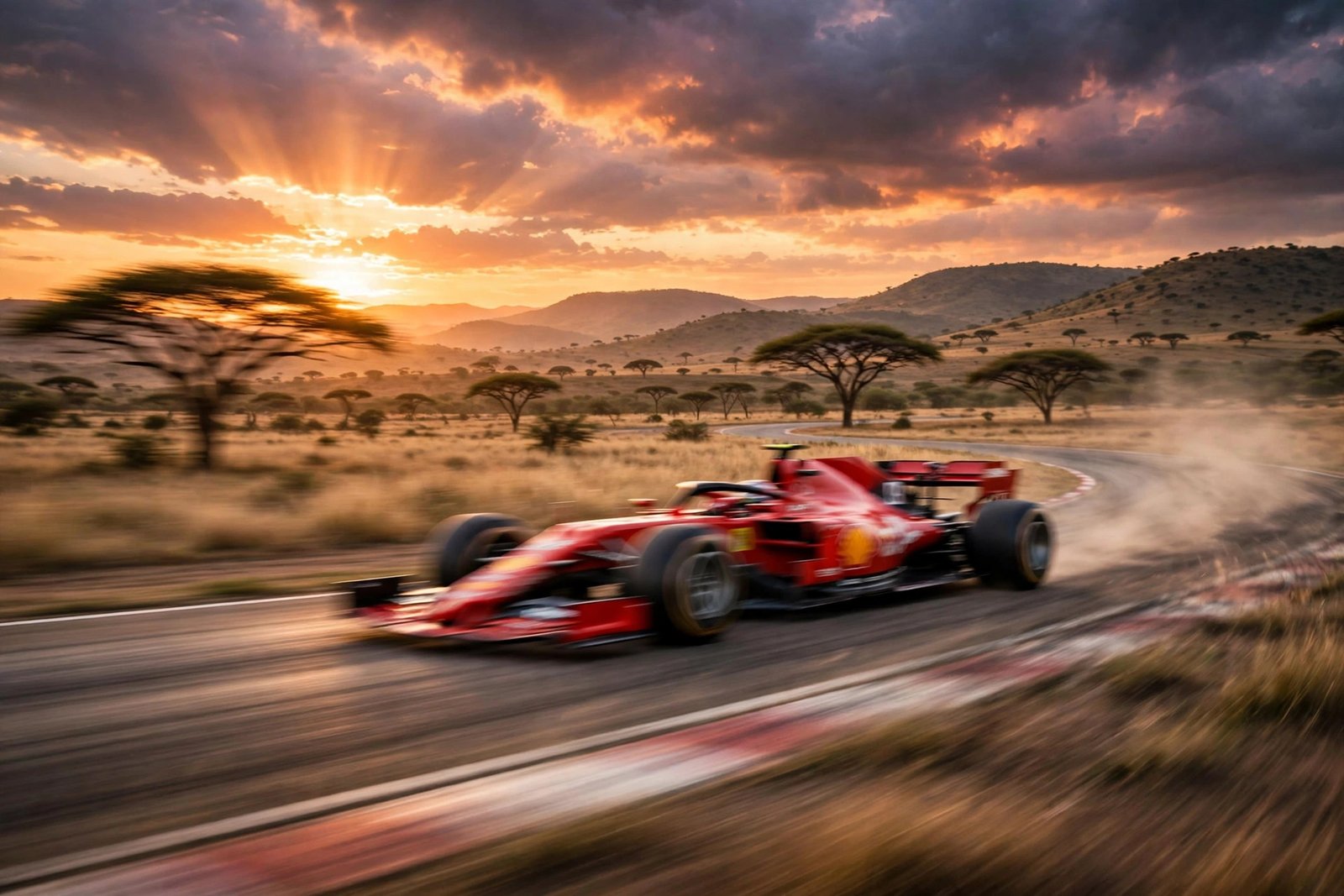
There is a blank space on the Formula 1 calendar that has been there for nearly thirty-three years — an entire continent. No grand prix in Africa since March 1993, back when Lewis Hamilton was just eight years old, a kid in Stevenage, England, dreaming about a future he could barely imagine. Today he is a seven-time world champion, the most decorated driver of his generation, racing in Ferrari red. And the dream that still makes his heart race isn’t another title. It is the Lewis Hamilton African Grand Prix dream: to race a Formula 1 car on African soil.
That dream moved one giant step closer to reality this week. Speaking to reporters on Thursday, October 22, 2026, at the Circuit of the Americas ahead of the United States Grand Prix in Austin, Texas, Hamilton welcomed Formula 1’s decision to return to Africa — while voicing honest reservations about Rwanda, the country chosen to host the continent’s first grand prix in more than three decades. He also made a promise that should thrill every fan: he intends to keep racing long enough to make sure he is on the grid when that race finally happens.
What Hamilton Said in Austin
The setting was familiar — a packed FIA press conference at COTA, three days before the United States Grand Prix on Sunday, October 25. But Hamilton’s words carried unusual weight. Formula 1 had announced just last week a 10-year agreement to race in Rwanda, with the race set to join the calendar after a brand-new circuit is built in the early 2030s. Asked for his reaction, the Ferrari driver was both enthusiastic and measured, according to an AFP report carried by Philstar.
“Of course, I don’t get to choose where we go and, naturally, there’s problems all over the world today,” he said. “I’ve seen many of the stories, but I think we really have to approach it with humility.”
Hamilton said he was aware of concerns regarding Rwanda and insisted they should not be overlooked. It was a careful, thoughtful answer from a driver who has never been afraid to speak his mind — and who has campaigned for years for Formula 1 to return to Africa.
Then came the line that lit up the paddock:
“There’s a lot that we don’t know,” he added. “But I still have hopes that Africa unites… And, of course, going doesn’t mean that you neglect the things that are happening there.”
The Rwanda Deal: F1’s 10-Year African Grand Prix Plan
Let’s put the announcement in perspective, because it is genuinely historic. Formula 1’s 10-year agreement with Rwanda means the sport is committing to the continent through the 2040s — the longest commitment to Africa in the modern era. The race will join the calendar only after a purpose-built circuit is constructed, with the debut expected in the early 2030s.
Rwanda, a small, mountainous country in East Africa often called the “land of a thousand hills,” will become the first African nation other than South Africa and Morocco to host a Formula 1 grand prix. Building a brand-new circuit from scratch is a massive undertaking — think years of design, environmental review, and construction before a single tire hits the tarmac. Planners will also be watching long-range climate patterns closely; forecasters are tracking what could be the strongest El Niño on record in 2026, a reminder that weather is part of the equation on every continent.
For Hamilton, the details of the deal matter less than what it represents: validation. As Free Malaysia Today reported, the seven-time champion has called for a return to Africa for many years. Now it is official. The only question left is whether he will still be racing when the lights go out.
1993: The Last African Grand Prix, When Hamilton Was Eight
To understand why this moment hits so hard, rewind to March 14, 1993. The venue: Kyalami, a fast, sweeping circuit in the highveld grasslands just north of Johannesburg, South Africa. The event: the 33rd South African Grand Prix — and, as it turned out, the last Formula 1 race ever held in Africa.
Alain Prost won that day in a dominant Williams, at the start of the season in which he would claim his fourth and final world title. Ayrton Senna, Michael Schumacher, and Damon Hill were on that grid. The sport was at the peak of a golden era — and Africa was part of it.
Somewhere in England, an eight-year-old Lewis Hamilton was watching. Born on January 7, 1985, he had just started karting and was years away from even imagining a Formula 1 career. But the image of grand prix racing was being burned into his imagination. By the time he reached F1 in 2007, the African race was gone — dropped from the calendar amid political and commercial shifts, never to return.
Think about that for a second. An entire generation of fans has grown up watching Formula 1 visit every continent except Africa. Hamilton has raced on every other continent. Africa is the one missing chapter of his career — and he knows it.
Why the Lewis Hamilton African Grand Prix Dream Matters
This isn’t just about one driver’s bucket list. Hamilton used the press conference to zoom out and talk about something bigger: how the world sees Africa, and how Africa sees itself.
“Growing up in England, they never taught us anything about Africa. It needs to be on the curriculum… A lot of the problems they have there are still the results of colonialism and the west intervening, but if you see the people, you see so many designs that are out there today. Top brands come from Africa, and it’s got all the richest resources.”
He went further, expressing a hope he has voiced before:
“I really hope, and I still have hopes, that Africa unites. I know there’s many people that don’t want that to happen — because they would be so powerful if they did, but I’m still hopeful that at some stage they will.”
This is vintage Hamilton. Beyond the records and the fashion and the speed, he has become the sport’s conscience on questions of diversity, representation, and history — from his anti-racism advocacy to his push for greater diversity in motorsport. A Lewis Hamilton African Grand Prix appearance would be more than a race; it would be a cultural moment, a homecoming broadcast to hundreds of millions of viewers.
And the fans know it. Across social media this week, supporters have been sharing the same thought: there is something poetic about the driver who has done more than anyone to broaden F1’s horizons finally racing on the continent where so much of his heritage lies. Hamilton has spoken openly about his roots — his father’s family is from Grenada — and about how important it is for young Black kids to see themselves in the sport.
Hamilton’s Long Campaign to Bring F1 Back to Africa
What makes this week’s news so satisfying is that Hamilton didn’t just wish for this — he campaigned for it. For years, he has used press conferences, interviews, and his enormous platform to push Formula 1 toward Africa. He has visited the continent, engaged with its culture, and repeatedly asked why the sport’s calendar skipped 54 countries and 1.4 billion people.
He isn’t alone, either. The commercial logic has been building for a decade: Africa has the world’s youngest population, a booming middle class, and a fast-growing appetite for global sports entertainment. F1’s owners have been expanding the calendar aggressively — new races in Las Vegas, Miami, and Qatar in recent years — and Africa was the glaring omission. The Rwanda deal closes that gap with a decade-long commitment, not a one-off experiment.
Other drivers have echoed the sentiment. The paddock consensus, as Flashscore reported, is genuine eagerness: nobody in Formula 1 wants the sport to be the one global championship that ignores an entire continent.
Racing Into His Forties: Will the Lewis Hamilton African Grand Prix Dream Come True?
Here is the delicious tension at the heart of this story. Hamilton is 41 years old. The Rwanda circuit won’t be ready until the early 2030s — meaning he would need to be racing at 46, 47, or beyond to make the grid. In a sport where reflexes are measured in milliseconds and most drivers retire in their mid-thirties, that sounds impossible.
But then again, everything about Hamilton’s career has bent the “impossible.” He is already the oldest driver to win a grand prix in the modern era conversation, still fighting at the front in Ferrari red at 41. Modern training, nutrition, and sports science have stretched athletic primes across every sport — and Hamilton is famously obsessive about his fitness. If anyone can defy the calendar, it’s him.
And here’s a fun thought: the boundaries of speed keep moving. Engineers just built a robot sprinter designed to outrun Usain Bolt — machines are now chasing human records. Hamilton’s quest is the reverse: a human refusing to let the machine of time win. Whether he makes it or not, the attempt itself is pure sporting drama.
Realistically, the timeline is tight. If the first Rwanda race lands in 2031 or 2032, Hamilton would be 46 or 47 — older than any driver to start a grand prix in decades. He would need a competitive seat, a willing team, and a body that still responds. But he sounded like a man who has already done the math and likes his odds.
What Happens Next
For now, the focus returns to Austin. The United States Grand Prix on October 25 is the immediate business — a track where Hamilton has won five times and where the championship fight continues. But the paddock chatter this weekend will keep circling back to Africa, because the Rwanda announcement has given everyone something to dream about — and the Lewis Hamilton African Grand Prix story is the one every fan wants to see finished.
- The deal: 10 years, Rwanda, new circuit, debut in the early 2030s.
- The dream: Hamilton wants to race in an African Grand Prix before he retires.
- The caveat: He says concerns about Rwanda “should not be overlooked” — humility first.
- The clock: He is 41; the race is years away. The countdown is on.
- The legacy: An entire continent returns to the F1 calendar after 30+ years.
One more thing to watch this weekend while you’re following the action: the skies. October’s night skies are putting on their own show — the Orionid meteor shower is peaking right now, debris from Halley’s Comet streaking overhead. Fitting, somehow, for a weekend when Formula 1 is dreaming bigger than ever.
The Bottom Line
The Lewis Hamilton African Grand Prix story is really three stories in one: a sport finally correcting a three-decade absence, a champion confronting the complicated reality of where the race will be held, and a 41-year-old refusing to let time dictate his ending. Whether Hamilton makes that grid in the early 2030s or watches from the pit wall, he has already changed the conversation — Africa is coming back to Formula 1, and he made sure the world noticed. The dream that started with an eight-year-old in front of a television in 1993 is now, incredibly, within reach.